Hi anon, index funds usually mean unit trusts so they are different from ETFs. The main difference is the fees. ETFs charge lower fees in general.
To choose ETFs, you can refer to our article here.
Extract from the article:
"Here are some of the extra factors that can help you out:
To put it bluntly, the expense ratio is how much you are putting into the fund manager’s pocket. Expense ratio excludes the brokerage commissions when you buy and sell your ETF shares. If two ETFs are really too identical, expense ratio works.
Of course, there will always be a lot of other factors involved.
At times, one should not pay a Toyota price, hoping to get the performance of a Ferrari.
If a certain ETF does not trade a certain number of shares per day, it is best to avoid it. The lack of liquidity can result in difficulty trying to sell your ETF in future. For short-term ETF traders, this factor plays an even more important consideration.
High tracking error may indicate that an ETF is falling behind the index they are benchmarked with.
Of course, there can also be a time where ETF outperforms the benchmark.
The bid-ask spread of an ETF in the stock market indicates how ready a market is. The more narrow the spread is, the more it facilitates trading."
If you buy ETFs listed in the US, you have to pay dividend withholding tax (30%) too.
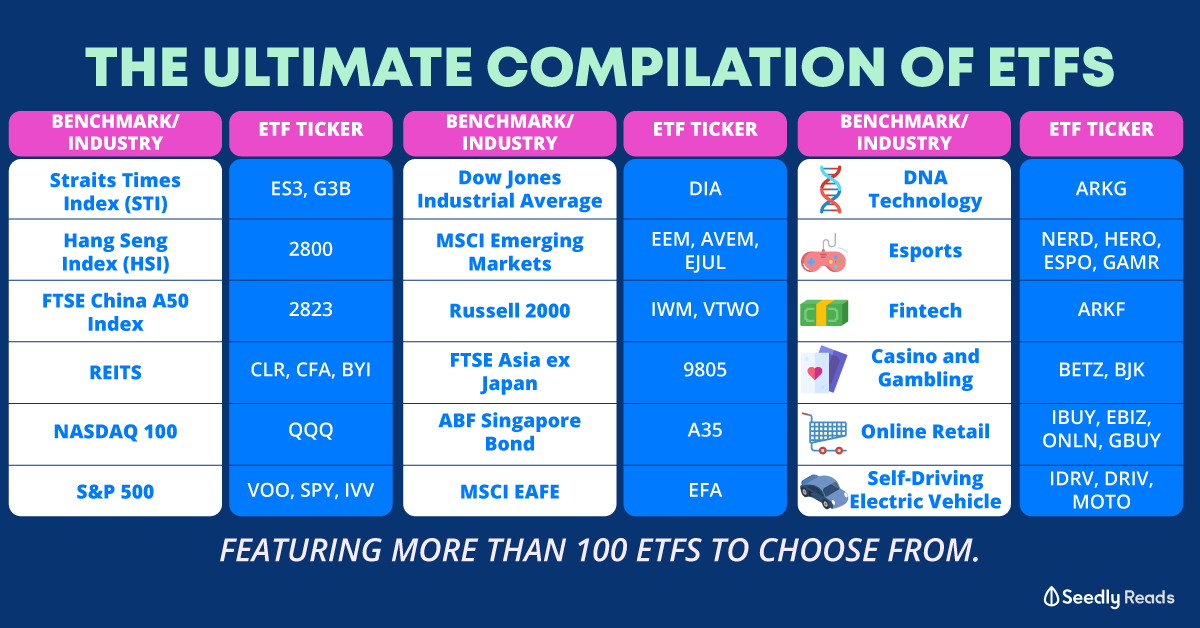
We have recently also published an ultimate ETF list which you can choose to construct your ETF portfolio.
Hope this helps.








Hi anon, index funds usually mean unit trusts so they are different from ETFs. The main difference is the fees. ETFs charge lower fees in general.
To choose ETFs, you can refer to our article here.
Extract from the article:
"Here are some of the extra factors that can help you out:
To put it bluntly, the expense ratio is how much you are putting into the fund manager’s pocket. Expense ratio excludes the brokerage commissions when you buy and sell your ETF shares. If two ETFs are really too identical, expense ratio works.
Of course, there will always be a lot of other factors involved.
At times, one should not pay a Toyota price, hoping to get the performance of a Ferrari.
If a certain ETF does not trade a certain number of shares per day, it is best to avoid it. The lack of liquidity can result in difficulty trying to sell your ETF in future. For short-term ETF traders, this factor plays an even more important consideration.
High tracking error may indicate that an ETF is falling behind the index they are benchmarked with.
Of course, there can also be a time where ETF outperforms the benchmark.
The bid-ask spread of an ETF in the stock market indicates how ready a market is. The more narrow the spread is, the more it facilitates trading."
If you buy ETFs listed in the US, you have to pay dividend withholding tax (30%) too.
We have recently also published an ultimate ETF list which you can choose to construct your ETF portfolio.
Hope this helps.