Advertisement


OPINIONS
Should You Cut Loss On Singtel?
At $2.32 at this time of writing, Singtel’s stock price is at its lowest in more than a decade.
If you had bought Singtel stock nearly 15 years ago back in September 2005 and held it till today, you would have earned almost zero in capital gains. At $2.32 at this time of writing, Singtel’s stock price is at its cheapest in more than a decade.
This could be an attractive entry point for new investors. But for people who bought Singtel shares earlier on, the last 5 years has been a disappointing slide towards the dreaded $2 level. Is it time to cut loss on your Singtel stock?
Before you hit the sell button, let’s take a closer look at Singtel’s business fundamentals and whether there is any growth potential remaining for Singapore’s biggest telco.
The fragility of Singtel’s core business
Putting aside Singtel’s dividend potential, its stock price has been on a persistent downward trend largely due to the company’s weak earnings performance. Year on year, the stock is down 29% because of the bearishness surrounding its core business and dividend cuts.
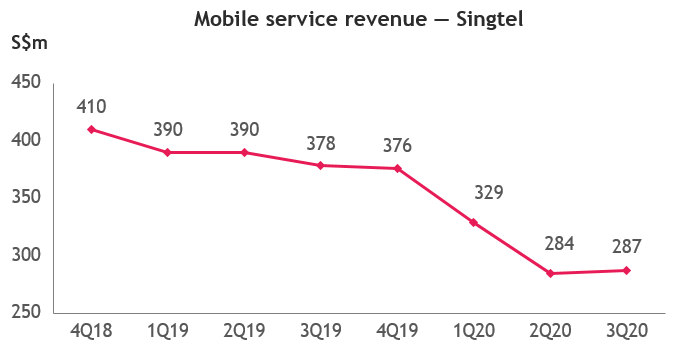
Singtel’s 9M20 underlying profit from Singapore fell 38% to S$396m and that is despite receiving S$23m income from the Job Support Scheme.
While Singtel’s consumer business was negatively affected due to COVID-19-related travel restrictions and deferment of enterprise projects, Optus (Singtel’s fully owned Australian subsidiary) fared much worse.
Optus barely entered positive territory with a profit of only S$13m in 9M20 compared to a profit of S$459m in 9M19. This was mostly due to structural weakness in its Australia fixed-line business amid migration to National Broadband Network (NBN), coupled with lower equipment sales and COVID-induced weakness.
Singtel’s associates Telkomsel and Globe were heavily hit by Covid-19
Telkomsel is Singtel’s biggest associate and in FY20 contributed approximately 67% of Singtel’s total associate pre-tax contributions. (Associates of Singtel are telco companies in which they have a less than 50% stake.)
With Singtel being highly reliant on associate revenue, this is a concern. Telkomsel continues to cede market share to XL Axiata, Indosat and other smaller telco players in Indonesia. According to a DBS analyst report, Telkomsel’s overall revenue contribution to Singtel is expected to drop to only 40% in FY22 due to weak cellular business and revenue market share losses.
Globe is another Singtel associate in the Philippines. Like its competitors in the Philippines’ telco market, Globe was badly hit by COVID-19 movement restrictions.
Globe’s mobile customer base is now down 20% year on year, and has fallen 12% since March 2020. This was mainly due to the decline in acquisitions in light of the pandemic.
Potential upside: Grab-Singtel digital banking license
It’s worth noting that at Singtel’s current low valuations, the market is ascribing almost zero value to the company’s core businesses.
But the company is cultivating new key businesses for the future.
In December last year, the Monetary Authority of Singapore (MAS) announced 4 successful digital banking applicants, including the Grab-Singtel consortium. Operations are expected to commence by early 2022.
This could be the start of something exciting. Singtel holds 40% of the digital bank JV with Grab. Products to be offered through this new digital bank are likely to seamlessly integrate with the daily lives of Grab and Singtel’s large, digital-first customer base. We go into detail on our blog post here, so do hop over if you're interested.
Singtel’s rapidly expanding 5G presence
Singtel also has a head start in deploying its 5G network. As the image below shows, it has outpaced Starhub.

On 8 October 2020, Singtel also launched Singapore’s first 5G standalone trial network for enterprises.
The network, which utilises 3.5GHz spectrum and Massive MIMO (multiple-input multiple-output) technology, provides enterprises with early access to 5G to develop and trial run 5G solutions.
What does the fox think?
The Frugal Fox bought Singtel shares back when the stock price was at $3.80. We invested around $10,000 at that time, so we’re making a loss of around $3,895 at the current share price of $2.32.
However, we’ve also received several years of generous dividends. Our average dividend yield over the past 5 years is 6.96%. This means that we have collected about $690 in dividends each year, or $3,450 in all for the past five years.
 Singtel dividend data taken from Dividends.sg
Overall, our net loss is only around $400.
Personally, we’ve chosen to hold on to Singtel stock. As the COVID vaccine gets rolled out worldwide, we think the stock price will rise in the immediate term. We’re optimistic that Singtel’s stake in the new digital bank and its rapidly expanding 5G presence will position it well for the future too.
For us, Singtel is ultimately a dividend play. We have no illusions that the stock price will suddenly rise and hit $5. For that sort of growth, we have our exposure to US tech stocks to count on. Instead, our plan is to continue collecting dividends from Singtel.
If you do not need to raise cash right now, The Frugal Fox thinks Singtel stock could still be worth holding for its long-term dividend potential. However, if you’re looking for a faster growing stock, then you may want to evaluate whether Singtel still fits the bill for you.
For more insights, check out The Frugal Fox!
Comments
1542
1
ABOUT ME
What does the fox save? 🦊 Find out here 👇👇👇 the-frugal-fox.com
1542
1
Advertisement
No comments yet.
Be the first to share your thoughts!