Advertisement


OPINIONS
Would Warren Buffett Buy Wilmar Today?
Read on to find out more about the black gold of Asia.
Dividend Titan
10 May 2021
Founder at Dividend Titan
This article originally appeared on Dividend Titan's Weekly Wealth (Free Email Newsletter).
Warren Buffett’s side-kick, Charlie Munger always likes to say: “I want to figure out where I’m going to die, so I won’t ever go there.”
It’s a light-hearted expression of a deeper philosophical idea, expressed by the mathematician Carl Gustav Jacob Jacobi.
To explain it in three simple words -- "invert, always invert."
Warren Buffett applied this concept to investing.
And for me, I want to learn the mistakes people make.
So I know I won’t commit the exact same thing.
What Warren Buffett Taught Me Exactly About Commodity Stocks
You see, back in 2006, Warren Buffett bought into a major oil company -- ConocoPhillips. Just when oil prices were at a near peak.
He paid, on average, US$80 for the stock. By the end of 2008, the stock went as low as US$28 per share.
In his 2008 annual report, he admitted: “I in no way anticipated the dramatic fall in energy prices that occurred in the last half of the year… So far I have been dead wrong.”
The terrible timing of his purchase cost Berkshire Hathaway many billions of dollars.
Now, ConocoPhillips is an “asset-rich” business.
Today, it owns US$62 billion worth of assets, mostly in oilfields.
Oilfields are huge oil reserves that come out from deep under the ground. The stuff that ConocoPhillips and big oil companies are rushing to own.
The very same stuff that we call -- the black gold of the world.
But to generate substantial income from these oilfields, ConocoPhillips must extract and sell oil from these reserves.
You could say oil reserves are like the lifeblood of ConocoPhillips.
So, to grow their business, ConocoPhillips must constantly buy new oil assets.
This means discovering and buying new oilfields. And it’s expensive to develop them. Think about hiring experts, buying equipment, technology, supplies and even getting approvals from various governments.
These huge capital costs put ConocoPhillips investors with a serious dilemma...
"How do I value such companies?"
If I were back in my old job, my boss would "simply" ask me to predict all the costs of these oilfields into an excel. Down to its supplies.
Then assign a value based on the future profits from these oilfields. Every single one of them. An oil major has dozens of oilfields. Imagine how tedious my calculations would be.
Even worse, valuing them would be awfully inaccurate.
In fact, this kind of calculation rarely works in investing.
Commodities Prices Go Up... And Then Down
And here's the other thing.
While we don't see it, I can tell you the competition to discover and develop big-scale oilfields is intense.
It’s the kind of scale that would allow ConocoPhillips to grow earnings over the next few decades.
And you still have to deal with accidents. Remember the Deepwater Horizon oil spill?
It caused not only a huge upset with governments, but British Petroleum had to spend billions of dollars to clean up the mess.
With these kinds of capital investments, huge competition and nature of all commodity businesses like the oil business, it makes it really hard for investors like you and I to find “alpha” returns investing in large vertically-integrated global oil majors.
What’s even more challenging is dealing with the ups and downs of oil prices.
When oil prices are high, you expect massive profits from these oilfields with respect to the capital costs they put in. I’d call these _excess _returns on capital.
But that’s only if oil prices continue to go up, forever.
The reality is, oil prices don't always go up.
Oil, after all is a commodity.
Wilmar Sells the Black Gold of Asia
It's the same thing with Wilmar. You see, Wilmar generates a huge cash flow when palm oil price rises.
They can do this because of historically buying cheaper palm oil.
So far, Wilmar's shares have risen 48% since a year ago.
"Does it mean it's a good buy now?"
Don’t forget, palm oil prices move up and down.
And like ConocoPhillips, Wilmar requires substantial capital investments -- factories, equipment, supplies etc. to make things work.
That's why Wilmar's return on invested capital (ROIC) has always been a low single-digit.
Think about a business like a bag. If a bag generates $100,000 a year, would you spend $50,000 just to make that money, or a business that only needs $5,000 to produce that $100,000?.
I'd focus on the latter. It’s just common sense.
Warren Buffett spent his entire career finding bags that produces the most money, for the least amount of capital. Of course, ConocoPhillips was one of the rare occasions he made a bad decision.
And to a casual observer, you can see Wilmar, like other oil companies, require _massive _amounts of capital to create decent returns for shareholders.
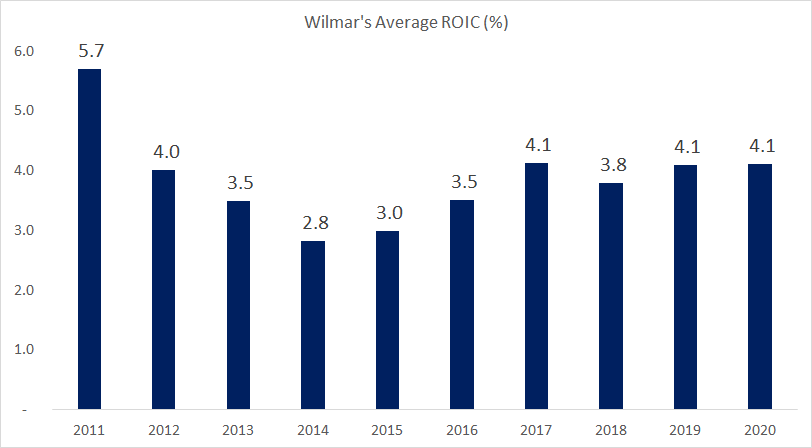
Source: Morningstar.com
In fact, Wilmar's average ROIC is less than 4%.
For every dollar you invest in Wilmar, in the long run, you get back less than 4 cents.
Wilmar must work very hard to even produce a modest return for its shareholders.
If you ask me if Warren Buffett would buy Wilmar today? My answer is a no.
And I don't think he wants to make the same mistake twice.
Sometimes investing can be simple.
Always here for you,
Willie Keng, CFA
Founder, Dividend Titan
Editor’s Notes: I invite you to join our growing community simply by subscribing for our completely FREE email list. In it, you’ll received some of our best ideas about how to protect and grow your wealth safely.
Comments
608
0
ABOUT ME
Dividend Titan
10 May 2021
Founder at Dividend Titan
Dividend Titan (www.dividendtitan.com) is a financial publication helping investors grow their wealth safely for retirement.
608
0
Advertisement
No comments yet.
Be the first to share your thoughts!