Advertisement

OPINIONS
What will 2023 be like? (My opinion)
With the stock market crashing over 20% from its peak and FED's aggressive tightening, what will happen in 2023?
Due to a combination of factors, inflation proved to be more stubborn than expected, rising to highs we haven’t seen in decades. As central banks globally aggressively raised rates to curb inflation, both the equity and bond markets suffered.
Market Outlook into 2023
Aggressive Rate Hikes
In 2022, central banks worldwide hiked rates aggressively to tame elevated inflation. The current federal funds rate in the US is 4.25% to 4.50%, the result of the fastest rate hiking cycle in over 30 years. The European Central Bank (ECB) also recently raised three of its key interest rates by 75 basis points to levels last seen decades ago. 2023 looks set to be a rough year as both central banks seem determined to keep raising rates to bring down inflation despite the clear threats to growth.

Growth Restriction
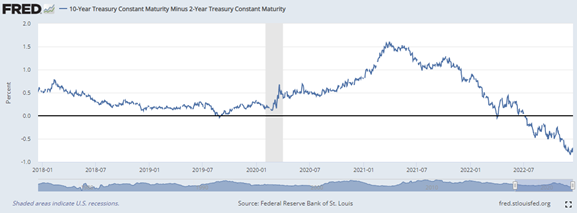
Current high rates should restrict economic growth, which coincides with market expectations. Most yield curves are deeply inverted, foreshadowing a sign of recession.

Sectorial Weakness
As growth dampens, interest rates-sensitive sectors e.g. real estate will likely get hit the hardest in 2023.
Also, activities in capital markets should drastically reduce as companies shunned higher borrowing costs.
Given the lagging nature of interest rates as a monetary policy, weaknesses in housing, capital markets, and technology should unfold throughout 2023.
Unemployment
While the labor market figures appear relatively tight with unemployment near a record low, the labor market decline is near.
As the lagging impacts of high rates become prominent in 2023, corporate profits should decrease and companies to start freezing hiring & firing workers, resulting in higher unemployment throughout 2023
Inflation
The inflation rate in the United States is currently at 7.04% far above the 2% inflation target of the FED.
However, as supply chain pressure eased, shipping time normalizes, shipping costs declined greatly from their peak, and commodities prices fell.
Inflation should fall throughout 2023, as FED continues to tighten interest rates.
Service inflation, however, is currently more rampant, a show of a tight labor market. However, as the labor market cools in 2023, service inflation should follow suit.

Recession
In line with market expectations and an inverted yield curve, a recession in 2023 is very likely, though I do not expect a severe recession. US households and corporations today have strong balance sheets, compared to the 2007-2008 financial crisis. This strong balance sheet should be able to cushion the economy preventing a recessionary crisis.
Pivot
While FED pivoting has been largely speculative throughout the year, I believe that the global rate hiking cycle should stop in 2023. Weaker growth, softer labor markets, falling inflation, and recession should be the key drivers in forcing the FED to pivot to avoid plunging the economy into crisis.
Attractive Valuations
Unsurprisingly, markets that went into 2022 with stretched valuations were crippled on the backdrop of elevated inflation, an aggressive global rate hiking cycle, and economic challenges in China. This pronounced reset in valuation crashed the traditional 60-40 balanced portfolios and created attractive valuations unseen in the last decade.
It is difficult to predict when the stock market will bottom but a 36% drop in the US stock market has been rare and is usually a good buying point for long-term investors.
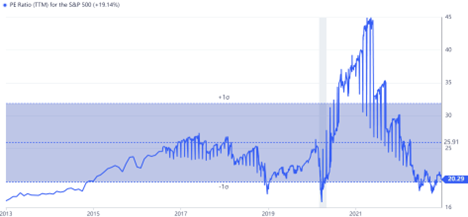

Furthermore, the P/E ratio of the S&P 500, an index tracking the United States stock market has fallen near to pre-pandemic valuation, signaling an attractive entry point for investors for long-term capital gains.

As inflation subsides in 2023, and the FED pivots its monetary policy, recovery in the stock market is very possible. While I do not think that the returns for US equities next year would be superior, there are still some upsides for investors.
None of the information contained here constitutes an offer (or solicitation of an offer) to buy or sell any financial instrument, to make any investment, or to participate in any particular trading strategy. Everything posted in this article is my own opinion and does not constitute as financial advice. I will not be responsible for any loss arising from any investment based on any perceived recommendation, forecast, or any other information contained here.
Comments
66
2
ABOUT ME
66
2
Advertisement
No comments yet.
Be the first to share your thoughts!