Advertisement


OPINIONS
What Is Pre-Authorisation Certification and How Does It Affect Hospitalisation Claims?
Great eastern’s move means you may need to review your hospital options to avoid unexpected costs.
This post was originally posted on Planner Bee.
Effective from 17 June, Great Eastern (GE) has temporarily suspended issuing pre-authorisation certificates for its Integrated Shield Plan (IP) policyholders admitted to Mount Elizabeth hospitals.
According to the insurer, this step is part of its efforts to manage rising healthcare costs and keep coverage affordable in the long term. But what does this mean for policyholders? To understand the impact, it helps to know what pre-authorisation is, how it works, and why it matters for your claim experience.
What is pre-authorisation?
A Certificate of Pre-authorisation (PAC) confirms that the insurer has approved both the medical treatment and the estimated costs before treatment begins.
With a PAC, patients can be assured that covered costs will be settled by the insurer. Without it, some or all of the bill might not be covered, leaving the patient to pay the difference.
Pre-authorisation is not required in emergencies where immediate medical attention is needed.
How does pre-authorisation work?
In Singapore, the process usually involves:
- Doctor consultation: Your doctor or specialist (preferably on the insurer’s panel) assesses your condition and recommends treatment.
- Submission of request: The hospital sends your pre-authorisation request, including diagnosis, procedure details, and cost estimates, to the insurer.
- Insurer’s review: The insurer checks whether the treatment is covered and if it is medically necessary.
- Decision: If approved, you receive a Letter of Guarantee (LOG), which allows direct billing to the hospital. If denied, you may need to explore alternatives.
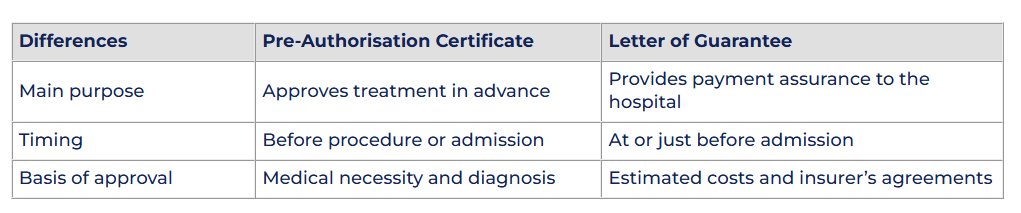
Pre-authorisation vs Letter of Guarantee
When your PAC is approved, a Letter of Guarantee (LOG) is usually issued.
A LOG is an assurance from the insurer to the hospital that it will cover the portion of the bill under your policy. This helps patients avoid paying a large cash deposit upfront.
Read more: Hospitalisation Claims: What You Need To Know and How To Do It
Can insurers reject pre-authorisation?
Yes, insurers can reject a pre-authorisation request based on the information submitted by your doctor and/or with your application. Common reasons for rejection include:
- The planned treatment is not covered under your policy.
- The treatment is not considered medically necessary.
- The estimated costs exceed what the insurer deems reasonable.
- Additional medical information is required from your doctor to assess the request.
Even in emergencies, where pre-authorisation is waived, the insurer may later reject the claim later if the treatment is judged medically unnecessary.
If your request is rejected, you can appeal the decision or provide further medical documentation to support the necessity of the treatment. It is recommended to check with your insurance agent about the requirements and documentation needed for a successful pre-authorisation request.
What happens when pre-authorisation is withheld?
If pre-authorisation is withheld for certain hospitals, patients may need to consider alternative hospitals to ensure their treatments are fully covered.
This can be inconvenient and may add unnecessary stress during treatment and recovery. It can also disrupt ongoing or complex treatments, especially for cases that require specialised facilities or specific hospitals.
In the Great Eastern case, policyholders who have already applied for a PAC for the two affected hospitals before the cut-off date of 17 June 2025 will undergo the appropriate approval process.
Both Mount Elizabeth Hospital (Orchard) and Mount Elizabeth Novena Hospital can still issue an e-LOG to Great Eastern policyholders during admission, subject to the terms and conditions of their policy.
The e-LOG for private hospitals covers up to S$50,000. It is important to note, however, that while the e-LOG waives the initial hospital deposit, it does not guarantee final payment of the claim.
As a result, some Great Eastern policyholders may feel discouraged from using these hospitals, which could reduce flexibility and limit personal choice when selecting healthcare providers.
What should policyholders do?
Policyholders should regularly review their coverage and the panel of doctors associated with their insurer.
Many insurers offer incentives for using their panel doctors, such as higher claim limits, waived deductibles, and faster pre-authorisation approvals. During consultations, check whether your procedure requires pre-approval and understand the steps to obtain it.
If your Integrated Shield Plan (IP) was purchased through Planner Bee, our dedicated claims team can help manage your pre-authorisation request, reducing stress and simplifying the process.
What can you do as a Great Eastern IP policyholder?
Reach out to your insurance agent to understand how this change will affect you when seeking care at the affected hospitals. Explore alternative hospitals that provide similar treatments and are covered under pre-authorisation certification (PAC).
If you regularly use Mount Elizabeth Hospital (Orchard) or Mount Elizabeth Novena Hospital, you might consider switching to another insurance provider. However, switching policies can be risky.
Pre-existing conditions could be excluded from coverage, or you may need to pay extra to include them. There may also be a waiting period before your new coverage begins, which could leave you exposed to unexpected medical emergencies.
Additionally, if your new insurer changes its claims policy later, you could face complications.
Before making any decisions, discuss your options with your doctors and insurer to determine the best course of action for your treatment. Since your current coverage remains unchanged, choosing a different hospital may be a safer and simpler solution than switching insurers.
Read more: 9 Smart Insurance Tips To Save Money Without Losing Coverage
In summary
Pre-authorisation provides financial certainty and peace of mind when facing costly medical procedures. GE’s decision to suspend it at Mount Elizabeth hospitals does not change policy coverage but does affect how claims and payments are managed.
Understanding your plan, knowing when pre-authorisation is needed, and working with your insurer or agent are key steps to ensuring smoother hospital admissions and minimising unexpected costs.
If you need guidance with your insurance, Planner Bee is here to help at [email protected]
Comments
17
17
ABOUT ME
Your Personal Mobile Financial Advisor Application Join us at telegram! https://t.me/plannerbee
17
17
Advertisement
No comments yet.
Be the first to share your thoughts!