Advertisement


OPINIONS
What Are Money Market Funds and Should I Invest in Them?
Money market funds are a smart, low-risk way to earn a bit more on your cash without locking it up for the long term.
This post was originally posted on Planner Bee.
As the cost of living rises and global markets remain uncertain, many people in Singapore are re-evaluating how they manage their savings and investments. One increasingly popular option is the money market fund, or MMF. It’s seen as a relatively low-risk way to earn slightly better returns than what you’d get from a regular savings account. But what exactly is an MMF, and could it be a good fit for your financial goals?
What are Money Market Funds (MMFs)?
Money market funds are a type of unit trust or mutual fund that invests in short-term, high-quality debt securities. These might include government treasury bills, commercial papers issued by companies, certificates of deposit from banks, and other low-risk fixed income instruments.
The goal of MMFs is to preserve your capital while offering liquidity, meaning they aim to keep your investment safe while allowing easy access to your money. Although they are not insured or capital guaranteed, they are considered among the safest investment options available in the market.
In Singapore, MMFs have been gaining traction. According to a recent article in The Straits Times, local investors have increasingly allocated their idle cash into MMFs to enjoy returns ranging from 2.5% to even above 4% per annum, depending on the fund and prevailing interest rate conditions.
How do MMFs work?
When you invest in an MMF, your money is pooled together with other investors’ funds and managed by a professional fund manager. The manager buys a diversified portfolio of short-term debt securities that typically mature within a year.
The returns generated from these investments—primarily in the form of interest—are passed back to investors after deducting fund management fees. Unlike equities or long-term bonds, MMFs do not aim for capital gains. Instead, they prioritise stability and steady income.
MMFs generally strive to maintain a stable net asset value (NAV), usually $1 per unit, although this is not guaranteed. The idea is that each dollar you invest can be redeemed at close to the same amount, plus the accrued interest.
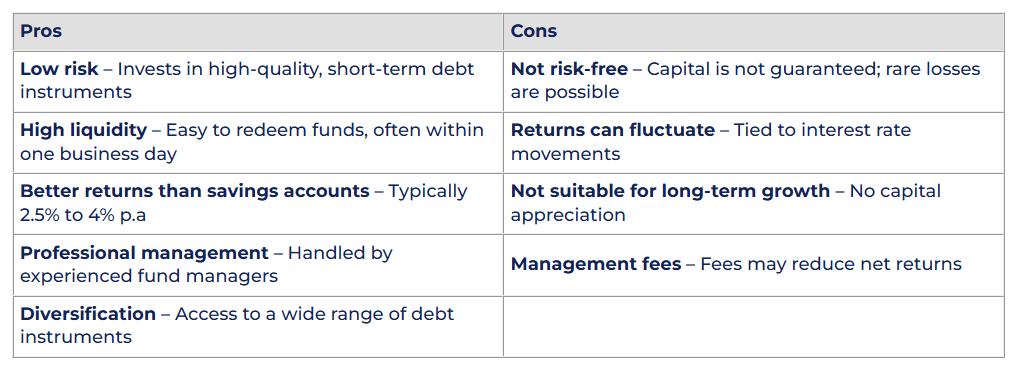
Pros & cons of investing in MMFs
Here’s a quick breakdown of the pros and cons of investing in money market funds.
Comparison of MMFs vs CPF savings vs mutual funds
If you’re deciding between MMFs, CPF savings, and traditional mutual funds, here’s a simplified comparison to help you choose:
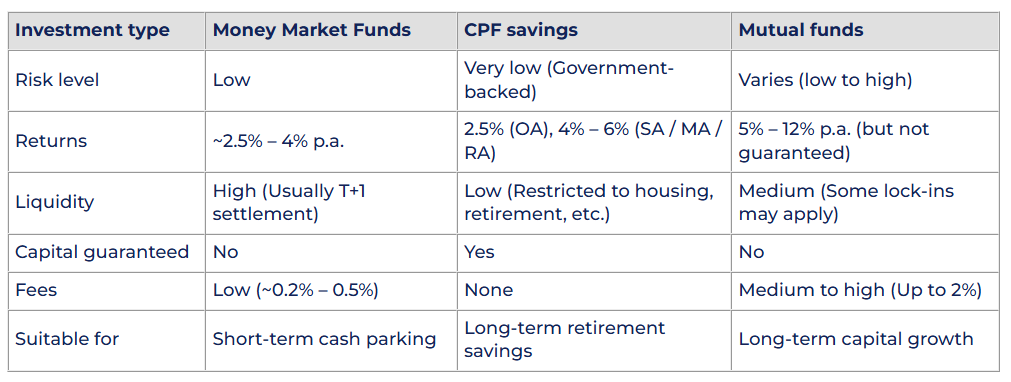
MMFs can be a good addition to your financial plan alongside options like the CPF and mutual funds. They’re ideal for parking money you might need soon, like for an emergency fund or short-term expenses. CPF is best for long-term goals like retirement, such as saving for retirement. Mutual funds are better if you’re comfortable with higher risk and have a longer investment timeframe in mind.
How to invest in MMFs?
Investing in MMFs in Singapore is straightforward and accessible. Here’s a step-by-step guide to get you started:
- Choose an investment platform MMFs are available on digital brokerages like Moomoo, Tiger Brokers, and UOB Kay Hian, or through bank-linked investment platforms and financial advisers. Some platforms offer automatic “auto-sweep” features, which transfer idle cash into MMFs for you.
- Select your fund Review available MMFs based on past performance, underlying assets, fund size, and management fees. Ensure the fund is well-managed and diversified.
- Open an account Most platforms require identity verification (e.g. Singpass) and bank account linking. Once verified, you can fund your account and start investing.
- Monitor your investment While MMFs are typically stable, it’s still a good idea to monitor your fund’s yield, especially when interest rates change. You can withdraw or switch funds easily if returns drop significantly.
- Understand tax implications In Singapore, there’s no capital gains tax, and interest income from MMFs is usually not taxable for individual investors. However, it’s always a good idea to double-check with a tax adviser if you’re uncertain.
Should you invest in MMFs?
If you’re looking for a safe place to park your cash while earning more than a bank deposit, money market funds are a strong contender. They offer a good balance between liquidity, stability, and yield—especially in a rising interest rate environment.
That said, they are not a substitute for long-term investments or government-backed schemes like CPF. Instead, MMFs can play a supportive role in your financial plan—acting as a buffer, emergency fund, or cash reserve for short-term goals.
As always, be clear on your financial objectives, risk appetite, and investment horizon before diving in.
Read more: Investing Your CPF Savings: Is It Worth Putting Them in a Fixed Deposit?
Comments
24
16
ABOUT ME
Your Personal Mobile Financial Advisor Application Join us at telegram! https://t.me/plannerbee
24
16
Advertisement
No comments yet.
Be the first to share your thoughts!