Advertisement


OPINIONS
UOB issues NEGATIVE yielding EUR bonds: Why investors buy them
There is US$17 trillion worth of negative yielding debt globally today. We explain why investors buy into them.
This article originated from The InvestQuest.
For real-time updates:
Join their Telegram Group: The InvestQuest
Summary
1) What is a Covered Bond?
2) Details of UOB’s 7-Year EUR Covered Bond
3) Why would an investor buy into this negative yielding bond
4) Full List of Covered Bonds issued by DBS, OCBC and UOB
Introduction
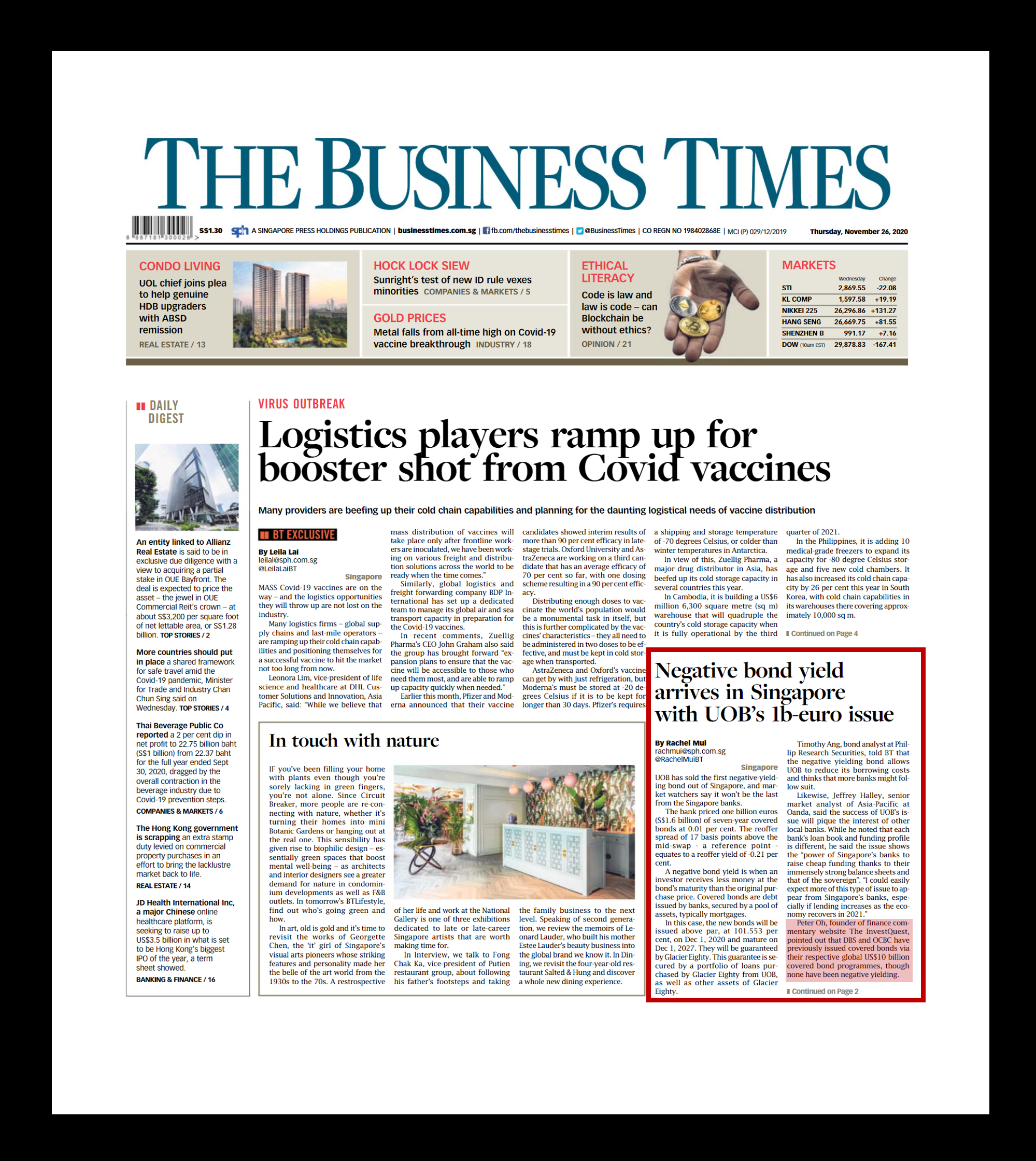
Two days ago, UOB issued a EUR-denominated covered bond with a -0.21% yield-to-maturity. Many might be wondering why would any investor want to invest in a bond with a negative yield. We explain why…
We were delighted to see our thoughts being quoted by The Business Times (the full news article may be retrieved via this page, if the text in the below images are too small).
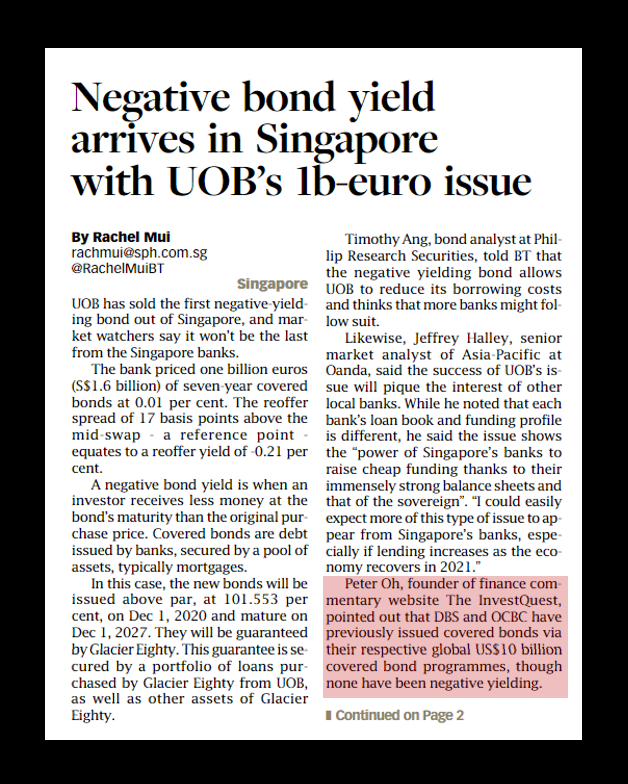
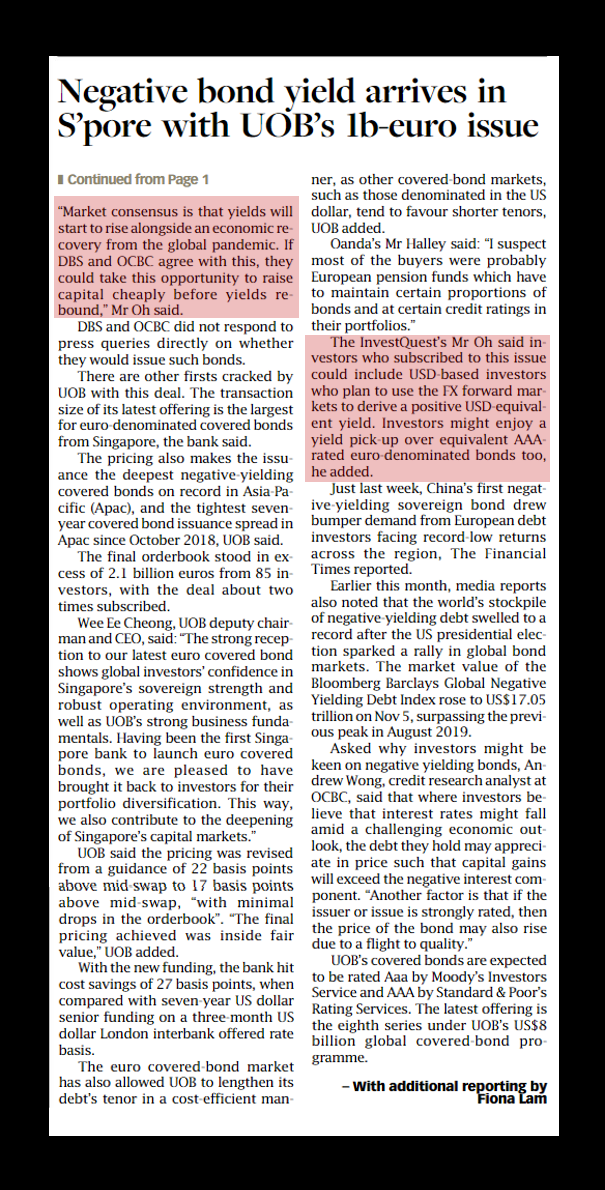
Source: The Business Times, published 26 November 2020.
1) What is a Covered Bond?
A covered bond is a corporate bond which is secured against a collateral pool (usually comprising of mortgages or loans).
These mortgages and loans are considered assets, as they represent future cash flows that debtors are obligated to repay back.
The collateral pool creates an extra layer of protection for investors. For example, if the financial institution issuing the covered bond faces financial troubles, the covered bond investors may still receive coupon and principal repayments derived from the collateral pool. As a result, covered bonds are commonly given “AAA” credit ratings.
2) Details of UOB’s 7-Year EUR Covered Bond
Currency Denomination: Euro
Maturity Date: 1st Dec, 2027
Coupon Rate: 0.01%
Issue Price: 101.553
Yield-to-Maturity: -0.21%
Issue Size: EUR 1bn
Min Trade Size: EUR 100k, with EUR 1k increments thereafter
Guarantor: Glacier Eighty Pte Ltd
ISIN: XS2264978623
Why would UOB issue a Covered Bond
It’s a win-win situation for UOB and investors.
A covered bond issue allows UOB to raise capital more cheaply compared to a typical unsecured bond.
On the other hand, investors are given an opportunity to invest in a very safe asset that is not only backed by UOB but additionally secured by a collateral pool. In addition, these investors enjoy a yield pick up over equivalent AAA-rated EUR-denominated bonds. For instance, a AAA-rated 7-year German Bund currently has a yield to maturity of -0.69%, which is 0.48% lower than what the UOB covered bond is offering at -0.21%.
Investors who subscribed to this covered bond issue could include :
Investors who plan to use the FX swap markets to derive a positive USD-equivalent or SGD-equivalent yield
EUR-based investors who are looking to switch out from similarly rated EUR bond issues which are offering an even lower yield
Institutions that are mandated to invest in very safe “AAA” credit rated instruments and desire a higher yield to what government bonds are offering
3) Why would an investor buy into this negative yielding bond
Reason 1: A negative yield in Euros does not necessary translate to a negative return for a USD-based investor
Despite negative Euro yields, a USD-based investor can use the FX-forward markets to generate a positive USD-equivalent yield.
For instance,
A USD-based investor can convert USD into EUR today at the FX spot rate of 1.1925 to pay for the UOB Covered Bond.
This USD investor can simultaneously enter into a 7-year FX forward contract to sell EUR, buy USD, at an FX rate determined today. According to Bloomberg, the EURUSD 7-year forward rate is 1.2955. This forward contract should mature when the EUR bond maturity proceeds are expected to be received in Dec-2027.
There’s a positive FX carry from doing the above. We calculate it by dividing 1.2955 by 1.1925 and annualizing the result. We get a positive FX carry of +1.19%.
Considering the -0.21% bond yield and the +1.19% positive FX carry, this investor would then be able to earn a USD-equivalent annualized yield of +0.98%. This might be deemed relatively attractive, especially when you compare it to 7-year US Treasuries that currently yield 0.65%.
Reason 2: The investor has a view that yields will go even lower in the short-term
Bond prices have an inverse relationship with yields. If the investor thinks that yields will trend even lower, they may buy into negative yielding bonds to benefit from potential short-term capital appreciation.
Furthermore, the price of negative yielding bonds is generally more sensitive to changes in yields, compared with the price of positive yielding bonds, which makes it appropriate for investors who have a strong conviction that yields will trend lower. This is a concept known as “convexity“, where lower yielding bonds have higher convexities than higher yielding bonds, all else equal.
Reason 3: Potential capital appreciation as the bond “rolls down” an upward sloping yield curve
Current EUR sovereign bond yields are upward sloping, meaning that longer-term yields are higher than shorter-term yields. Some investors may be positioning to benefit from short-term capital appreciation, as the bond rolls down the yield curve as time passes.
For example:
A 7-year German Bund has a yield-to-maturity of -0.686%. A 6-year German Bund’s yield-to-maturity is even lower at -0.743%.
If you bought the 7-year German Bund today and held it for one year, and assuming that there is no change in the shape of the yield curve, the bond’s yield-to-maturity would be now at -0.743%, resulting in a higher bond price.
4) Full List of Covered Bonds issued by DBS, OCBC and UOB
Covered bonds issuances are not new to the Singapore banks. DBS and OCBC currently have Global Covered Bond Programmes that allow them to issue up to US$10 billion of covered bonds each, while UOB’s Covered Bond Program allows for issuance up to US$8 billion.
In the below table, we have compiled the full list of covered bonds that have been issued by the three local banks, and are currently tradable on the secondary market. We have sorted the bonds by their maturity dates. The recent UOB bond issue is highlighted in yellow.
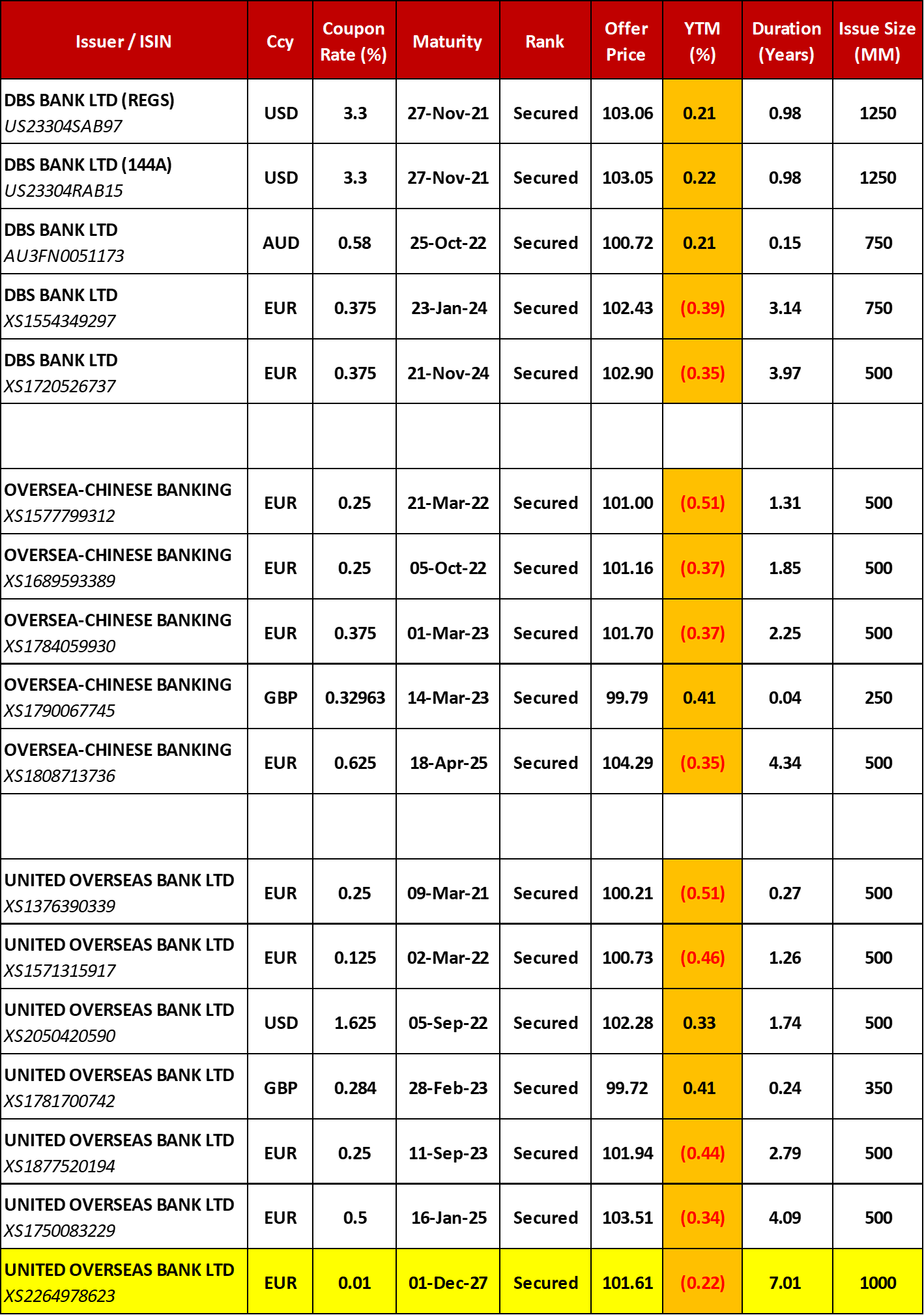
Source: Bloomberg, retrieved 26 November 2020.
Note 1: The DBS AUD-denominated bond is a floating rate bond. Its coupon resets quarterly to the prevailing 3-mth Australian Bank Bill rate (currently 0.02%) + 0.52%
Note 2: The OCBC GBP-denominated bond is a floating rate bond. Its coupon resets quarterly to the prevailing 3-mth GBP Libor rate (currently 0.04%) + 0.27%
Note 3: The UOB GBP-denominated bond is a floating rate bond. Its coupon resets quarterly to the prevailing 3-mth GBP Libor rate (currently 0.04%) + 0.24%
Comments
1848
0
ABOUT ME
Level up your investment knowledge with us!
1848
0
Advertisement
No comments yet.
Be the first to share your thoughts!