Advertisement


OPINIONS
The Semiconductor Industry
Looking at what all the hype is about…
This article was originally published on Medium.
Executive Summary
Semiconductors have become a necessity within the tech space as demand increases. Semiconductors are required as the foundation for various usage such as personal devices, automotive and data storage. To name a few, they are required in the development of Artificial Intelligence (AI) and Machine Learning technologies, 5G technologies, Cloud related technologies and development of computational power and memory capacity.
Macro Outlook
Industry Overview
A semiconductor is a hybrid component, consisting of a conductor and an insulator. They are essential to many electrical devices across a range of products such as communications, computing, healthcare, military systems, transportation, banking and clean energy to name a few. The semiconductor success depends on creating a smaller and more efficient product at a lower cost.
In line with Moore’s Law, the innovation and development of technologies should double every two years as efficiency increases while chip size shrinks. Chip size matters as a smaller chip equate to better efficiencies and performances. This allows for a smaller die size, reducing cost while increasing its density or more cores per chip.
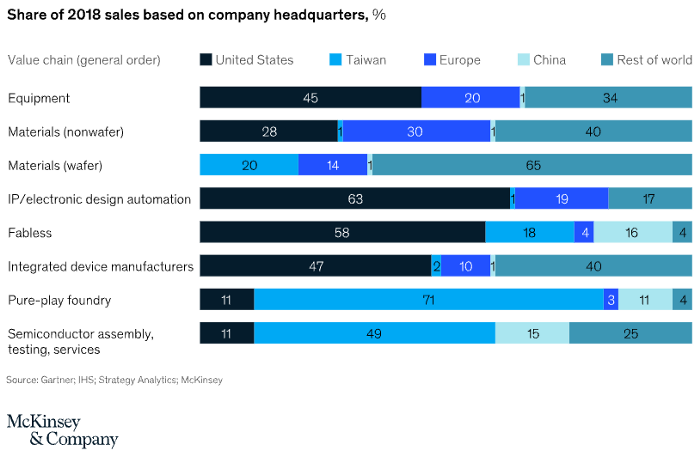
Currently, within the industry, there is no region that has end-to-end capabilities for semiconductor design and manufacturing. This reflects their inter-reliant among semiconductor companies. This is also why the semiconductor industry was disrupted in the recent supply chain disruption.
Industry outlook
Moving forward, the semiconductor industry has an upside potential given the increased demand due to the demand in various technological advancements such as the Internet of Things (IoT) and automotive. We are expecting an approximately 42.72% growth within 5 years from 2019–2024(figure 1). _The current global semiconductor revenue forecast is also expected to grow 19.7% in 2021 and 8.8% in 2022(_figure 2). The semiconductor has seen a conservative 5.02% compound annual growth rate between 2012–2020 (Figure 3).
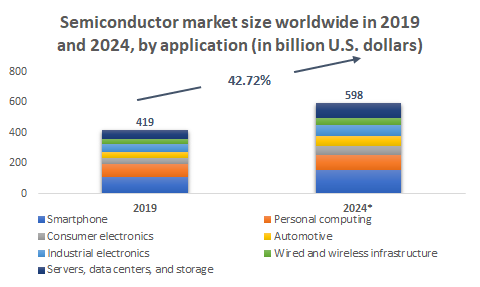
Figure 1, Source: ASML
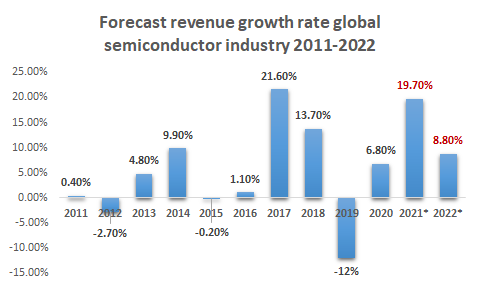
Figure 2, Source: WSTS
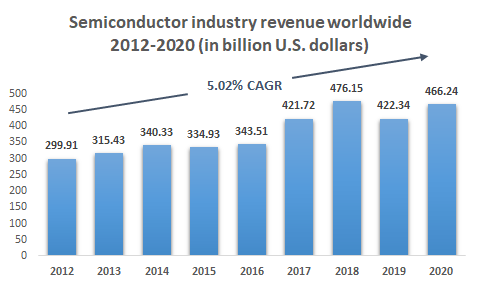
Figure 3, Source: Gartner
Semiconductor Foundries
A foundry is a manufacturing company that makes chips for other companies in a fabrication plant also known as “fabs”. TSMC is currently the largest foundry, a key supplier to multiple tech companies (figure 4).
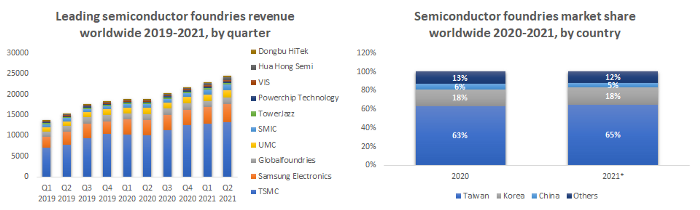
Figure 4, Source: TrendForce
Semiconductor segments
Optoelectronic, sensor and discrete (O-S-D) components are one of the six categories under semiconductors. They are used for solid-state lighting, 3D imaging, Internet of Things (IoT), build-out of 5G cellular networks and multi-sensor “fusion”. It is expected to generate over USD 109 billion by the year 2022.
Next to OSD is an integrated circuit also referred to as a microelectronic circuit or microchip. A single unit component can be found in many electronic devices such as automobiles, traffic lights, watches etc. They are expected to reach approximately USD 436.37 billion in revenue by the year 2022.
The logic semiconductor is used to process digital data with the intention to control the operation aspect of the electronic system. They are expected to reach approximately USD 147.18 billion in revenue by the year 2022.
Analog semiconductor is used to handle and process “real world” input such as temperature, speed, sound, and electrical current. They are expected to reach approximately USD 71.18 billion in revenue by the year 2022.
The micro semiconductor is a crucial integral component in all electronic devices such as our personal devices, coffee maker and GPS. They are expected to reach approximately USD 78.16 billion in revenue by the year 2022.
Memory semiconductor. Their core function is used for digital data storage. They are expected to reach approximately USD 181.71 billion by the year 2022.
Overall, as a whole will expect to see a compounded annual growth rate of 9.07% moving forward (Figure 5).
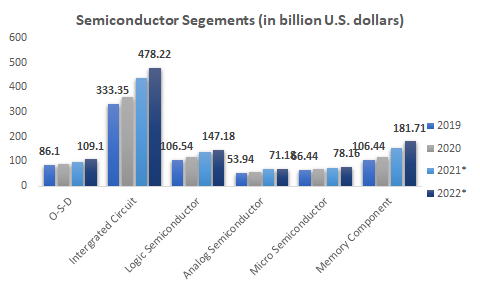
Figure 5, Source: WSTS, IC Insights
Related Industries
Artificial Intelligence (AI) has increased the demand for Semiconductors. Artificial intelligence will likely see a decade-long growth through 3 kinds of algorithms — Machine Learning (ML), Deep Learning (DL) and Natural Language Processing (NLP). Additional various sectors have increased their reliance on AI-enabled technology to increase operational efficiencies such as the Automotive, Financial Services and Industrials. Global AI Chip market revenue is expected to see a compound annual growth rate of 31.06% from 2017–2027 (figure 6). They are estimated to occupy a 19% market share within the semiconductor industry by the year 2025 (figure 7).
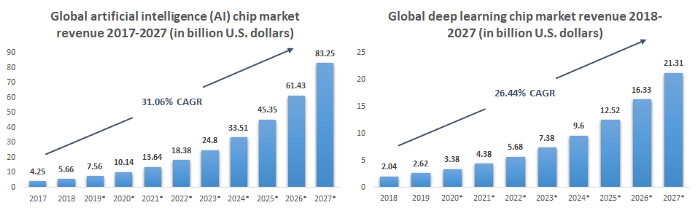
Figure 6, Source: The Insight Partners
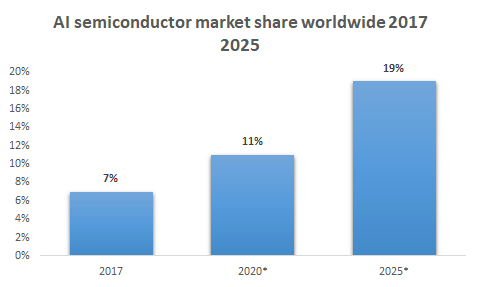
Figure 7, Source: McKinsey
Automotive is expected to see a compounded annual growth rate from 2020–2028 globally (figure 8). As countries globally move towards zero carbon footprint, the adoption of hybrid and electric vehicles is forecasted to increase in the next decade. Such cars require about 2 times the semiconductor component as compared to conventional cars. Purposes of the semiconductors are used for powertrains, next-generation chassis, safety systems and sensor functions.
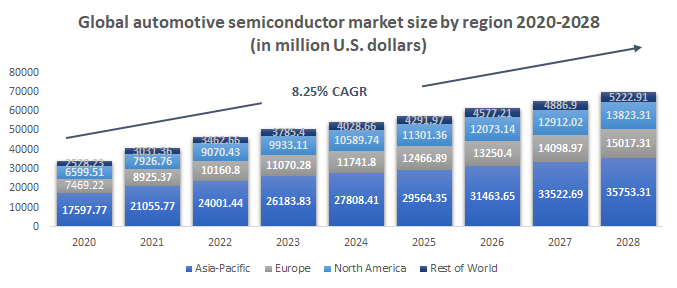
Figure 8, Source: Inkwood Research
Cloud computing has become increasingly common among various industries given the current pandemic situation as companies migrate their operations online. This has translated to an increase in demand for cloud infrastructure pushing growth for server CPUs and storage. Cloud infrastructure is expected to have a 15.66% compound annual growth rate (figure 9).
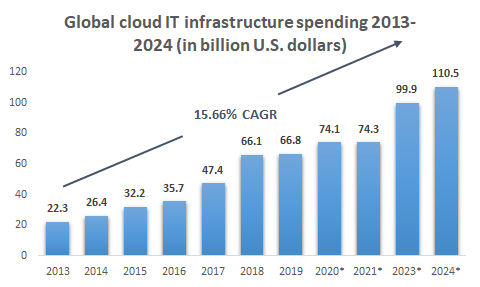
Figure 9, Source: IDC
Lastly, the increased popularity of the Internet of Things (IoT) as countries transit into a smart city, has driven the demand for semiconductors up. We are expecting to see a 13.78% compounded annual growth rate (figure 10) on the conservative side and the overall types (figure 11) moving forward. The growth outlook is backed by the technological advancement in sensors, more efficient computing power and increased reliability in connectivity.
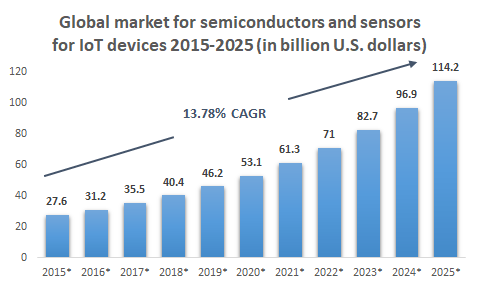
Figure 10, Source: Semiconductor Equipment and Materials International
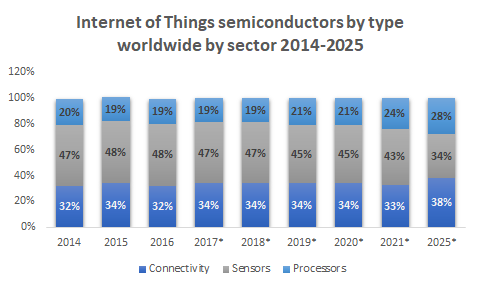
Figure 11, Source: IHS; Statista estimates
Based on recent studies from KPMG; GSA, we are able to identify the key applications for the semiconductor industry (figure 12). Data is interpreted as such: 1 = not important at all and 5 = very important.
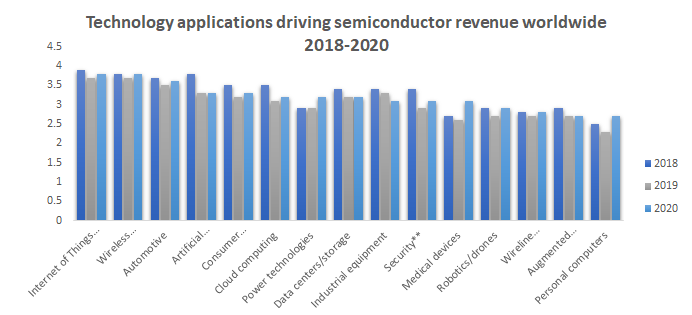
Figure 12, Source: KPMG; GSA
Concluding our article, despite the upside potentials indicated, the semiconductor industries have to factor in headwinds such as the supplies of materials, being in a cyclical industry, Moore’s law and the sentiments and valuations of various companies in these industries by investors.
Previous Articles
Drama of the World Newsletter
Sign up for our FREE newsletter for a weekly update on current affairs by clicking the Link Here.
Comments
1002
0
ABOUT ME
Student | Writer | Investor
1002
0
Advertisement
No comments yet.
Be the first to share your thoughts!