Advertisement


OPINIONS
The Real Value of Technical Analysis in Long-Term Investing.
Learn how technical analysis can create a powerful edge for you in your value and long-term investing strategy.
With so many discussion forums on technical analysis flying around in seedly yet there are barely any concrete conclusions, I thought I share my two cents on how technical analysis can power boost your long-term investment strategy.
Technical analysis has been a popular tool used by traders worldwide to trade the financial market, and yet more than 80% of those traders fail and quit. This gave rise to critics of technical analysis with even my university professors claiming that technical analysis does not work and no one can time the market.
In fact, I agree with the popular saying: 'time in the market beats timing the market, and patience usually pays off in the stock market'. However, do you know that by incorporating technical analysis in your long-term investing strategy, you can actually greatly increase your investment returns over the same investment timeframe?
Let me explain further.
A quick introduction to technical analysis.
Technical analysis is a trading method used to evaluate investments and identify trading opportunities by analyzing historical data and price action. Technical analysts believe that past trading activity and price changes of a security can be valuable indicators of the security's future price movements, and they make trades based on those theories.
Since its inception, technical analysis has been used by popular traders such as Charles Dows, Paul Tudor Jones, and Steven Cohen. Just to name a few.
There are hundreds of different indicators and price action trading strategies in the world of technical analysis. But today, I will be covering how you can use technical analysis to identify attractive price levels for long-term investment, as well as identify when to exit an investment.
How important it is you might ask when the sacred strategy of 'dollar cost average' and 'buy the dip' seem to be the strategies on investors' minds today.
Let me ask you this question: Do you really think hedge funds and financial institutes, managing billions of money simply dollar cost average/buy the dip as and when they like? Multiple sources including Investopedia suggest that hedge funds and investment banks worldwide make ample use of technical analysis as well. In fact, investment banks have a specialized team on technical analysis to help them with their investment decisions.
The real value of technical analysis
So let's go back to the million-dollar question, how can technical analysis supplement your investing strategy? In my humble opinion, after 2 years of active trading, I believe that there are 2 prominent ways in which technical analysis can supplement your long-term investment strategy.
1. Technical analysis, particularly the concept of support and resistance can help you identify attractive price levels to enter into an investment.
Before I proceed any further, can I ask how the vast majority of you enter into an investment? Regardless of whether you are 'dollar cost averaging or 'buying the dip' or entering into an investment for the first time. Do you invest regularly at a certain time of the month or do you invest on red days or do you invest based on 'feels'?
Well, by identifying support levels, you will be able to determine and invest at 'attractive' prices to get better returns for your money, say goodbye to investing based on 'feels' and fixed time of the month which the financial market likely does not care about.
So what are support levels and how do we use them?
Support levels are low price levels for a security or commodity below which prices do not ordinarily fall through. This does not mean that support levels are invincible and prices cannot fall through them, but rather, it means that there is upward pressure on prices when they reach the support levels, resulting in prices rebounding upwards from that level.
Essentially, to put in layman's terms, support levels are the best levels you can purchase a security at, at a particular period of time, as prices have a tendency to rebound from those levels, allowing you to buy at the 'bottom' of that particular point in time. Perhaps an example below can better illustrate the concept.
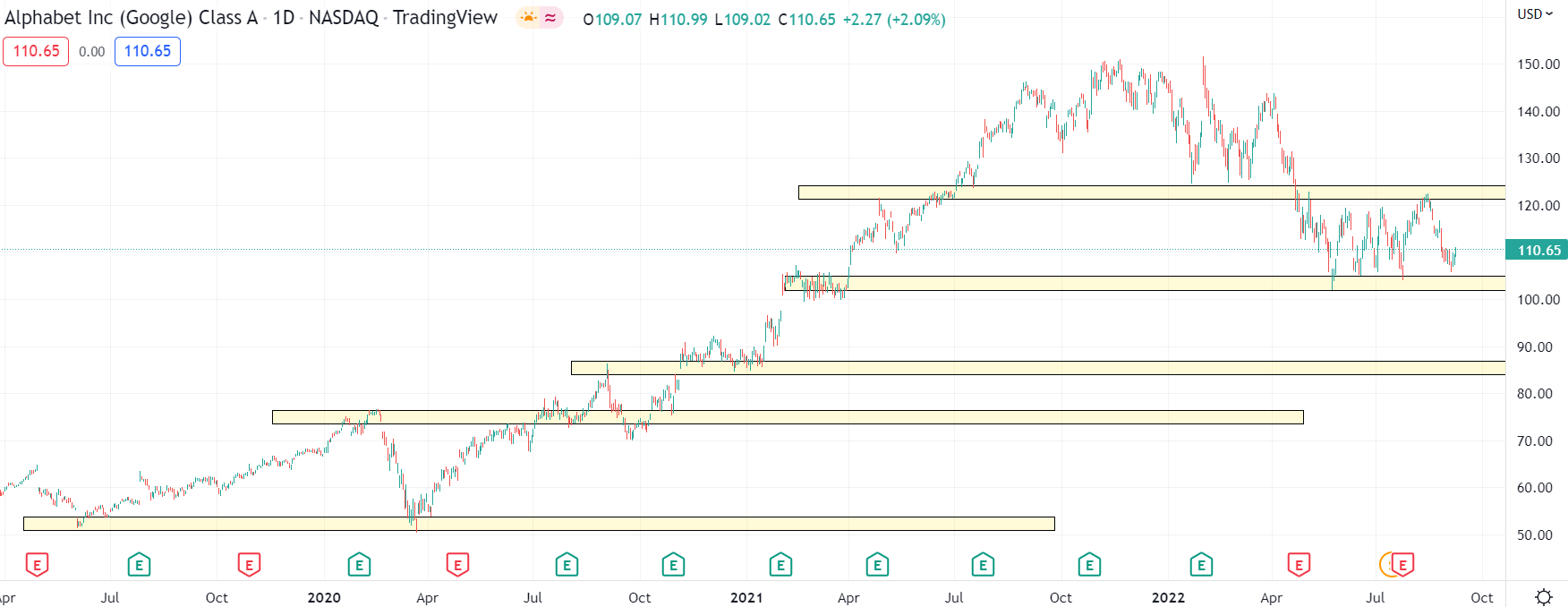
Performance of Google, a popular 'FAANG' stock, over the past 2 years.
The yellow boxes indicated in the image above are support levels and as can be seen, prices tend to rebound upwards after they reach those levels. While prices do break support levels at times, support levels show you the lowest price the stock will likely hit before rebounding. Buying at these levels hence allows you to truly 'buy low and sell high', achieving the max returns for your investments, compared to investing at random times.
P.S. Please note that support levels are actually areas on the charts.
OHH and the concepts are support and resistance are highly learnable and easy to master, so please do go and learn them to achieve better returns and lower risks for your money!
2. Using technical analysis to help you identify exit levels for your investment.
This second usage of technical analysis may not be very popular amongst long-term investors who want to hold a security through the ups and down, in which case, there is no need for an exit plan, except for when things change fundamentally of course. But for younger investors who have a larger risk appetite, and often meddle in volatile investments, such as cryptocurrencies and commodities, having an exit plan can greatly help you safeguard your investment profits and limit your loss.
There are many tools in the world of technical analysis that can help know when to exit an investment. They include hundreds of indicators, trendlines, and many more. For simplicity, I will be using only support, resistance, and trendline to analyze the crash of Bitcoin last year.
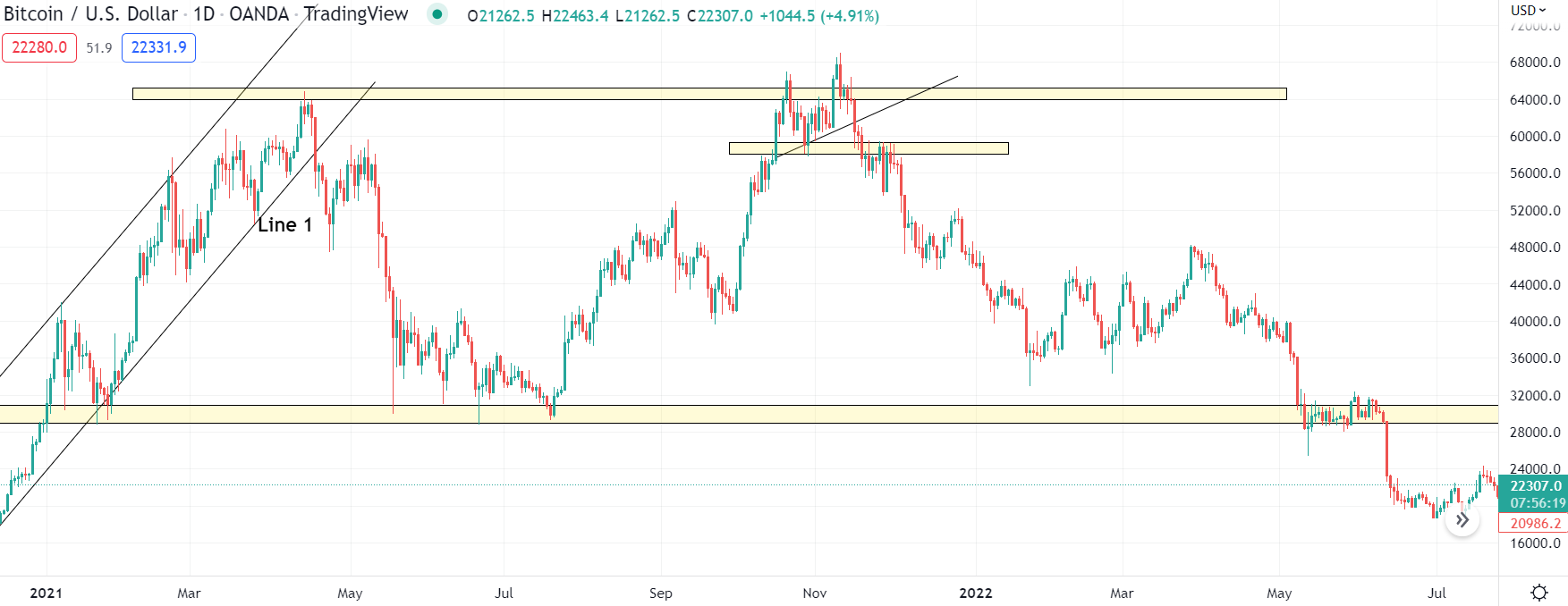
As can be seen from the above image, bitcoin has been bouncing upwards off the trendline L1, and the decisive break of L1 should have been a signal to exit the investment as Bitcoin tumbled close to 50% downwards, wiping out a large portion of the profits of those early investors. While Bitcoin eventually reclaimed the 65k level, it got rejected, broke another structure, and tumbled downwards as well.
As can be seen from the above example, knowledge of chart reading can help you analyze how your investment is doing, allowing you to make informed decisions to secure your profit.
Needless to say, this strategy involves risk as well, and that is the price might rally higher without you in the trade. However, this should not be a big issue as you can simply just enter again if your exit turns out to be wrong. While your re-entry price might be worse than your initial entry, this strategy helps you to secure your profits early in the event that there is a huge plunge in the price of your investment.
And here are some tips for you to increase the accuracy of your exit strategy.
- When technical analysis tells you that an asset might plunge, look out for news that seems to add confluence. For example, major institutions might be dumping their positions as well.
- Use a larger timeframe (daily and above) to perform your analysis for long-term investors.
In conclusion, there are different opposing arguments that support and criticize the use of technical analysis in long-term investing. My take is that, as an investor trying to maximize returns in the financial market, one should learn about the various tools available and decide what works best for themselves.
None of the information contained here constitutes an offer (or solicitation of an offer) to buy or sell any financial instrument, to make any investment, or to participate in any particular trading strategy. Everything posted in this article is my own opinion and does not constitute as financial advice. I will not be responsible for any loss arising from any investment based on any perceived recommendation, forecast, or any other information contained here.
Comments
699
9
ABOUT ME
699
9
Advertisement
No comments yet.
Be the first to share your thoughts!