Advertisement


OPINIONS
Singapore’s Financial Architecture: Why Marriage is a Blueprint, Not Just a Milestone
Singapore’s system rewards each household differently—if you understand the mechanics.
Marriage in Singapore: A Financial Blueprint, Not Just Romance
In Singapore, marital status isn’t merely a personal choice. It is a financial framework — one that subtly but powerfully shapes the trajectory of wealth building. From Housing and Development Board grants to Central Provident Fund interest mechanics, household structure affects access to subsidies, capital accumulation, risk sharing and long‑term optionality.
Put simply: the number of “pistons” in your engine — whether you are single, dual‑income without dependants, or a family — alters how fast you can accelerate, how much drag you carry, and how resilient you are to life’s shocks. Each profile has strengths; each has trade‑offs. None is intrinsically superior.
The Mechanics of CPF and Housing in Singapore
Understanding the mechanics of CPF and public housing is the key to understanding why household configuration makes a difference.
CPF Interest Rate and Compounding
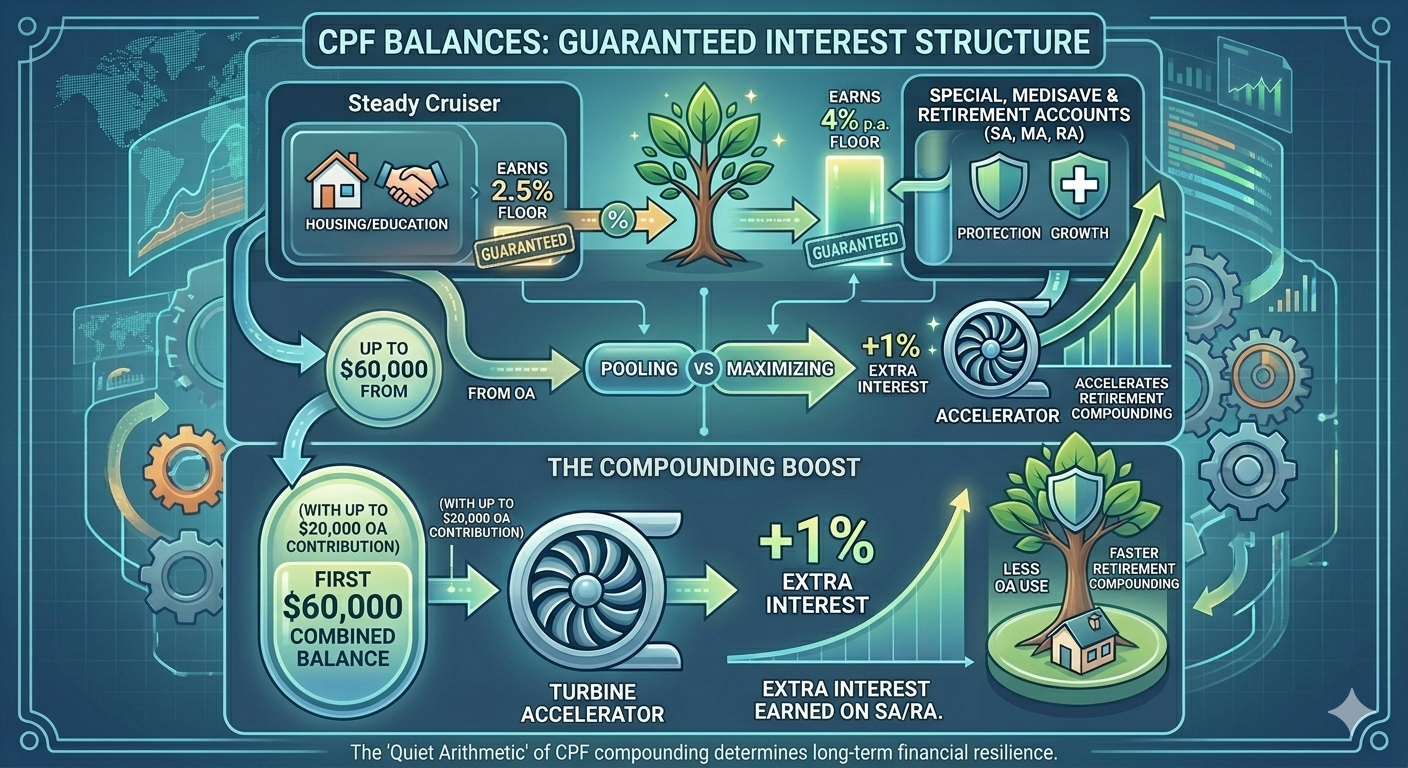
CPF balances earn guaranteed interest: the Ordinary Account (OA) earns a floor rate of 2.5% per annum, while the Special, MediSave and Retirement Accounts earn a floor of 4% per annum. Members below 55 receive an extra 1% interest on the first $60,000 of combined CPF balances (with up to $20,000 from the OA). This extra interest is earned on the SA/RA, further accelerating retirement compounding.
CPF fund — used for housing, retirement, and healthcare — grow predictably and often more consistently than many retail investment products. It also means that how you allocate contributions between accounts matters.
The structure of CPF interest rates is not merely administrative detail. It shapes housing choices, retirement readiness, and risk appetite. A household that understands how to preserve higher-yielding balances and avoid excessive depletion for property purchases effectively enhances its long-term compounding power. Over decades, this quiet arithmetic — rather than headline income — often determines financial resilience.
Housing Grants: Wealth Boost or Constraint?
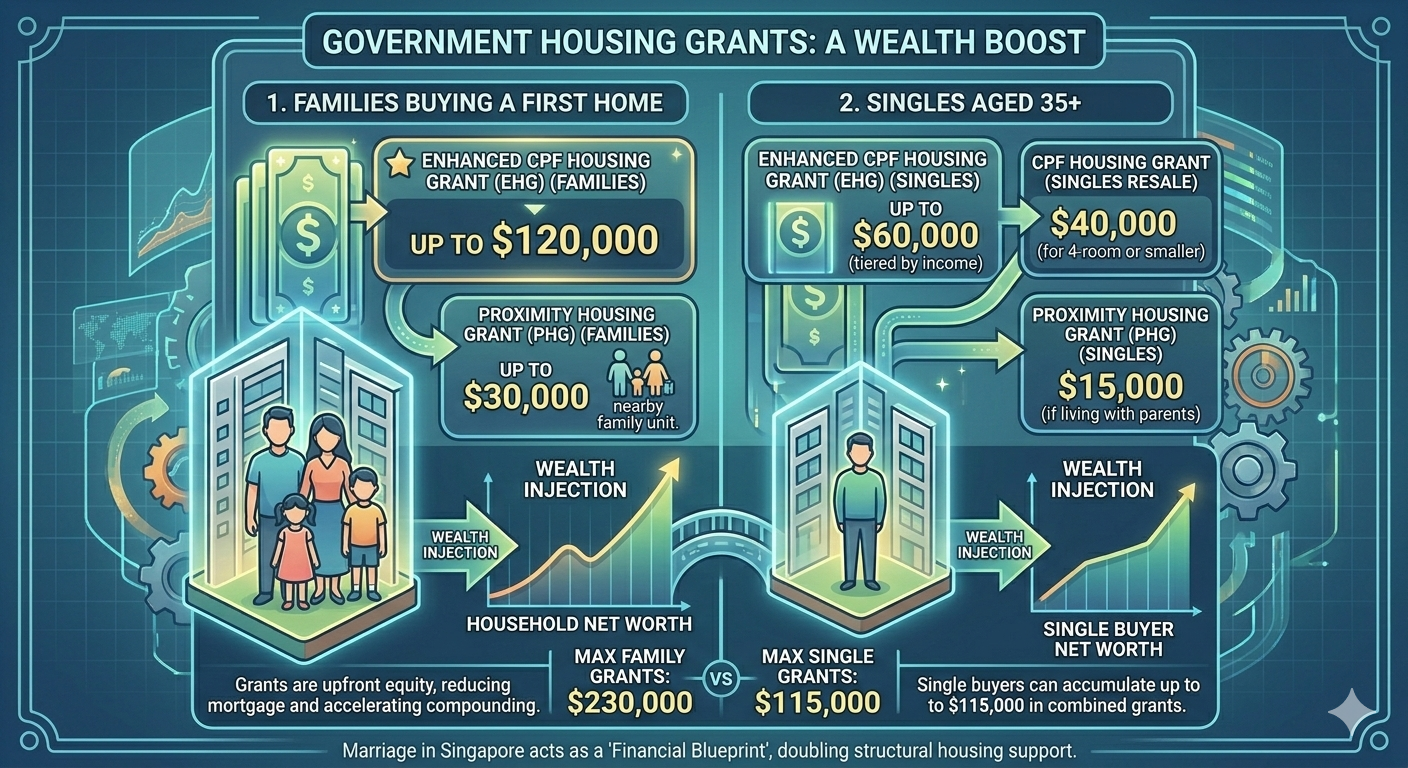
Government housing grants effectively act as wealth boosts—but eligibility depends on household structure and income. For families buying a first home, the Enhanced CPF Housing Grant (EHG) can be up to $120,000, with additional grants like the Proximity Housing Grant (PHG) worth up to $30,000 if buyers live with or near family.
Singles aged 35 and above can access their own EHG, which is now capped at $60,000, though actual amounts are tiered by income. When combined with the standard CPF Housing Grant ($40,000 for a 4-room or smaller resale flat) and the PHG ($15,000 if living with parents), a single buyer could receive up to $115,000 in total housing grants.
https://www.gov.sg/explainers/a-home-for-everyone-singapores-public-housing/
The difference is not subtle. A couple can potentially receive roughly double the structural housing support of a single buyer. This is not accidental. Singapore’s housing policy is calibrated around household formation. The system rewards pooled income, shared financial responsibility, and multi-generational proximity.
A housing grant is not merely a subsidy — it is upfront equity. A $230,000 grant reduces mortgage size, lowers interest cost over decades, and accelerates net worth accumulation from day one. It changes the compounding trajectory of a household.
For singles, the path remains viable—but the mathematical leverage is smaller. Without the doubled grant ceiling or the ability to pool two CPF Ordinary Accounts, personal financial discipline must compensate for where policy support is lighter.
The Singles: The Speedboat
High agility. High risk. High intentionality
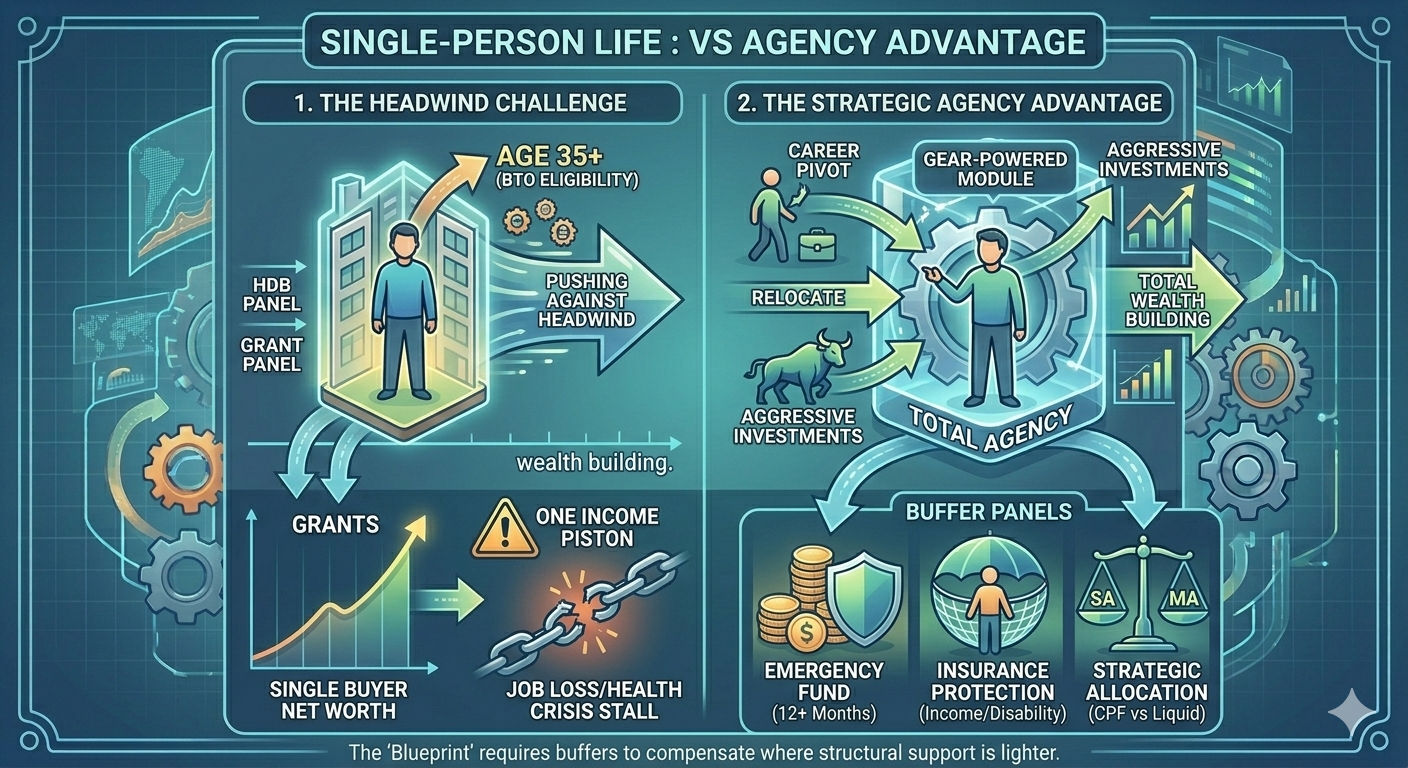
For singles, especially those under 35, the journey to home ownership and financial security often feels like pushing against a headwind. HDB eligibility for singles only begins at age 35 for new BTO purchases, and grant amounts are smaller than for couples.
Yet this headwind comes with a unique advantage: total agency. Singles can pivot careers, relocate, and allocate savings without consensus meetings. They can adopt aggressive savings and investment strategies — be that concentrated equity exposure, entrepreneurial risk, or rapid skill acquisition.
But speed comes with a cost. With only one income piston, a job loss or health crisis can stall progress entirely. Without a partner’s CPF contributions to bolster housing affordability or retirement savings, singles must build robust buffers:
- Emergency fund covering at least 12 months of expenses.
- Insurance protection for income loss or disability.
- Strategic allocation of savings between CPF and liquid investments.
For the financially disciplined single, this profile offers a form of reasoned autonomy: wealth creation becomes less about entitlement and more about intentional engineering.
The DINK: The Twin-Engine Powerboat
Dual incomes. No dependants. Massive structural arbitrage.
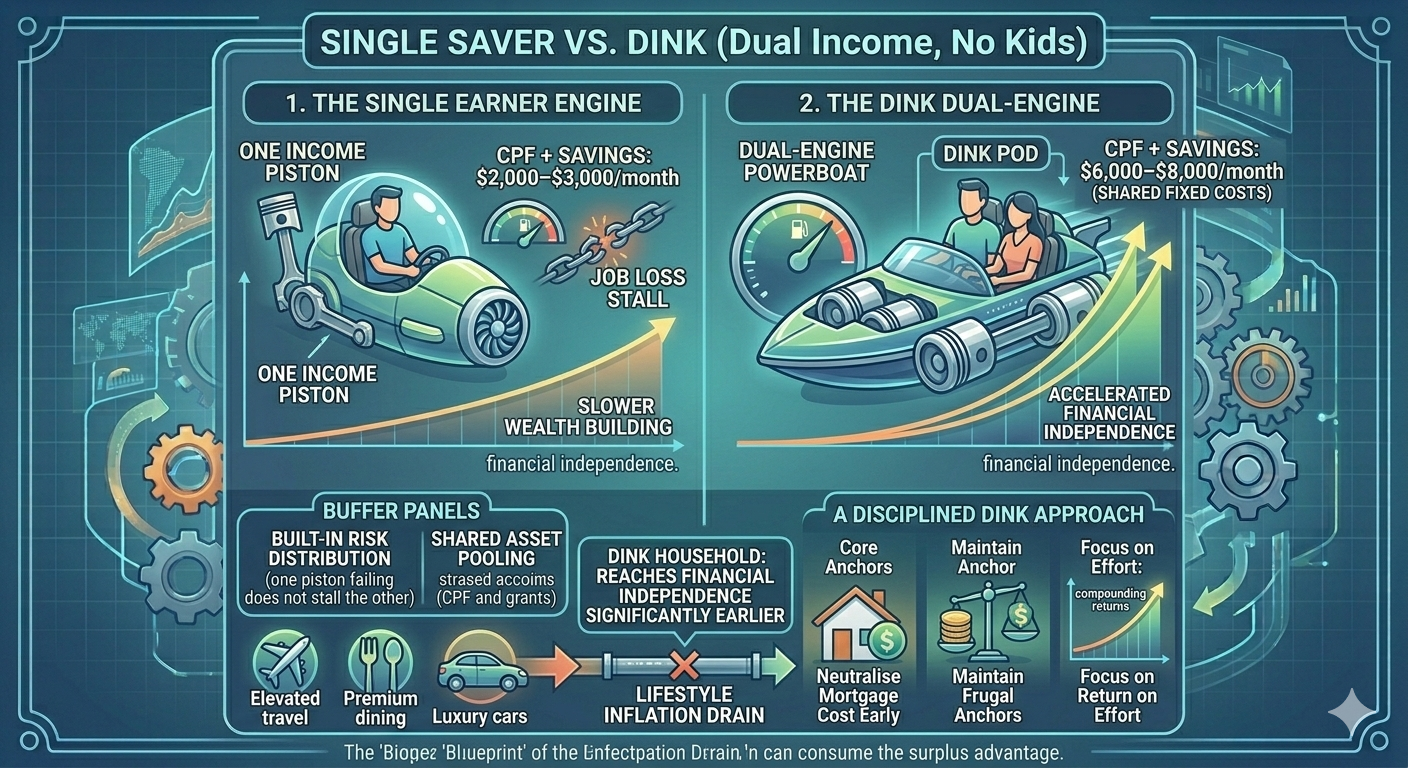
In Singapore’s financial architecture, the DINK profile — Dual Income, No Kids — is often the most efficient engine. Two incomes mean two CPF contribution streams, shared fixed living costs, and the ability to leverage housing grants and CPF pooling early in the life cycle.
Consider this: while a single saver might realistically put away $2,000–$3,000 a month into CPF and liquid investments, a DINK couple sharing basic living costs may save $6,000–$8,000 a month without feeling financially strained. This surplus can be deployed into a blend of property equity, retirement accounts and diversified investments.
The dual‑engine setup also provides built‑in risk distribution: a job loss for one spouse does not automatically stall the entire household engine the way it might for a single earner. Mortgage servicing, household expenses, and long‑term planning can continue on a more stable footing.
Yet the DINK advantage — like any advantage — must be actively maintained. Many dual‑income couples fall prey to lifestyle inflation: premium dining, elevated travel, larger cars, or luxury housing upgrades can consume the very surplus that provided their advantage.
A disciplined DINK approach looks like this:
- Neutralise mortgage cost early: leveraging CPF OA and shared cash flow to pay down principal faster.
- Maintain frugal anchors: keeping core living costs modest while deploying surplus into long‑duration investments.
- Focus on return on effort: prioritising compounding returns over consumption.
When executed well, a DINK household can reach financial independence significantly earlier than other profiles.
Families: The Tanker
Dual incomes, children, high stability — but high burn.
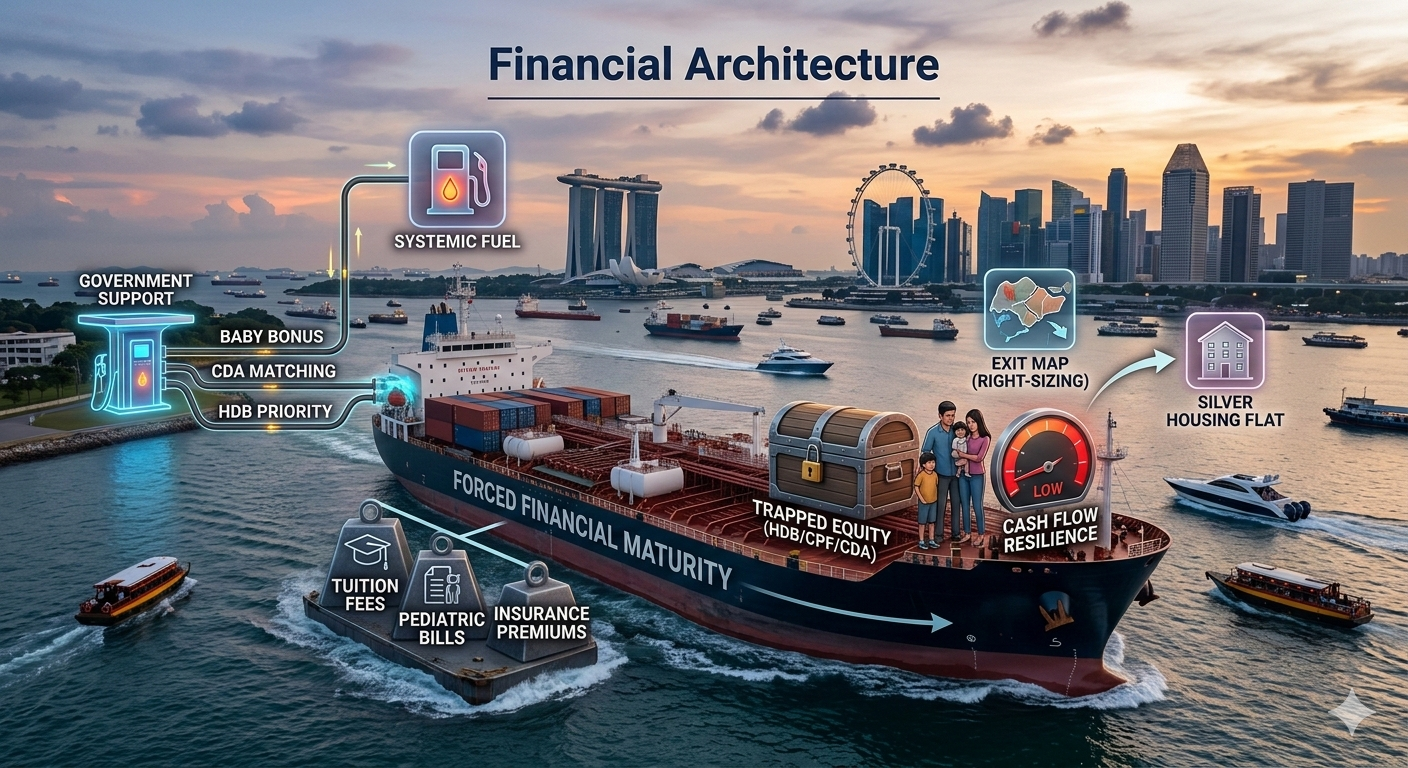
The "Tanker" represents the bedrock of Singapore’s social strategy. It is massive, stable, and carries the most significant cargo, but it operates with immense inertia. While the state provides the most "fuel" to this profile through HDB priority and CPF-linked subsidies, the internal "burn rate" is the highest of the three. For the Tanker, the challenge isn't reaching top speed; it’s ensuring the ship doesn’t stall under its own weight.
In Singapore, parenthood acts as a form of forced financial maturity. The "drag" of tuition fees, pediatric bills, and insurance premiums creates a rigorous, albeit involuntary, budgeting discipline. To support this, the government provides the most aggressive structural "fuel":
- Direct Cash Infusions: The Baby Bonus Cash Gift and CDA (Child Development Account) co-matching.
- Fiscal Relief: Significant tax offsets such as the Working Mother’s Child Relief (WMCR) and Qualifying Child Relief (QCR).
- Asset Support: Priority HDB allocation and enhanced housing grants (EHG) designed to anchor the family unit.
The primary risk for the Tanker is becoming "Asset-Rich, Cash-Poor." Many parents find their net worth "trapped" in a fully paid-off HDB flat and restricted education funds. On paper, the family looks wealthy; in reality, they are one paycheck away from a cash-flow crisis. This leads to the "One More Year" syndrome—an inability to retire because the wealth isn't liquid enough to sustain daily expenses once the salary stops.
To avoid the Tanker becoming a "Ball and Chain" in the final decade before retirement, parents must prioritize Liquidity Velocity:
- Separation of Concerns: Avoid Investment-Linked Policies (ILPs) that muddle protection with savings. Use pure Term insurance to lower costs and free up cash for flexible investments.
- Education Arbitrage: Use the CDA and CPF-linked grants to cover essentials, allowing private savings to be diverted into liquid, globally diversified portfolios.
- The Exit Map: Assess the "Right-Sizing" potential early. Understanding how to transition from a 5-room flat to a smaller unit (unlocking the Silver Housing Bonus) can turn trapped equity into an immediate retirement stream.
The Goal is to Cash Flow Resilience. The Tanker wins by leveraging systemic support today to ensure they aren't forced to keep rowing well into their 70s.
Conclusion
There is no "better" path, only different mechanics. The Single wins through intentionality—turning the lack of a buffer into a sharpened focus. The DINK wins through arbitrage—resisting the urge to spend their massive surplus so they can hit the financial flexibility in record time. The Parent wins through longevity—leveraging systemic support to build a stable, multi-generational foundation.
Wealth in Singapore is rarely accidental. It is engineered - slowly, structurally, and often quietly.
Comments
43
16
ABOUT ME
Deal with your problem by being rich
43
16
Advertisement
No comments yet.
Be the first to share your thoughts!