Advertisement


OPINIONS
Singapore Civil Service Careers and Benefits 2025
A civil service career offers rare stability, steady growth, and a real chance to make a difference.
This post was originally posted on Planner Bee.
The Singapore civil service plays an integral part in maintaining the country’s efficiency, stability, and innovation. It is one of the most comprehensive and well-structured employment sectors in the country.
Civil servants are employed in key ministries responsible for Singapore’s governance, from transport and finance to education and defence, while others are involved in crafting policy, implementing national projects, and engaging communities across the island.
Whether you are a fresh graduate seeking purpose-driven work or a mid-career professional looking for job stability and growth, a role in the civil service offers a compelling blend of security, national impact, and personal development.
This guide breaks down everything you need to know about the latest civil service careers in Singapore, from salaries and benefits to challenges and opportunities.
Why consider a civil service career in Singapore?
Civil servants are directly related to the development and implementation of government policies that affect education systems, access to healthcare, economic growth, environmental sustainability, and others. You may be designing grant programmes to low-income families, negotiating across borders, or organising green programmes across the country.
Outside the influence, the attraction of civil service positions by many Singaporeans is because of the compatibility with their personal values. Integrity, impartiality and high level of service to the citizens are expected of public officers. The positions are aimed at those who are eager to make a difference in society, who are able to solve complicated problems, and who can act in rapidly evolving socio-political environments.
Types of civil service jobs
The Singapore civil service includes a wide range of job types that support different government functions. These roles are critical to maintaining public services and ensuring the smooth operation of society.
Local government roles
Local-level civil servants manage neighbourhood-focused services such as sanitation, public cleanliness, estate maintenance and environmental health. Officers in agencies like the National Environment Agency or town councils interact directly with residents, manage local issues and ensure public spaces are clean, safe and liveable.
Ministry and statutory board roles
At the national level, civil servants in ministries and statutory boards play a critical role in policy development, public administration, and service delivery. Examples include:
- Ministry of Education (MOE)
- Ministry of Health (MOH)
- Housing & Development Board (HDB)
- Land Transport Authority (LTA)
Specialised agency roles
Certain government agencies focus on specialised domains requiring deep expertise. These include:
- Monetary Authority of Singapore (MAS)
- Infocomm Media Development Authority (IMDA)
- Energy Market Authority (EMA)
- Cyber Security Agency (CSA)
Roles in these agencies often demand technical or sector-specific skills, such as in data science, engineering, finance, or national security.
Ministries employing civil servants
Civil servants work across a wide range of ministries, including:
- Ministry of Communications and Information (MCI)
- Ministry of Culture, Community and Youth (MCCY)
- Ministry of Defence (MINDEF)
- Ministry of Education (MOE)
- Ministry of Finance (MOF)
- Ministry of Foreign Affairs (MFA)
- Ministry of Health (MOH)
- Ministry of Home Affairs (MHA)
- Ministry of Law (MINLAW)
- Ministry of Manpower (MOM)
- Ministry of National Development (MND)
- Ministry of Social and Family Development (MSF)
- Ministry of Sustainability and the Environment (MSE)
- Ministry of Trade and Industry (MTI)
- Ministry of Transport (MOT)
- Prime Minister’s Office (PMO)
Civil servants may serve under specific schemes such as the Administrative Service, Legal Service, Education Service, Police Service, Civil Defence, and Accounting Service.
How to start a career as a civil servant?
Educational requirements
Most public sector roles require a diploma or degree from a recognised institution.
Applicants for policy, administrative or specialist roles usually need a relevant degree in areas such as public policy, law, engineering, political science or computer science. Certain jobs in healthcare or cybersecurity require industry-specific qualifications.
For senior management or strategic positions, a postgraduate qualification such as a Master in Public Administration may be expected.
Examinations and assessment
Although Singapore does not have a centralised civil service exam, most government roles include rigorous selection processes.
These may involve online assessments, case studies, structured interviews and written tasks. Candidates are assessed on critical thinking, communication, subject knowledge and problem-solving abilities.
For law enforcement and uniformed services, additional physical tests or psychometric evaluations may apply.
Internships, networking and graduate programmes
Gaining early exposure to the civil service is helpful. Programmes such as the Public Service Internship Programme (PSIP) give students real-life experience working on policies or operational projects.
Graduate schemes such as the Management Associate Programme (MAP) provide structured training and rotation across different departments.
Networking through university events, career fairs or LinkedIn can also open doors and connect aspiring civil servants with mentors and hiring managers.
Read more: 21 Questions To Ask at Your Job Interview
Who can become a civil servant in Singapore?
Eligibility requirements
Applicants must typically be Singapore citizens and at least 18 years old. Most roles require academic qualifications such as a diploma or degree, although there are also positions available for Institute of Technical Education and Nitec graduates.
Other requirements may include good conduct, a clean record and, in some roles, medical or security clearances.
Application process
Job vacancies are posted on Careers@Gov, Singapore’s official public service job portal. The process generally includes submitting an online application, attending interviews and completing assessments.
Some agencies may also conduct job previews or written tasks. Selection is based on qualifications, skills, potential and cultural fit with the agency’s values.
Emphasis on inclusion and diversity
The civil service actively promotes inclusivity. It recruits individuals from different backgrounds, races, genders and age groups to reflect the diversity of Singapore’s society.
Flexible work arrangements, inclusive policies and diversity-focused training are in place to support a workplace culture that values fairness, respect and equality.
Civil service careers are open to fresh graduates, mid-career professionals and even those looking to switch sectors.
Salary, bonuses and benefits
The Singapore civil service remains committed to fair and progressive compensation, aligning rewards with the country’s economic performance and labour market conditions. Salary structures are reviewed in consultation with public sector unions, and a system of variable bonuses ensures that civil servants are recognised during periods of economic growth, while maintaining sustainability during uncertain times.
Civil service salary overview
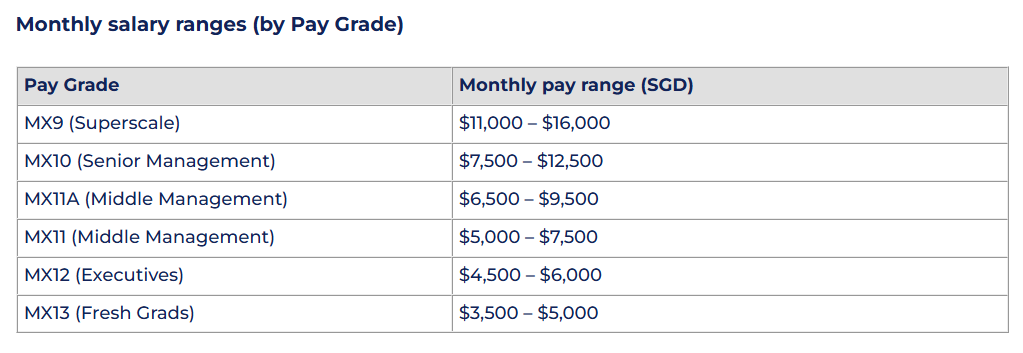
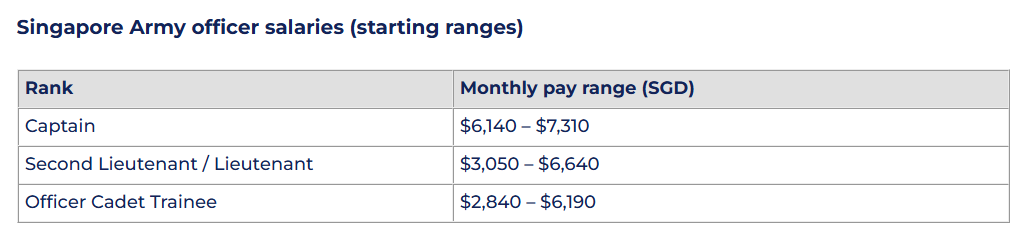
While there are no official public datasets on civil service pay, available information from Parliament statements, government recruitment sites, and anecdotal sources suggest the following salary ranges:
Source: Dollars and Sense Salary Guide
Source: Dollars and Sense Salary Guide
Note: Starting civil service salaries are influenced by an individual’s skills, experience, job scope, and market conditions.
2025 Mid-year bonus
In light of moderate economic growth and global uncertainties in early 2025, the government has announced a mid-year AVC of 0.4 month for all civil servants.
To provide additional support to lower-wage officers, the government will also give a one-time lump sum payment as follows:
- S$400 for officers in grades equivalent to MX15, MX16, and those in the Operations Support Scheme (OSS)
- S$250 for officers in grades equivalent to MX13(I) and MX14
These measures reflect a progressive approach to supporting junior officers while maintaining fiscal prudence amid a subdued economic outlook.
The Ministry of Trade and Industry has projected GDP growth of 0.0% to 2.0% for 2025, while labour market data from the Ministry of Manpower shows a slowing pace of job growth and slightly rising unemployment.
Enhanced public service benefits
The civil service has introduced enhanced benefits aimed at supporting officers’ well-being, professional development, and health.
1. FlexiGrow annual benefit
From October 2024, public officers will receive a new FlexiGrow benefit of S$500 per year. This flexible allowance can be used for:
- Health and wellness programmes (e.g., gym, counselling, wellness apps)
- Personal growth and learning (e.g., professional or interest-based courses)
FlexiGrow empowers officers to take charge of their personal development and holistic well-being.
2. Medical and dental subsidies
To further support healthcare needs, the civil service will improve its medical and dental benefits from 1 January 2025:
Medical benefits:
- Cap per outpatient visit to private clinics increased from S$20 to S$50
- Annual subsidy limit remains at S$500
- No change to public clinic subsidies, which continue to be uncapped within the S$500 annual limit
- Applies to all public officers, including re-employed officers and those in Statutory Boards
Dental benefits:
- Annual subsidy increased from S$120 to S$250
- Valid for both public and private dental providers
These enhancements align with Singapore’s focus on preventive care and are designed to encourage officers to proactively manage their health.
Challenges of working in the civil service
While civil service careers offer stability and purpose, they are not without their complexities. Civil servants must navigate structured environments, high expectations, and evolving demands from both the government and the public.
Navigating bureaucracy
One of the most common challenges civil servants face is working within a highly regulated system. Strict procedures, layered approval processes, and established protocols often slow down decision-making and limit flexibility. This can make it difficult to implement new ideas or respond quickly to emerging issues.
Civil servants must work through multiple levels of review and clearance, which can delay projects and dampen innovation. While these systems ensure consistency and accountability, they can also hinder efficiency and responsiveness.
Constant public scrutiny
Civil servants operate in the public eye, which means their work is often subject to criticism. Because they manage taxpayer-funded programmes and services, any mistake, even minor, can lead to public backlash. This level of scrutiny can place pressure on individuals and teams, affecting morale and increasing stress levels.
Maintaining transparency and accountability is essential, but the challenge lies in managing public expectations while delivering results under tight regulations and limited resources.
Geographic constraints and transfers
Certain civil service roles may require deployment across different regions or agencies. Career advancement sometimes involves accepting assignments in unfamiliar locations, which may affect personal commitments or family arrangements.
Although such mobility can broaden experience and skills, it may not suit those seeking stability in one area. Civil servants must be open to moving between departments or geographic locations as part of their career growth.
Opportunities in the civil service
With the rise of technology, growing citizen expectations, and greater focus on collaboration, civil servants today have access to numerous opportunities for growth, impact, and fulfilment.
Professional development and career growth
The civil service offers structured career progression supported by extensive training and development opportunities.
Public officers benefit from government-sponsored programmes that help build leadership, policy, and technical skills. Whether through in-house training, external workshops, or postgraduate sponsorships, these opportunities prepare employees for higher-level roles and changing job demands.
Civil servants can develop expertise in areas such as public health, law enforcement, environmental policy, or international relations. Specialisation not only enhances job satisfaction but also opens doors to advisory and leadership roles within ministries and agencies.
Performance-based promotion systems reward achievements, leadership, and service quality. This ensures that officers who contribute meaningfully are given the opportunity to advance, both laterally and vertically, within the service.
Digital transformation and smart governance
Singapore’s push towards digital government presents exciting opportunities for civil servants to work on nation-changing initiatives. As discussed at the Global Government Summit (21–22 January), the focus is on using digital tools and artificial intelligence to deliver more responsive, inclusive, and efficient public services.
Inter-agency collaboration and integrated services
Today’s citizens expect seamless government experiences, whether they are applying for housing grants, seeking healthcare support, or registering a business. This has led to greater cooperation across ministries and statutory boards.
Empowered and inclusive public service culture
The civil service is embracing a more people-centred and future-ready mindset. Officers are encouraged to take initiative, provide feedback, and become active change-makers, rather than passive administrators.
Read more: Smart Ways To Financially Plan for a Midlife Career Change
Is a civil service career right for you?
Choosing a career in the Singapore civil service means more than securing a stable job. It’s about being part of a national mission to improve lives, shape policies, and support the nation’s growth.
With structured career pathways, reliable remuneration, generous bonuses, and a strong emphasis on public impact, civil service jobs continue to attract both young graduates and seasoned professionals alike.
As the public service evolves to meet future challenges, there is increasing room for innovation, digital skills, and diverse talents from all walks of life. Whether you’re passionate about social issues, data science, diplomacy, or environmental sustainability, there’s a role waiting for you in the civil sector.
So if you’re seeking a career that offers long-term security, continuous learning, and the chance to make a difference in Singapore’s future, then the civil service may just be your ideal path.
Explore open roles on Careers@Gov, and take the first step toward a meaningful public service journey.
Read more: A Fresh Grad’s Guide to Starting Salaries in Singapore
Comments
59
11
ABOUT ME
Your Personal Mobile Financial Advisor Application Join us at telegram! https://t.me/plannerbee
59
11
Advertisement
No comments yet.
Be the first to share your thoughts!