Advertisement


OPINIONS
SIA Issues S$850m of Convertible Bonds: What does it mean for shareholders and MCB bondholders?
SIA’s newly issued “convertible bond” is very different from its “mandatory convertible bonds (MCBs)”. We explain why.
This article originated from The InvestQuest.
For real-time updates, do join our:
- Telegram Group: The InvestQuest
We had previously written on SIA’s Mandatory Convertible Bonds (MCBs). Feel free to read it first if you need a refresher.
- 1st October 2020: Singapore Airlines’ Mandatory Convertible Bonds (MCBs) are now yielding 7-8% p.a. Are they a good buy?
Summary
On 13 Nov 2020 (Fri), SIA announced that it had raised S$850m via a convertible bond issue, which was 4x oversubscribed given strong interest from institutional investors.
Link to Article from The Straits Times
Link to SIA’s SGX Annoucement
The word “SIA convertible bond” surely caused a nervous stir for investors holding SIA’s Mandatory Convertible Bond (MCBs) and SIA stock, who have been anticipating a potential announcement of a second tranche of MCB issuance – a clear negative for SIA’s MCBs and stock prices if it happens.
Fortunately, this announcement is not it…
“Convertible Bonds” are quite different from “Mandatory Convertible Bonds (MCBs)” and in this article, we will explain the difference between the two, and if the newly issued convertible bonds are cheap.
The InvestQuest View:
Impact on SIA shareholders: Mildly negative.
- If SIA share prices recover strongly over the next five years, the newly issued convertible bonds (CB) will likely be converted to SIA shares, diluting existing SIA shareholders.
Impact on SIA MCB bondholders: Negligible impact.
If SIA share prices recover strongly, SIA would most likely redeem the MCBs prior to maturity and refinance at a cheaper cost of capital. This result would leave MCB owners largely indifferent.
If SIA share prices stay weak, the newly issued CBs would not be converted to shares and function like a vanilla SIA bond. Again, this result would leave MCB owners largely indifferent.
1) Key Investment Terms of SIA’s S$850m Convertible Bond Issue
What is a convertible bond? A convertible bond is a fixed-income security that can be converted into shares at certain times during the bond’s life, and is usually at the discretion of the bondholder.
We highlight the key investment terms of SIA’s recent convertible bond issue:
Coupon rate: 1.625% per annum, paid semi-annually
Maturity Date: 3 Dec 2025
Bond issue size: S$850 million
Minimum trading size: In multiples of S$250,000 of the bond’s face value
Conversion price: S$5.743 for each new SIA share (a 45.8% premium to SIA’s closing price on 12 Nov 2020).
Conversion ratio: Each S$250,000 bond can convert into 43,531.2554 shares of SIA (S$250k bond divided by S$5.743 conversion price)
Conversion Period: Bond holders can choose to convert the bond into shares from 13 January 2021 (41 days after bond issue date) until 23 Nov 2025 (10 days prior to bond maturity)
Bond ISIN: XS2260025296
2) Differences between SIA’s “Convertible Bond (CB)” and “Mandatory Convertible Bond (MCB)”
In the below table, we list down the key differences between SIA’s CBs and MCBs.
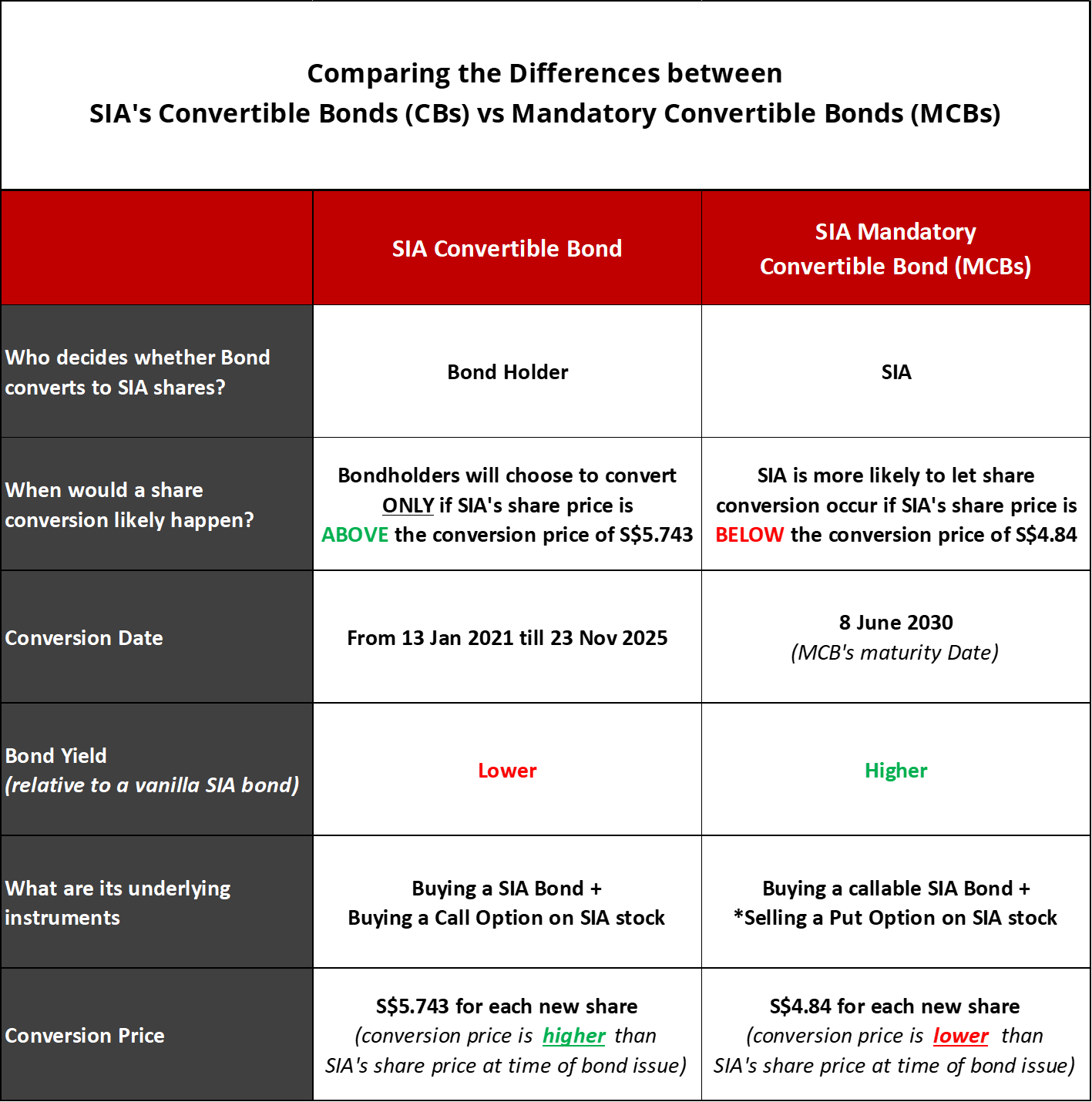
*The put option will “knock out”, if the MCB is called back by SIA prior to the maturity date.
In summary, CBs and MCBs are really different. While both may be potentially converted to shares, the scenarios that would result in that happening are polar opposites, which is the reason why we believe that there should be negligible impact to MCB bondholders from this new CB issuance. We run through the various scenarios below as illustration:
1. Convertible Bonds (CB):
Share conversion likely If SIA share price increases to above S$5.743, CB owners will benefit from converting the CB into shares (or selling the CB at a high price at that time).
No share conversion If SIA share price remains below S$5.743, you can treat the CB as a bond and simply let it mature.
2. Mandatory Convertible Bonds (MCB):
No share conversion If SIA share price increases, SIA is more likely to call back the MCB and refinance at a cheaper rate. (It is difficult to peg it to a particular share price threshold, so think of it more like a sliding scale, where the probability of redemption increases as share price increases). If there is no share conversion, you can treat the MCB like a callable bond.
Share conversion likely If SIA share price decreases, SIA may decide not to call back the MCB and let it be converted to shares, resulting in a potential principal loss for the investor.
Qn: Would the MCB’s conversion price be adjusted, if the newly issued CBs get converted to SIA shares?
No. If newly issued CBs get converted to SIA shares, the MCBs’ conversion price would not be adjusted.
Some MCB owners may believe that they are protected by anti-stock dilution clauses (where the MCB’s conversion price gets adjusted lower) – these clauses don’t apply for this CB’s issuance. Anti-stock dilution clauses only kicks in if new SIA shares are issued at less than 90% of the market price, at time of the CB issuance (see page 30 of MCB’s offering documents). For this newly issued CB, the conversion price is 45.8% above SIA’s market price at the time of CB issuance and hence, there will be no adjustment to the MCB’s conversion price.
Nonetheless, from the perspective of a MCB owner, we are not concerned about share dilution from CBs for two reasons.
If CBs get converted to shares, it implies that SIA’s share price is above S$5.743. In this case, it is highly likely that the MCBs would be redeemed early.
Even if the MCBs do not get redeemed when SIA’s share price is above S$5.743, it is positive for MCB holders as they have a potential chance to convert their MCBs into shares at a lower price of S$4.84.
3) Are SIA’s Convertible Bonds cheap?
In the below image, we have listed all of SIA’s outstanding bonds, including the recently issued convertible bond (in green) and the MCBs (in yellow).
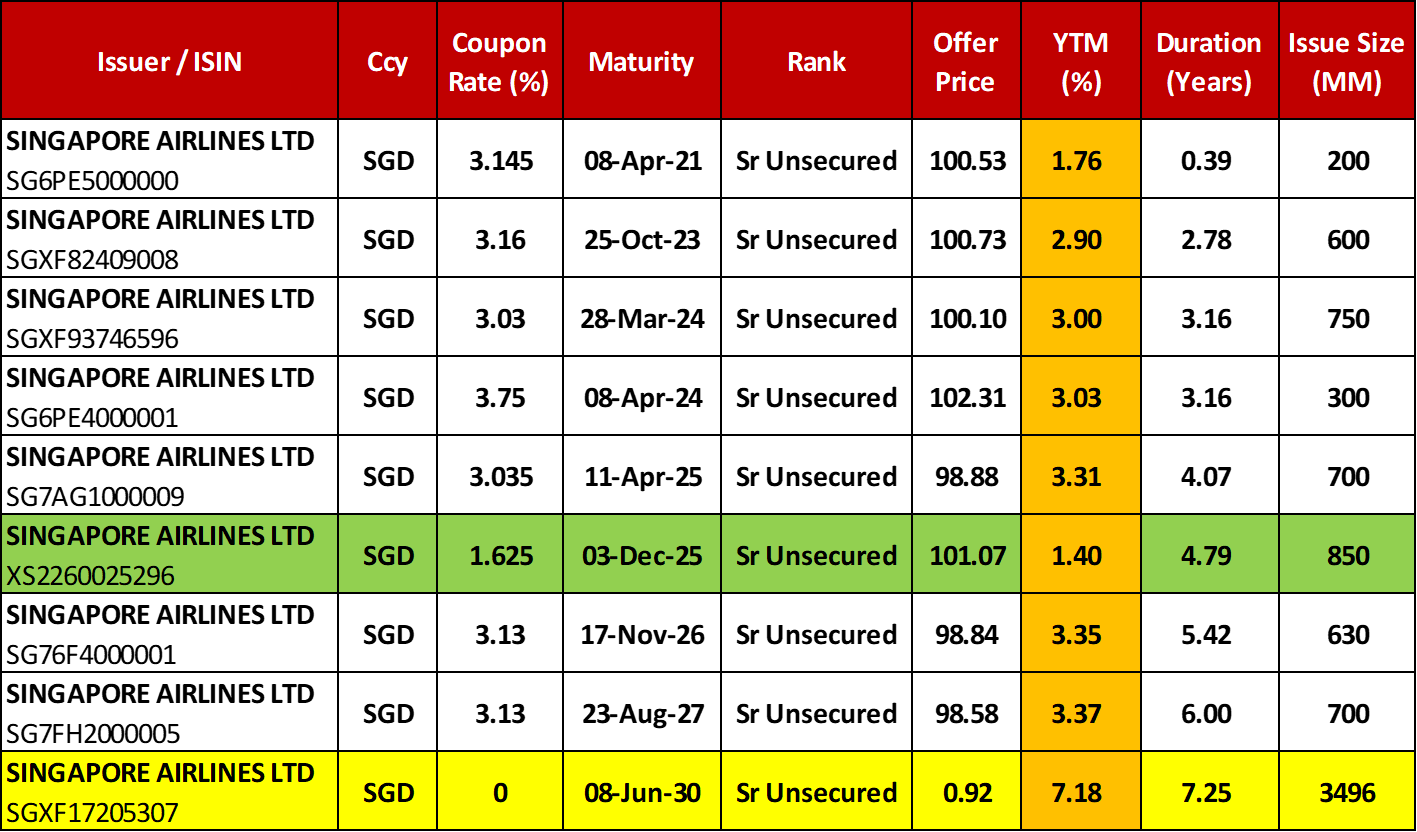
Source: Bloomberg, retrieved 15 November 2020.
For similar bond maturities, SIA’s convertible bonds (green row) yield 1.40% vs 3.35% for SIA’s vanilla bonds (1 row below green row). This is to be expected, as convertible bonds have the extra benefit of being able to be converted into shares, and provide capital upside if SIA’s share price recovers over the next five years.
To determine if the newly issued convertible bond (CB) is cheap, we need to break it up into its components and value them individually. The CB’s two components are:
Buying a Vanilla SIA bond – You RECEIVE a yield, which would be approx 3.35% p.a.
Buying an American-style Call Option on SIA stock, maturing in five years, with a strike price of S$5.743 – You PAY the option premium
In the table above, we had already listed the YTM of the convertible bond (1.40%), and the YTM of a vanilla SIA bond (3.35%). The yield difference between the two (1.95%) is the implied annualized cost that an investor is paying for the embedded SIA call option.
If we believe that the value of this SIA call option is worth more than 1.95% p.a., it would imply that the Convertible Bond is relatively cheap.
What is the fair value of the embedded call option?
We have attempted to estimate the value of the embedded call option using a Black Scholes calculator, using the same option terms underlying the SIA convertible bond, at varying levels of implied stock volatilities. The results may be found in the table below.
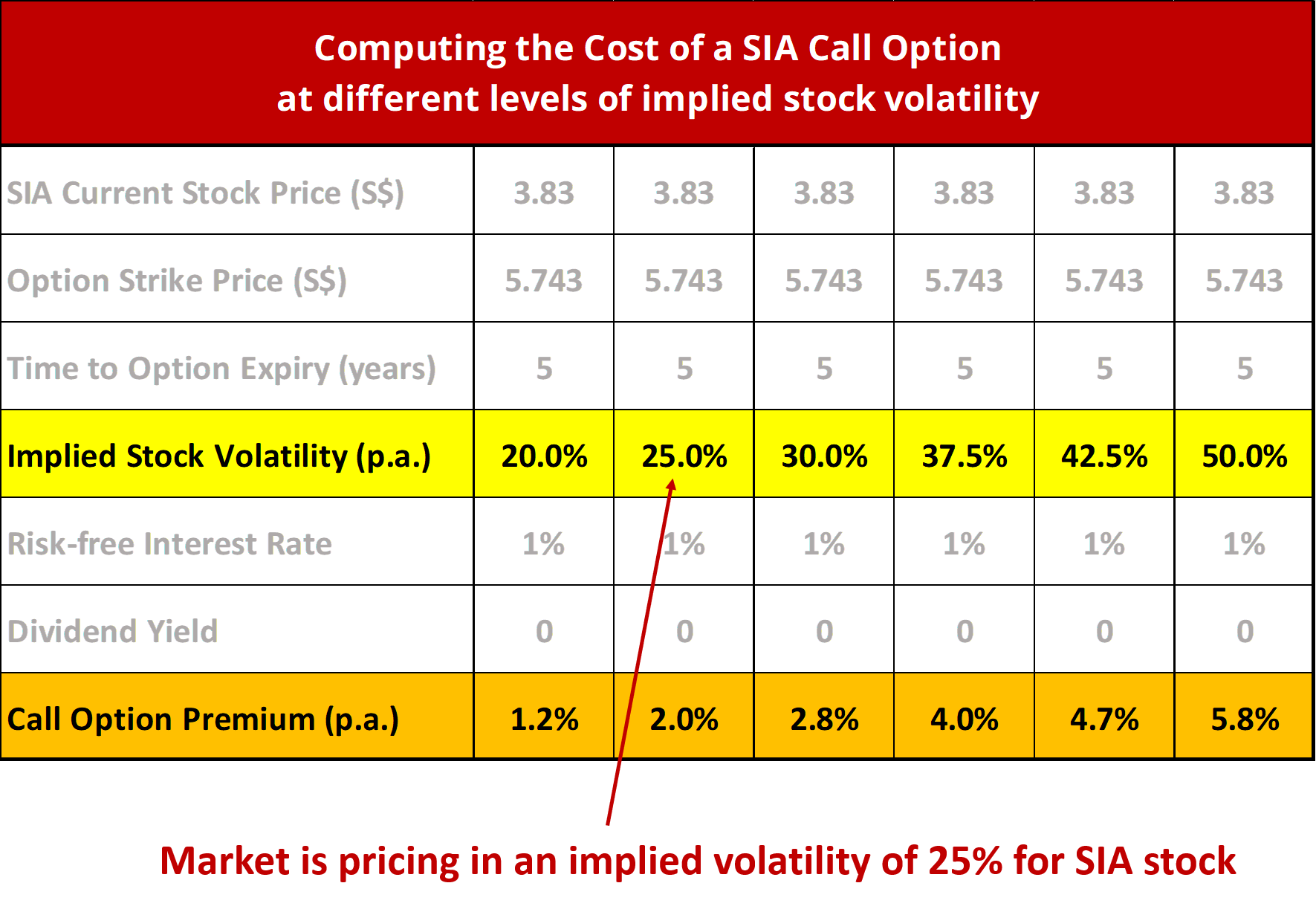
Source: IQ estimates, Black Scholes Options Calculator retrieved from https://goodcalculators.com/black-scholes-calculator/
At 1.95% p.a. call option premium, the market is implying that the forward-looking annualized volatility for SIA stock would be around 25% (see red arrow in picture above). For context, the historical 10-year annualized volatility and past 1-year annualized volatility for SIA shares is 18.4% and 37.5% respectively.
It’s largely gut feel but I believe 25% implied volatility is on the low side for SIA shares, given the current climate. If this is true, it means that the call option premium should cost more than 1.95% p.a., and that there is still some room for price appreciation for SIA’s newly issued convertible bond.
Disclaimer: Black Scholes is used to price European-style options, while the embedded call option is actually closer to an American-style. However, we chose to use it for convenience and to add some conservativeness, as European-style options should trade at or below the value of American-style options.
The InvestQuest View:
Impact on SIA shareholders: Mildly negative.
- If SIA share prices recover strongly over the next five years, the newly issued convertible bonds (CB) will likely be converted to SIA shares, diluting existing SIA shareholders.
Impact on SIA MCB bondholders: Negligible impact.
If SIA share prices recover strongly, SIA would most likely redeem the MCBs prior to maturity and refinance at a cheaper cost of capital. This result would leave MCB owners largely indifferent.
If SIA share prices stay weak, the newly issued CBs would not be converted to shares and function like a vanilla SIA bond. Again, this result would leave MCB owners largely indifferent.
Comments
5720
0
ABOUT ME
Level up your investment knowledge with us!
5720
0
Advertisement
No comments yet.
Be the first to share your thoughts!