Advertisement


OPINIONS
Should You Split Bills 50/50 If You Earn More Than Your Partner?
Fair doesn’t always mean equal, the healthiest couples find a balance that works for both their hearts and their wallets
This post was originally posted on Planner Bee.
In a perfect world, love would be all you need in a relationship. But in the real world, especially when two adults are trying to navigate rent, groceries, insurance, and lifestyle choices together, money matters. If you earn more than your partner, or they earn much more than you, you might have faced a common but tricky question: should couples with different incomes still split everything 50/50?
This usually comes up when things start getting more serious. Maybe you’re moving in together, saving for a home, or just trying to figure out who pays for what. On the surface, splitting things equally sounds fair. But when your incomes are quite different, it might not feel that way.
Here’s a closer look at how many modern couples are managing money, especially when their earnings don’t match, and how to find an approach that suits both your relationship and your finances.
Is splitting 50/50 always fair?
At first glance, splitting everything 50/50 seems like the most straightforward and fair way to go. Each partner pays the same dollar amount for shared expenses, whether it’s rent, bills, or that trip to Bali.
But fairness isn’t always about paying the same number. If one person earns much less, a 50/50 split can feel like a bigger burden. For example, someone earning $2,500 a month might struggle if $1,250 goes towards rent. But for someone earning $8,000, that same amount may feel far more manageable.
This is where the difference between equality and equity matters:
- Equality means both contribute the same amount.
- Equity means each contributes in line with what they earn, recognising that not everyone has the same financial capacity.
In many cases, equity-based arrangements can lead to a more balanced and sustainable financial relationship.
Common ways couples manage shared finances
When you and your partner bring in different incomes, it helps to align on a framework for managing shared expenses. Here are some of the most common financial arrangements couples use, especially in dual-income households:
1. 50/50 split
Each person pays half of all joint expenses, regardless of income.
Best for: Couples with similar earnings or where both feel comfortable contributing the same amount.
Example: If monthly rent is $2,400, each partner pays $1,200.
2. Proportional contribution
Each person contributes a percentage of their income toward shared expenses. The higher earner pays more, but the financial impact is more evenly distributed.
Best for: Couples with a significant income gap who still want shared responsibility.
Example: If Partner A earns $3,000 and Partner B earns $6,000, and they agree to contribute 50% of their income, they would contribute $1,500 and $3,000 respectively.
3. Shared pool
Both incomes go into a single shared account that’s used for all household expenses. Some couples add a personal allowance for discretionary spending.
Best for: Long-term or married couples with joint financial goals and high trust.
Variation: Some couples combine only a portion of their incomes for shared costs, while keeping the rest in individual accounts.
4. Split by type of expense
Instead of contributing the same percentage or amount, partners divide financial responsibilities based on preference or practicality.
Best for: Couples who want to retain some independence but still share costs.
Example: One partner pays for housing, the other handles groceries, bills, and outings.
5. Separate finances
Each partner pays for their own expenses. Shared costs are settled as they arise, often split ad hoc or tracked using apps like Splitwise.
Best for: Couples in earlier stages of the relationship or those who strongly value financial independence.
Read more: Managing Money as a Couple
Pros and cons of each setup
Here’s a quick comparison of each financial arrangement:
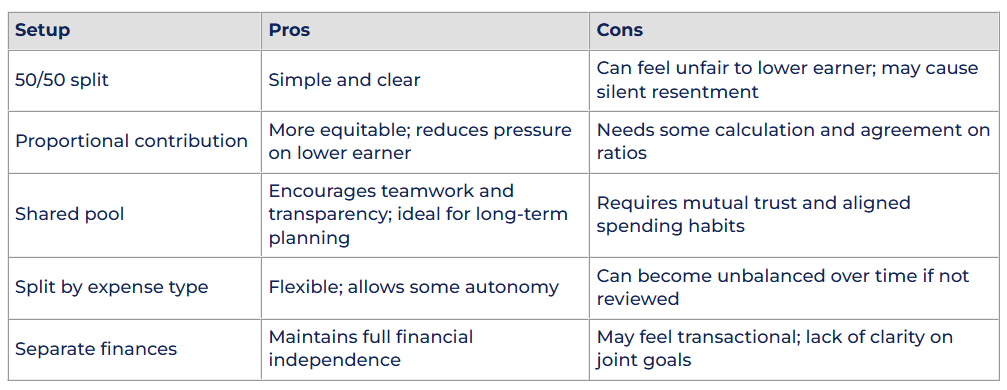
Read more: 8 Financial Red Flags To Look Out for in a Partner
How to choose the right setup?
There’s no one-size-fits-all solution. The best approach depends on your lifestyle, how you communicate, and what you’re working towards as a couple. These questions can help you decide:
- Are you saving for something together, like a house or a wedding?
- Do you have similar spending habits, or are they quite different?
- Do you prefer financial independence or shared responsibility?
- Would one of you feel pressured or resentful with a 50/50 split?
If you’re unsure where to begin, consider a proportional split. It’s a good middle ground: fair, flexible, and often better suited to couples with unequal incomes.
Read more: Money and Love Languages: Understanding Your Partner’s Financial Style
Why communication matters more than any formula
Budgeting apps and spreadsheets are useful, but they’re not enough on their own. What really keeps things on track is clear, regular communication.
This doesn’t mean holding a formal finance meeting every month. Just make space now and then to check in on money matters, especially if incomes or priorities have changed.
Things to discuss:
- What does “fair” mean to each of you?
- Are you saving for shared goals like travel, a home, or children?
- How do you want to split day-to-day and larger costs?
- What kind of lifestyle are you both comfortable with, and can you both afford it?
You don’t have to agree on every detail. The key is understanding each other’s perspective and finding a system that feels right for both of you.
Read more: Practical Ways for Couples To Set Financial Goals Together
Tips for talking about money (without killing the romance)
Let’s face it, money chats can feel awkward, especially early on. But your financial habits will affect your day-to-day life together, so it’s worth having the conversation.
Here are a few ways to make it easier:
1. Normalise the conversation
Start small. Talk about shared bills or future plans before diving into income or debt. Make money part of everyday life, not something off-limits.
2. Use “we” language
Say “our bills” instead of “your rent” or “my groceries”. It sets the tone for teamwork, not blame.
3. Be open, not judgemental
Be honest about what you earn, owe, or hope to save, but avoid comparisons or criticism. It’s about building trust, not keeping score.
4. Keep it practical
Use tools like budgeting apps or spreadsheets to help focus the conversation. That way, it’s less about emotion and more about planning.
5. Review regularly
Life changes over time with new jobs, promotions, bills, or unexpected costs. Check in on your setup every few months to make sure it still works.
Money can be one of the harder things to manage in a relationship. It’s not just about the numbers, but what they represent. When one person earns more, guilt or frustration can easily creep in. A thoughtful setup can help ease that tension.
Fair doesn’t always mean equal. A strong financial partnership isn’t about splitting everything down the middle. It’s about building a life you can both afford and enjoy together.
Comments
65
26
ABOUT ME
Your Personal Mobile Financial Advisor Application Join us at telegram! https://t.me/plannerbee
65
26
Advertisement
No comments yet.
Be the first to share your thoughts!