Advertisement


OPINIONS
Should You Plan Your Parents’ Funeral?
Planning a funeral early helps reduce stress, avoid conflict, and ensure your parents’ wishes are respected.
This post was originally posted on Planner Bee.
Talking about death is hard. Talking about our parents’ deaths is even harder.
Funeral planning is often left unspoken until it suddenly becomes urgent. Many avoid the topic out of fear, guilt, superstition, or simply because they do not know where to start.
Yet the reality remains: Someone will eventually need to plan, pay for, and manage every detail of the funeral. If not now, then when?
Why do so few people plan ahead?
Let’s look at what often stops us.
1. Death is taboo in Asian culture
In many Chinese, Malay, and Indian households, discussing death is considered bad luck. It can feel disrespectful or even unfilial. Some worry that talking about it might hasten a parent’s passing.
“Don’t say such things!” is a common response when adult children bring up funeral planning.
But avoiding the topic often leaves families to chance, or, worse, conflict.
2. It feels too soon
You might think, “My parents are healthy. Isn’t it too early?” or “We’ll deal with it when the time comes.”
Yet age and health do not always predict timing. Sudden illness, accidents, or unexpected diagnoses can happen. Planning ahead ensures decisions are made thoughtfully, not in a rush.
3. We assume someone else will handle the situation
Many people believe funeral planning is a tradition passed down through families. Modern families are often smaller, more diverse in religion, and busier than ever. Without prior planning, you may be left guessing what your parents would have wanted.
What happens if no one plans?
Imagine a parent dies suddenly. You and your siblings are grieving but must make immediate decisions. Within hours, you may need to:
- Decide between burial or cremation
- Select a funeral provider
- Find a location for the wake (HDB void deck, funeral parlour, or temple)
- Engage religious personnel (Taoist priest, pastor, or monk)
- Pay deposits (often S$2,000 to S$5,000 upfront)
- Register the death and apply for permits
All this happens while managing hospitals, relatives, work, and your own emotions.
Without a plan, you risk:
- Disagreements about the funeral style or budget
- Overspending due to emotional decisions
- Delays in coordinating logistics
- Guilt over not honouring your parent’s wishes because no one knows them
Misconceptions that delay planning
Planning ahead does not mean deciding every detail now. It means addressing myths that give false confidence.
“Can’t we use Medisave for funerals?”
No. Medisave cannot be used for funerals. It covers approved medical treatments during life. After death, any remaining funds go to your CPF account and nominees, or the Public Trustee if there is no nomination.
“My parents have insurance, so it’s fine.”
Insurance can help, but payouts are rarely immediate. You still need to pay the funeral provider upfront. Not all policies cover death benefits, and disbursement speed varies. Speak to your insurer or financial advisor about policies that offer immediate funeral payouts or living benefits for terminal illness.
“Funerals are cheap unless you go all out.”
Even a modest three-day wake in Singapore can cost S$5,000 to S$7,000. Extras like catering, video montages, or obituaries increase the cost. Religious or elaborate ceremonies can exceed S$15,000.
Read more: Financial Planning While Supporting Elderly Parents
What funeral planning actually means
Funeral planning does not mean buying a coffin today. It simply means being prepared. Think of it in two parts:
1. Financial preparation
- Budget realistically: Know what funerals cost in Singapore for your faith or cultural background.
- Set aside a fund: Some families keep a “bereavement buffer” of S$5,000 to S$10,000 per parent.
- Consider a joint savings or trust account: Siblings can agree to contribute a small monthly amount to share the cost.
2. Preference mapping:
- Would they prefer cremation or burial?
- Do they want a religious ceremony?
- Which funeral provider do they prefer?
- Are there specific songs, readings, or rituals they want included?
You can record these preferences in a shared Google Doc, or keep them with their will or estate plan.
Read more: Making a Will: What Is It, Why Is It Important, and What Happens When You Die
Who usually pays for the funeral?
There is no fixed rule, but in Singapore, common arrangements include:
Elderly parent pays in advance
Some seniors prepay for funeral services through providers such as Nirvana Memorial Garden or Singapore Casket. These packages often include everything from the casket to catering. Prepayment removes the burden from children but may be expensive or unsuitable for some families.
Children split the cost
Siblings often share the expenses. Disputes can arise if:
- There is a large income difference.
- One sibling lives overseas.
- One party refuses to contribute.
Clarifying contributions early helps prevent conflict.
One sibling pays first
Sometimes one child covers the cost initially and settles with others later. This can be efficient but may cause tension if reimbursement is delayed or resisted.
Tools and resources to help you plan ahead
Many resources exist, but most people only use them when it is too late. Here is a quick guide:
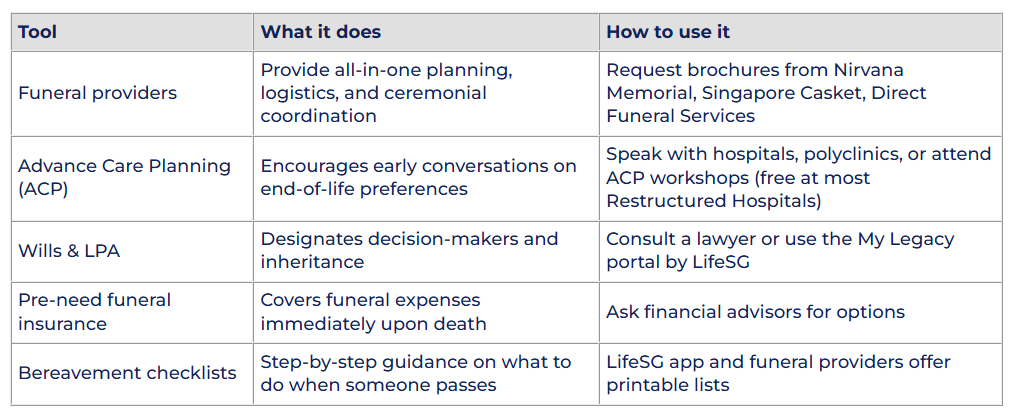
Pro tip: Keep soft copies of your parents’ identification, medical history, CPF nominations, and insurance details in a secure, shared family folder.
Read more: How To Make a Nomination for Your Life Insurance in Singapore
When should you start planning?
The best time to start is before it becomes urgent. Consider beginning when:
- Your parents are still healthy and mentally sound.
- You start estate planning or setting financial goals.
- You notice a sibling raising similar concerns.
Make it a gradual process. Have one conversation at a time.
Planning your parents’ funeral is not morbid. It is practical, responsible, and, above all, kind. When the time comes, you will be grieving. You will want to focus on remembering them, not rushing to compare coffin prices or argue over wake venues.
Think of funeral planning as a final act of respect, not for yourself, but for the people who raised you. Talk, plan, and share the burden.
Read more: Legacy Planning: How To Build and Protect Your Legacy
Comments
9
5
ABOUT ME
Your Personal Mobile Financial Advisor Application Join us at telegram! https://t.me/plannerbee
9
5
Advertisement
No comments yet.
Be the first to share your thoughts!