Advertisement


OPINIONS
Shares Collapsed 46% Since 2015. Is Singtel Such a Lousy Stock?
I've found myself figuring out about Singtel (SGX:Z74) and its massive price drop. Here's what you exactly need to know.
Dividend Titan
15 Apr 2021
Founder at Dividend Titan
This article originally appeared on Dividend Titan's Weekly Wealth** __(__Email Newsletter).**
I’ve found myself struggling to answer this — “Is Singtel such a lousy stock?” When a friend asked me two weeks ago.
I wrote my thoughts down.
Nowadays, we hear the media talking about 5G, or fifth-generation wireless technology.
5G is the stuff that promises huge surfing speed 20x faster than our current 4G networks.
This will help boost the connection between devices -- in self-driving cars, “internet of things”, artificial intelligence, and our smartphones.
It’s the very same stuff that Singtel (SGX:Z74) has won the license to sell.
And Singtel has to roll out the 5G network across half the island by the end of 2022.
Full coverage by the end of 2025.
Normally, when Singtel bags a big license like this, you know there’s a huge growth opportunity.
You’d expect to see soaring revenues. You’d expect to see rising profits and more importantly, collect growing dividends as a shareholder.
But that’s not the case here.
The ugly truth about Singtel
Spectrum auctions impose a huge cost on Singtel — 5G actually requires more infrastructure investments than legacy 3G and 4G networks.
Spectrum auction is how governments allocate rights to sell data signals to telco providers. In this case, Singtel is one of the two winners who can sell 5G data signals here.
And the result is an obsessive drive to charge consumers and companies higher.
But the thing is, at the same time, Singtel faces an economic challenge.
That it’s not possible to raise 5G data prices indefinitely. In other words, Singtel is a price-taker.
Think about it, even when 5G comes, what’s stopping you from switching to another cheaper telco? Nothing.
Over time, intense competition will _simply _force Singtel to lower their data plan prices. We see this happening with previous 3G, 4G rollouts. Data gets cheaper over time.
For me, Singtel is essentially a “commodity” business.
To be fair, of course, not all commodity businesses are bad.
And this intense competition is the chief threat Singtel is facing.
You see, like dealing with Singapore’s low fertility rate, our government is not stopping at three.
In 2016, TPG Telecom, an Australian telco operator became the fourth telecom operator here. Then, came along with Circles.Life and MyRepublic.
The entire telco landcape was wrecked the moment new players came in — competing in a small domestic market (I admit, this was something I sorely missed out).
Look, no matter how great your services are, the telco business is dead simple.
The government controls the number of telco licenses. So you know how many players can be in the industry — you predict how much data you sell, how much you charge to customers and how many of telco plans you can sell.
Then factor in costs, including licensing fees. Work out the profits.
You see, Singapore is just a tiny 5.7 million people island city. This is so much different than the U.S., China and Japan, where populations are much bigger.
Unlike other telcos elsewhere, Singtel has to fight it out with many players for a ridiculously small market.
Singtel by the financial numbers
In its latest third quarter financial results, Singtel’s total revenues fell 5.9% to S$4.2 billion, while operating profits sunk 39% to S$328 million. Both Australia and Singapore segments were down 8% and 11% respectively.
All due to intense competition in Singtel’s roaming and prepaid mobile businesses.
What made Singtel’s business worse was the _massive _write-down of S$2 billion from its India associate — Bharti Airtel.
This major Indian telco was hit with a huge levy by the Indian government on spectrum charges.
Because of this, in its financial year ending March 2020, Singtel’s net profits fell a shocking 65% to S$1 billion.
Singtel used to be a dividend darling. Since 2010, Singtel grew its dividends from 14.2 cents to 17.5 cents in 2019. But, for its full financial year March 2020, it lowered dividends to 12.25 cents per share because of its Indian subsidiary write-off.
Now, Singtel is expecting to pay a paltry dividend of 5.1 cents per share for its full year March 2021 results. Singtel shares work out to be around 2% dividend yield today.
Its dividends are cut, shares sunk 46% to S$2.46 since 2015. At one point, shares traded at a peak of S$4.46.
It’s going to take more than just 5G to pull this telco giant back on track.
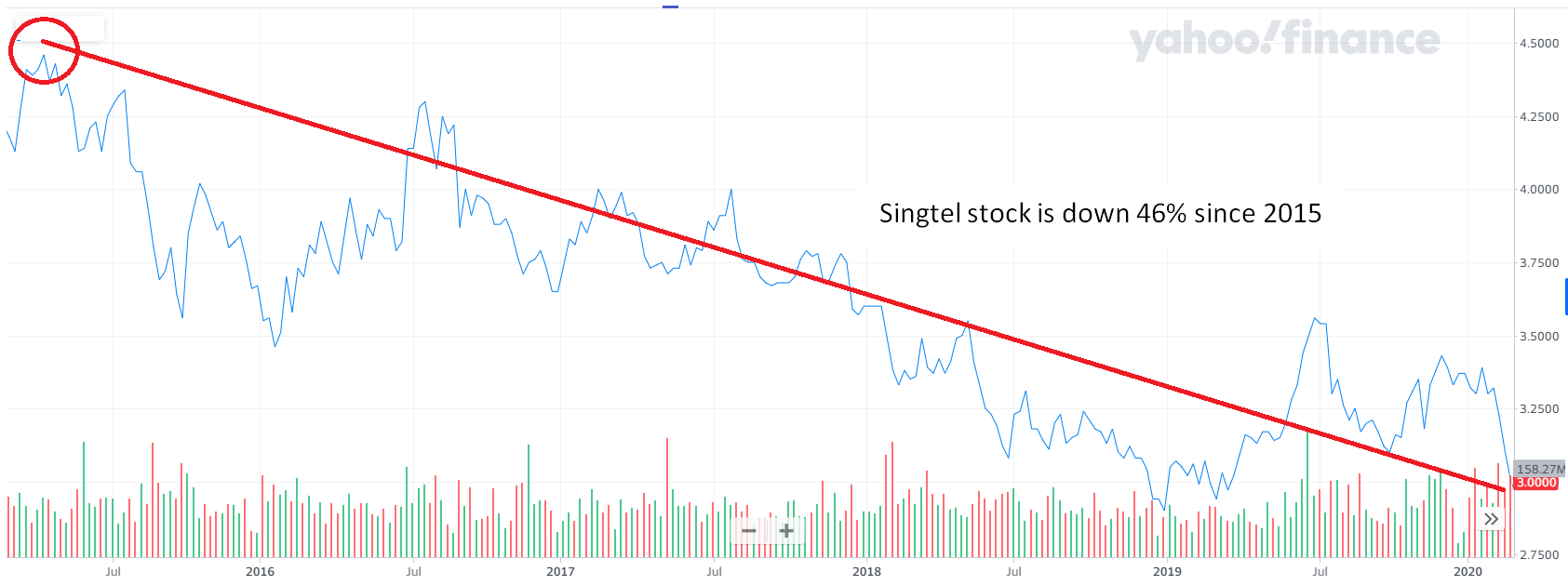
Source: Yahoo! Finance
Zombie companies are 'dead fish' in the waters
They say commodity businesses are like 'dead fish' in the waters.
But I think Singtel is far from being in financial trouble. Singtel simply can’t grope in the dark and buy loss-making acquisitions. It’s going to cost more than what their company is worth. This is what filled the investing graveyard.
In my opinion, what this company needs is to rethink its overseas strategy.
Because that’s where I expect its future growth.
Sometimes, investing can be simple.
Always here for you,
Willie Keng, CFA
Founder, Dividend Titan
Editor’s Notes: I invite you to join our growing community simply by subscribing for our completely FREE email list. In it, you’ll received some of our best ideas about how to protect and grow your wealth safely.
Comments
1396
3
ABOUT ME
Dividend Titan
15 Apr 2021
Founder at Dividend Titan
Dividend Titan (www.dividendtitan.com) is a financial publication helping investors grow their wealth safely for retirement.
1396
3
Advertisement
No comments yet.
Be the first to share your thoughts!