Advertisement


OPINIONS
S-REITs are down 7% from January highs, should you be buying now?
We list the REITs with the highest implied upside (according to analyst consensus)
This article originated from The InvestQuest.
For real-time updates, do join our:
Telegram Group Chat: Search for “The InvestQuest”
Whatsapp Broadcast: Just send “Hello IQ” to 8840 2520
Facebook Page: Press “Follow” at The InvestQuest Facebook

This is Part 2 of our series on rising govt bond yields.
In Part 1, we had analyzed five past instances of short-term US Treasury yield spikes and its impact on the broader stock market. We ranked the sectors that performed from best to worst on average, and also covered the two criteria that typically results in positive stock returns, during a rising yield environment.
Article Summary
Prior yield spikes and corresponding S-REIT sector performance
S-REIT sector valuations relative to history
Which S-REITs are analysts most bullish about?
The InvestQuest View
Historically, S-REITs have underperformed the STI Index during periods of yield spikes, and outperformed the STI Index in the months after the yield spikes. For the current episode, the S-REIT sector has underperformed the STI Index by 18%, significantly more than past episodes.
This potentially opens up an opportunity for a convergence trade, which could materialize in the short-term if rate volatility subsides.
At the same time, we are cognizant that S-REIT valuations are not cheap from a historical standpoint and so, we retain a neutral longer-term view. Among the large-cap REITs, Ascendas REIT looks fairly interesting to us at this juncture.
Disclaimer: We currently hold shares of Ascendas REIT and may choose to accumulate more going forward. As always, our articles are meant as a record of our investment journey. It is not intended as investment advice and should not be relied upon as such. Do your own due diligence!
1) Prior yield spikes and corresponding S-REIT sector performance
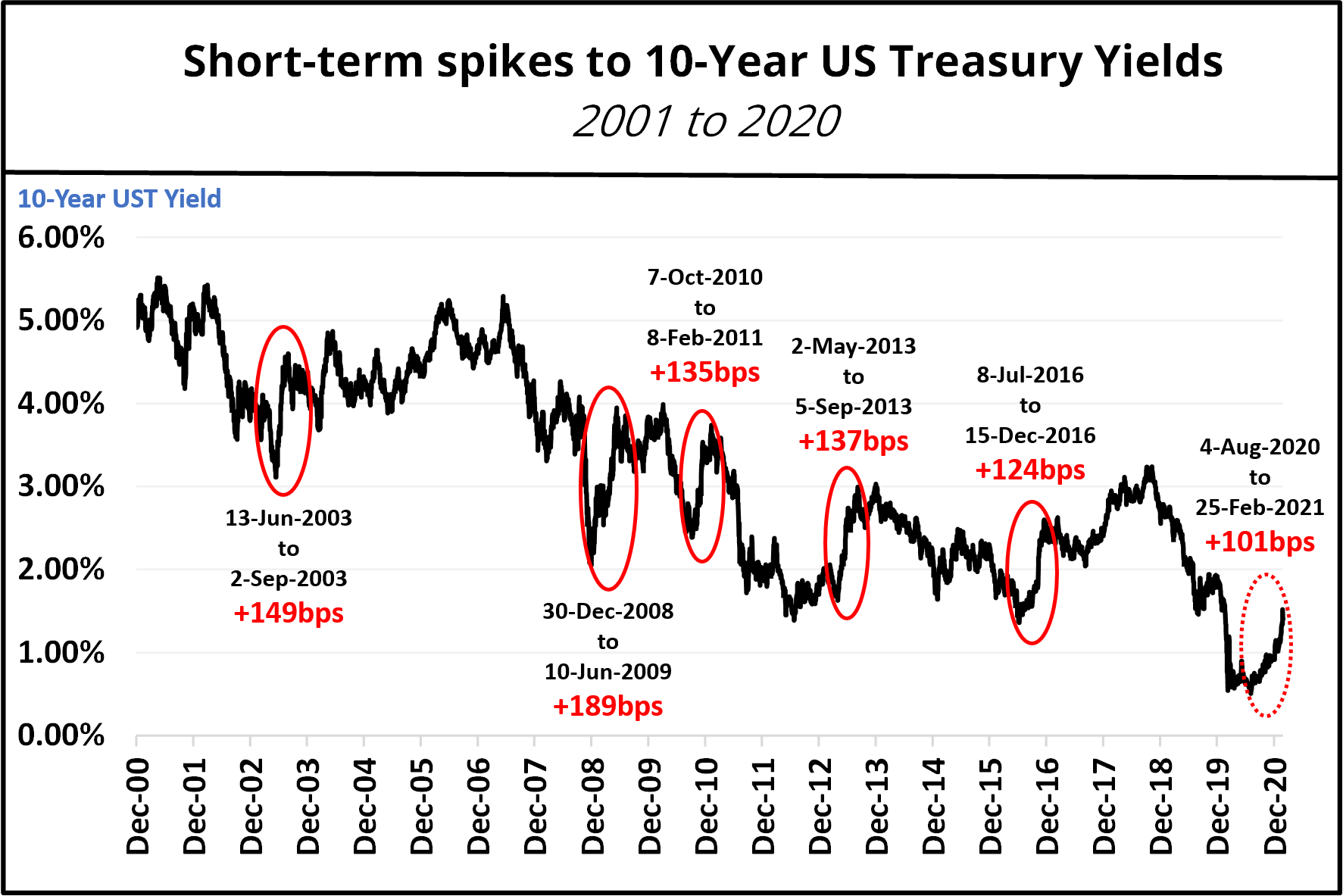
Here are the prior short-term spikes in the US Treasury Yield
Some local investors may be concerned about rising yields, given the potential negative impact on the S-REIT sector. Let’s first see if there’s any truth to such thoughts by looking at historical short-term US Treasury (UST) yield spikes, and the corresponding S-REIT sector performance during these periods.
In the chart below, we plotted the 10-year US Treasury yields since 2001, compiling the dates where there had been a short-term spike in UST yields (circled in red).
Source: Bloomberg, retrieved 28 February 2021
During these yield spikes, what was the return of the STI Index & the FTSE ST REIT Index?
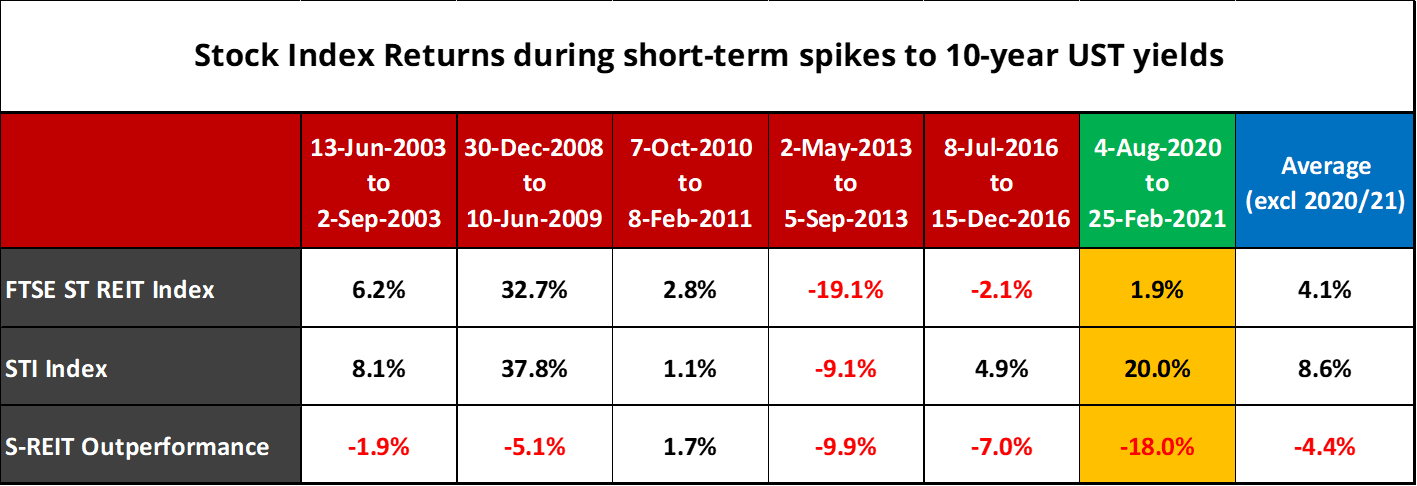
For these date ranges, we calculated the returns of the STI Index and FTSE ST REIT Index (see table below).
On average, the STI Index returned 8.6% and the FTSE ST REIT Index returned 4.1% (rightmost column in below table), implying that S-REITs had underperformed by 4.5% on average. This result is in line with our expectations.
During the most recent UST yield spike, S-REITs have underperformed the STI Index by 18.1%, which is much more than prior instances. This potentially opens up an opportunity for a convergence trade, especially if rate volatility stabilizes from here.
Source: Bloomberg, retrieved 28 February 2021
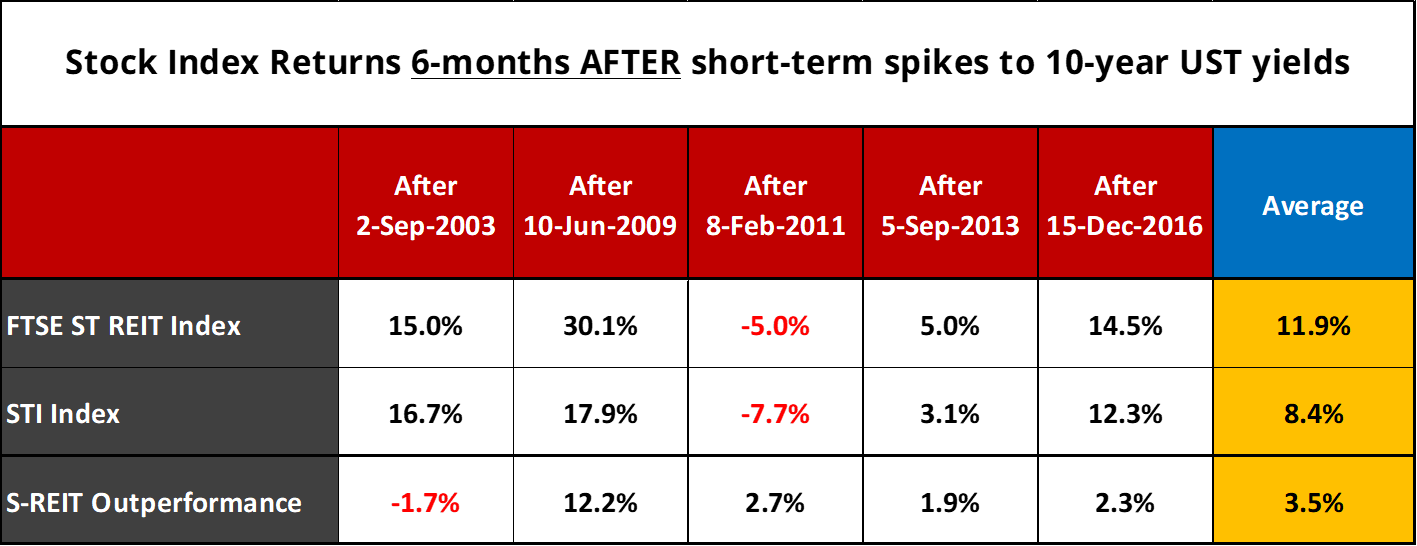
In the 6 months following these yield spikes, what was the return of the STI Index & the FTSE ST REIT Index?
AFTER short-term spikes in 10-year UST yields have occurred, S-REITs outperformed the broader STI Index by an average of 3.5% in the following 6-months. In the rightmost column of the table below, we can see that across the five date ranges, the FTSE ST REIT Index returned an average of 11.9% vs STI Index’s 8.4%.
Source: Bloomberg, retrieved 28 February 2021
No one knows for sure if US Treasury yields will continue rising. However, the magnitude of the recent yield spike is closing in to the largest spikes seen in the last 20 years, so we remain optimistic that rate volatility should subside soon, which could be a short-term positive for S-REITs.
2) S-REIT Sector Valuations relative to History
While S-REITs could potentially narrow its underperformance against the broader STI Index, we acknowledge that valuations for the sector aren’t cheap, so stock selection might be key from here.
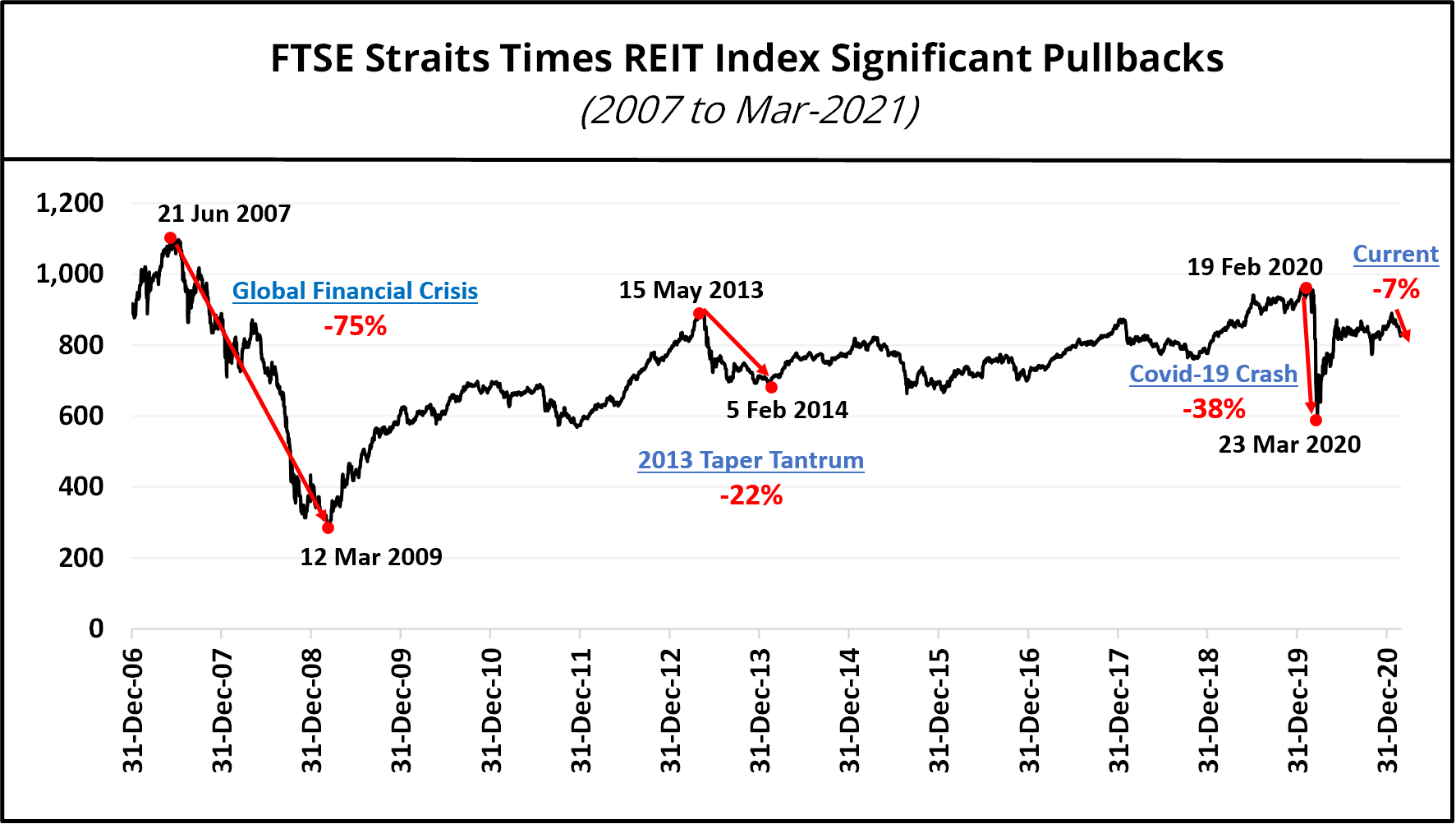
S-REIT sector current pullback vs largest historical declines
The below chart shows the largest declines experienced by the FTSE ST REIT Index since 2007. The recent pullback has been relatively shallow in comparison, at less than half of the 2013 taper tantrum so far.
Source: Bloomberg, retrieved 28 February 2021
Historical Price-to-Book Ratio
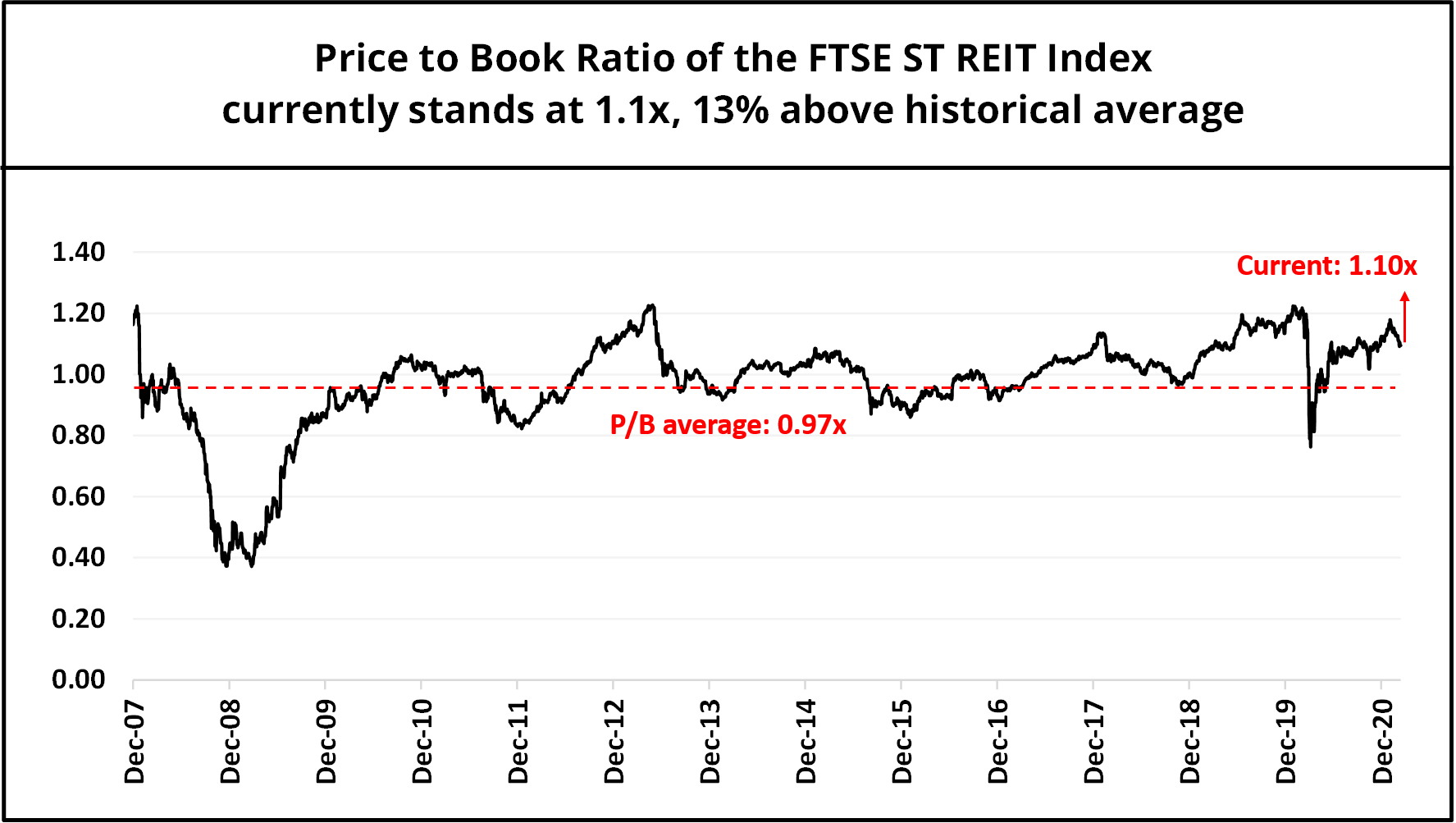
Some investors buy into REITs for the underlying value of the investment properties, hence looking at P/B ratios might be relevant. At a current P/B of 1.10x, the S-REIT sector trades at a 13% premium above the historical 0.97x average (see chart below).
To be fair, this could be justified from a relative value perspective, since broader markets are also trading at a valuation premium given to the sustained low interest rate environment and the increase in market liquidity since pre-Covid.
Source: Bloomberg, retrieved 28 February 2021
Historical Trailing Dividend Yield
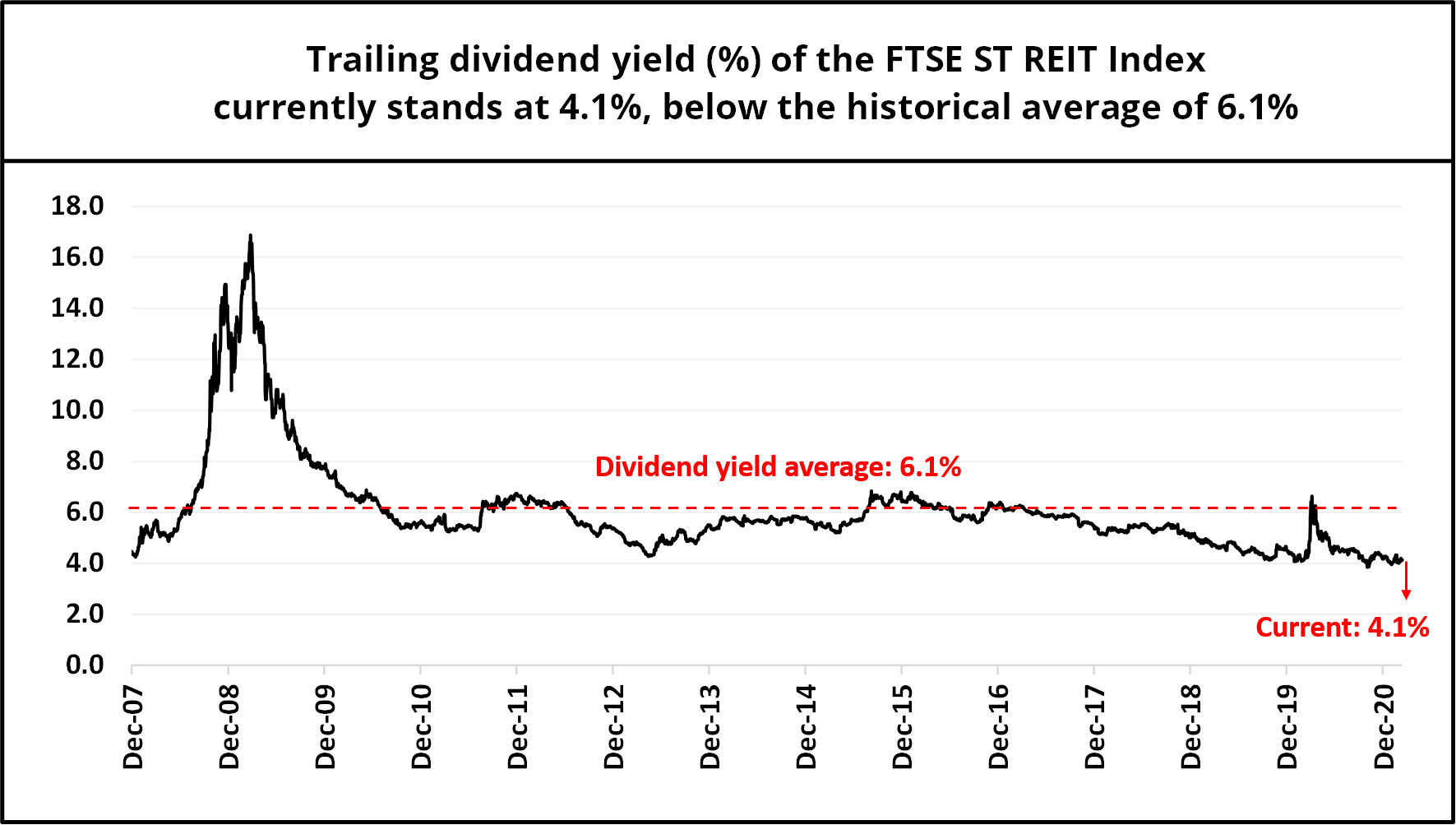
The S-REIT sector trailing dividend yield is currently at 4.1%, below the historical average of 6.1%. Do note that this is backward looking. In 2020, many REITs were impacted from Covid restrictions and some may have also withheld dividend distributions, so we should take the 4.1% figure with a pinch of salt.
However, we would imagine that even with some normalization to operations in 2021, the trailing dividend yield would likely be below the historical average of 6.1% (Dec-2007 to current) or 5.5% (Jan-2011 to current).
Source: Bloomberg, retrieved 28 February 2021
Historical Dividend Yield Spread over 10-year SG Govt Bond Yields
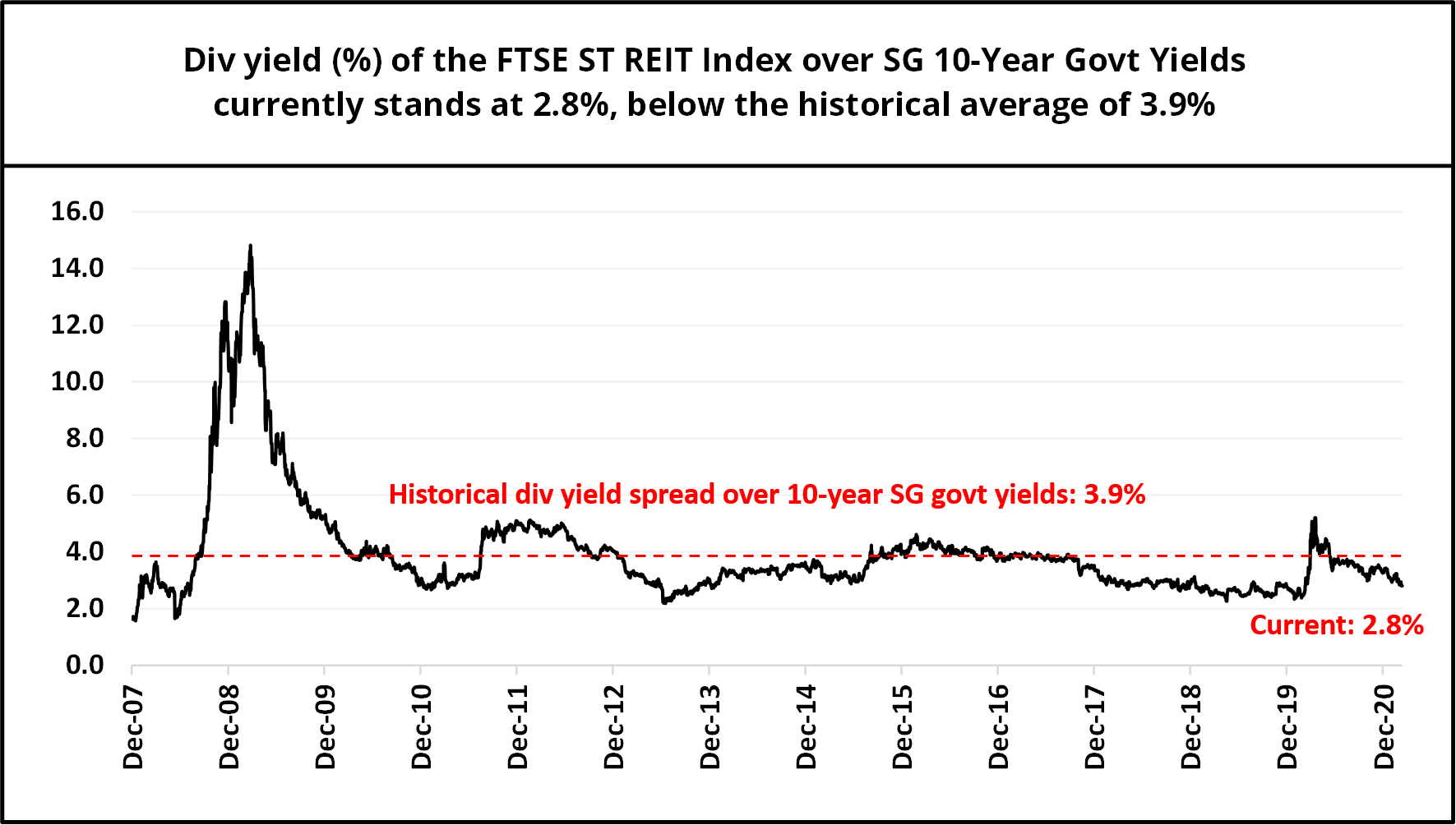
The dividend yield spread is a measure of how much investors are getting in higher returns as compensation for buying REITs (a riskier asset) versus buying the SG government bond (risk-free asset).
Dividend yield spread = Trailing Dividend yield – 10-year Singapore government bond yield.
The dividend yield spread is currently at okay levels of 2.8% versus its historical average of 3.9%, especially once you factor in the depressed dividends for 2020 mentioned earlier.
Source: Bloomberg, retrieved 28 February 2021
4) S-REITs that look interesting to us
Overall, we are neutral on the S-REIT sector. While we think that S-REITs might outperform in the short-term if rate volatility subsides (as mentioned in Section 2), we are also cognizant that the sector isn’t cheap on traditional valuation metrics (as seen in Section 3).
S-REITs ranked by implied upside to analyst consensus target price
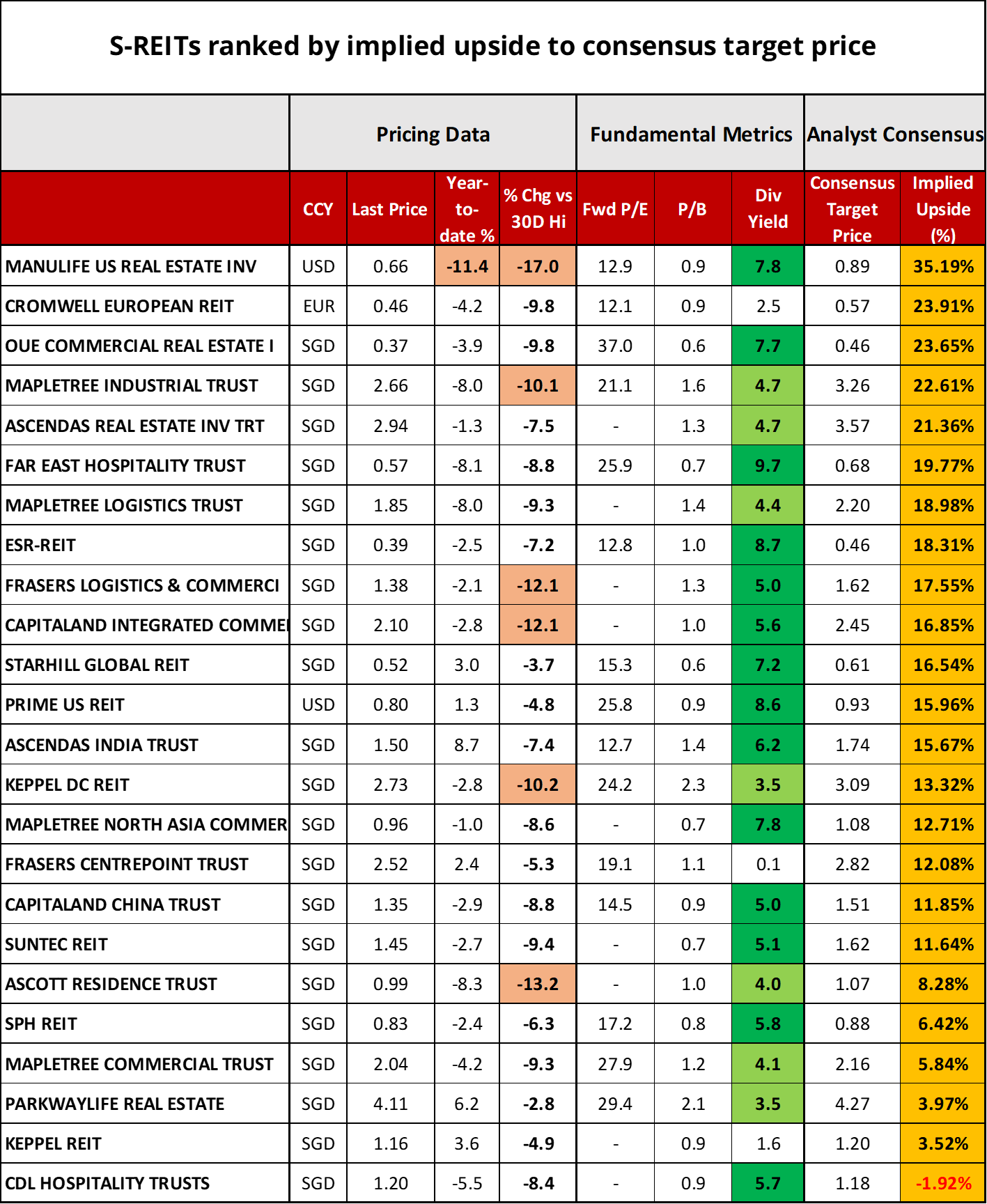
For investors looking for REIT-specific ideas, we have listed all the S-REITs with market caps of over SGD 1bn in the table below. They are sorted by the implied upside to the analyst consensus target price (rightmost column in orange).
Source: Bloomberg, retrieved 28 February 2021
Ascendas REIT looks interesting to us
Ascendas REIT looks quite interesting in our view, since it had recently completed an equity fundraising in Nov-Dec 2020. This was done via a preferential offering and private placement, with new shares being issued at S$2.96 and S$$3.026 respectively. So, you can potentially at buy below these prices which is great.
In addition, the intention to use half of the recently raised capital to purchase a portfolio of European data centres will likely sit well with investors and help support the REIT’s valuations moving forward. For instance, other large-cap Industrial S-REIT peers with more data centre exposure such as Mapletree Industrial Trust and Keppel DC REIT are trading at 1.6x and 2.3x book value respectively, a steep premium to Ascendas REIT’s 1.3x book.
The InvestQuest View
Historically, S-REITs have underperformed the STI Index during periods of yield spikes, and outperformed the STI Index in the months after the yield spikes. For the current episode, the S-REIT sector has underperformed the STI Index by 18%, significantly more than past episodes.
This potentially opens up an opportunity for a convergence trade, which could materialize in the short-term if rate volatility subsides.
At the same time, we are cognizant that S-REIT valuations are not cheap from a historical standpoint and so, we retain a neutral longer-term view. Among the large-cap REITs, Ascendas REIT looks fairly interesting to us at this juncture.
Comments
338
0
ABOUT ME
Level up your investment knowledge with us!
338
0
Advertisement
No comments yet.
Be the first to share your thoughts!