Advertisement


OPINIONS
Portfolio Reviews (February 2024)
Portfolio Review
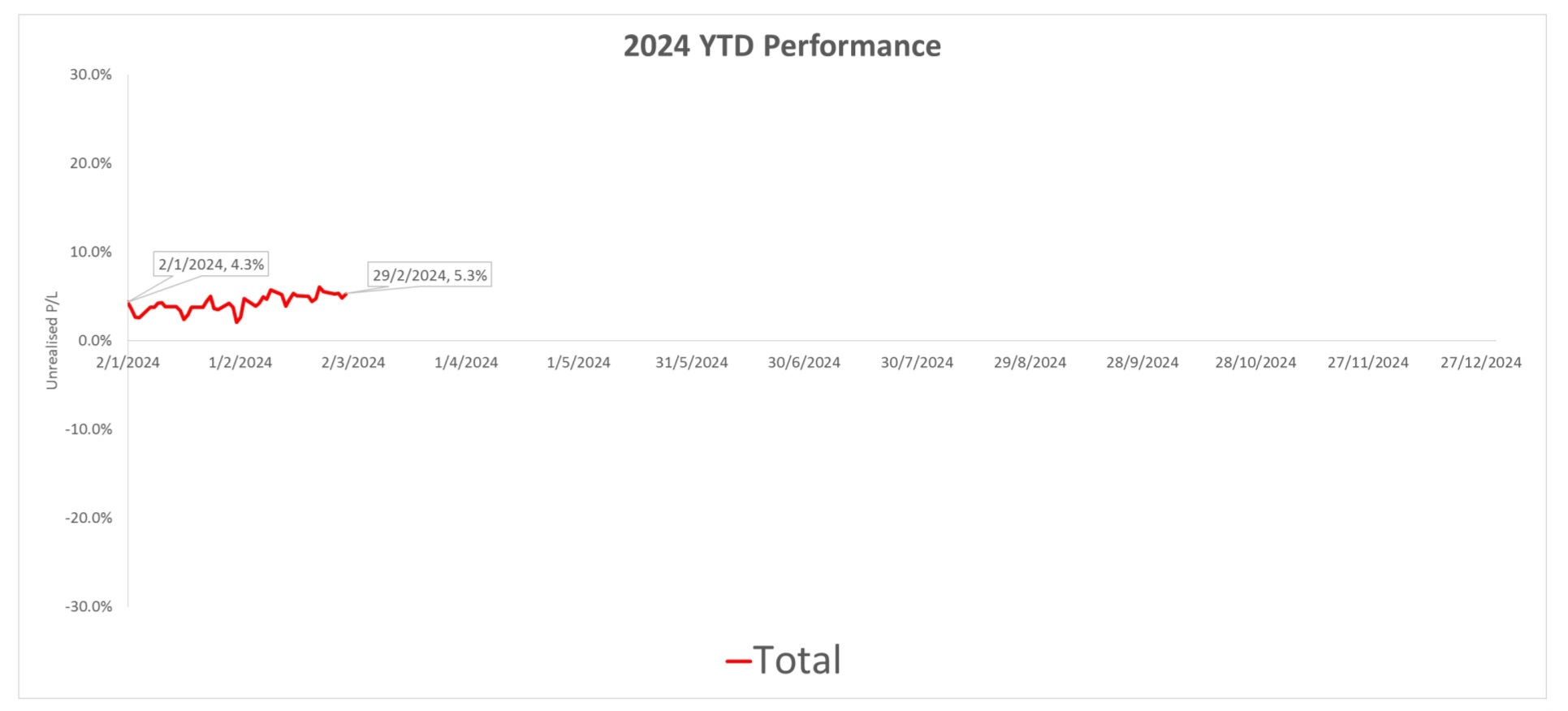
Review of my Portfolio (29/02/2024)
Total unrealized profit: +5.3%
YTD performance: +1.0%
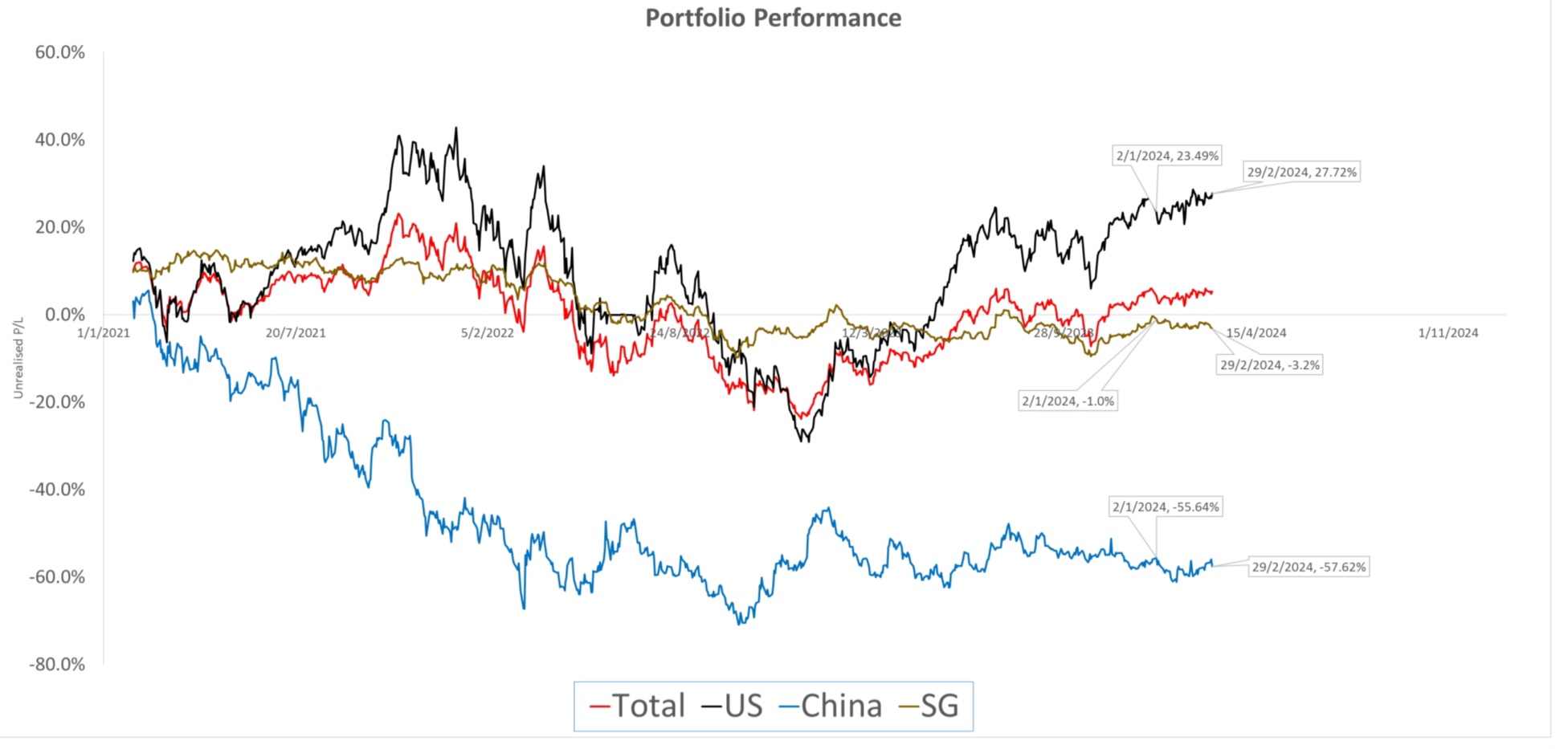
Added in February
Goal 1: ( $11,387.53 / $81,594) ⚔️
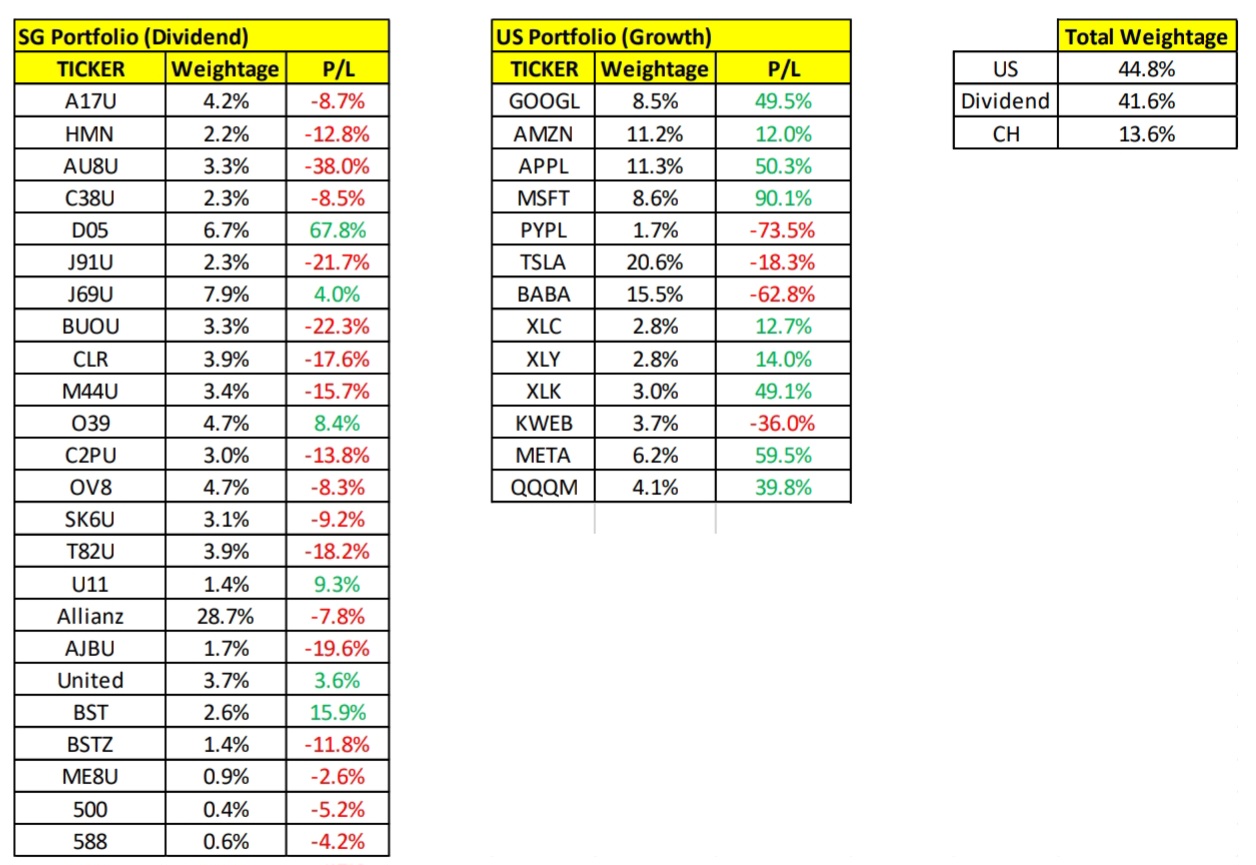
Growth Portfolio: QQQM
Dividend Portfolio: HMN, C2PU, A17U, AU8U, J91U, C38U, SK6U, United global durable Equities
Portfolio Weightage
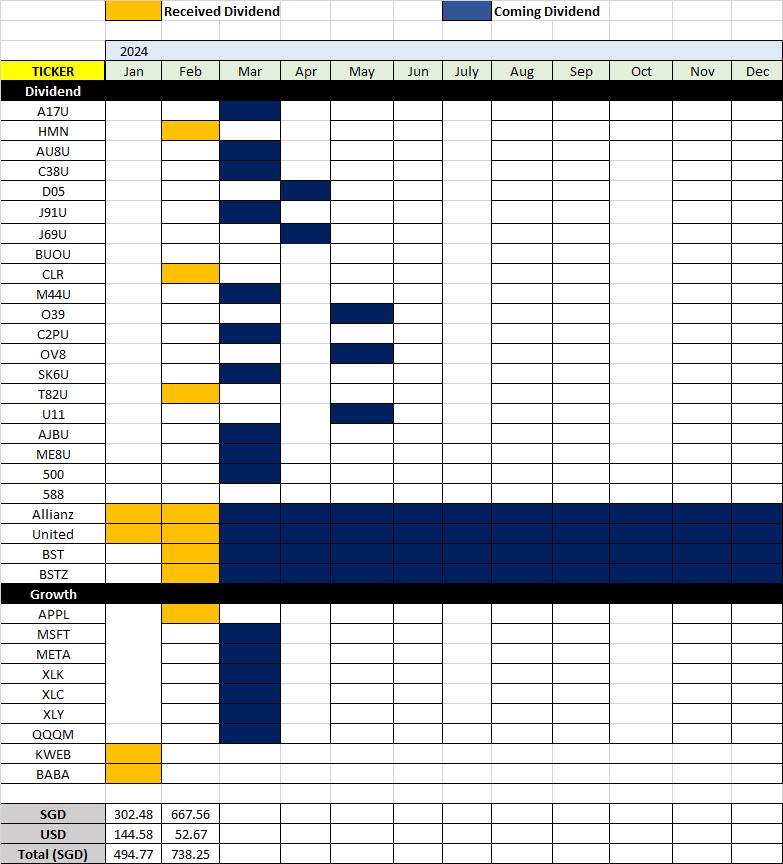
Dividend Recieved
Goal 2: ($1,233.02 / $14,212) ❤️
Dividend recieved in Feb = $738.25
5 Locking Mechanism Keep Us From Financial Freedom
Education System 🔒
- Our entire education system is to help us to write a resume to become a qualified employee.
- The content of our education are similar to our future professions.
- In addition, we are taught to abide the rules and regulations; and obey authority.
- The school cultivates our focus and patience on specific tasks; and the ability to complete tasks within specified time.
- We learn the so-call problem solving ability using established methodology to solve problems which already had an estiblished answers.
- The school's standardized examination is a comprehensive verification of these skills.
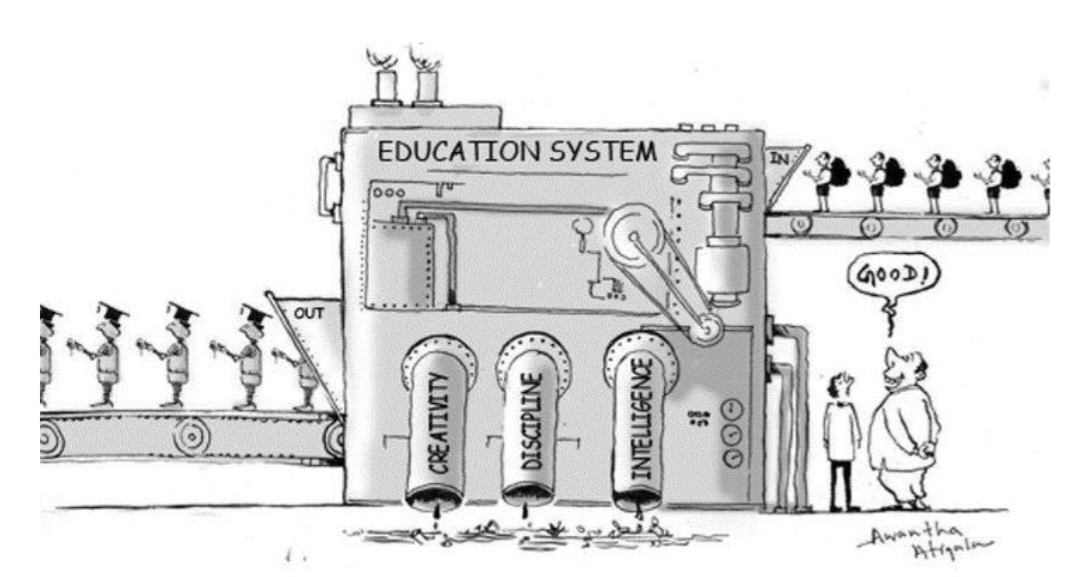
- As the demand for degree increases, universities will lower admissions standards while constantly raising tuition fees and this give an illusion that more people are given a chance to succeed.
- But as more people have a degree, competition become more intense and the cost become higher.
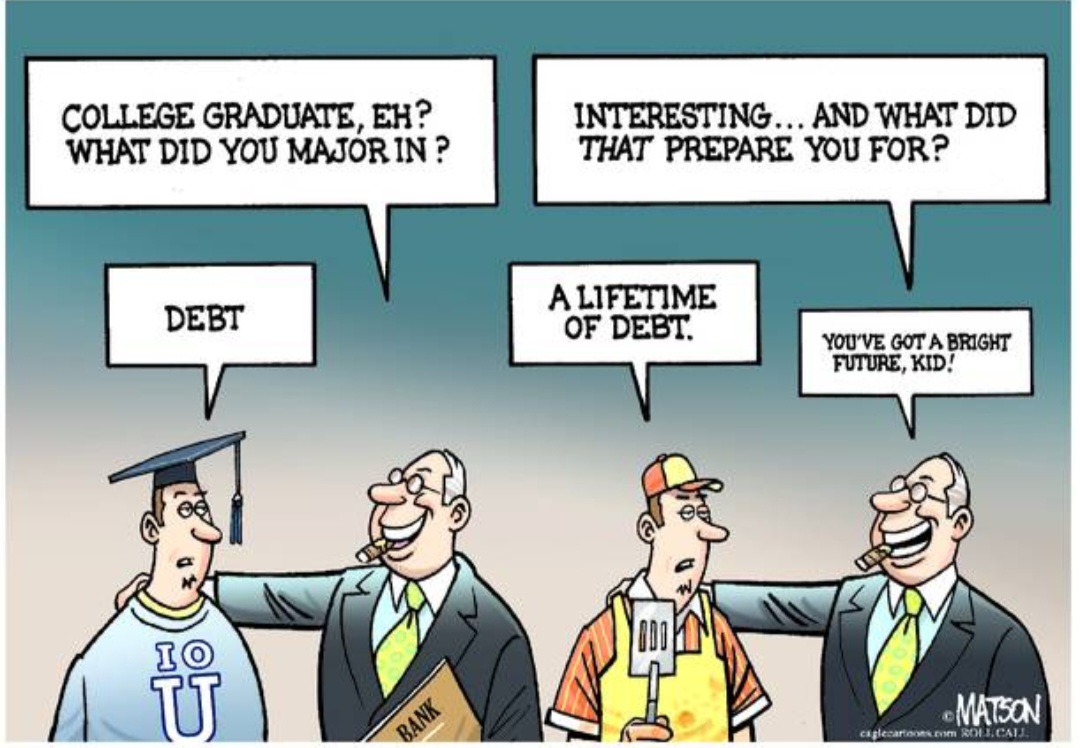
- It become a norm for students to take up loan to go to university and these loan may require student to repay them until 30. This will lock them firmly in their future job or at least the next 5 years.
Some people will call these liabilities as investment for the future, but the school didnt really teach us about real investment knowledge.
Labour Relationship 🔒
- After graduate, similar in school, our time is completely controlled by work.
- When we wake up, go to bed and take vacation follows a fixed schedule.
- This make people adapt to and ultimately rely on a series of rules and processes specified by others to survive, eventually our job become our identities.
- Many people find it difficult to adapt life without work is an evidence of that.

- Secondly, the jobs today are pursuing specialization, become an expert in specific aspect.
- You will not hire an accountant for an engineering role and vice versa.
- For companies, this is a way to improve efficiency, but for workers it is an increase in cost and risk.
- When we become specialized, most of our time will be spend on upskilling in that specialty.
- We can only look for jobs that are related to the specialization because we dont have other professional skills.
- If we decide to make a career change, we will face with huge learning cost.
- In addition, specialization intensifies competition. People can only choose role correspond to their specialization, many people with similar skill will have to compete for the same position.
- Since everybody skills are similar, the hiring decision may be influenced by other factors rather than that skills we specialized in, factors such as interviewing skill, willingness to work OT etc.
- Productivity is a black hole that make us fall deeper and deeper. Hustle culture.
- There will still be people who subscribe to work-life balance. Therefore, labour relations alone is not sufficient to lock us in place.
The society also need consumerism and debt to pin us down to our job.
Consumerism** **🔒
- The emergence of consumerism is a direct results of increase productivity.
- As productivity increases, the products and services will reach a balance with people's needs.
- When the productivity is futher improved, it will create an imbalance. Production output will exceeds consumption.
The solution is to increase demand by stimulating consumption.
- Advertising is a propaganda tool of consumerism.
- It mainly targets on human desires such as identity, status, wealth, health and image rather the actual function of the product.
- The influence of advertising constantly reshaping our values and self-perception.
- The ultimate goal is to imbue us with more desires, mistakenly regard these desires as necessities, thereby increasing consumption.
- At the same time, the price of the products keep increasing (inflation), until eventually we cannot afford and have to go to work.

- The advancement of technology have also promote consumerism.
- Data analytic and algorithms allow companies to understand indivdual preference and target advertising with more precision making more likely of a purchase.
- Technology streamline shopping experience and removed the friction from the transaction process, promoting impluse purchase.
- Social media platform can also fuel consumerism by showcase idealised lifestyle leading to feelings of inadequacy and desire to keep up with the joneses.
It doesnt matter even we cant afford it, we can go into debt. 😈
Debt** **🔒
- You may go into debt by using credit cards, BNPL, installment payments and loans.
- All major purchasing decisions are made through debt such as student loan, car loan and mortgage loan.
- Your increase in income almost always correspond to your increase of consumption. This is what many term as lifestyles inflation.
Retirement System** **🔒
- Work, consumption and debt are sufficient to lock up most people.
- However, there will still be some people who are frugal and able to save some money.
- There are two major categories of financial management option for a salaried workers: (1) financial products that banks and insurance companies sell to us and (2) government retirement plan (CPF for Singapore).
The bottomline of any financial products are to help the people who sell us the products to make money. Our interest is not the priority. Whether you make money or lose money we will still have to pay commission.
- As a salaried worker, our salary are pre-deducted and deposit into a retirement fund (CPF). The system assumed we dont know how to manage our own money and they have to manage for us.
- These accounts usually cannot be touched until we reached specific age.
- When the money for retirement is controlled by others, we will have no say if they choose to extend the retirement age. They can change policies anytime.
- Compare to a buisness owner or even a self-employed, after recieving a fund, they can decide whether to invest to generate more income or purchase equipment and raw material to increase production and to reduce taxes.

- There are people obsessed with topping up CPF with cash. But CPFLife payout is only at 65 (for now), the FRS amount cannot be withdraw and CPFLife is only sufficient for very basic living, excluding mortgage.
- When we passed on only unused CPFLife premium will be distributed to our next of kin, interest earn in RA dont belong to you, is a red flag if you want to build generational wealth. CPF is never designed to make us rich but just enough during old age.
- Whatever is mandatory by CPF we just comply, because we have no choice, however we should never limits our returns to just 4% p.a. for our cash at an expense of liquidity.
Liquidity MUST always be the priority. Never lock our cash and throw the key away when building wealth. Is a financial suicide.
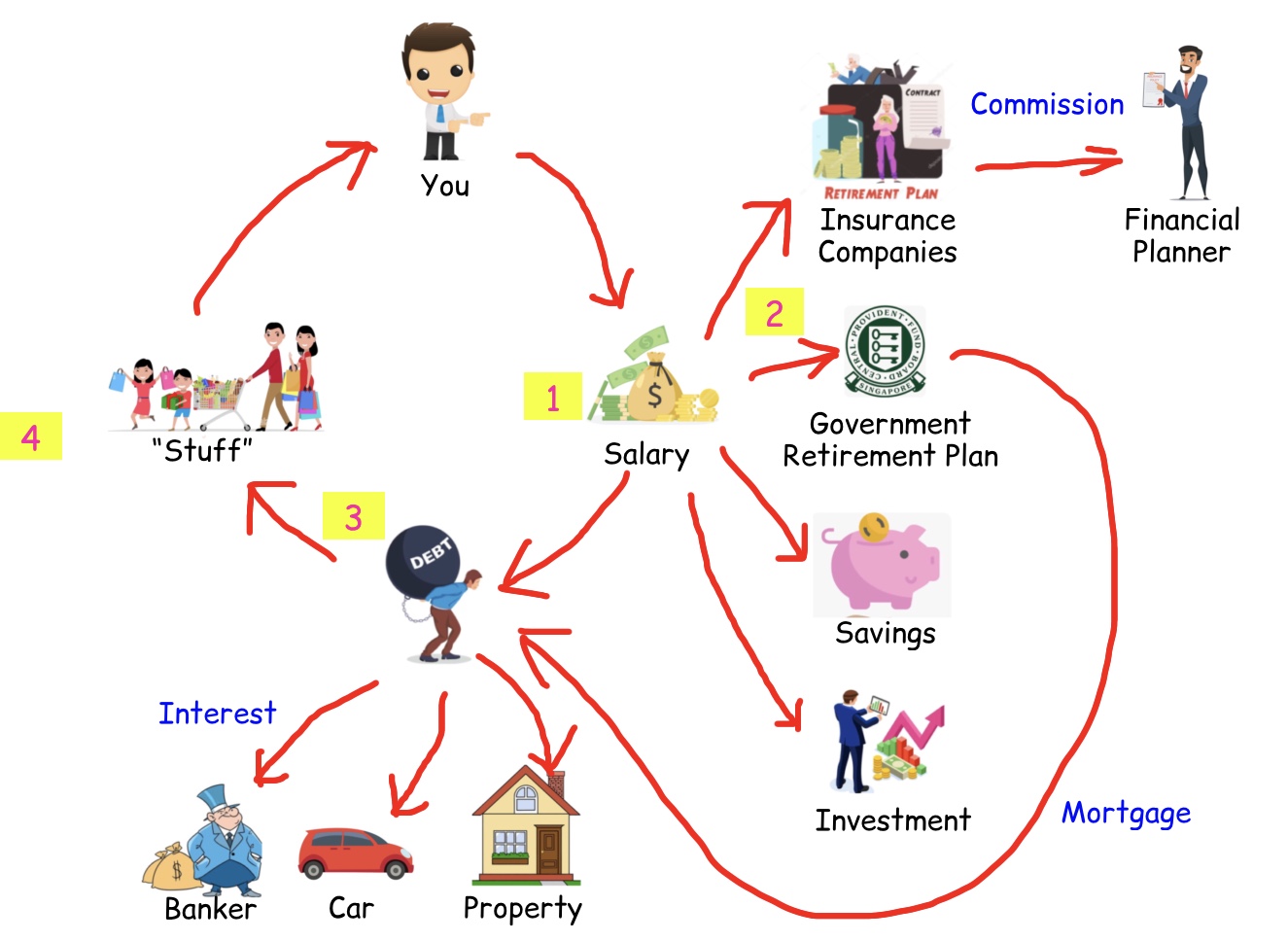
Typical Cashflow of a Salaried Worker
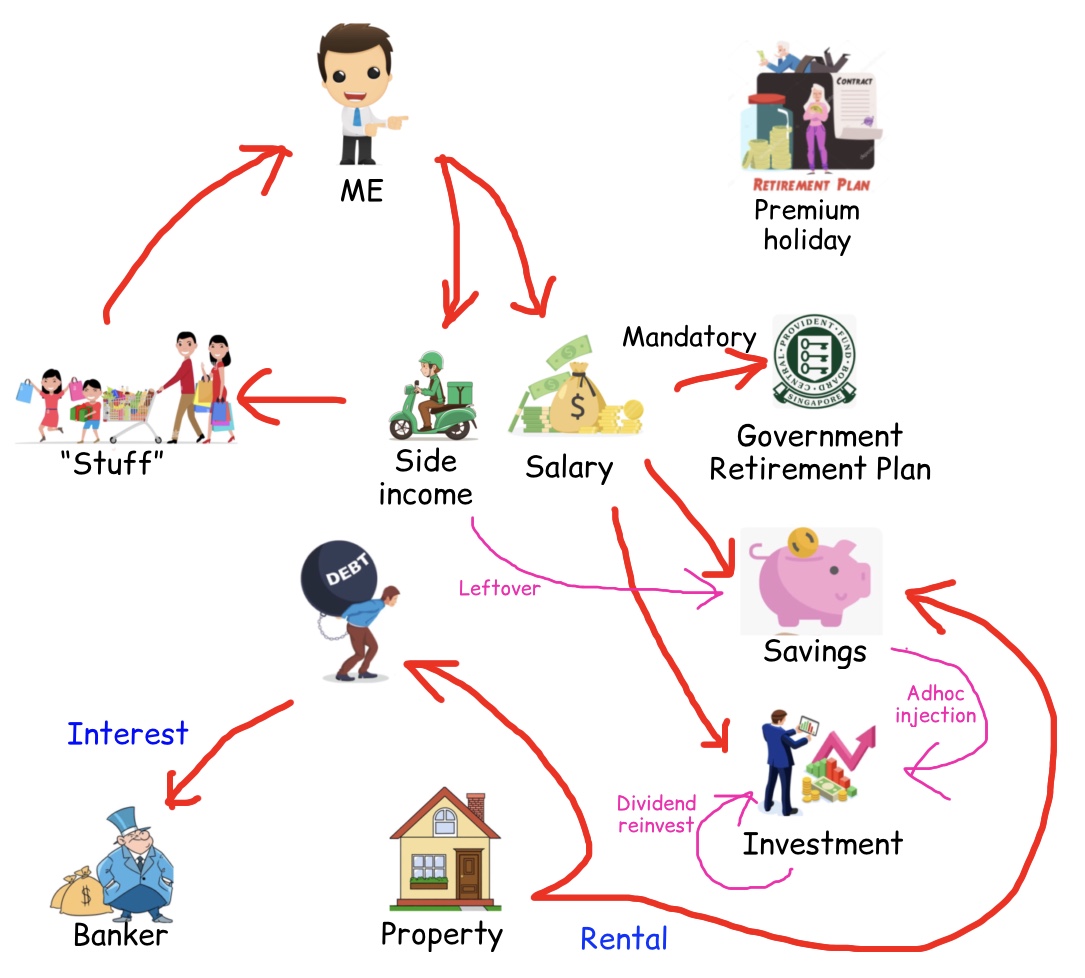
We recieve our salary ➡️ 20% is pre-deducted to CPF ➡️ pay insurance companies ➡️ pay car loan, mortgage loan ➡️ if cash is not enough, CPF will help to pay mortgage ➡️ then we use credit cards to buy "stuff" ➡️ Go back to work to earn money to pay for the debt.
We will be locked in an endless cycle:
- Labour Relationship🔒
- Retirement System 🔒
- Debt 🔒
Consumerism 🔒
- The only way out is to increase your salary, thus you need to climb the corporate ladder, upskilling & continue to stay competitive, work OT and your boss might reward you for your hardwork. 😊
- Then you reward yourself with a cup of $7 "atas" coffee, a $20+ sumptuous meal, $100+ of lovely bags, $100+ of high tech gadgets, few thousands $$$ tour.... it doesnt matter, because you can afford it, is once in awhile and life is short. 😊
- You want a car because you want to save time travelling around, you want a bigger house because you deserve it. 😊
- You focus on been paying off debt ASAP, so you can have a peace of mind been debt free. 😊
- You can depend on CPF for retirement at 65, aggressively top up CPF with cash. You also able to save a few hundred dollar to invest each month. You should be fine. 😊
- But you are still "Locked" in the system. 😈
Decoupling From The System
- Financial freedom is a process of progressively decoupling ourself from the system i.e. consumerism, retirement system, debt and labour relationship.
The final step will be teaching our kids about financial iteracy that our education lack, so they wont make the same mistakes we made and hopefully can achieve F.I. eariler than us.
1. Less Desire Is the Key to Escape Consumerism
- The first step is to cut down on consumption.
- If we dont do this first, everything else wont work.
- Controlling our spending is relatively easier compare to increasing our income.
- There are alot of tactic online to teach us about saving, budgeting, needs and wants.
- However, to escape consumerism, we need to define the meaning of "happiness" for ourself.
- Is happiness (1) instant gratification of our desires or (2) long term freedom?
- Fulfilling immediate desire can only achieved through consumption. We will need to constantly consume to feel satisfied, which is not be substainable long term.
- If our happiness is derive from freedom of choice, time and physical freedom and financial freedom. Then freedom can only achieve through saving and investment.
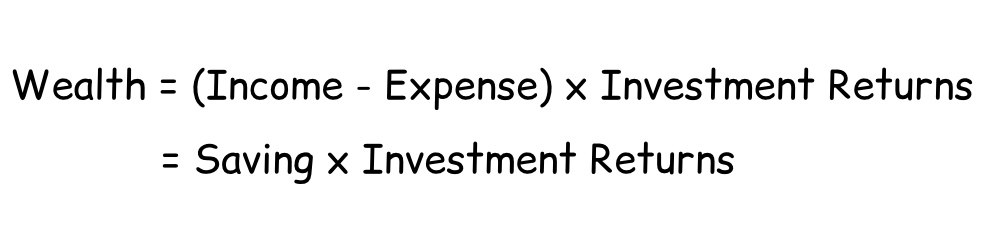
For example:
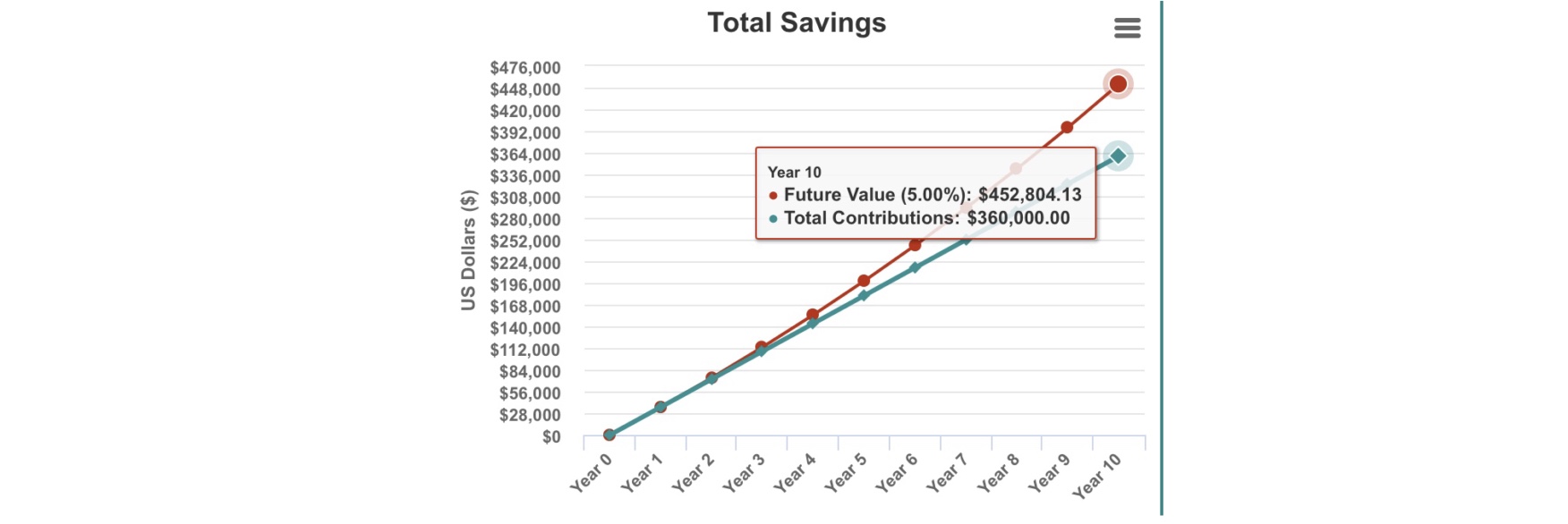
- Joe have a bring home salary $4,000. His monthly expense is $1,000. He will save $3,000. He will then allocate 60% to saving account (3% p.a.) and 40% to index Fund (8% p.a.). The expected returns will be (0.6 X 3) + (0.4 X 8)= 5% p.a.
- Investment is a multiplication game. If you just invest a few hundred a month, it will not be a life changing amount even after 30 years. The main purpose of investing is to hedge against inflation, so only the few hundred dollar that you invested are hedged, the rest in your money in the bank are depreciating.
- The fear of losing money is the main causes of losing money.
2. Use Debt Responsibily
- Although most financial advices recommend us to be debt-free by retirement, it is not wrong but is not completely right either.
- If you really dont know how to handle debt, then avoiding may be the best option.
- Being debt-free does not equivalent to financial free and vice versa.
- Financial freedom is the ablility to cover all expenses by the our passive income without having to actively working.
- The repayment of liabilities are already included in the expenses. Thus, we can either be debt-free or have lot of debt and still be financially free.
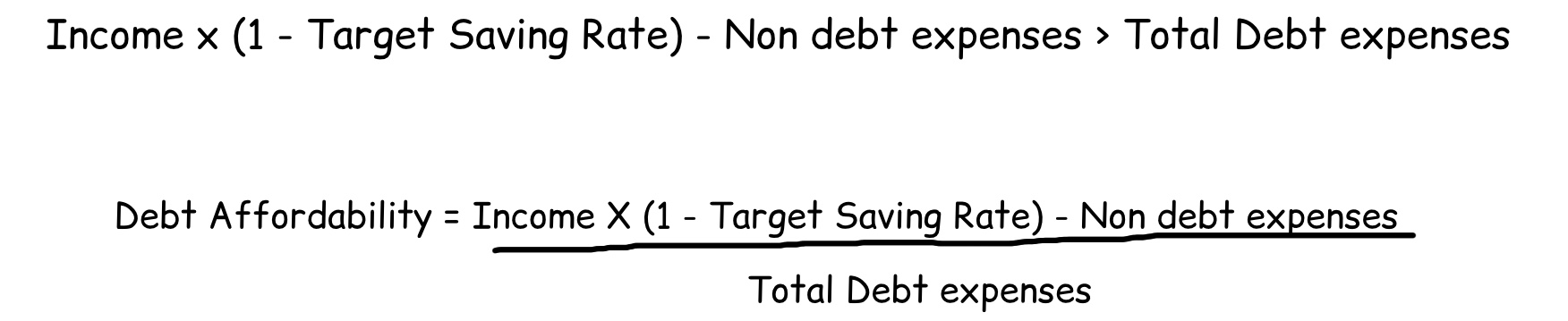
- We can do a self-assessment whether we are over-leverage using the equation below.
For example:
- Joe have a take home salary of $4,000, he target to save 50% of his income and his expense per month is $500. Thus, Joe should not have debt expense of more than $1,500. 4000 * (1 - 0.5) - 500 = 1500.
- For the second equation, if the value is more than 1 means Joe is able to afford take on the debt. The larger the number the higher the safety margin.
- If Joe get a car loan and need to pay $2,000/mth for the car instalment, it will be beyond his debt affordability, 0.75.
- He can either increase his income or reduce his non-debt expenses.
- He may also consider reducing his target saving rate, but this will affect his financial goal. Which he needs to assess using the wealth equation.
Although in Singapore , the borrower's TDSR must be less than 55% gross salary. Meaning Joe maximum debt repayment per month is $5,000 x 55%= $2,750. This amount do not factor his personal expenses and financial goal.
3. Increase Our Income, not just salary
- Being a salaried worker, our salaries are based on experience, role, industry and the market rate.
- It is undeniably that salary provide a sense of security, knowing that money will hit our bank account every month.
- Being risk adverse is the main reason we choose to be an employee rather than a self-employed.
However, recieving a fixed rate limits our earning potential. Unless, you are a high flyer, able to climb to the top management, where your remuneration will be very different from a normal workers. Those who have make it to the top are the minority.
- As a salaried workers to increase our income, we just need to get a side hustle while continue to climb the corporate ladder. A hybrid between employee and a self-employed is the best option. Create multiple sources of income.
- This bypassed the need to climb the corporate ladder inorder to get a higher income, which lower our cost, better income security and less stressful.
- Some would use hourly rate to determine if a side hustle is worth their time, but ironically they are alright to do OT for free in their 9 to 5 job.
- Being a self-employed, it will be difficult to determine hourly rate, because income is fluctuating.
- Therefore, rather than looking at the per hour rate, compare what are the options we have, because the hourly rate after office hour is always $0 if we did nothing.
- Some may also argue side hustles are just a short term solution, but isnt our career too? If we have a plan that can get us out of the rat race way earlier.
The main purpose of increasing the income is to buy assets, because we cant work forever.
4. Income Generating Assets
- The purpose of an investment is to ultimately replace our active income, so we can break free from the cycle and achieve financial freedom.
- Inorder to achieve financial freedom early, we should invest a portion into dividend stocks, even in our 20s.
- Although, invest fully in S&P will yield the highest long term returns, but we can never know where the stock price may go.
- To attain financial early, we should invest like we are going to retire soon. Increasing networth and cashflow are both equally important.
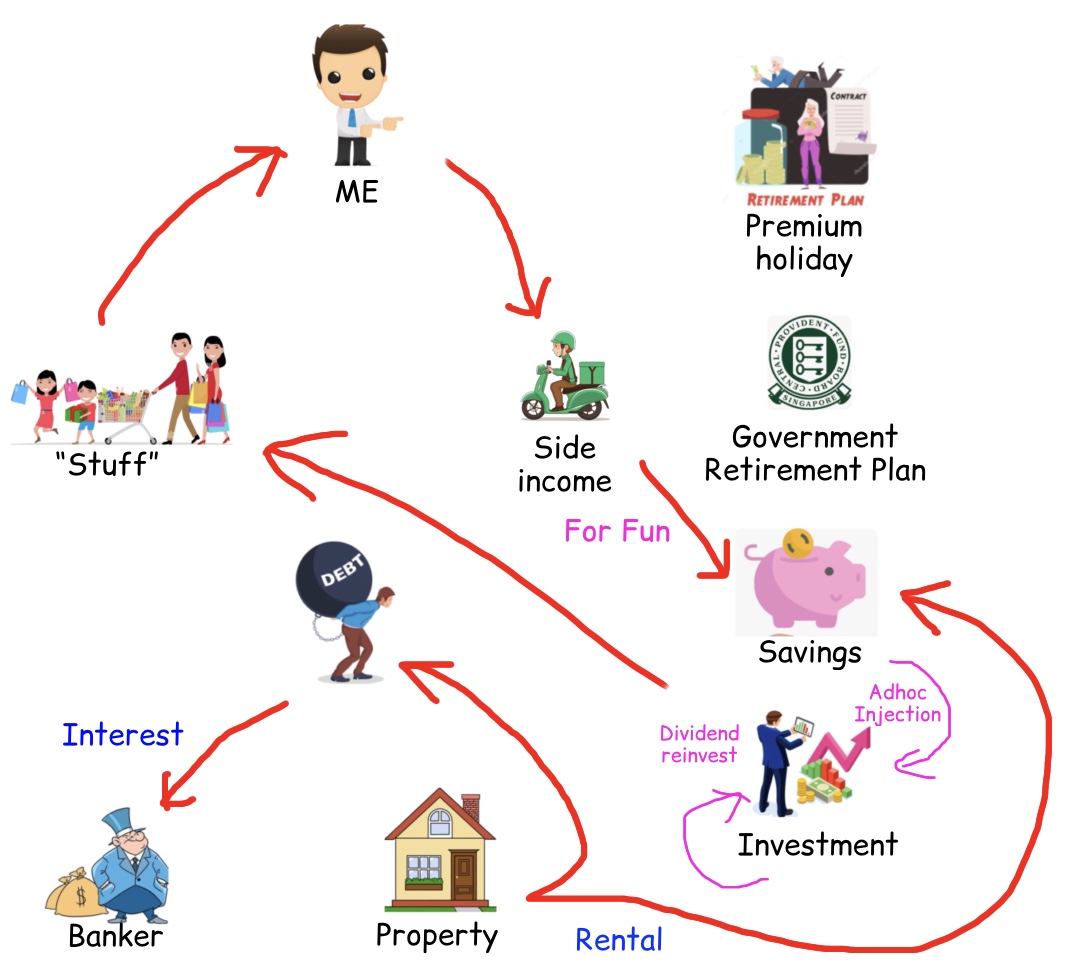
My Current Cashflow as a Salaried Worker
- Our performance in investments depends on how well we handle cash flow outside the stock market.
- If we manage personal finances effectively, we can build a larger capital base, don't need to take excessive risks, and develop a stronger holding power.
- Additionally, our absolute returns may also be higher i.e. 1% of $100 VS 1% of $100k.
My Ideal Cashflow When Financially Free
- I am perfectly fine with the concept of been not debt-free but financially free.
- Of course, i also have an option to deleverage if i want.
- As long my investment are able to pay for my "stuff" then i am free.
- CPF is always a good to have, a bonus and never my priority. It is risk-free but at what cost?
- Why i did not use CPF to pay for the mortgage? i just want more cash for my sale proceed, not because i really care about that 2.5% interest.
- I had never subscribe to the idea that CPF is a safety net for retirement. The recent policy changes just reinforced my belief. 😆
Conclusions
- Debt and consumerism are the most talk about in personal financial topics, which i can mostly agree. This is where i start to draw the line and do things differently.
- Upskilling to increase salary is actually a more difficult, expensive and uncertain path, you need to compete, be lucky and the reward maybe just a 2-10% increment.
- To increase income more efficiently, get a side hustle that do not require huge upfront cost, learning cost and easy to start. There will be at least a 30% - 40% increase in income.
- i wont use HDB and CPF for building wealth, the risk is too big. The strategies that build around them can just fail overnight. Always stay liquid, when building wealth.
Comments
265
6
ABOUT ME
Deal with your problem by being rich
265
6
Advertisement
No comments yet.
Be the first to share your thoughts!