Advertisement


OPINIONS
Portfolio Review (October 2024)
Portfolio Review (Tips to be a better Investor)
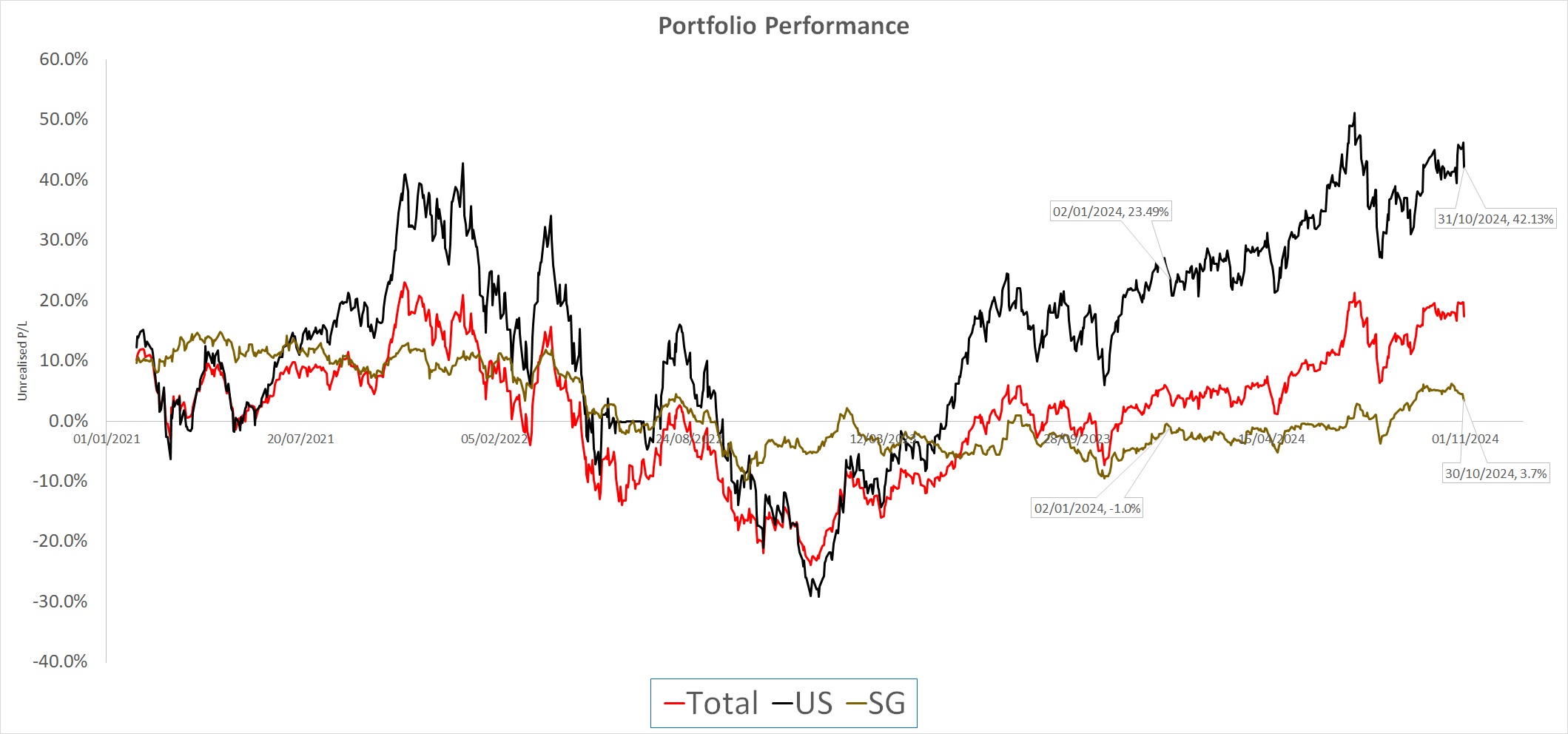
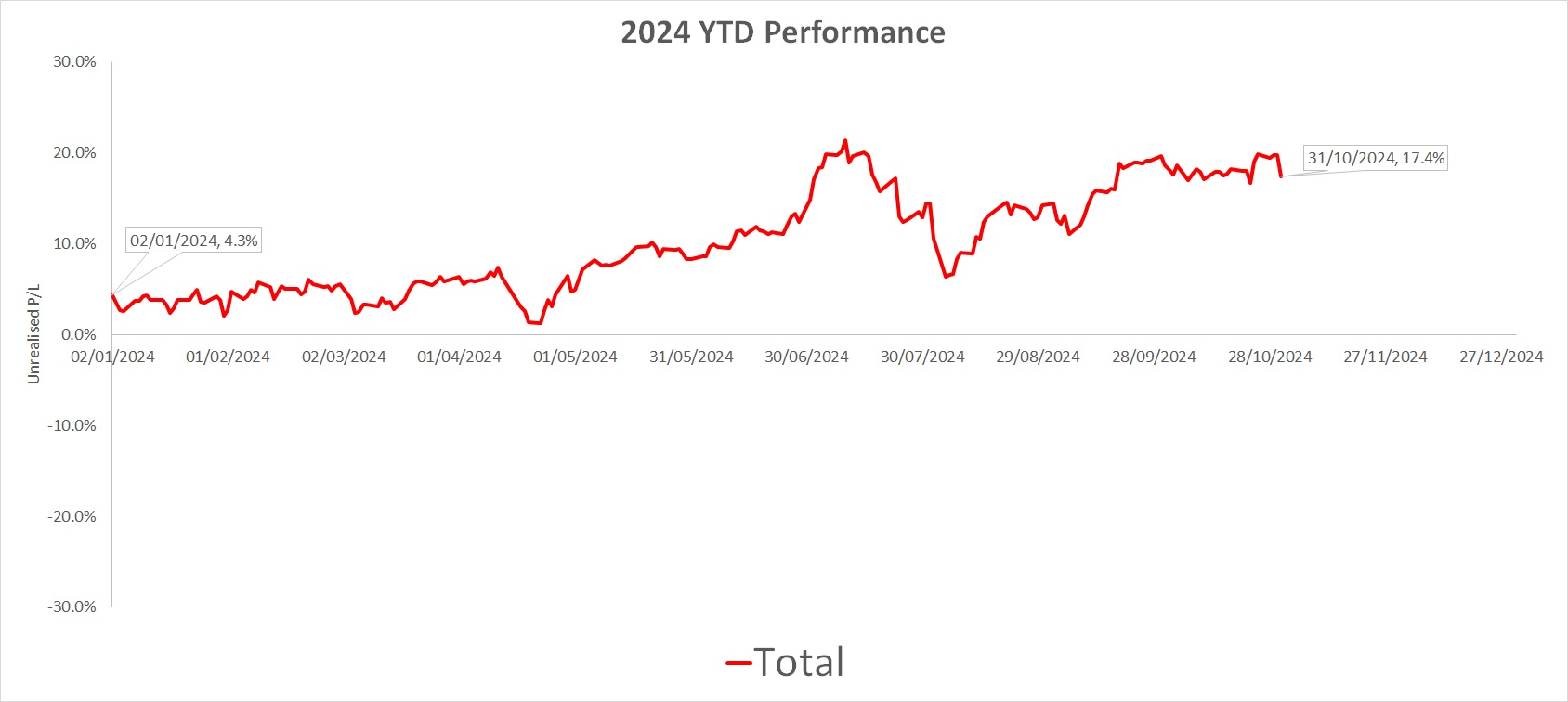
Review of my Portfolio (31/10/2024)
Total unrealized profit: +17.4 %
YTD performance: + 13.1 %
 ![]
![]
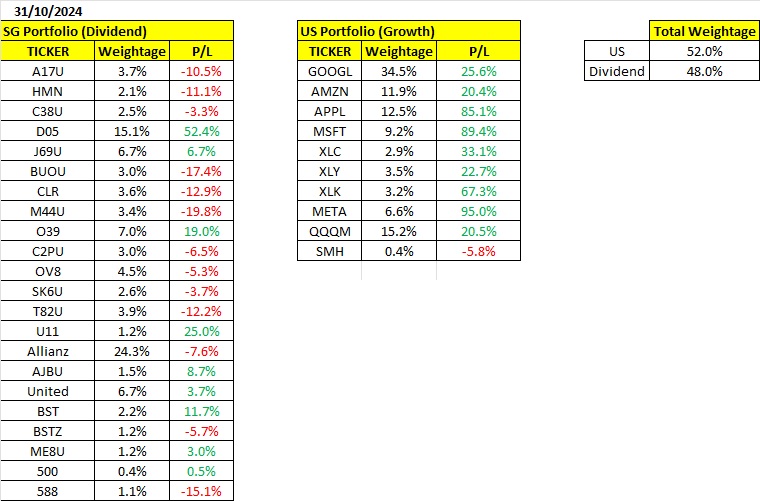
Added in October
Goal 1: ( $ 65,326.13 / $ 81,594) ⚔️
Growth Portfolio: GOOGL
Dividend Portfolio: 558, C38U, M44U, T82U, J69U, United Global Durable Equities
Sold in October
TSLA
Portfolio Weightage
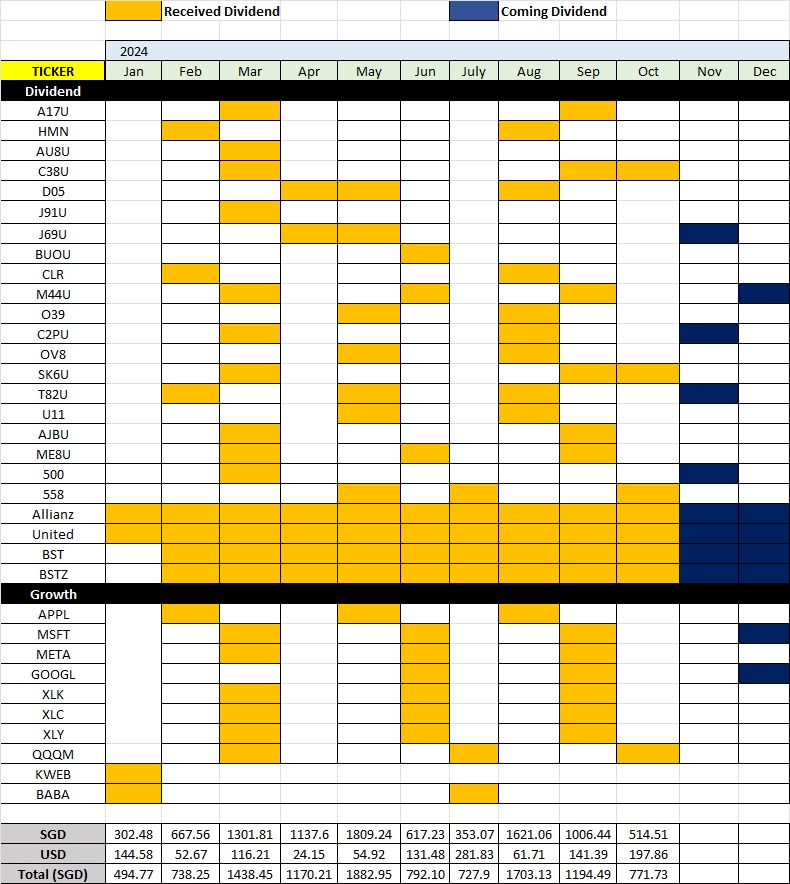
Dividend Recieved
Goal 2: ($ 10,913.98 / $ 14,212) ❤️
Dividend recieved in October = $ 771.73
Tips To Be a Better Investor
Understand How Compounding Interest work
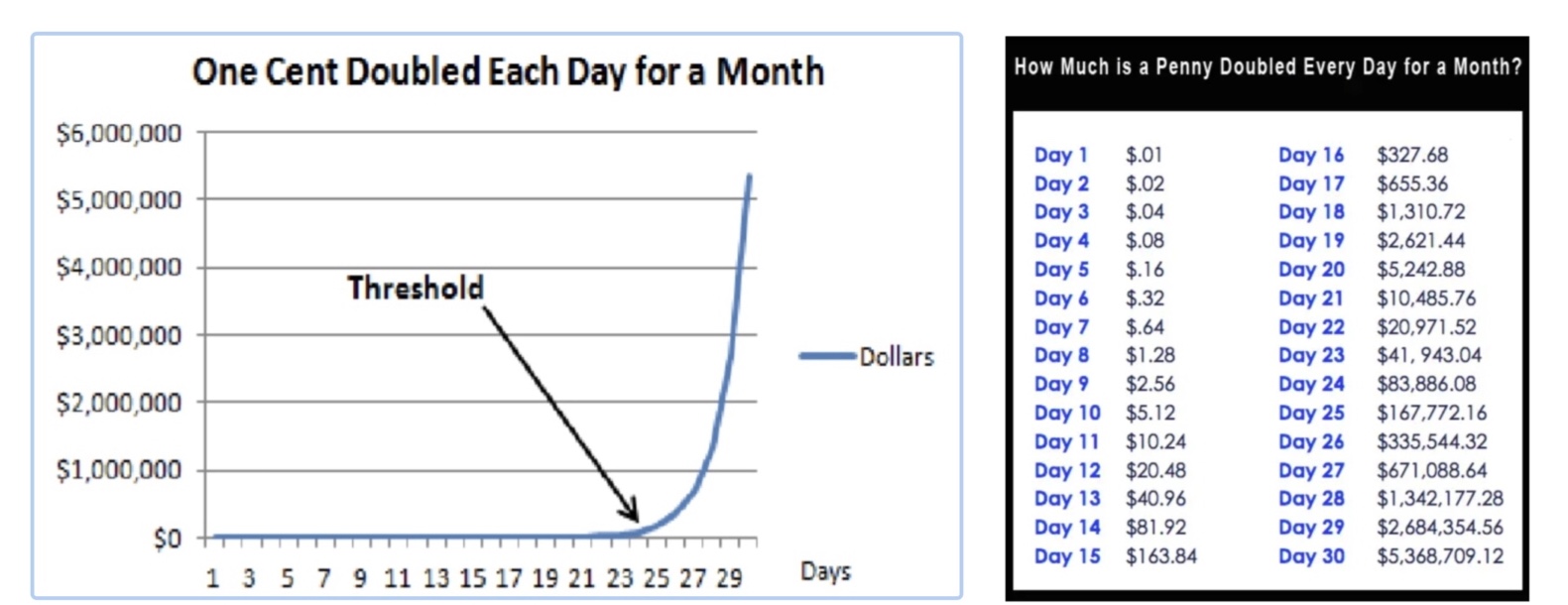
- When faced with the choice between $1 million today or a single cent that doubles every day for 30 days, many people opt for the immediate $1 million, if decision have to be make within seconds.
- While this seems like a rational choice, the power of compounding can make the latter option far more lucrative.
- Even by day 15, it would be just worth $160, that will make us doubt the decision of not taking the $1 million. But after 30 days of doubling, the cent would have grown to over $5 million
- This illustrates the exponential nature of compounding, where most of the growth occurs in the later stages.
- During the investing journey, it's easy to feel as though progress is slow, even after many years. This is because the most significant gains from compounding often materialize later in the investment horizon.
- To reap the full benefits of compounding, it's essential to remain patient and disciplined in your investment approach."
Understand Rule of 72
- In reality, there is no investment that can double every day. This is because such a growth rate would be unsustainable and defy basic economic principles.
- To understand how long it takes for an investment to double, we can use the Rule of 72.
- This rule states that dividing 72 by the expected annual interest rate gives us the approximate number of years required for the investment to double.
- For example, if the S&P 500 has a long-term expected return of 10% per year, it would take approximately 7.2 years for an investment to double (72 divided by 10).
- If we put $100k in S&P500 for 36 years, our money would have grown 32 times (2x2x2x2x2), which is over $3M.
- While in CPFSA, our money would have grown 4 times (2x2), which is about $400k.
This illustrates the importance of rate of returns for a given time period.
Understand the Bear market
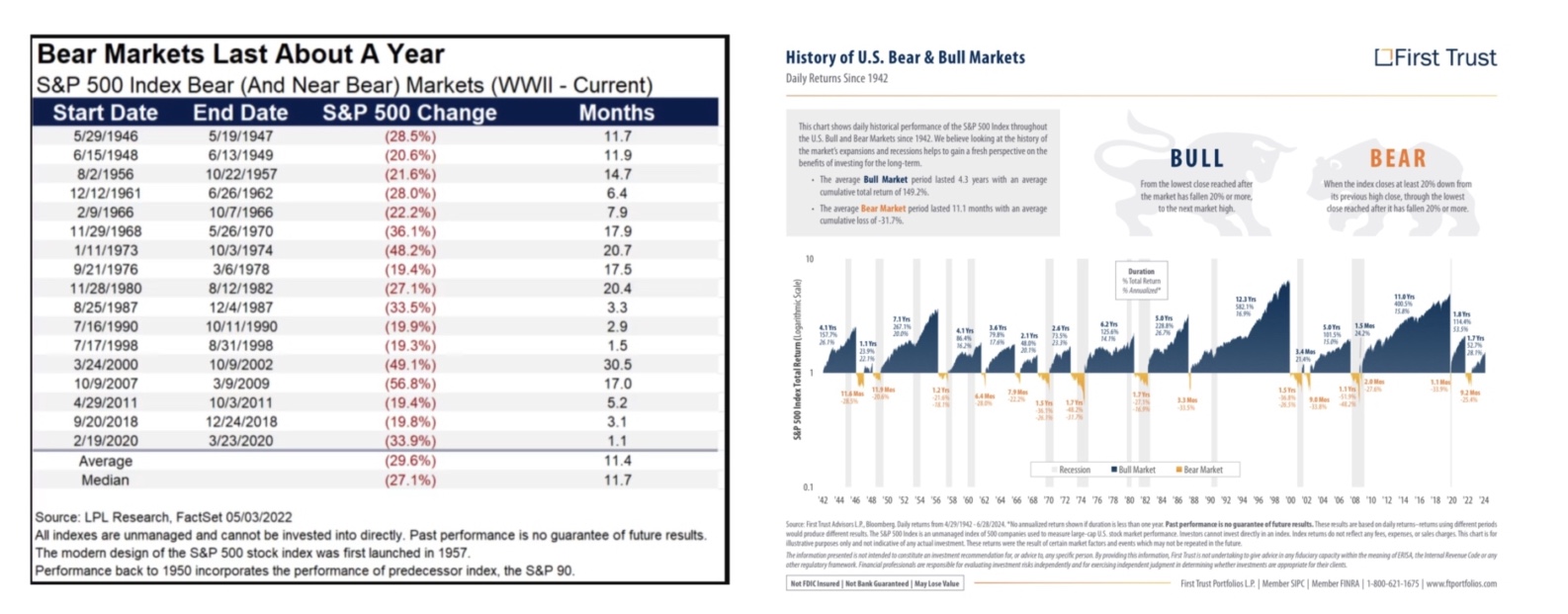
- A bear market is defined as a market decline of 20% or more.
- Historically, bear markets have typically lasted for 11 months, while bull markets have averaged 4 years.
- Unlike fixed deposits, which offer a consistent returns, the market is cyclical.
- Successful investing requires not only a sound strategy but also the right mindset.
- Trying to consistently time the market's highs and lows is often futile.
- To achieve superior returns, it's essential to remain committed to our investment strategy, even during market downturns
Understand Range of Outcome
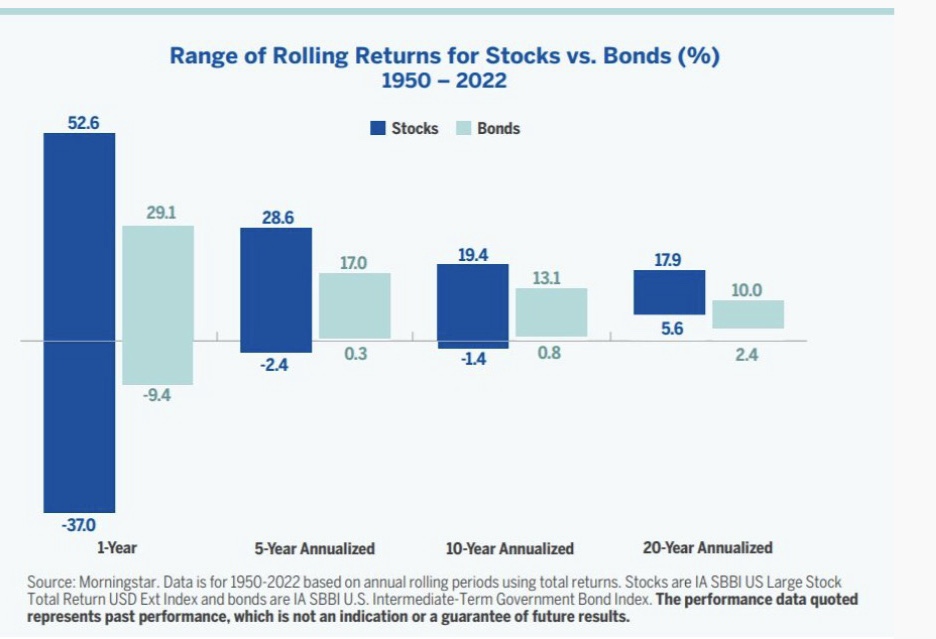
- The chart illustrates the potential range of returns for investments in stocks and bonds.
- In a single year, stocks can experience significant fluctuations, with a best-case scenario of a +52.6% return and a worst-case scenario of a -37% loss.
- While investing in the S&P 500 can yield substantial long-term returns, it's crucial to recognize that these returns won't be consistently positive each year.
- Instead, expect a range of outcomes. It's also important to note that the variability of returns tends to decrease over longer time horizons.
- Therefore, it's essential to be mentally, emotionally, and financially prepared for market volatility.
Know the Cross-Over Point
- This is the point at which the growth of your investment exceeds your annual contributions.
- Assuming you contribute $30,000 annually and expect a long-term return of 8% per year, the crossover point would be $375,000.
- This is calculated by dividing your annual contribution by the expected return rate: $30,000 ÷ 8% = $375,000.
- When we first start investing with a $10,000 capital, a 10% annual return yields $1,000.
- Once our investment portfolio reaches $1 million and we maintain annual contributions of $10,000, a 10% annual return generates $100,000, surpassing our yearly investment.
- Most of the portfolio building work is depend on our contribution rate before the compounding effect make any significance impact.
Previous Review
Comments
What are your thoughts?
View 3 other comments
193
3
ABOUT ME
Deal with your problem by being rich
193
3
Advertisement
💬 Comments (0)
What are your thoughts?
No comments yet.
Be the first to share your thoughts!