Advertisement


OPINIONS
Portfolio Review (May 2023)
Portfolio Review
Review of my Portfolio (31/05/2023)
Total unrealized loss: - 5.6%
YTD performance: +17.5%
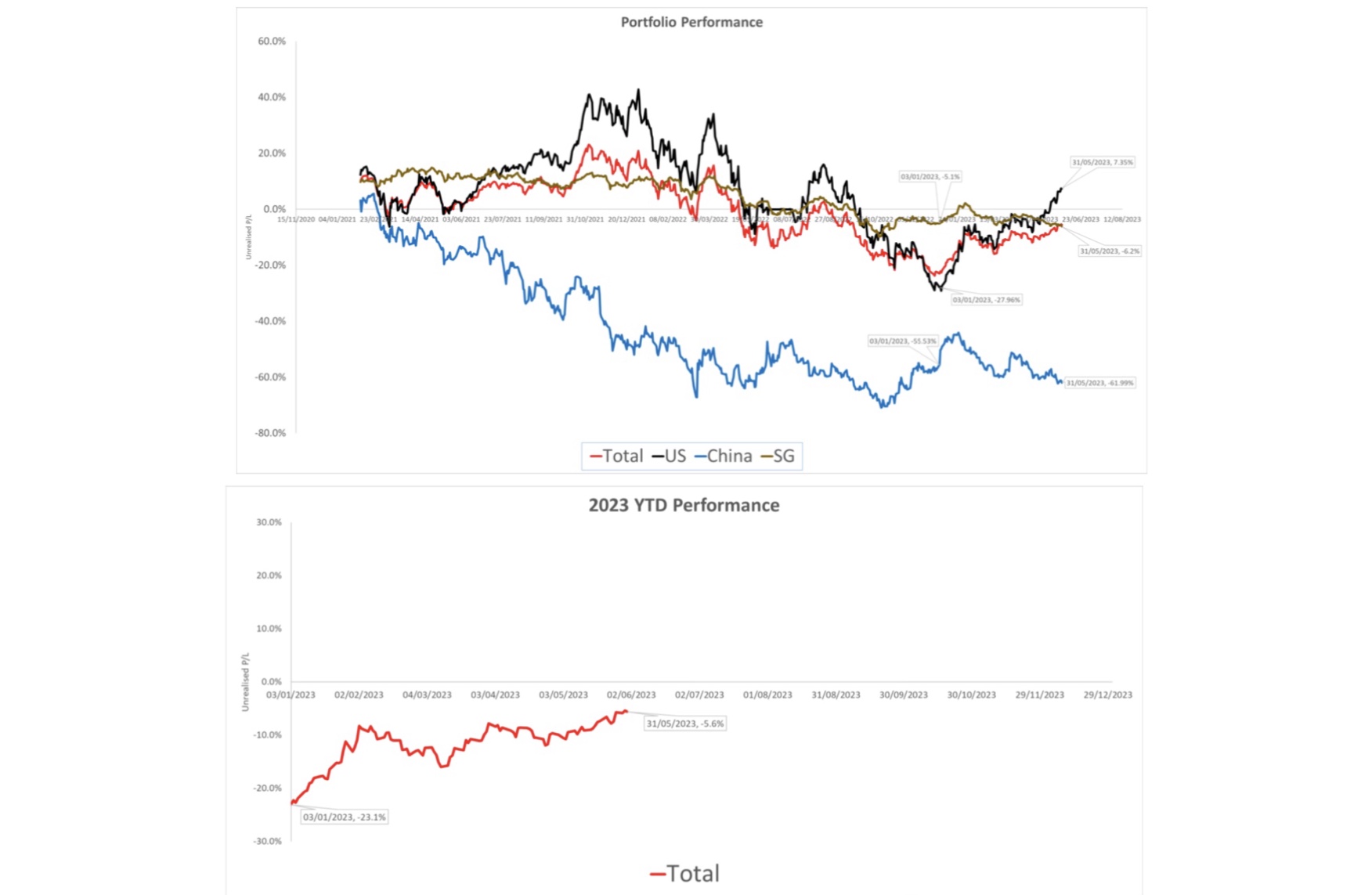
Added in May
Goal 1: ( $34,290.82 / $66,186)⚔️
Growth Portfolio: XLY
Dividend Portfolio: Allianz income & growth, J69U, T82U, ME8U, BUOU, BST, HMN, A17U
Portfolio Weightage
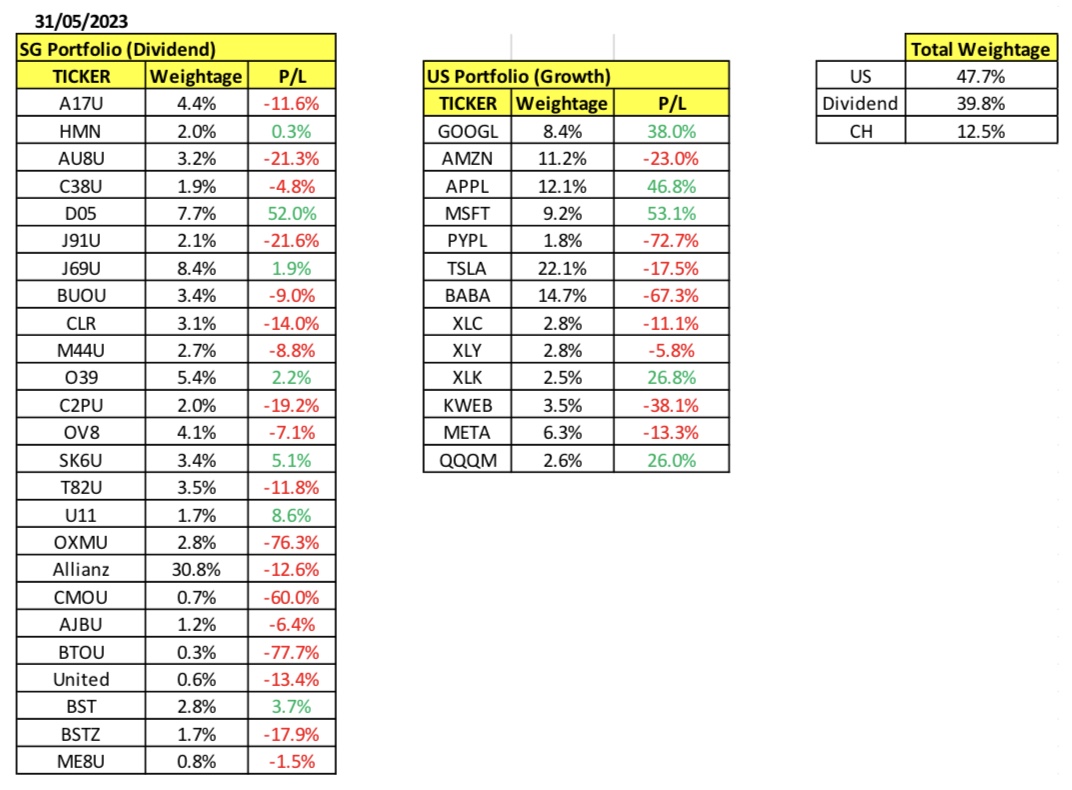
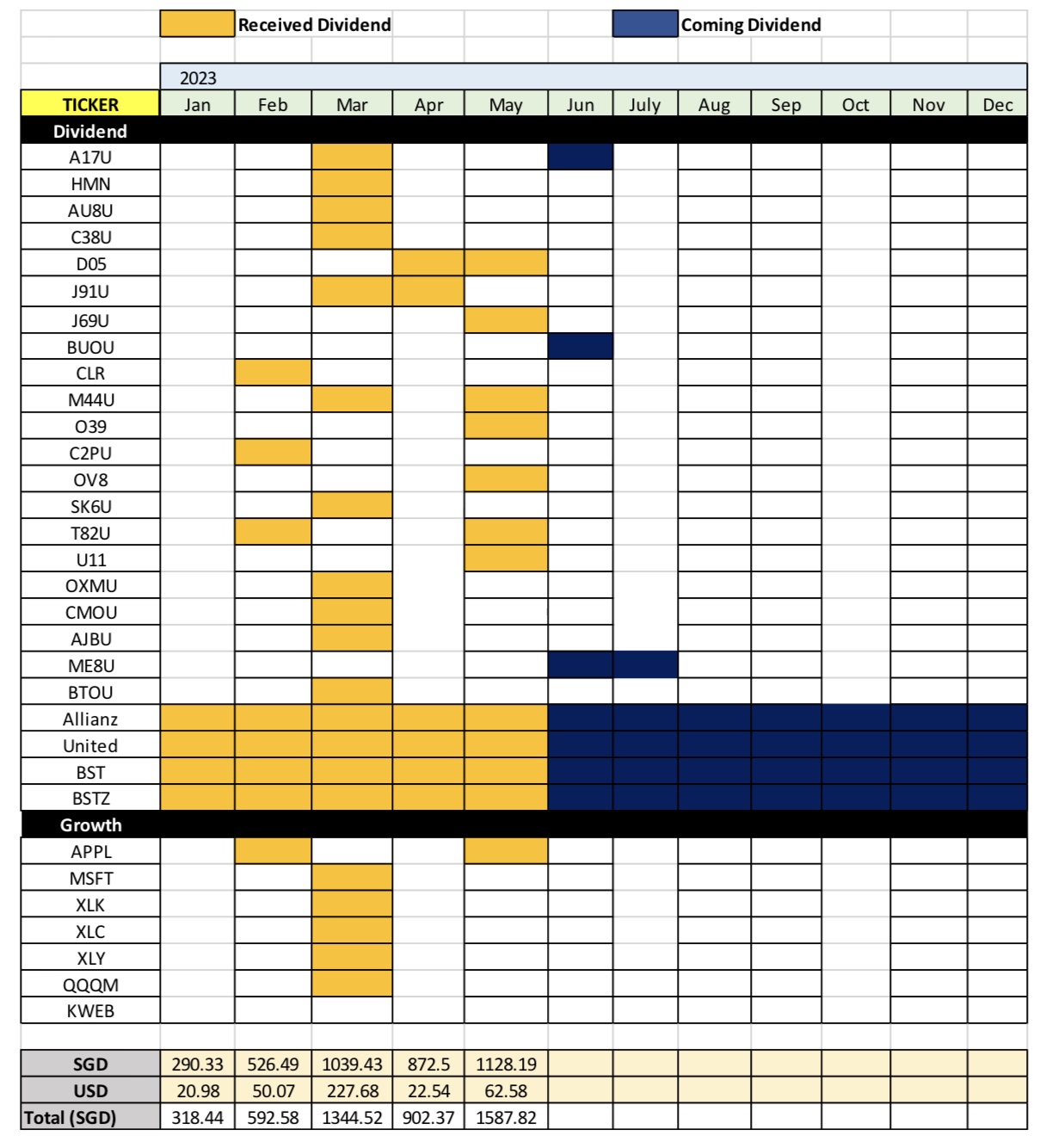
Dividend Recieved
Goal 2: ($4,745.73 / $11,000)❤️
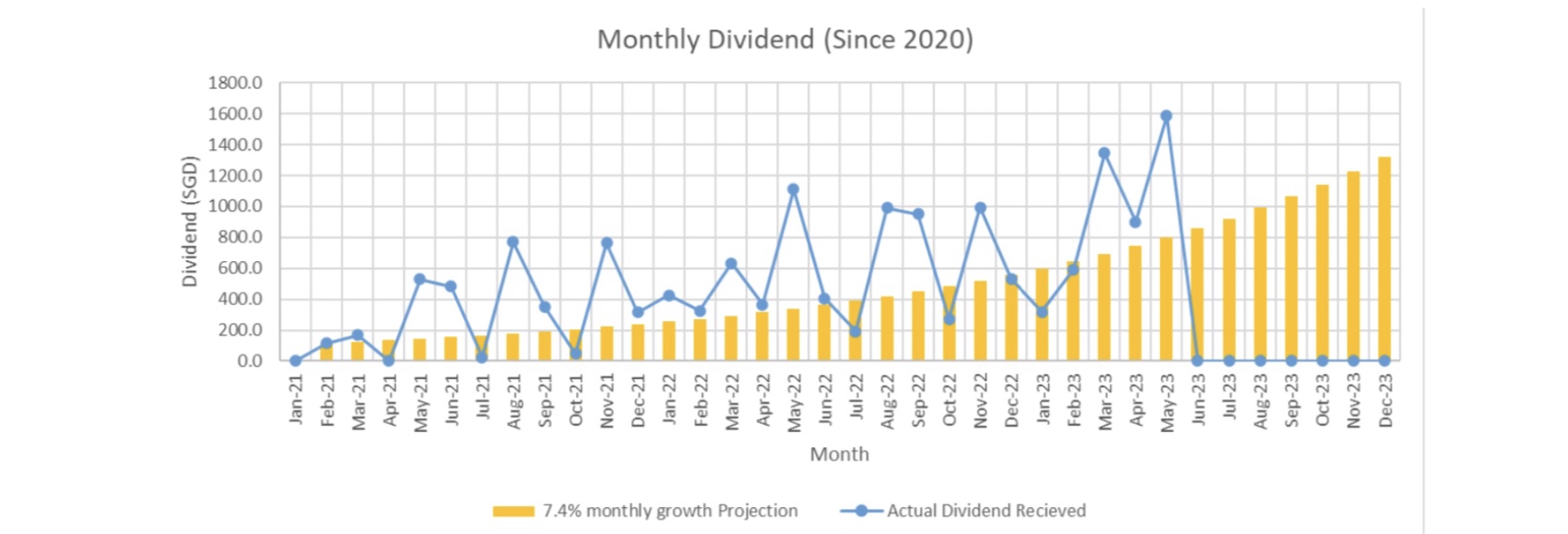
Dividend recieved in May: $1,587.82
Opinons
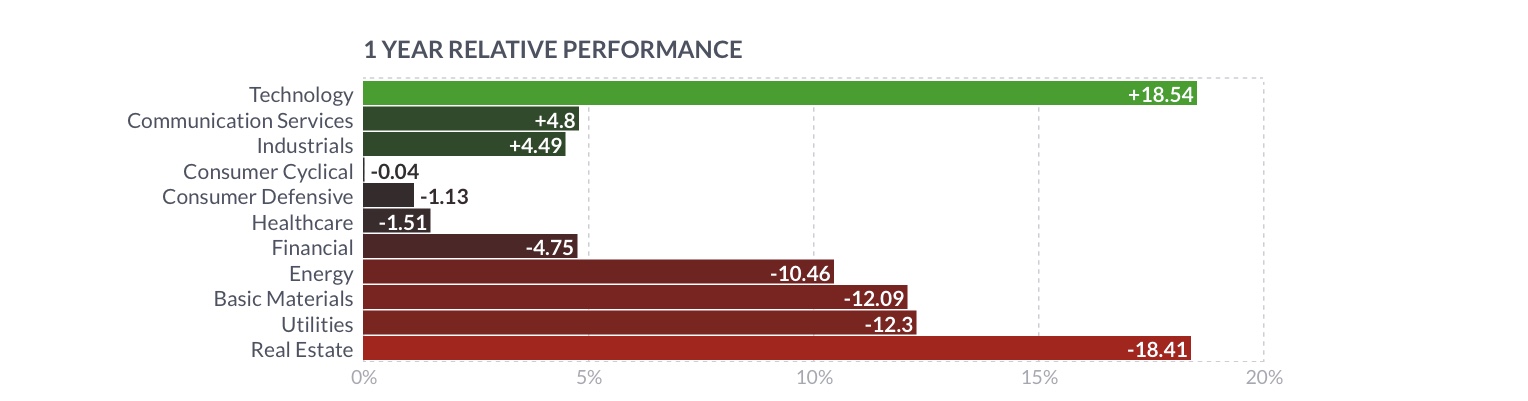
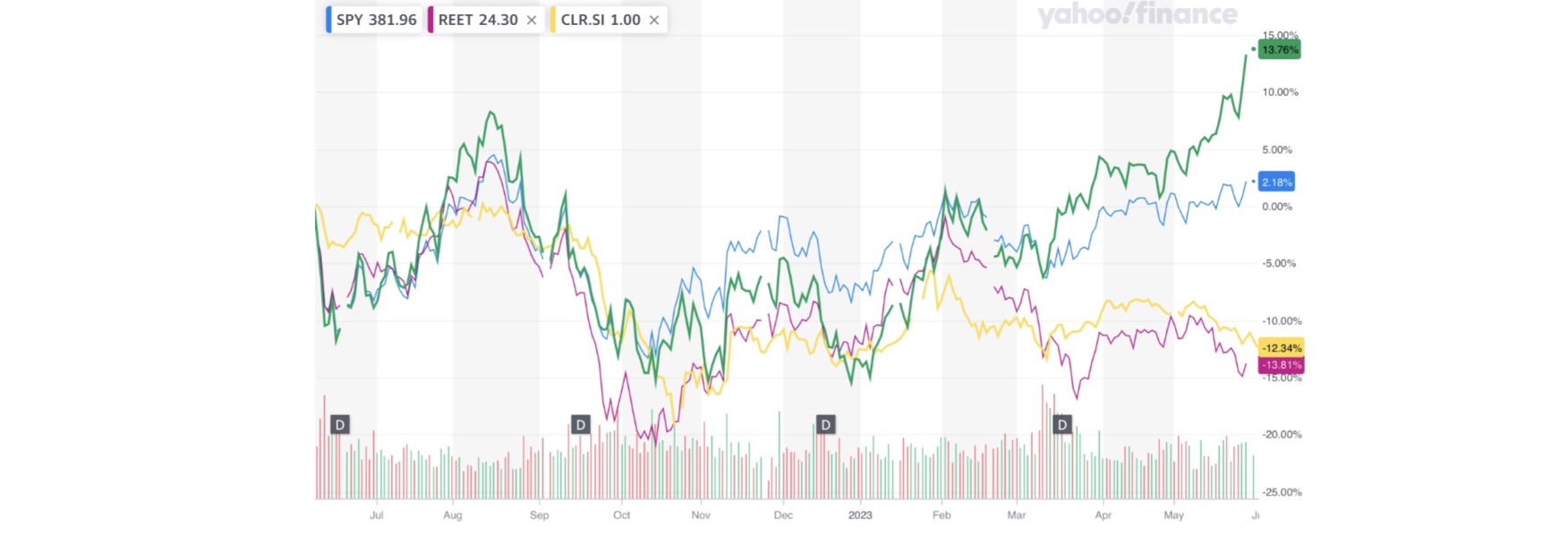
Graph as 30/05/2023
- Currently, the market is still in an uptrend.
- Market always cycle, sectors always rotate.
- Seem like the sector had start rotating again. Currently, real estate sectors are in distress.
- This not only affect US market but also global reits issue. Those who invest in SReits should also see their portfolio go down. SReit look cheap?🤔
- Within the Tech, seem like consumer cyclical sector, $XLY, still lagging.
- Over long period of time, sectors should correlate with the index, currently there is a divergent.
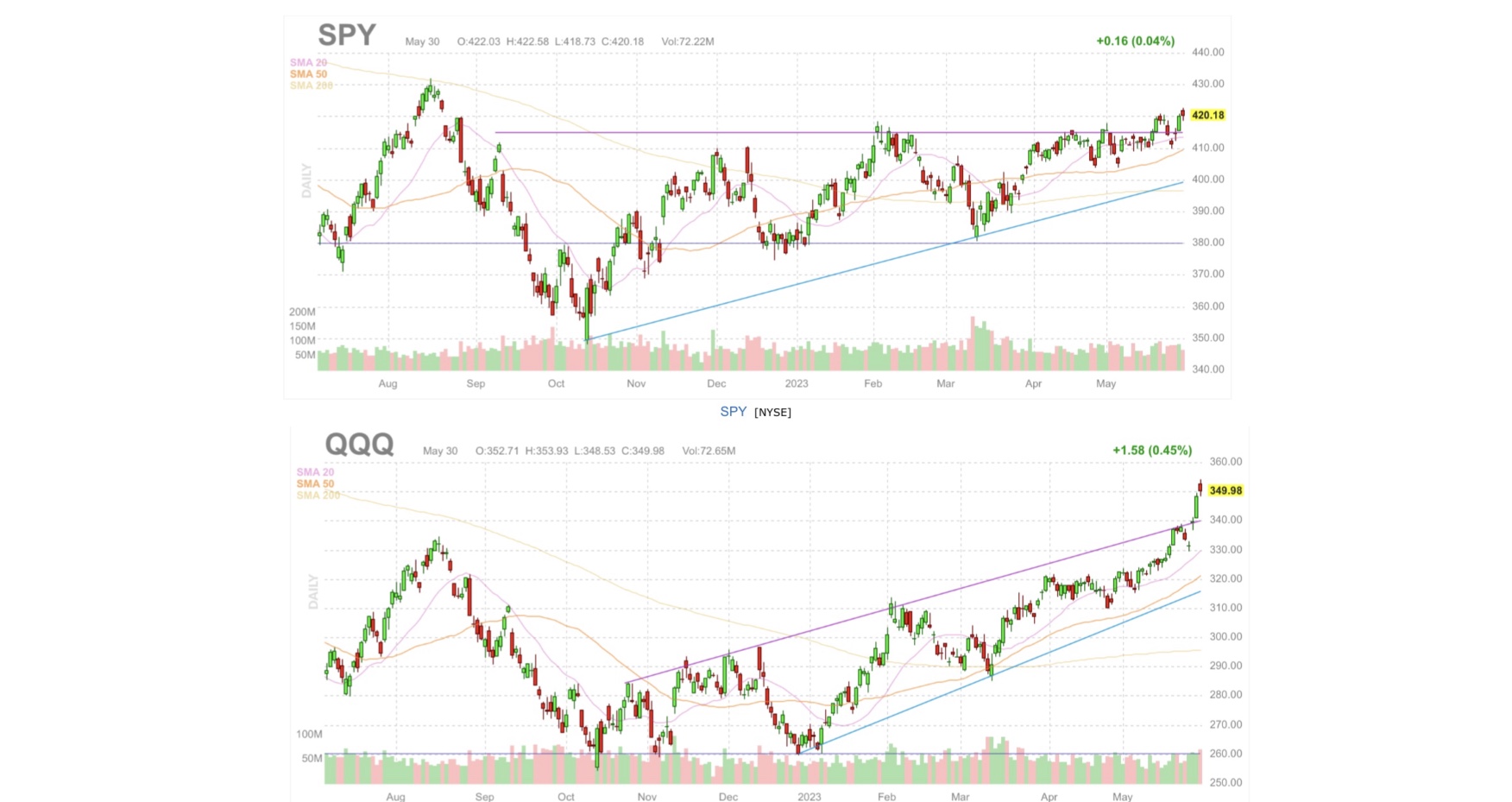
- For the index, $SPY, look like a breakout?🤔 The moving averages are very close to the previous resistant, which is a good sign. May test the support again.
- However, $QQQ, look over extended, very far from moving average... 2 things may happen (1) crash back to near moving average or (2) consolidate until the moving average catch up.
- I shall see which is which, then decide what to do. 🧐
- i will approach with caution for the US tech sectors, i.e. $XLK & $XLC.
Framework to Financial Independence & Retire Early.... maybe?
- What does it takes to achieve $1 million stock portfolio (excluding CPF, property, insurance, cash....) in 10 years if you are an average salaried worker? 🤔.
- Basically, if you want to live like no one else later in life, you need to live like no one else now.
- It is true that most of us won’t achieve FIRE, because is really not easy, especially in Singapore.
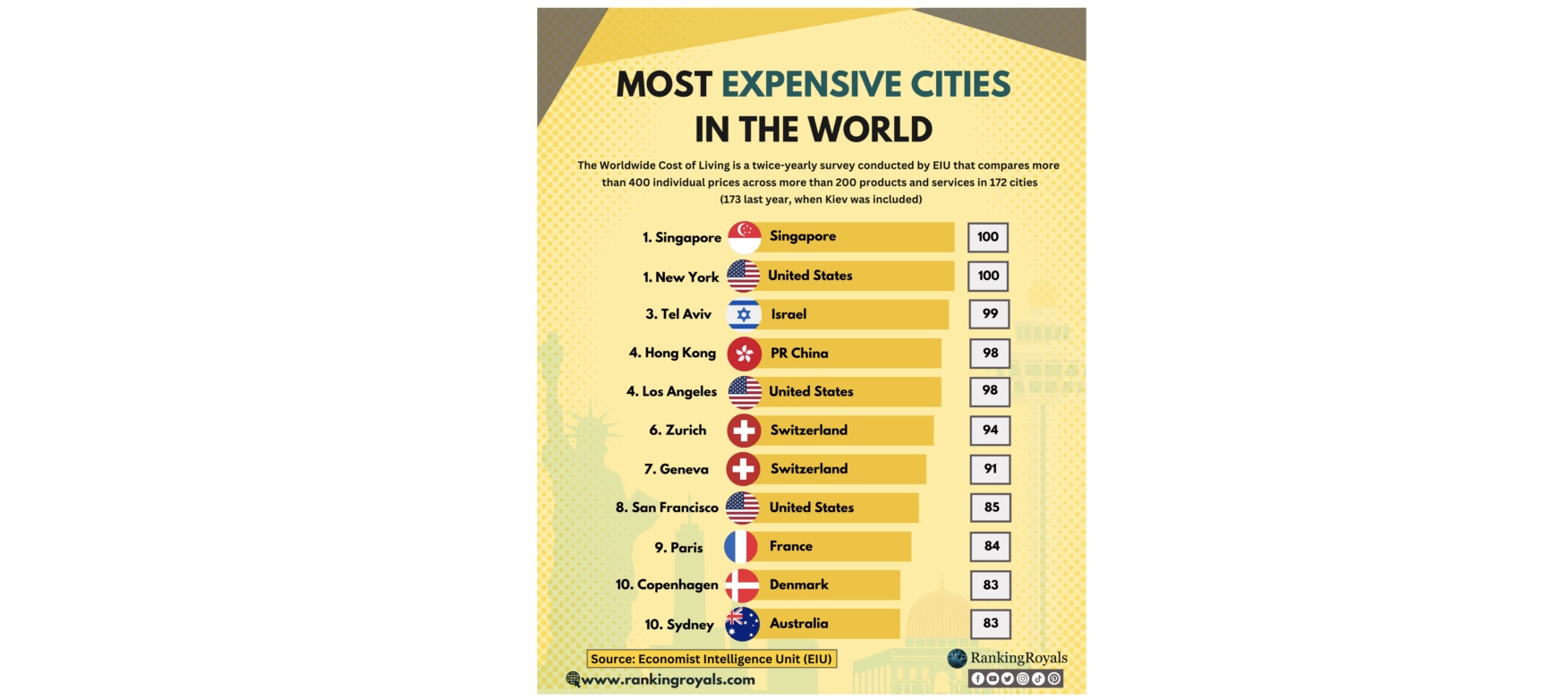
- The FIRE community often focus too much on saving, staying frugal and sacrifice, sometime too extreme, to accumulate wealth. 😨
- It definitely helps by cutting down expenses but it is not enough, we have to solve the main problems "where to get more money to invest?"
STEP 1: Know how much to invest each month.
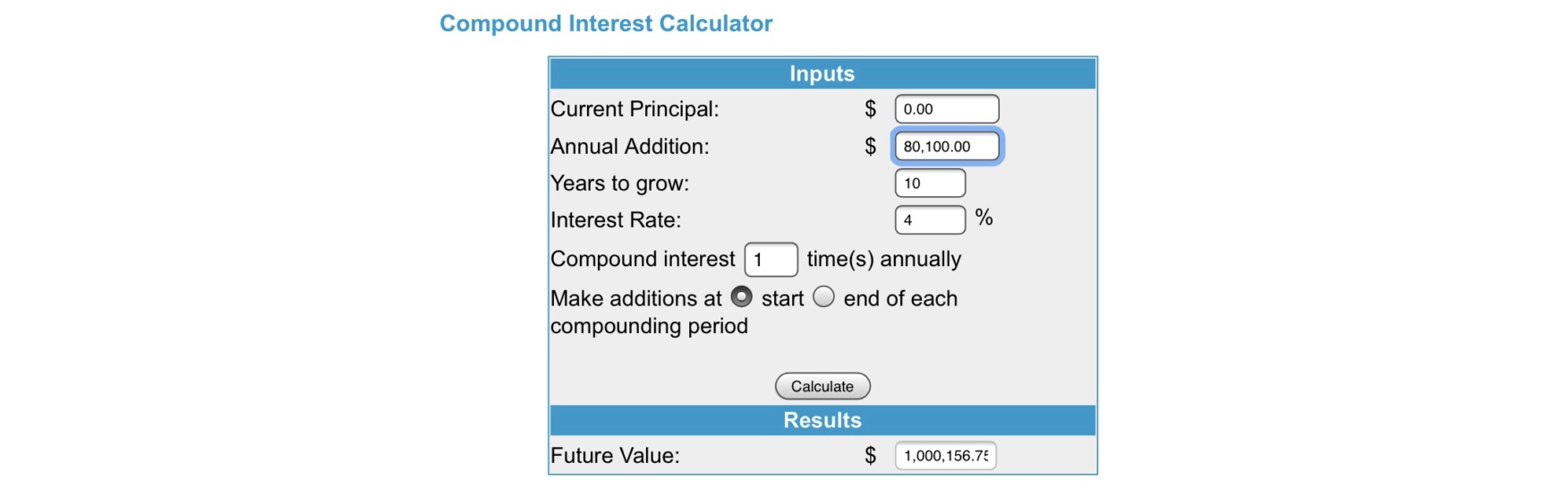
- To have the margin of safety, 4% p.a. compounded rate is used. So even if missed the target, it wont be too far off.
- In order to achieve a $1 million portfolio in 10 years, one have to invest $80,100 p.a. or $6,675 per month.
STEP 2: Build the Foundation.
- Always follow one rule "Invest the money you dont need." as i repeated many time. 😂
A strong financial foundation focus on protecting what you already have.
1) Emergency Fund
- This is most basic of personal finance. Emergency fund is just there so that when things turn nasty you do not need to liquidate your investment which will potentially cause you to lose the gain.
- Conventional wisdom is to have 6mth to 12 mth of expenses saved up.
- But I would suggest $50k if you are single and at least $100k for married.
- May park these fund in high interest account, SSB or T-Bill.
- This amount will be more than enough to solve most money related issues.
After achieving the sum, just maintain it and you may choose to stop saving.
2) Manage the Debt
- Debt is just a tool to gain excess to your future earnings, the price to pay is the interest.
It is alright to be in-debt if you are able to use your future earnings to earn more money.
- Mortgage is probably the largest debt most Singaporean have and the recent interest hike had create lot of financial stress to many.
- Interest rate will always fluctuate. Thus is always good practice to fix the loan when interest rate is low, and float it when is high.
- Of course, playing with debt will involve risks, thus will need to have mitgation plan.
- My primarily focus is on improving my holding power and the potential upside of the property.
Improve Holding Power
- Have different stream of income so that there is always cash flowing in.
- Have cash reserve on top of the Emergency fund.
- Rental is a "hedge" against interest rate, I prefer to let the property to pay for itself.
Paying the instalment using cash instead of CPF, not only ensure more cash return back to me upon sale but also the untouched CPF-OA provide additional safety net if i run low on cash.
- For people who just want to have a house to live in and not going for asset progression, should just follow the conventional wisdom.
- "Buy a house within your affordability, then try to pay it off ASAP." Because it is an liability.
- You may use CPF to pay if you want, since you will not be selling.
- You may also rent out any spare rooms to generate some income, if you want to.
Keep things simple.
3) Manage the Tax
- There are a hidden cost for every income we earn. Tax! The lesser we pay to the government, the more for ourself.
- Before topping up any account ensure you check, if you are eligible for any tax relief, any other option will lockup the cash.
- You are able to top up for yourself ($8k) and your love one ($8k). Caping at $16,000 max.
- This is a tax defer account. You are able to withdraw within the 10 years at retirement without penalty.
- 50% of the withdrawals from SRS are taxable at retirement.
Early withdrawal will incurr 5% penalty charge
- Personally, i just use the tax relief + CPF top up for my parent.
- Cutting tax and 1 less expense.
But if you going to do that, always ask your parent, if they are comfortable depositing their annual allowance into their CPF.
STEP 3: Build Multiple Income Source.
- We buy insurance because we want to protect ourself from things that yet to happen.
- Building multiple sources of income serve the same purpose. Start preparing before anything even happen.
- When economic is bad, company will cut headcount by retrenching and freeze hiring.
- When job is scarce, it will become harder to find job.
So is always better to have something on the side and earn as much as possible when economy is good.
- I will still encourage you to try your best to climb the corporate ladder even if you dislike it, because you have a bigger goal to achieve, every cent count.
- However, just understand that the ultimate decision is not up to you.
- There are very few top level positions but so many people competing for it so just try your best.
You may give everything you got but still experience career stagnation, but is alright 💪 as long your finance continue to progress and on track, that is what really matters.
STEP 4: Know how much income you needed. (Set Income goal)
- How much do i really need to earn per month in order to invest and achieve the goal?🤷
Calculation Example:
INCOME
- The amount left for investing is determine by the saving rate and the CPF.
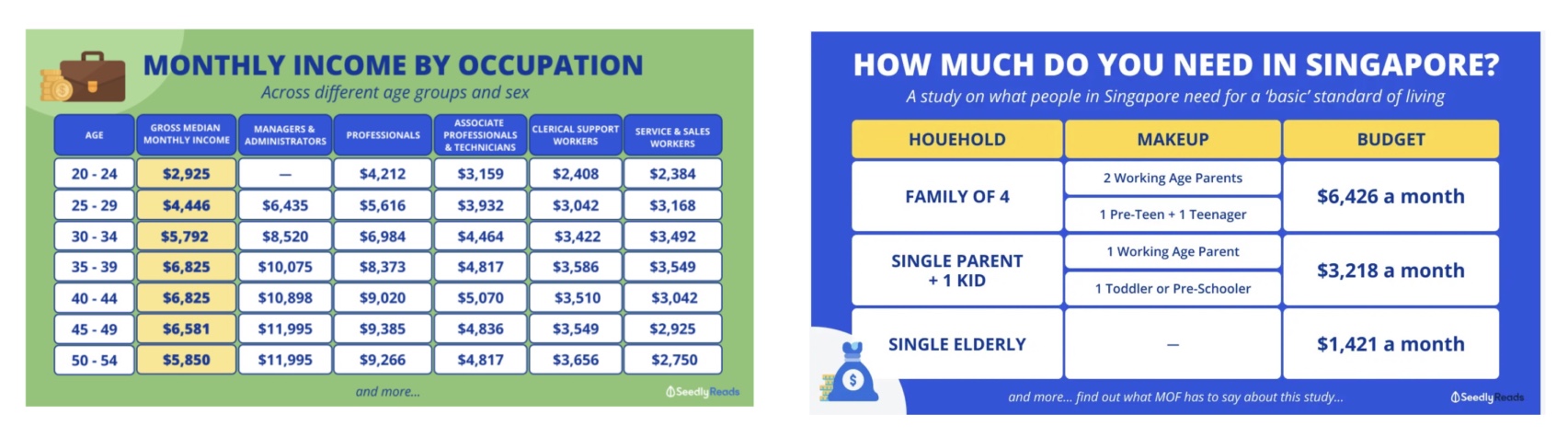
- The recent article state that the median income is $6,825 for age 35 to 39.😲
- However, when i look at job ads is more in the range of $5,792 per month, or maybe i took a wrong career path? 😭
So i should use $5,792 for my calculation instead.😅
EXPENSES
- A single person monthly expense is about $1,421/mth (an article from 2021).
- However, i think it is still achievable even if you are married with kids and the bills are spilt 50-50 between you and your spouse.
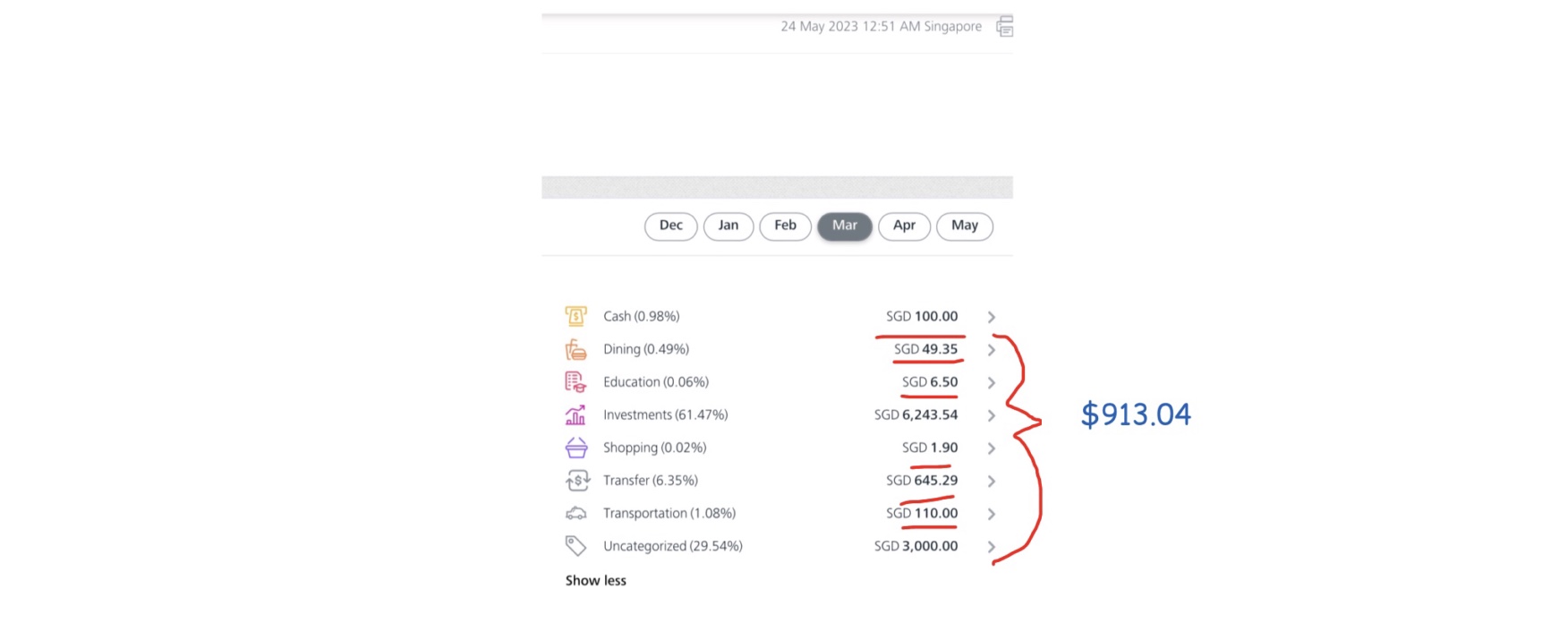
- I didnt really keep track religiously on my expenses because it is not my main focus in life. I just have a simple lifestyle.
- But based on DBS NAV planner my monthly expenses vary between $800 to $1200.
- Thus, i should use $1,421/mth in my example.
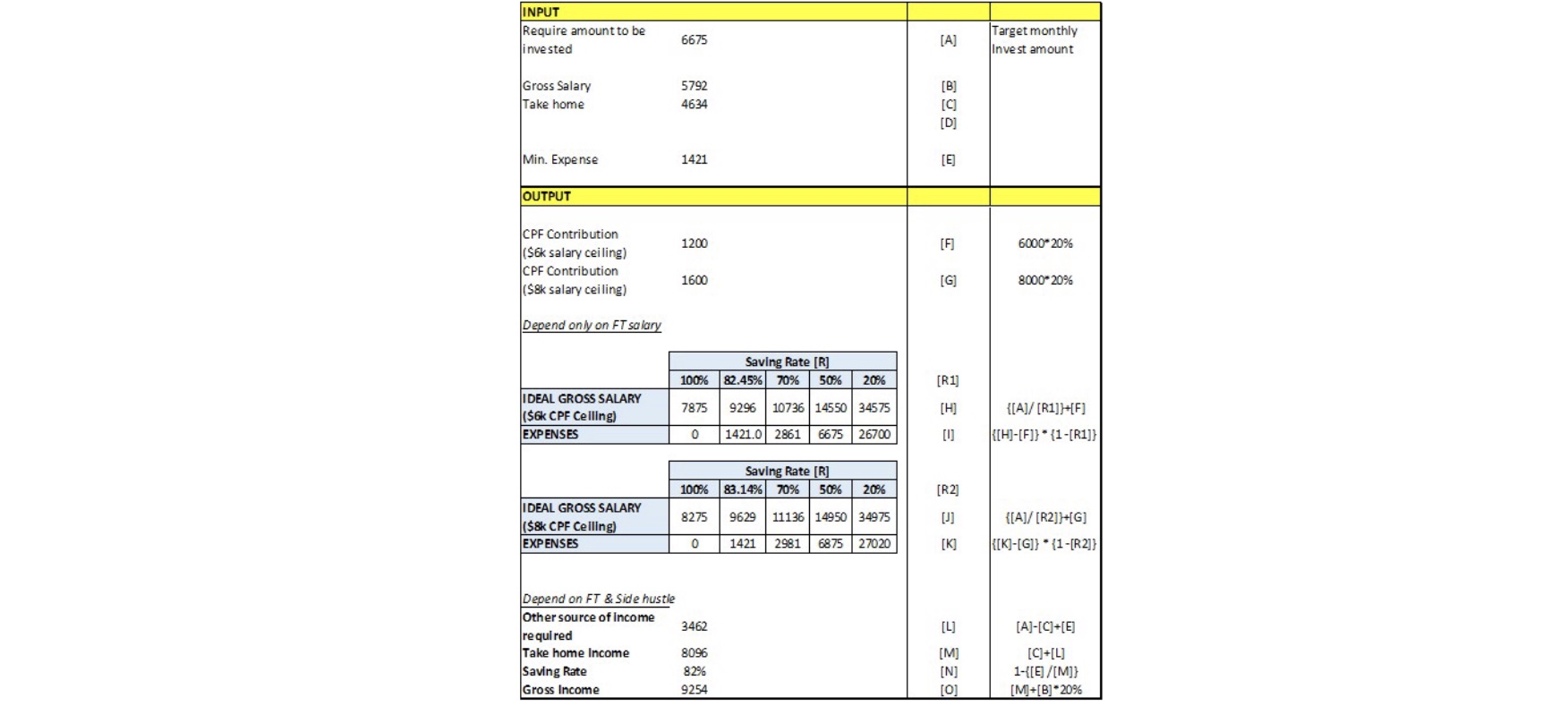
- Able to invest $6,675 per month, the income will definitely hit the CPF salary ceiling.
- Currently, the ceiling is $6k and will be progressively rise to $8k.
- This mean to invest the same amount in the future, the gross income and saving rate will need to increase.
Attaining FIRE will be more challenging, but retire at 65 will be more secured.
- Based on calculation, in order to achieve $1 million portfolio in 10 years. Having a min. $8,096 take home income and saving rate of more than 80% is a basic requirement.
If we work a 9 - 5, we will need a gross salary $9,296/mth and you need to save at least 80%. How many can achieve that kind of salary in their lifetime? 🤷
- If we have a take home pay of $4,634, there will be a gap of $3,462.
- Side hustle may narrow the gap, based on experience as a part-time delivery rider bringing home $1.5k to $2k per month consistently is achievable.
- Side hustle / self-employed CPF contribution is not manatory, that is a definitely a plus point for me.
- There may be other more profitable side hustles, but may require skill, taking risk, starting capital.... etc. But it cannot be easily replicable by others and the amount of money earned will vary widely.
- Thus for calculation sake, i will assume a side income of $1.5k per month. Thus narrowing the gap to $1,962.
- That bring us to next step to fill the gap.
STEP 5a: Build your Passive income
- There is always cap on how much you can earn for active income, if you working a 9 to 5.
- You may upgrade your skills and potentially get a higher salary, but it is still limit by the market rate.
- The only way to scale the income is to stop exchanging time for money.
- It can done either by having a scalable buisness or acquire assets that generate income.
- Not everybody is an entrepreneur, thus buying assets become a much easier option.
And in Singapore, we do not have to pay tax for dividend income.👍
- If your expenses is low, your dividend may exceed your expense even before reaching $1 million.
- But should you FIRE immediately? 🤔...... No! It will be unsubstainable long term because of inflation.
- However, this stream of cashflow may serve as extra safety net if needed, else always reinvest.
- You should continue to invest to close the gap.
$6,675 / mth is based on 4% p.a. compounded rate, dividend yield is typically 3% to 8% p.a., thus it is likely that you will be on track even the stock price stay flat.
- In addition, it will be easier to forecast the amount of dividend you will recieve, thus able to set a target every year, then track it.
- if you continue to DCA into your dividend portfolio (diversified), your cashflow will increase even in a bear market.
STEP 5b: Grow your Portfolio
- While building your passive income, you should also allocate some to US equities for higher returns.
Historically, the index return 8% p.a. but past result dont guarantee future performance.
Why not just all buy the index?
- There is this 4% rule. Achieving 25x of your annual expense. $1,421 x12 mth x 25 = $427,500 invested (~5 years)
But if your average dividend yield is 5% p.a. $1,421 x 12 / 0.05 = $341,040 invested (~4 years). if your yield is higher, you may reach the retirement sum even faster.
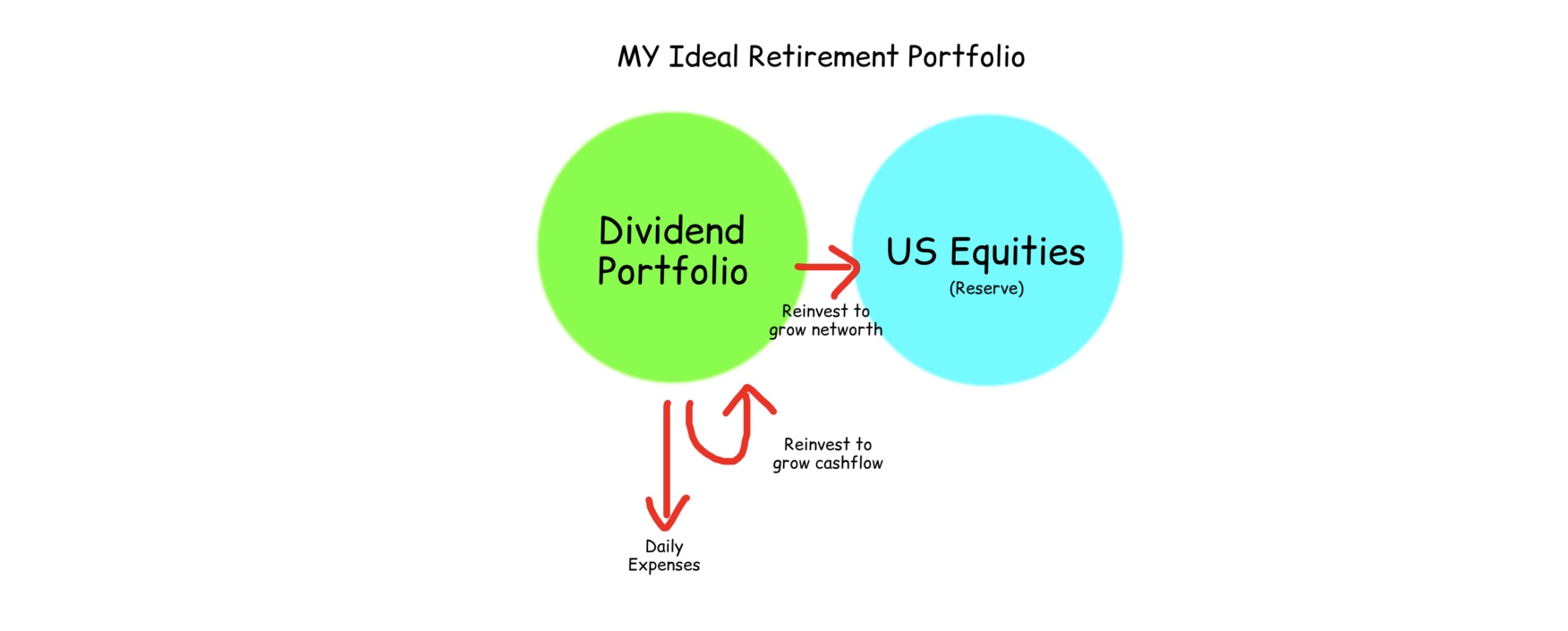
What will be my ideal portfolio look like:
- Essentially, i will want my wealth to continue to grow at the same rate even after retirement.
- In order to do that, i need to generate at passive income that is at least equal to how much i Invest before stop working, $6,675/mth is my magic number.
- $1 million may not be sufficient for retirement in 10 years time, it will worth lesser due to inflation.
Conclusions
- FIRE will only possible if you have high income + low expenses. Frugality alone is not enough and unsubstainable.
- Having a high income for a 9-5 job is not easy. With a side hustle + dividend investing it can help to bridge this gap.
- Currently, i am still trying to bridge the gap. So i will be able to invest at least $6,675 /mth consistently.
But will i able to achieve $1million stock portfolio in 10 years? We shall see in year 2030. 😅
Previous Review
Comments
236
0
ABOUT ME
Deal with your problem by being rich
236
0
Advertisement
No comments yet.
Be the first to share your thoughts!