Advertisement


OPINIONS
Portfolio Review - Jan-2022 (Crypto)
I don't wanna play with you anymore - Jerome to growth stocks & crypto
Full article on Substack can be found here.
December's crypto article on Seedly can be found here.
Crypto Portfolio 2021 Performance
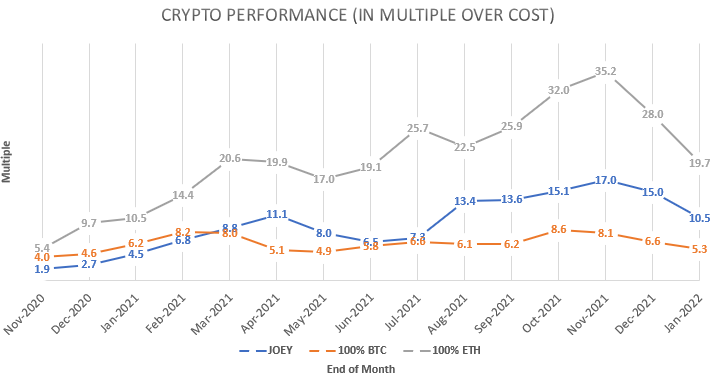
*Charts start from end of November 2020 when I started recording my crypto portfolio. Summarizing:
2020 performance: 2.7x-ed my portfolio
2021 performance: 5.5x-ed my 2020 portfolio
Lifetime performance: 9.8x-ed my cost
Lifetime result:
- Outperformed BTC by 2.02x (10.5/5.2)
- ETH outperformed me by 1.88x (18.5/10.5)
Goal is to continually outperform BTC and ETH from here on out. 👍🏻
===
% of Net Worth (direction change from previous month) in:
Stocks: 17.1% (🔼)
Crypto: 74.6% (🔽)
Net worth excludes fixed assets (e.g. house)
===
Crypto portfolio commentary
My crypto performance chart looked like it held up well in the face of altcoin obliteration but that was thanks to my CapEx into compass mining (more on that below), which I’ve valued at historical cost basis (paid about 7.7k USD/miner back in Jul/Aug 2021). That has become my main position as shown below:
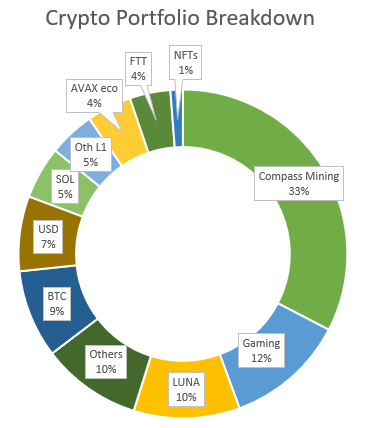
I’ve made quite a fair bit of changes to my portfolio. I’ll go through my thought process behind the main changes, which were influenced by the broader macro economy (i.e. rate hikes and quantitative tightening) as well as a shift into the P2P kind of investor mentality as opposed to P2E. Let me explain P2E P2P.
During 2020 and 2021, what got BTC to 65k was the influx of capital from retail and institutions. Even in 2020 there was only ETH for DeFi, SOL came later in the year. Then came AVAX and LUNA with anchor protocol. In 2021 the Fed put was still there. Money was dropped from helicopters (aka government). People had money but nowhere to put it. Capital flows further and further out onto the risk spectrum. Everything has gone up during that period.
P2E: Just like MMORPG games, you hunt monsters which are often too easy to kill. Without doing much, you can get an easy 2-5x. See $SOL in 2021 for a perfect example.
It’s a 1 ratio between capital inflow and capital required by crypto.
Fast forward to end of 2021 and 2022. I’ve lost count in how many Olympus-DAO forks exist right now. How many variations of Ape NFTs are in existence (and which are the authentic ones)? How many wannabe OpenSea competitors airdropped tokens to OpenSea users trying to conduct vampire attacks on OpenSea? How many GameFi tokens raised money via the IDO wanting to be the next AAA game on the blockchain? How many alt L1s can we do our DeFi business on?
There’s no kind way to put it. Current # of projects that demand investor’s attention amount of capital inflows into the space. It has become a rotatoooors game now, trying to find the next niche _or _retail trap project that will turn into a winner.
Related, great read by Cobie here.
Hence, with the MMORPG example, now you are fighting against other players. Should you choose the wrong project to _ape _into (i.e. $TIME with the Sifu fiasco), your rebased token will become worthless faster than the rebasing period itself. We are all trying to _spot _the rotation and profit from it. Thus more effort is needed to actively read and hunt for the projects under the radar. Much more difficult than waiting for monsters to come.
===
Solana
Solana, for the better part of 2021, was the largest spot position in my portfolio. Everything seems _so _much clearer in hindsight but there were calls for Solana to hit $400, $500 per token at its ATH of $250. It takes a bear market to really understand cycles and how reflexive things can be. It dropped to a YTD low of $82. Now at $90+.
I sold my first stacks (which I held throughout H2 2021) of SOL in the $160 price, then subsequently more and more. While the fundamental thesis hasn’t changed (which is to be institutional grade NASDAQ in the blockchain space), the macro sentiment weighed quite heavily in my mind (as explained above). Retail flows had also exited the building for 2022. It also didn’t help that Solana had network issues that occurred during a crash which made DeFi activity like liquidations much more painful. It’s worth noting that ETH doesn’t get congested bc you just pay higher fees. Solana has constant fees, so throughput is constantly stressed and it proved to be too much in recent weeks.
Right now, it’s also just 1 of many alt L1s that can potentially _onboard _the next million users into crypto (though have seen encouraging signs from it’s mobile phantom wallet). In light of this, I took some profits on the way down and rebalanced accordingly into other alt L1s like Harmony One (more on this later), Fantom and NEAR.
In reflecting over this rebalancing, something kept resurfacing in my mind:
Unrealized gains are not the same as profits.
What’s the point of sitting on a mountain of unrealized gains? Especially when crypto is such a volatile and reflexive asset; prices moon and crash all in a span of 1-2 months. By the way, I’m still working a full-time job. I’m still in the G in WAGMI.
Hodling for the long-term is a sure way of turning into a bag holder in an industry where solutions from 2018 are nearly extinct and irrelevant. My rebalancing into other alt L1s is a bet on the future where users don’t really know (or care) which chain they are on. In the back-end, the protocols do all the necessary bridging for them. All will grow, and some will grow faster. I am no oracle, so my strategy is more of an index play, weighted based on my conviction.
To be transparent, my alt L1 positions (in order of size from biggest in mcap):
LUNA SOL AVAX (incl XAVA/JOE) FTM ETH NEAR ONE
LUNA has an added catalyst in UST which I think deserves a higher allocation in the alt L1 play.
Added ETH as a benchmark and hence will denominate more in ETH (+ owning more ETH through my crypto plays).
===
Olympus DAO forks
While the $TIME craze had warped into hyper drive with Dani of Frog Nation, I too had been over exuberant with other such forks, putting about 1k into another similar protocol Snowbank ($SB). I think this month has brought such rebasing tokens into the forefront of CT and exposed a huge blind spot. How_ authentic _is 80,000% APY? We aren’t ALL going to be millionaires for sure, so what will give way? Price did. I bought my first chunk of TIME back in the 4k to 6k region. End up selling it all at 2k. For SB, I was lucky enough to escape with only a small loss.
In essence, such protocols require constant inflows into their treasury to offset the expansion in supply from the rebasing. At the height of this craze, many protocols were valued at a multiple of their risk-free value (which should exclude their own token e.g. TIME). As price cratered towards 1x multiple a negative feedback loop ensued. TIME (or wMEMO or wonderful memories) is now valued at ~$500. More like worse memories.
See here for what I mean by multiples:
https://twitter.com/DegenSpartan/status/1481896573290553345?s=20
Notably, near to the end of Jan, it turns out that 0xSifu (CFO of wonderland’s treasury) was actually a co-founder of QuadrigaCX which collapsed after the founder ran away with the money. Very bad look for Daniele & co. Related threads here and here.
https://twitter.com/zachxbt/status/1486591682728673282?s=20&t=CCADqjMPf94NOApSX7wY0w
The info on the Wonderland fiasco was also posted on seedly here.
I am thankful that I sold before it cratered. Suffice to say I’ve experimented enough with such tokens to know that it’s a Ponzi scheme (though we can say that for all of crypto).
===
Gaming
I also want to clarify my position/perspective on gaming tokens. Generally speaking there are 2 main categories: Pure play gaming tokens ($AXS $PYR $JEWEL) and gaming guild tokens ($YGG $MC). Within the former category, you have some games with an inflationary token (i.e. $SLP for Axie, $ATLAS for Star Atlas) that is designed to support in-game activity & mimic real world economies with the assumption of linear game activity growth over time. You have other games that require their base token (e.g. $JEWEL) to perform actions in the game such as summoning heroes.
I remain very bullish on GameFi as I think it’s ties in _very well _with the gamer community at large (especially in 3rd world countries w/o 1st world country’s work opportunities).
People spend hours on end on Twitch looking at eSports athletes play their favorite games like CSGO, PUBG or League of Legends. eSports championships has already reached many million viewers. A sure sign of things to come as more and more teenagers get onboarded onto games (as they naturally do).
The base assumption is that there exists a generation of global gamers often daydreaming about making a living out of gaming. Imagine such a user earning above minimum wage in their local town whose median income is below the poverty line, all from their mobile phone?
Take that and merge GameFi (i.e. play-to-earn) + scholars (i.e. getting capital upfront to play the game; rewards split between guild and yourself). The end result is (hopefully) a self-sustaining ecosystem of guilds earning yields from scholars + scholars themselves playing to actually better their real lives in the real world though the rewards earned (which can be sold for USD). It’s already happening with Axie and people in the Philippines, and that imo was a successful experiment of retail/global adoption which I think bodes extremely well for the future of blockchain gaming.
The latter category is gaming guild tokens. It’s still a nascent space, many guilds like Yield Guild Games, Merit Circle, Rainmaker Games, Metaverse Mining Alliance have just raised funds via a pre/public sale of their tokens. Everything seems rosy and these guilds/platforms are also aggressively onboarding scholars and games to earn more yield. Price should moon, right?
What’s the catch?
Token emissions. See the below:
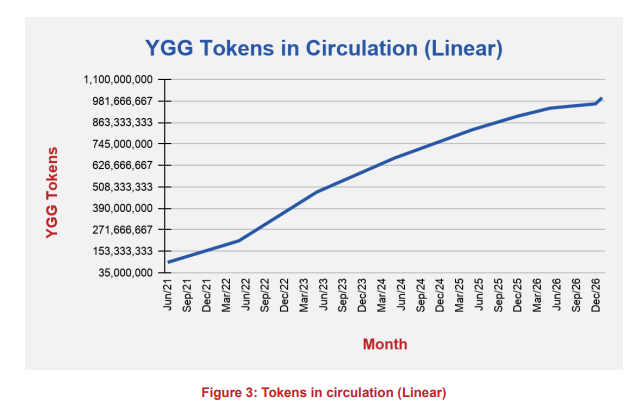
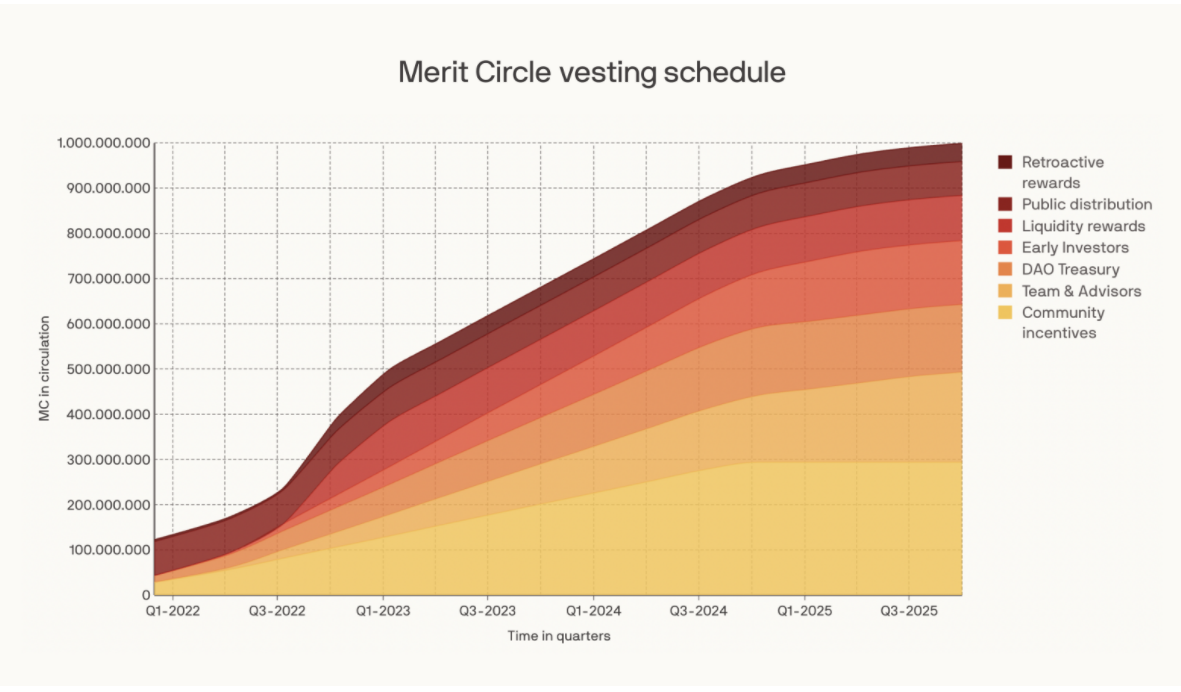
Just see the gradient of the slope. Also side note: seems like all the guilds decided that their max tokens should be 1 billion? lol.
Anyway, you can see why the gradient is important. You, a loyal supporter of the GameFi space, also bought into the LBPs on Balancer protocol for these gaming guild tokens. Without doing anything, your token will get massively diluted (about 1/8 to 1/9 in proportion of supply) by the end of the emissions curve (~3-4 years); Correspondingly, supply will roughly 8-9x.
In such cases, you are often forced to accept some Impermanent Loss (IL) to get the highest yield via LP on your existing spot tokens (by locking it up for 1 year) just to stay ahead of inflation. This is the catch. In a bull market we are none the wiser and as long as price goes up, we’re close one eye on this. But in a bear market, as price crashes + your token is diluted (due to selling pressure from unlocked tokens), how much further can your token price crash?
Answer: another 99%.
Of course, I hope it doesn’t turn out this way. I’m already in both LP and staked positions for 12 months to earn the highest yields. For me, while the trend is likely to be down (assuming no new retail inflows etc. and no positive catalysts), it is unlikely I can time the bottom with great accuracy (though it may just be an accumulation range). The optimistic side of me thinks that in 1 year my cost basis will have dropped substantially (from the farmed tokens) and that the market price will be higher from where it is now.
We’ll see. If it’s materializes, then good. Otherwise, I’ll move on. Everything is a bet & we can’t win them all.
TL;DR: Gaming tokens have higher upside but requires more effort to evaluate each game -_ _which one will be the next Axie, gaming guild tokens requires demand & inflows to offset dilution.
===
Other activities
During the month, I’ve also bought and sold some stuff because I was experimenting with the ecosystem. I’ll also try to highlight some to share the extent of my experimentation in the various ecosystems to highlight some protocols in case you’re curious.
Yield Guild Games: Sold. For the reason described above in the gaming section + for the fact that it is bigger in mcap. I rebalanced into other related plays like JEWEL and PYR.
Octopus Network: A infrastructure play. Basically it’s a blockchain-as-a-service, allowing dapps to spin up their own blockchains while Octopus handles the infra and necessary inter-chain communication with larger chains. Am holding spot tokens on my NEAR wallet (can buy via Ref Finance). Watch this video (founder of OCT) to learn more.
Pocket Network (POKT): Similar infrastructure play. Pocket Network wants to be the TCP/IP protocol for the Web3 infrastructure. Read Ansem’s Substack to find out more. Currently staking my tokens with Poktpool which allows for fractional staking.
GenesysGo (SHDW): Similar to Pocket Network but primarily focused on the Solana blockchain. Currently lending my spot tokens on Francium for yield.
Platypus Finance: This protocol is a stablecoin farm based on the voted escrowed token model. Essentially you lock up your tokens for voting power and the proportion of voting power vs total will correspond to your farm apr. If you don’t continuously stake those earned PTP tokens (you earn PTP by farming PTP/AVAX or by putting stables into the farms with PTP staked) for vePTP, your proportion will slowly reduce which will also reduce your APR. You will never be able to beat whales that have bots that do the compounding for you. So you’re already a non-winner, and that’s before the emissions (PTP/AVAX was yielding 500%+ APR at some point) dilute your holdings further. Sold at about 50% loss, though am still linearly vesting PTP tokens (which I will sell) on a monthly basis up till EOY 2022 from Avalanche’s launchpad.
Etherprint: I’ve only got a small bag (relative to my portfolio) as a degen play. It’s a token that has no utility (as far as I can tell). Buying ETHP requires the buyer to pay x% in taxes. 5% was paid in Ethereum to existing holders. 2% to operations, 1% to marketing. Previously I think the refractions paid to existing holders was in the teens. This is essentially earning yield on volume. If volume is low and there’s only sell pressure, unlikely your price depreciation will be offset by refractions earned. Sold at a small loss.
Cookie Game: A perfect example of Ponzi scheme. Note that I do not recommend anybody to buy NFTs of this game. Essentially, users first buy NFTs of bakers to bake cookies. From these earned cookies, they can be used to buy upgrades that improve the cookies per minute generated from your account. It doesn’t take long for the early adopter with loads of cash to win the game by simply buying the most OP item there is: Stand Mixer. Once the first user buys the stand mixer they can mint another mixer in 769 minutes or 12.8 hours (1.28 mil / 1664 / 60 minutes). The next mixer can be minted in half that time. Within 1 day the user can already mint 5, and it won’t be long until he/she mint them all.
Does it smell like cookies or ponzi’s in here?
 a.image2.image-link.image2-391-658 { display: inline; padding-bottom: 59.3062605752961%; padding-bottom: min(59.3062605752961%, 390.23519458544837px); width: 100%; height: 0; } a.image2.image-link.image2-391-658 img { max-width: 658px; max-height: 390.23519458544837px; }
The real cost here is the price paid (in AVAX) to mint the original baker NFTs. This project is a real piece of work. Experiment complete. 🤢
This is not an exhaustive list.
Compass Mining
I earlier remarked in my December article that running a miner is actually not as easy as setting up the rig and running the program. What is your program fails? Are you tech savvy enough to troubleshoot? What if your miner requires maintenance? How do you prevent it from overheating?
Times like these I’m glad I’ve got Compass Mining handling all of these for me. It’s been a sweet, sweet month mining more satoshis, but as with any endeavor, it has its ups and downs. I had 2 miners online from late December, but around early-mid Jan, 1 of them started going off and on. After several intermittent hashing periods (on off for a few hours), it finally flat-lined on 13th Jan. About 24 hours later, I emailed support. They said they will check with the ops team onsite.
After 4 more days, no word. I asked again. They said they will get back to me. After few more days, I asked. They said that the miner is in the troubleshooting queue. After a few more days (i.e. 30th night local time), my miner finally came back online 🎉🎉
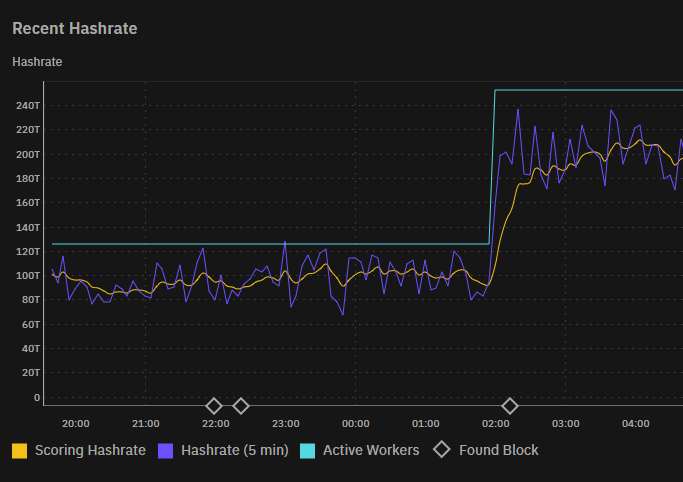
17 days of missed satoshis… No matter, at least the miner isn’t down and requires replacement of parts from BitMain themselves (which will take super long with shipping).
Anyway, this is just one of the problems you will face as you host your own rig (either via compass or at home). It’s not all smooth sailing, and with my problematic miner, how do you do technical troubleshooting? For now, I’m a happy customer of Compass Mining, and have just paid my second instalment of a mini-VIP bundle of another 6 miners, each of which should come online by mid-March (2 weeks delay due to logistics) then 1 month thereafter.
I am unlikely to purchase more miners unless the cost per miner drops sufficiently enough to make economical sense. That said, I think these 8 miners will mine me sufficient satoshis over their lifetime to deploy into other protocols, raise cash or just stack sats.
Here’s my miner tables that I created to track my outputs. About 0.025 in total since starting in late Dec + 1 miner offline for 17 days. Can’t complain eh? As mentioned in my previous article, due to delays, my miners’ hosting fees are waived for the first 12 months (hence the green cells in 2nd table). Hope this helps inform people on the economics of BTC mining.

===
Token holdings
Last but not least, my holdings not in order of size, degen plays (if any) excluded:
L1s: LUNA SOL AVAX (incl. XAVA JOE) FTM ONE NEAR Gaming: MC RAIN JEWEL PYR MMA (presale tokens) Infrastructure: SHDW POKT OCT RNDR HNT Large caps: BTC ETH Others: BASIS SD
===
Conclusion
Thank you for reading thus far. I do apologize for ranting in the articles I’ve written (like this one), and I acknowledge that it could have been more concise. I’m still only 11 months (wow) old in my writing pursuit. Hopefully I’ll evolve into a better writer (and thinker) in the future.
In the meantime, if you learned something from my journal, or if you have any strong comments, feel free to let me know :)
Your words of appreciation (currently measured in article views) means a lot to me. Thank you again.
Happy Chinese New Year! 🧧🧧 💰💰
Joey
Comments
220
-1
ABOUT ME
Crypto and Growth stocks investing with focus on thematic trends Aim: Achieved outsized returns over the long term.
220
-1
Advertisement
No comments yet.
Be the first to share your thoughts!