Advertisement


OPINIONS
Liquidity Is Power: Why I Refused to Become a Singaporean Millionaire
Are you building a net worth you can actually use, or are you just waiting for 65?
The "Handcuffs" of Security: Why I Ignored the Standard Singaporean Path
Most people look at a high CPF balance and feel secure.
I see handcuffs.
In Singapore, we are taught to worship the “locked account” — CPF balances, fully paid homes, structured retirement plans. The system promises comfort at 65.
But I don’t want a guaranteed future if it costs me a liquid present.
I value optionality over automation.
The Myth of the Singaporean Millionaire
In Singapore, being a “millionaire” is often deceptive. High property prices and mandatory savings mean many reach a million-dollar net worth by accident—but there’s a huge difference between having a million dollars and having access to a million dollars.
The Property/CPF Millionaire (The Sprint): Asset-rich, cash-poor. Wealth is locked in walls or behind a CPF statement. Achieve by drifting with the system. This is the default path.
The Financial Asset Millionaire (The Ironman): Fully liquid $1M, deployable at will. Hardest path because it requires consciously opting out of societal norms.
Becoming a net-worth millionaire in 10 years is a sprint, but becoming a liquid millionaire is an Ironman triathlon.

My Pivot: Starting at 36
I didn’t start as a fresh graduate. My journey truly began at age 36. By then, I had checked the “standard” boxes:
- Owned a BTO
- $200k cash surplus
- Zero investments and no stock portfolio.
While my peers were using their surpluses to upgrade to condos and lifestyle debts, I realized I didn't want my wealth in bricks. I wanted $1M in liquid assets within 10 years.
The Architecture of the "Default" Trap
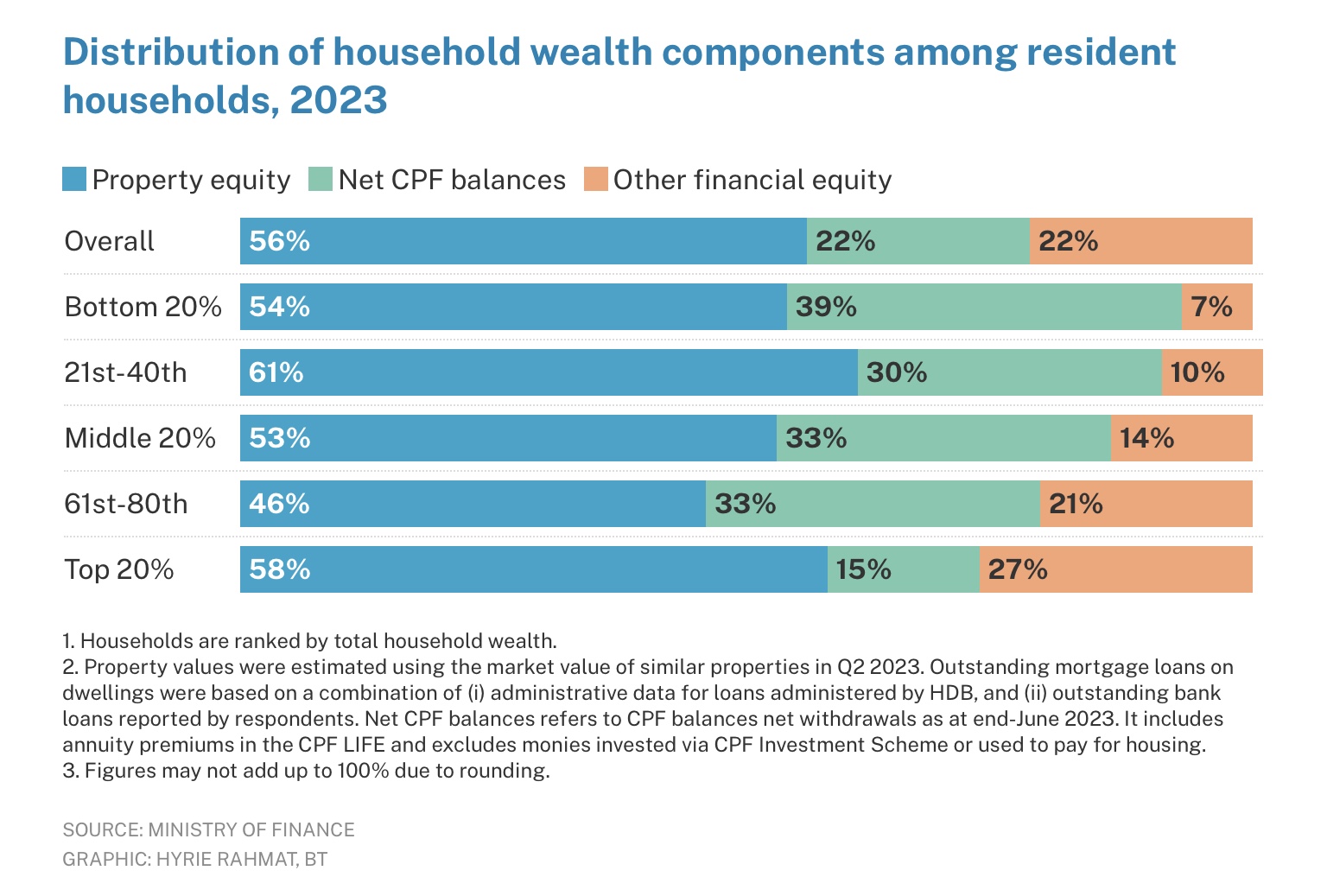
Property assets make up over 50% of the average Singaporean household’s net worth. Among the three major wealth sources—Property, CPF, and Financial Assets—the third is almost always the smallest.
By design, the system funnels your wealth into the first two. If you follow the standard path, you’ll eventually hit a million-dollar net worth—but you’ll be handcuffed to your home and CPF. True optionality requires intentionally growing the bucket most people ignore: financial assets.
Liquidity Audit
Stop looking at your Net Worth statement. It’s a vanity metric. Instead, calculate your Liquidity Ratio:
Liquidity Ratio = (Cash + Stock + Bond) / Total Networth
- Standard Path: < 15% (You are handcuffed to your job and your home).
- The Ironman Path: 50% (You have the power to walk away).
Net worth is a vanity metric. Liquidity is power.
Liquid Wealth Conversion Efficiency (WCE)
Liquid WCE = ∑(Surplus Income * Liquidity Multipliers) / Gross Income
Cash = 1.0 (Instant access; no volatility)
Stocks/ETF = 0.9 (Accessible in 2 to 3 days; subject to market drop)
CPF-OA = 0.3 (High mental value; no liquidity before 55)
Investment property= 0.2 (Take over 6 month to sell; high transaction cost)
CPF-SA = 0.1 (Essentially "Locked" money)
Residence property = 0 (Selling it required moving out)
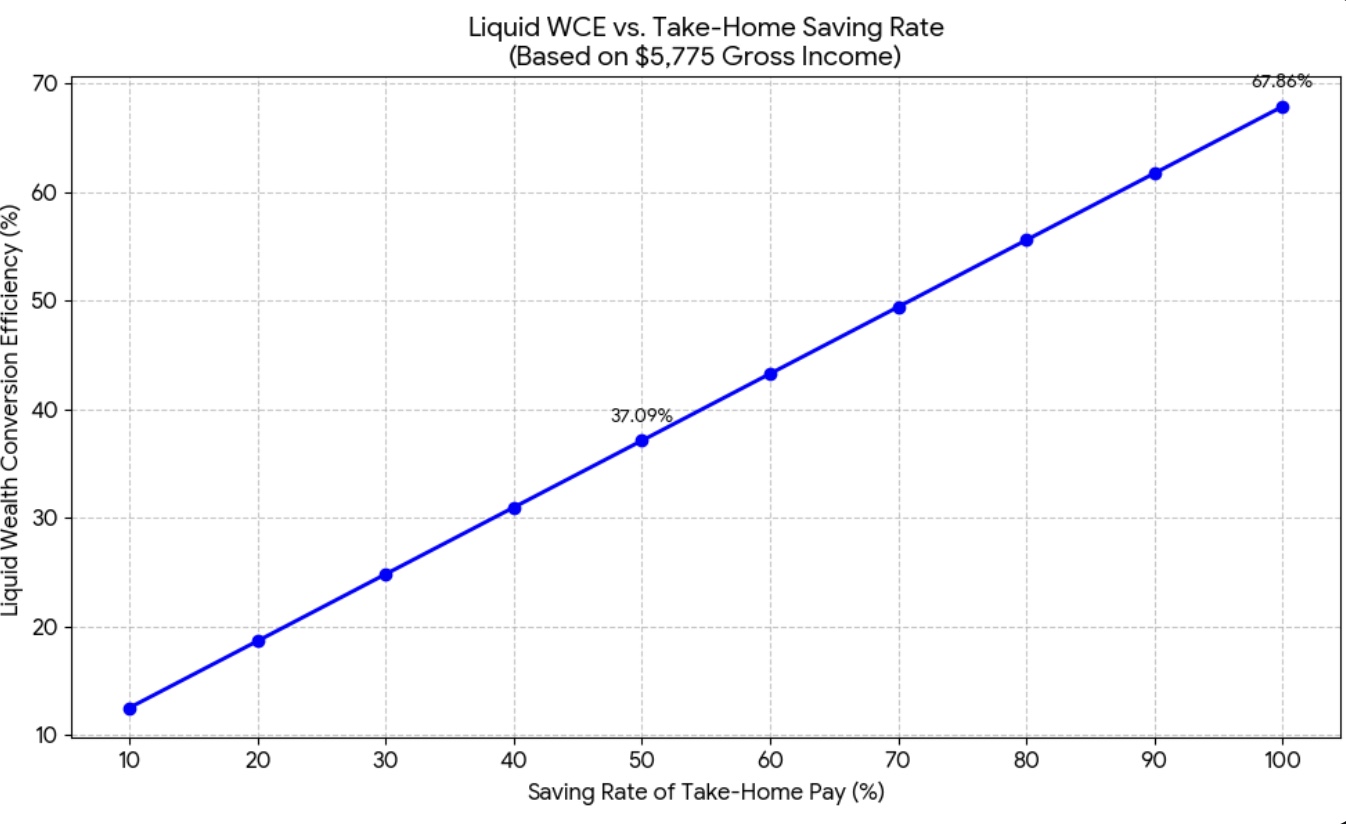
Saving Rate VS Liquid WCE
Most people find that once their passive income covers their lifestyle, they stop caring about WCE and start focusing on Net Worth Velocity
The Math of the “Impossible” Gap
Most advisors say: “Save more.” But for a median Singaporean earner (~$5,775 gross/month), the math is brutal:
- Take-home pay: ~$3,948 (after employee CPF)
- 50% savings rate: ~$1,974/month
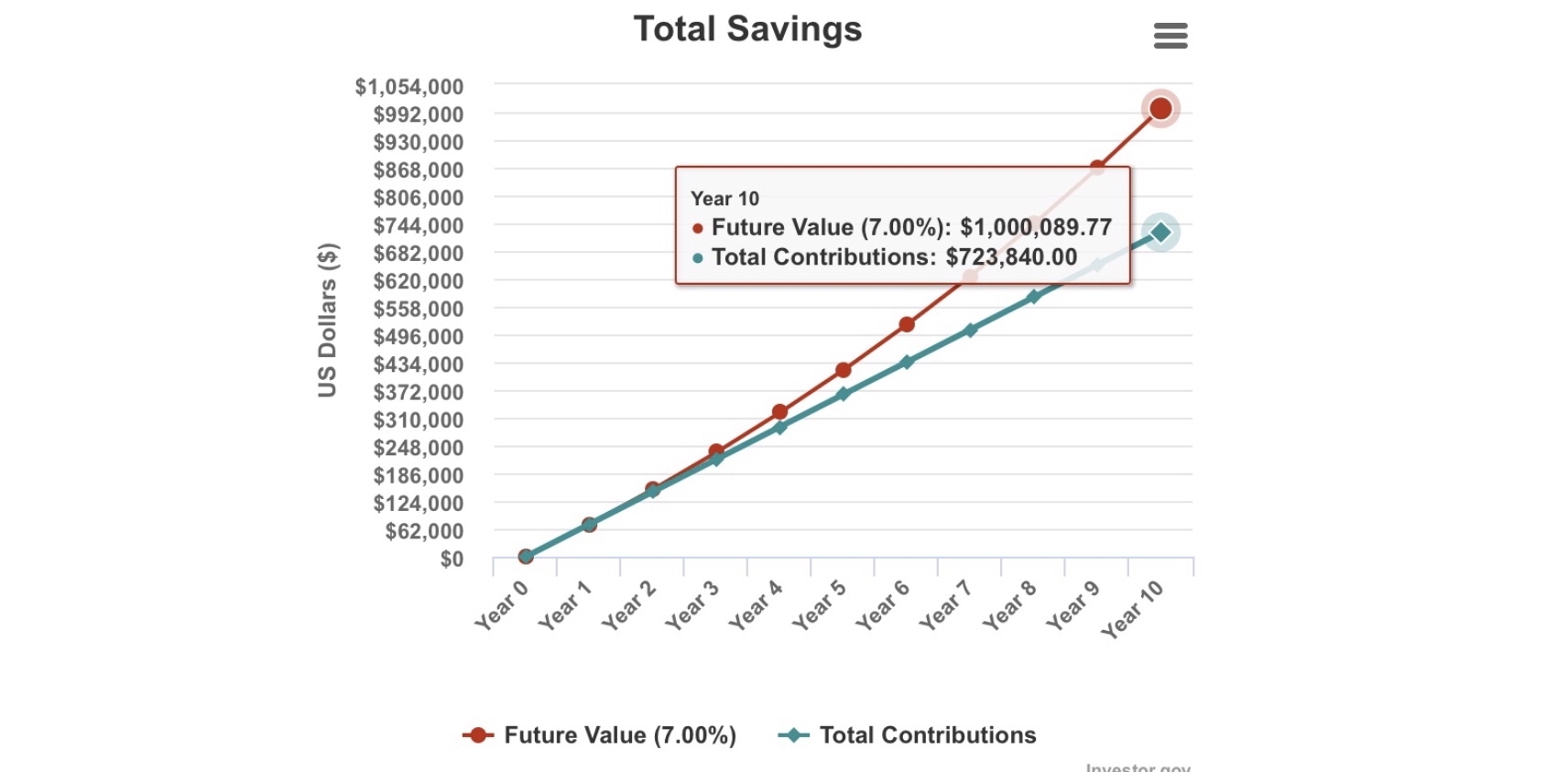
- 10-year result at 7% p.a.: ~$330,000
To reach $1,000,000 in 10 years at 7%, you need to invest $6,032 every month if start from $0.
- Monthly gap: $4,058
Cutting lattes or hawker stalls doesn’t close this gap. You must earn and leverage your way across it.
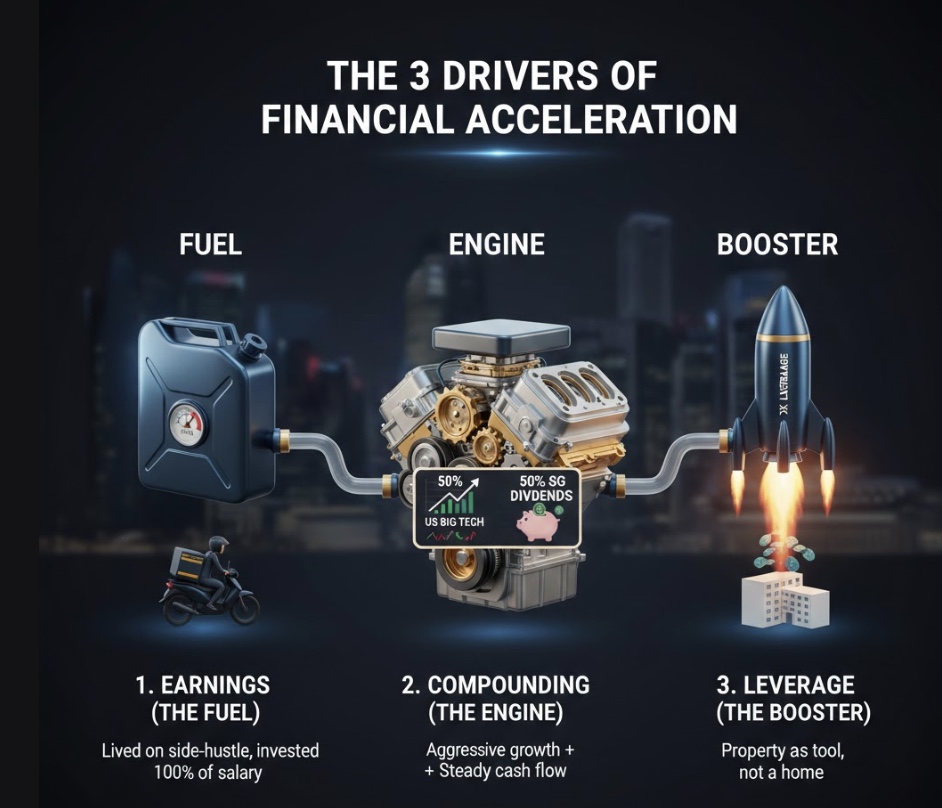
The 3 Drivers: Fuel, Engine, and Booster
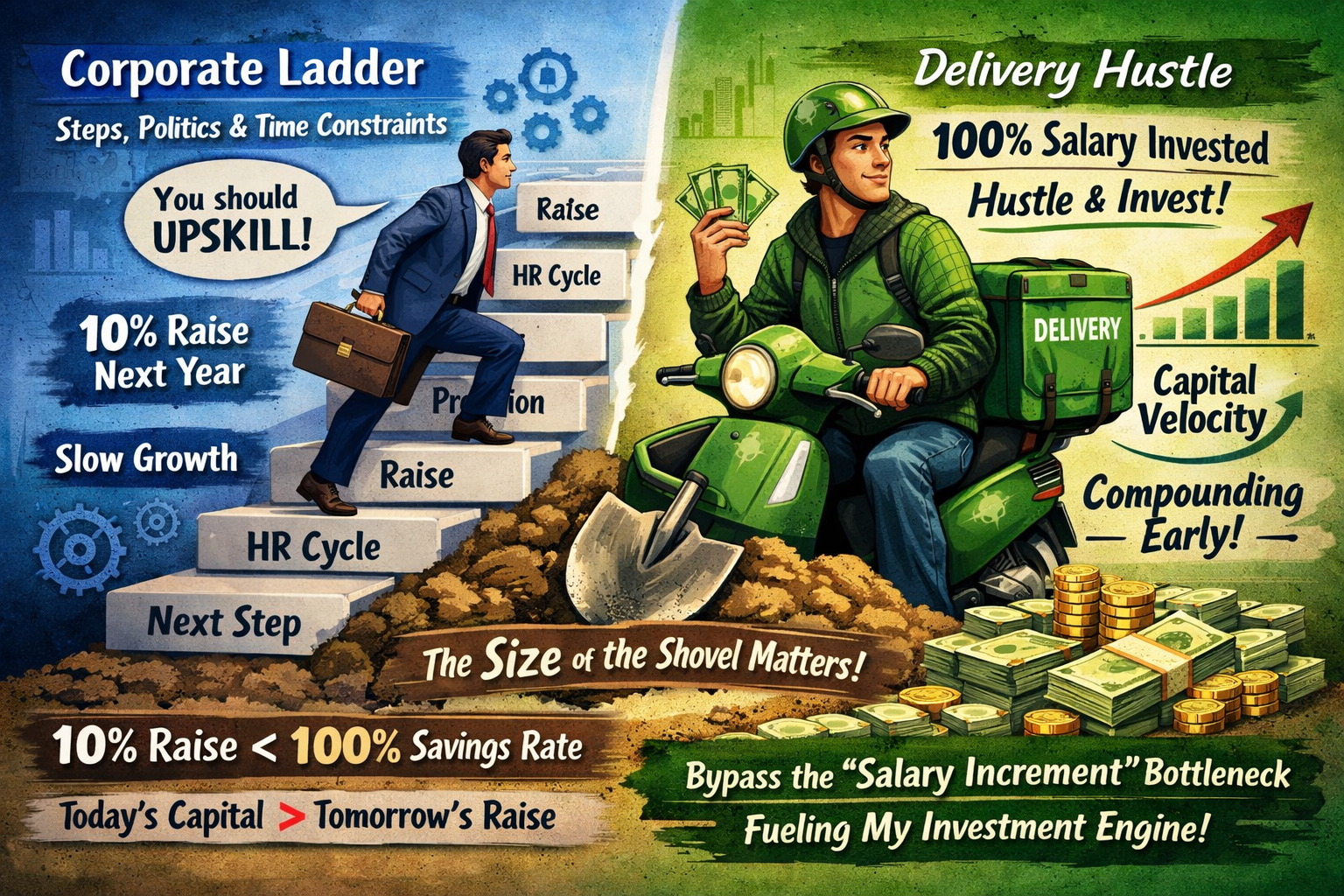
1. Earning (The Fuel) – The 100% Investment Rule
I took up food delivery alongside my 9-to-5. I lived entirely on delivery income and invested my full corporate salary. I am not just hustling harder but I have changed the Capital Velocity.
By living on delivery income and investing 100% of my corporate salary, I front-loaded compounding. I didn’t increase my savings rate — I eliminated lifestyle from the equation. In compounding, the size of the shovel matters as much as the length of the road.
Critics said I should "upskill" instead, but delivery paid me today—and today’s capital compounds faster than a future promotion. The "upskill" crowd isn't wrong about long-term ceiling, but they ignore velocity.
The corporate ladder has "steps" (Promotions) that are often gated by time, headcount, HR cycles, corporate politics and market adjustment.
Most "upskillers" forget that a 10% raise next year is worth less than a 100% savings rate today when compounded at 7-10% over a decade.
I bypass the "Salary Increment" bottleneck and create a surplus of "Fuel" for my investment engine.
2. Compounding (The Engine) – The Barbell Strategy
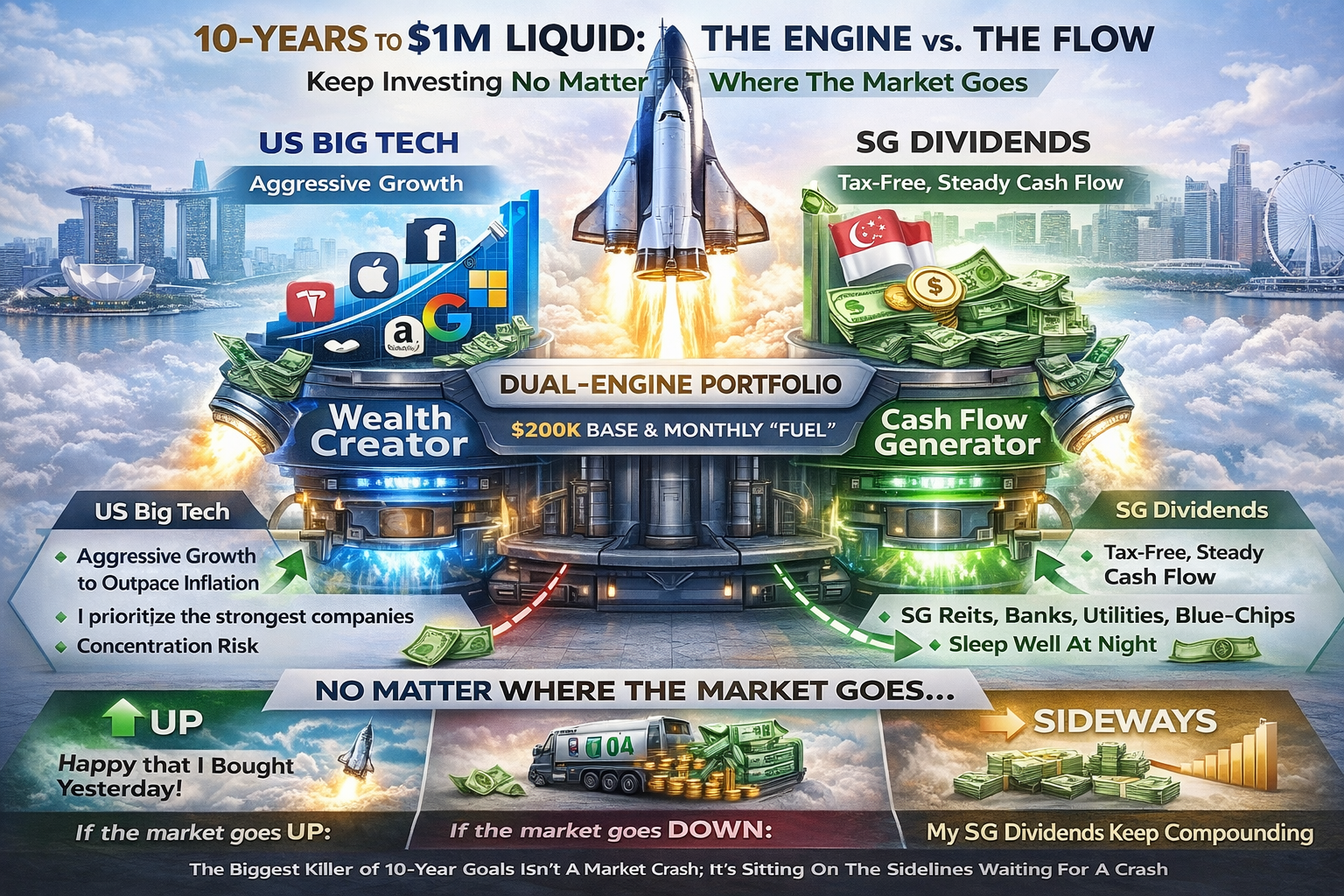
My $200k base and monthly "fuel" go into a dual-engine portfolio:
US Big Tech: Aggressive growth to outpace inflation. This half is my Wealth Creator. I prioritize the "Magnificent 7". I choose concentration risk on the companies with strongest moat.
- SG Dividends: Tax-free, steady cash flow for the "Sleep Well At Night" factor. This half is my Cash Flow Generator. In Singapore, this is my "Synthetic Salary" that is 100% tax-free; Singapore’s 0% capital gains and dividend tax is a massive tailwind that most people underutilize.
To hit a $1M liquid goal in 10 years, the Structure is only half the battle; the Flow is the other half.
The biggest killer of 10-year goals isn't a market crash; it's sitting on the sidelines waiting for a crash that doesn't come.
- If the market goes UP: I am glad I bought yesterday.
- If the market goes DOWN: My monthly "Fuel" (Delivery + Corporate Salary) buys more shares at a discount.
- If the market goes SIDEWAYS: My SG Dividends keep compounding.
3. Leverage (The Booster) – Absolute Minimum Cash Rule
I treat property as a financial instrument, not a "forever home." This is where I use the system's greatest gift: 4x Leverage.
In Singapore, a 25% downpayment allows you to control a $1.5M asset with only $375k.
I follow the ‘Absolute Minimum Cash’ rule: just 5% Cash + 20% CPF, the legal minimum to control a property, keeping my real money on the front lines.
- The Logic: CPF is an illiquid credit system. By draining my CPF OA and hoarding my cash, I trade "trapped credits" for a leveraged asset while keeping my "Real Money" on the front lines.
- The "Rental Shield" Buffer: When I sell for a profit, the excess stays liquid. It does not go back into the market or the next house. It sits as a cash buffer. If a tenant leaves and the mortgage is due, I don't panic or sell my stocks; I pull from the buffer. This ensures the property never cannibalizes my investment engine.
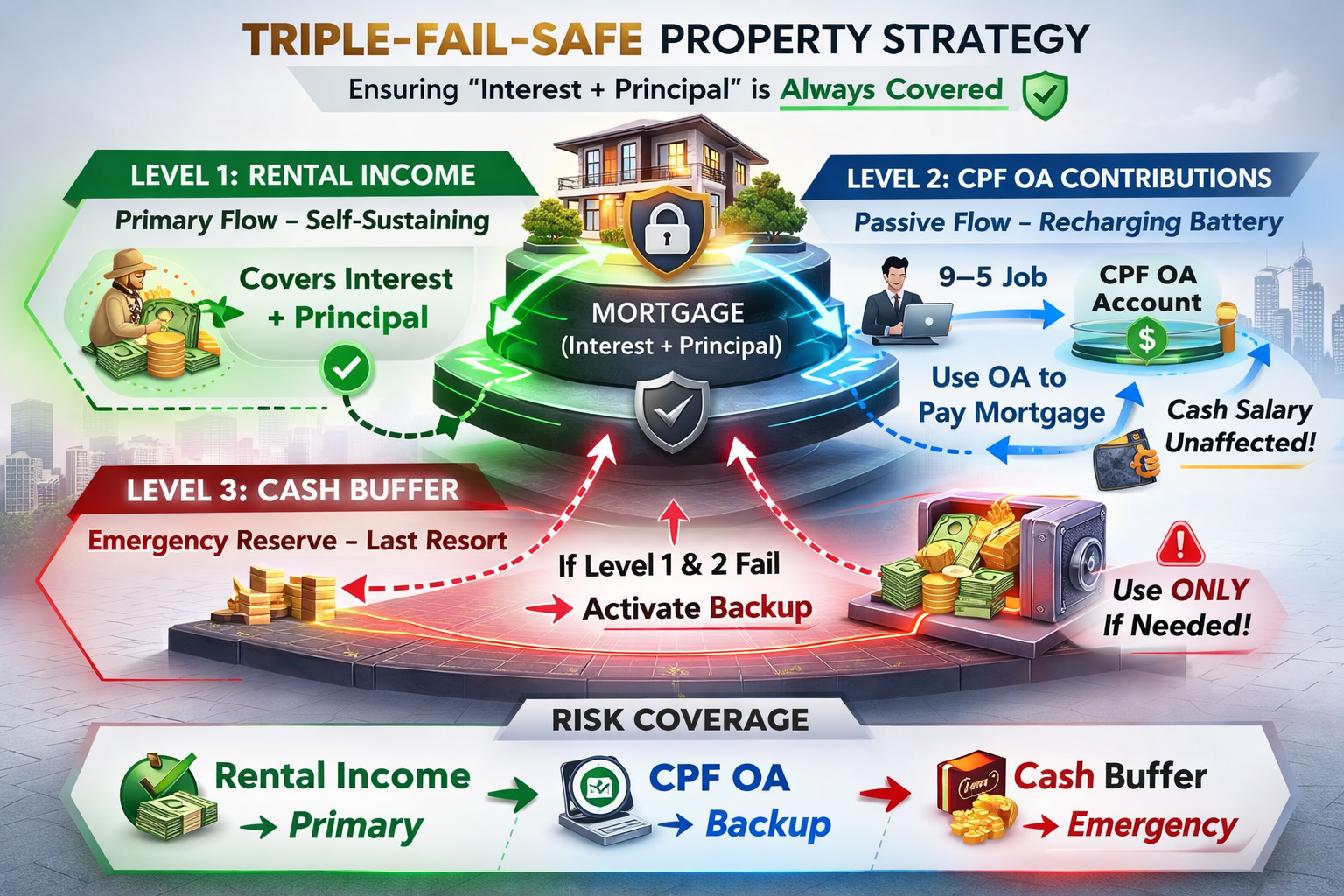
Risk Management I engineered a Triple-Fail-Safe architecture.
- Level 1: Rental Income (The Primary Flow): This covers the "Interest + Principal." It makes the asset self-sustaining.
- Level 2: New CPF OA Contributions (The Passive Flow): Since I am still working 9–5, my OA is a "recharging battery." Using this to pay the mortgage is the most efficient move because it keeps my Investment Fuel (Cash Salary) untouched.
- Level 3: Cash Buffer (The Emergency Reserve): This is my "Sale Proceed" stash. It only gets touched if the tenant leaves (Vacancy Risk).
Conclusion
I’m not just building a portfolio — I’m building exit velocity from a system designed to keep me productive until 65.
I re-engineered my life’s balance sheet. I stopped treating the Singaporean system as a rulebook and started treating it as a toolbox. The “handcuffs” became a ladder. If you’re willing to challenge the default path, optionality can be yours too.
By year six, I crossed $1 million liquid assets at 42.
I’m staying the course. I’m not targeting “retirement” — I’m targeting irrelevance to mandatory work by 50. I wanted to build margin of safety.
The math is brutal. The discipline is repetitive. The reward is freedom.
This strategy is not safe. It is asymmetric. It concentrates risk early (income risk, market risk, concentration risk) in exchange for optionality later. I accepted volatility in my 30s - 40s so I don’t have to accept dependency in my 60s.
Comments
216
26
ABOUT ME
Deal with your problem by being rich
216
26
Advertisement
No comments yet.
Be the first to share your thoughts!