Advertisement


OPINIONS
Let's Talk About Diversification
Feeling less painful when the market is down
Jared Lee
Edited 30 Nov 2021
Finance at Murdoch University
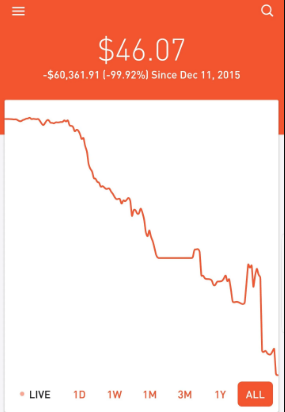
Ever had a day you open your trading account or portfolio tracking app only to find out that your portfolio is in the red:
Source:
Yeap... Not pretty.
What is diversification?
We’ve all heard this word, some of us practice it, and some of us don’t due to other reasons such as a lack of capital. But what does it mean to be diversified?
A textbook definition would be to allocate capital across different asset classes (stocks, bond, precious metals, Crypto(?)) or for stock investors, across different regions, markets, and industries
At the end of the day, it’s about not having all your proverbial eggs in one basket.
Why diversify?
Diversifying allows us to protect our portfolio against market volatility and downturns because typically, different sectors perform differently as their correlations are lower, so they move differently. (Tech is up 1%, Financials down 0.5%)
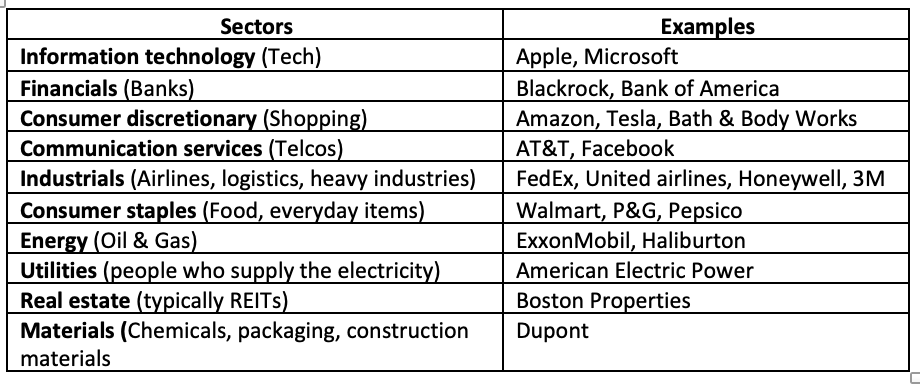
Introduction to the major sectors of the S&P (or similar market index)
Before we discuss about how we can diversify, I think it would be helpful to know the different sectors that we commonly see in these market index and some companies within them.
The S&P comprises of 11 sectors:
Source:
How to diversify?
To diversify is to spread out portfolio exposure and risks across different companies. Therefore, one way to diversify is to buy stocks encompassing the 11 sectors.
But wait, wouldn’t buying the S&P 500 be easier?
“BINGO!”
What if I picked my own stocks?
Here’s where things get a little bit tricky. While it’s important to diversify, it’s easy to fall into the trap of ‘indexing’ which means, buying the same stocks as the S&P 500 because one can just buy an ETF tracking the S&P 500 for less in transaction costs and having to rebalance, incurring even more transaction costs.
Here’s a hypothetical investor’s portfolio may look like especially after seeing all the high-flying growth and tech stocks outperform the market last year:
Google – 1 Share
Tesla – 1 Share
Microsoft – 3 Shares
Amazon – 1 Share
Apple – 10 Shares
Hypothetical Year to date performance of our portfolio is shown below:

Basically, we've outperformed the S&P with 39.02% instead of the index's 27.14%
Sooo....... What’s so bad?
Everything seems to be looking great! But what happens if we go into limited pullback/correction like one we’ve seen at the start of the year:

Sources:
Price Data: Yahoo Finance
Instrument used: SPY
On this particular day (March 8th 2021) our portfolio was actually in the red, -3.55%. This means whatever gains we had at the start of the year? Gone. The S&P on the other end? Still up by slightly more than 1.5%.
Volatility
Also, one should keep in mind the volatility of the portfolio. Basically, risk is measured by volatility. This is measured using the price movement; therefore, the more price moves in a stock, the higher the volatility (Hence more ‘risk’).
Therefore, an index will always have lower volatility compared to individual stock picks due to the lower weightings of each stock in the entire index (the top 10 companies in the S&P 500 only took up between 1-6% of the total index each)
Which means, if you had a portfolio you picked on your own that returned the same amount as the S&P 500 this year, chances are you could have just bought the index, enjoy the same return and also take on lesser risk.
Diversification
Using our hypothetical portfolio, it would then make sense to diversify your holdings by either:
Adding more companies to our portfolio (There is no widely agreed number, but academics tend to be in congruence that about 50 companies would do the trick)
OR
Just buy the index.
Option 1 would seem to make more sense if an investor has a huge amount of capital to deploy but then there’s the problem of picking the right stocks. Therefore, an approach that makes sense for most investors would be to buy an index, which allows greater exposure to market-wide returns while managing risks more effectively.
Comments
866
0
ABOUT ME
Jared Lee
Edited 30 Nov 2021
Finance at Murdoch University
I like Investing
866
0
Advertisement
No comments yet.
Be the first to share your thoughts!