Advertisement


OPINIONS
Joey's Investment Journey - Equities (Sept 2021)
Being transparent and providing commentary on my crypto and equities portfolio, as well as my future moves.
Hi Seedly folks 👋
I have been posting about my crypto and equities portfolio for about 6 months now on substack. In the spirit of transperancy, I'll also share an adapted, concise version on Seedly below so that people can understand where my viewpoints and perspectives on Crypto and Equities come from.
This article focuses on my equities investments, which are mainly oriented towards growth stocks. As this is the first post, it will also be slightly longer to explain how I approach my performance review + my holdings.
Over time, I will also include interesting reads I've encountered over the month, as well as attempt to reflect on my past decisions made; What I have done well (or not so well). Self-reflection is a key part of learning and progress; The greatest investors didn't get rich and successful by being stagnant and not learning; they do so by always learning and improving their mental models to investing. I hope to do the same by forcing myself to write on a frequent basis.
Furthermore, I intend to stay on this investing journey (lest there are black swan events that prevent me from being invested) for as long as I can. As such, it's always good to have a community of like-minded folks who are also on this journey; we can learn from each other and in doing so, improve our investment performance.
Note that our risk appetite, tolerance, and thinking will definitely be different, and the info below is not finacial advice.
Without further ado, let's dive in!
Portfolio Holdings
This chart describes the current equity holdings I currently own.
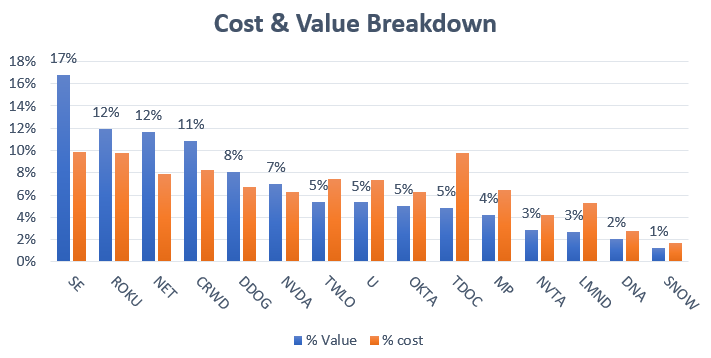
Blue: Current value as % of my portfolio Orange: Cost as a % of my total cost invested into equities.
I don't have a hard rule of a cost % allocation, as I'm still building out my portfolio (not in steady state yet). It's a useful visualisation to highlight any divergences between your conviction (aka cost) and what the market thinks. Of course, smaller positions are not yet 'full' positions; hence we can disregard those divergences.
Performance - Equity
This shows the Internal Rate of Return (IRR) of my equities portfolio. My current brokerage is Saxo, and IRR refers to basically the time-weighted returns of the portfolio. As you can see here, NASDAQ's Tech 100 has been outperforming me by a few percentage points in 2021.
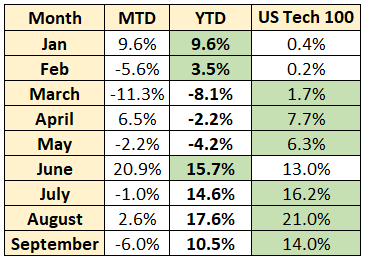
Am I worried? No.
Performance over 6-months, 1-year or even 2-years is quite random and may not be reflective of true company fundamentals that you've invested in. A great example is 2020, whereby the Covid crash and the subsequent rally is frankly quite unbelievable for some companies out there. Low interest rate environment coupled with helicopter money go brrrr__ _enabled a retail frenzy in the _stonk market to take place. The result? Everybody got 20%+ returns on their investment and suddenly thinks they can achieve financial freedom.
I am well aware of the reality of my future expected returns, as many of my companies have 2x or more since 2020. Still, I'll stay invested for the long-term.
CAGR Performance - Equity
This is a handy chart highlighting the reality - CAGR returns from my portfolio inception vs other benchmark indexes.
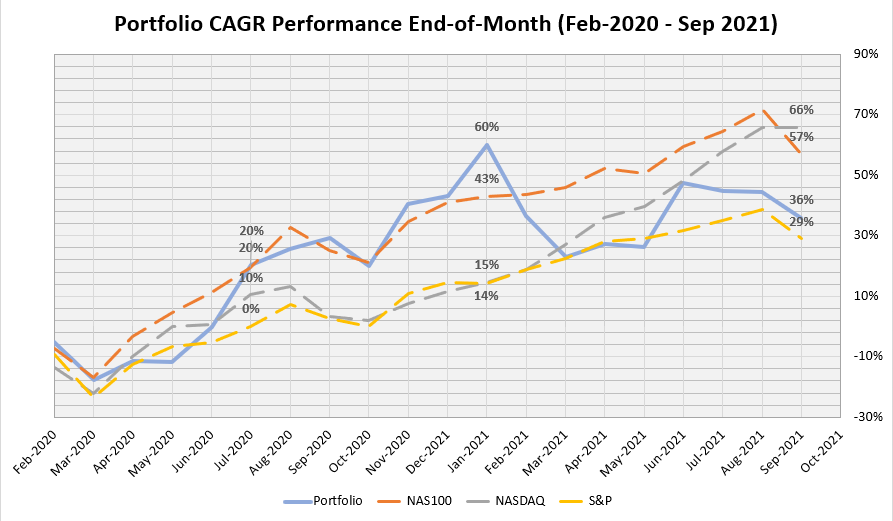
The reason behind plotting this chart is because when you do liquidate your portfolio or take profit, the eventual return on your investment is basically your value as a ratio to your cost. If value cost, then you lost money. If value cost, then you earnt some.
Of course, this completely disregards the time when you started buying the actual stocks. Buying stock A, and having it gain by 10% over a 6-month period would make you (all things equal) a better investor than someone buying stock B and having it gain by 10% over a 12-month period.
However, this is the stark reality; Your family or whoever's using that cash, won't appreciate this difference. Instead, they will care about how much money they receive, vs how much they put in. Hence, it's a decent measure that's well understood by non-investors, but misunderstood by investors.
For anybody interested, here's my IRR (time-weighted returns) since portfolio inception (Feb 2020): 81%.
September Portfolio changes:
Added: $SE, $DNA
Investment Themes
Since this is my first post, I'll outline the generic themes driving investment in my portfolio companies. The hard part of understanding why companies are worth investing, I'll leave it to you. 😉 I curate a list of fellow growth investors who often share excellent insights on the themes below (& more!). Most of my insights on such themes are from content shared by them.
- eCommerce: The world is increasingly becoming digital. With a new generation of digital-native users (like you or me), we grew up being accustomed to online purchases as the norm. I expect that to continue well into the future, particularly accelerated from Covid-19 where physical interactions are minimised. As C-19 becomes endemic (the world lives with it), eCommerce as a secular trend stands to benefit. (Sea Limited)
- Streaming/Advertising: When was the last time you watched linear TV (channel 8/5)? Chances are, you watched channels from PayTV bundles StarHub or SingTel, or simply subscribed to Streaming Video on Demand (SVOD) like Netflix or Disney+ (aka cord cutters). As consumer demographics shift their preferences (to SVOD/AVOD), advertisers would have to follow. Roku is the leading US TV streaming platform by hours watched. I expect TV advertising to migrate their ad dollars from linear/Pay TV to SVOD/AVOD platforms, with Roku being the key beneficiary. (Roku) Related reading here.
- Software eats the world: This is quite a large category comprising of multiple companies. The key idea is that throughout all organisations, digital transformation is well underway. With Covid-19 and remote work, companies are finally waking up to how analog their operations are. Within these there are secular tailwinds that only accelerates from here, such as: Cybersecurity, observability, edge networks, communications. (Cloudflare, Crowdstrike, Datadog, Okta, Twilio). Each company needs the above 4 components as part of their digitalisation strategy. The next related tailwind here is the proliferation of AI. With digital transformation, business/data analytics become super important for insights generation. Every company likely has at least 1 machine learning model deployed. You can bet that the big companies are training super complex AI for usage. These require intensive compute power. Nvidia is one of the key enabler of this, pushing the boundaries of compute/AI to literally advance science and technology. (Nvidia). Another related company here is Snowflake, which is operates in the data space, much like a cloud-within-a-cloud. (Snowflake). Take a look at Muji @ hhhypergrowth for his tech write ups on this mega-tailwind.
- Metaverse/Gaming: Gaming adoption has accelerated, and looks here to stay as gaming habits normalize after Covid-19. With games increasingly becoming social (users watch concerts in games), the concept of metaverses became more relevant and apparent. Even Facebook now touts itself as a metaverse company, rather than a social media company. In this theme, a few companies are contributor/enablers to the structural tailwinds. (Unity, Nvidia, Sea Limited)
- Virtual care / Telehealth: Covid-19 has permanently changed the way people think about primary care. Whilst before Covid people would simply travel to clinics and hospitals for care, after Covid, patients are more wary about the diseases present in a hospital setting. Furthermore, as we've seen locally, clinic/hospitals can get overwhelmed easily if everybody wishes to consult a doctor with any onset of symptoms. Beyond covid, mental health has also taken an important spotlight especially with working adults being stressed out and the boundaries between life and work blurring. It's not easy to achieve scale via physical sessions; which is why I'm bullish on telehealth / virtual care as the primary source of care for the long-term. (Teladoc)
- Biotech: This in my opinion will be the largest trend of 2021, next to AI proliferation. DNA sequencing and engineering/writing will be advanced like no other with general innovation in technology led by AI proliferation. There is a lot of money being invested in the next cancer killer or disease killer. Instead of buying companies with potential to develop the next cancer killer (which seems like a moonshot if we don't have the background domain expertise), I am focusing on the less exciting ends of the biotech wave - DNA Sequencing and engineering (aka synbio). The current 2 companies I've invested in are: (Invitae, Ginkgo Bioworks)
These are the key tailwinds I'm invested in. Other themes that I've invested in are: Rare Earths (MP Materials) and Insurtech (Lemonade).
As always, do your own research!
While the companies mentioned above have gone through a decent run in 2020 and 2021, I think there's a certain sentiment around Seedly about wanting to wait for a pullback before investing, or that companies have become too expensive. For me, I don't factor valuations as a key criteria to add to a stock, unless it has already appreciated by quite a big margin.
Valuations are simply market's opinion on assets discounted back to present value. As long-term investors, what matters to your investment success is the companies' Return On Invested Capital (ROIC), or how the management invests their earnings. Is it for growth, or to return to shareholders? An investment will still do well even when buying at a high valuation if it has a high ROIC.
My main aim is to own great companies for the long-term, and let the compounding do it's thing. My investment objective is: To achieve outsized returns over the long-term. Short-term price fluctuations will be nice to have, but I will not trim my portfolio for the sake of buying them lower. I think this is where a lot of investors overestimate their ability to time the market. That's just me! 😁
I'll end my commentary here as the article is getting long. I also chanced upon this tweet, and it got me thinking.
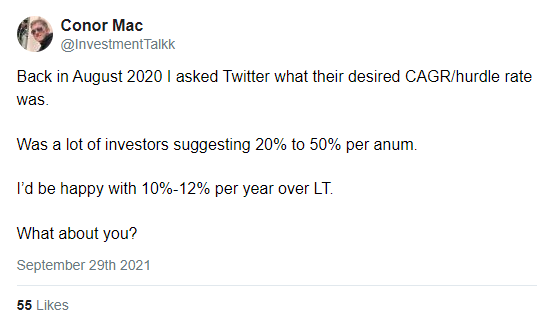
What is your hurdle rate? I'm still a relatively young investor, and so my hurdle rate will be inflated by my ego due to my short-term investment success. Interested to hear what your thoughts are in the comments!
Conclusion
If you've read thus far, thank you. I simply want to share my journey in stocks, and I invite all users to share your opinions about my portfolio below! 👇 Criticism is absolutely welcome; please put forth your strongest bear case (non-valuation related). If so much as 1 person has benefit from what I have written, then this article won't be in vain.
Otherwise, stay safe and invest for the long-term,
Do check out and/or subscribe to my monthly substack article to join me on this investing journey (both Equities and Crypto).
Comments
156
0
ABOUT ME
Crypto and Growth stocks investing with focus on thematic trends Aim: Achieved outsized returns over the long term.
156
0
Advertisement
No comments yet.
Be the first to share your thoughts!