Advertisement


OPINIONS
Joey's Investment Journey - Equities (Nov-2021)
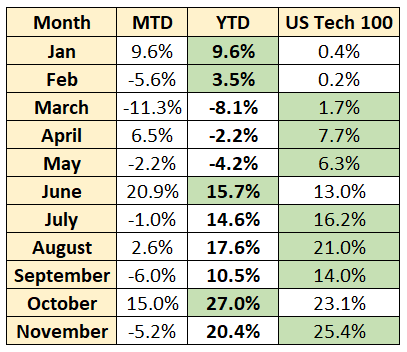
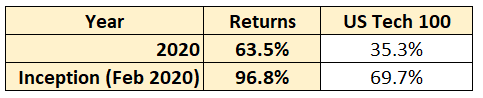
Time-weighted returns: YTD: 20.4% Since inception (Feb-2020): 96.8%
*Note: This is an adaption of my substack article here. I post monthly reviews on Seedly like this. Check out October's stock portfolio review. Follow me on Twitter to connect :)
=
Equity Portfolio Breakdown
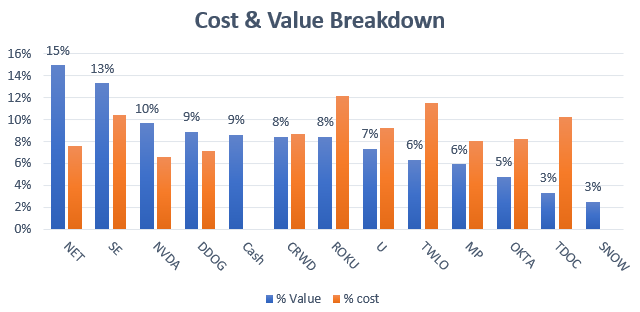
Blue: Current value as % of my portfolio
Orange: Cost as a % of my total cost invested into equities
No hard rule on % cost allocation for stocks yet, nor a threshold where I will trim them. This chart simply visualises the divergence between my investment thesis and the market expectations of the company.
*Raised cash this month & hence showing it as a % of my portfolio.
=
Equity Portfolio Performance
Time-weighted returns (IRR):
CAGR* Performance:
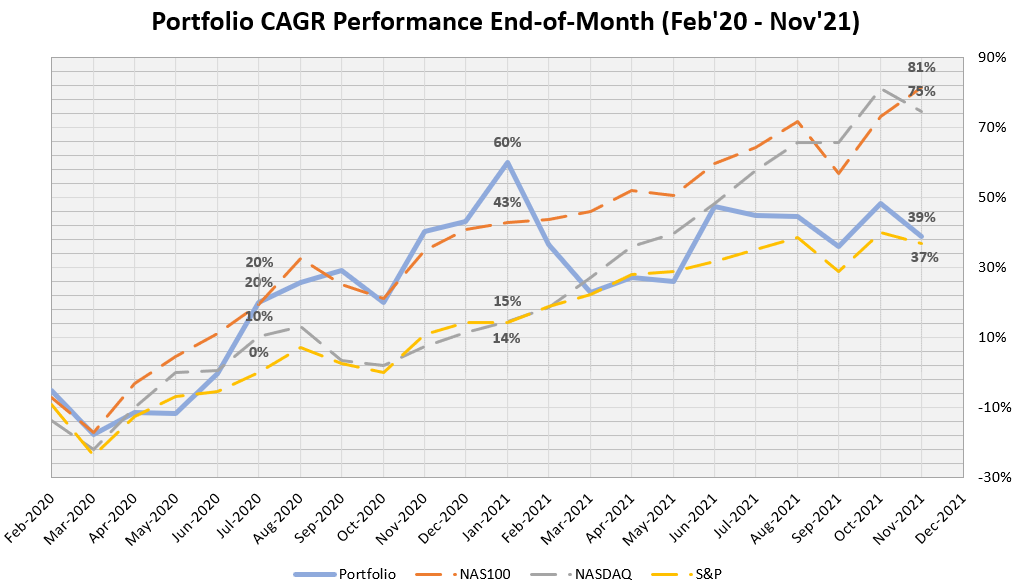
*Note: Brokerages and most investors use IRR (time-weighted returns) as that is what most platforms provide. Practically speaking though, you’d want to know what 1$ of your investment (if all invested since inception) will be worth today. It’s a crude metric, but to everyday people, this is more relatable (since if I liquidated my $1 portfolio right now, I’d get $1.48 over my total cost invested). Still pretty good.
IRR stats:
=
Portfolio Changes
Bought: $ROKU $U $OKTA
Sold: $NVTA $LMND $DNA
=
% of Net Worth (exclude fixed assets) in:
Stocks: 17%
Crypto: 78%
=
Portfolio Commentary
Overall, my portfolio don’t feel so good. From my memory, November had been marked by 2 distinct phases (as annotated in ugly red lines).
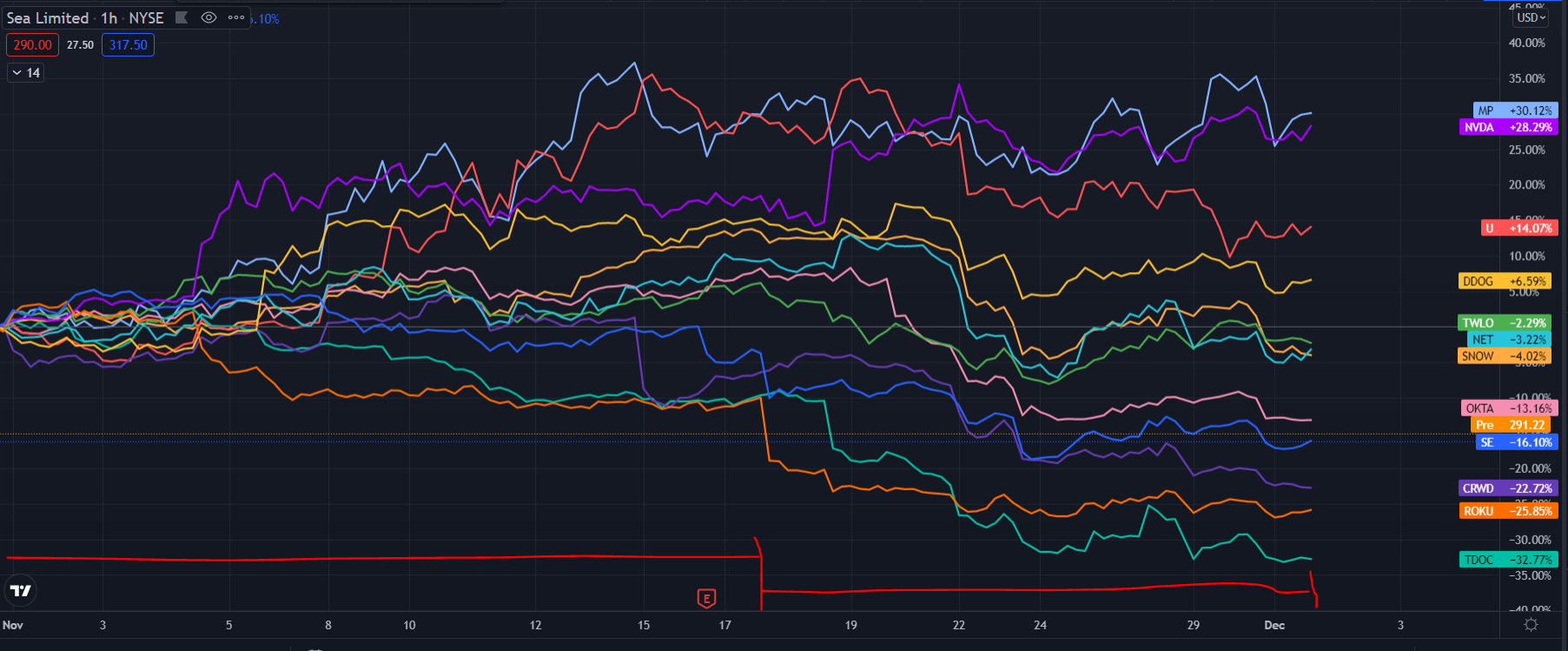
The first phase marked what I would call being seasonally bullish. Heading into the tail end of the year, it is generally observed that markets trend higher, especially in November and December. Despite that, once in a while, inflationistas repeatedly banged the drum on sky high inflation which was quite evident as the supply chain crisis exacerbates across the globe.
The overarching theme within this macro backdrop (particularly for my portfolio stocks) is one of high valuations. November was also the month where most of my companies report their earnings. One would think that given the high valuations, stock prices are less likely to go even higher. I was wrong, as Unity shot up to $200 with a good Q3 2021 result (I reviewed it in a thread here). Sure, some of it was due to its acquisition of Weta digital, but perhaps price increases are correlated to the amount of “metaverse” mentions during the earnings call transcript.
I kid.
In short, contrary to what people say, its near impossible to predict the post-earnings performance of stocks. Just because a stock has had a run before earnings, does not mean that the run cannot continue. Remember that the stock market is just an amalgamation of millions and millions of participants, each with their own thinking of how earnings will play out. It will only play out according to what you think if the cumulative net buying power of participants that have the same thinking are those that think differently. Not as easy as people think.
Anyways, for November the markets was pretty mixed for the first phase (as above), until the stark reality of high inflation hit the FED as a signal markets are functioning well (second phase). They are announcing faster tapering of asset purchases from January onwards. The invisible hand of Mr. FED is long gone; what remains is a shadow of its former self as the market feeds on its self-serving momentum. I don’t try to time the market according to this, but there is a certain element of froth that can’t be denied by even the most ardent of Tesla fanbois.
Who will be the greater fool?
As a reminder, Cloudflare went from $20-$30 to $200; Sea Limited went from $50 to $300+. Did their revenue grow by similar amounts? A good time to rehash this pic.
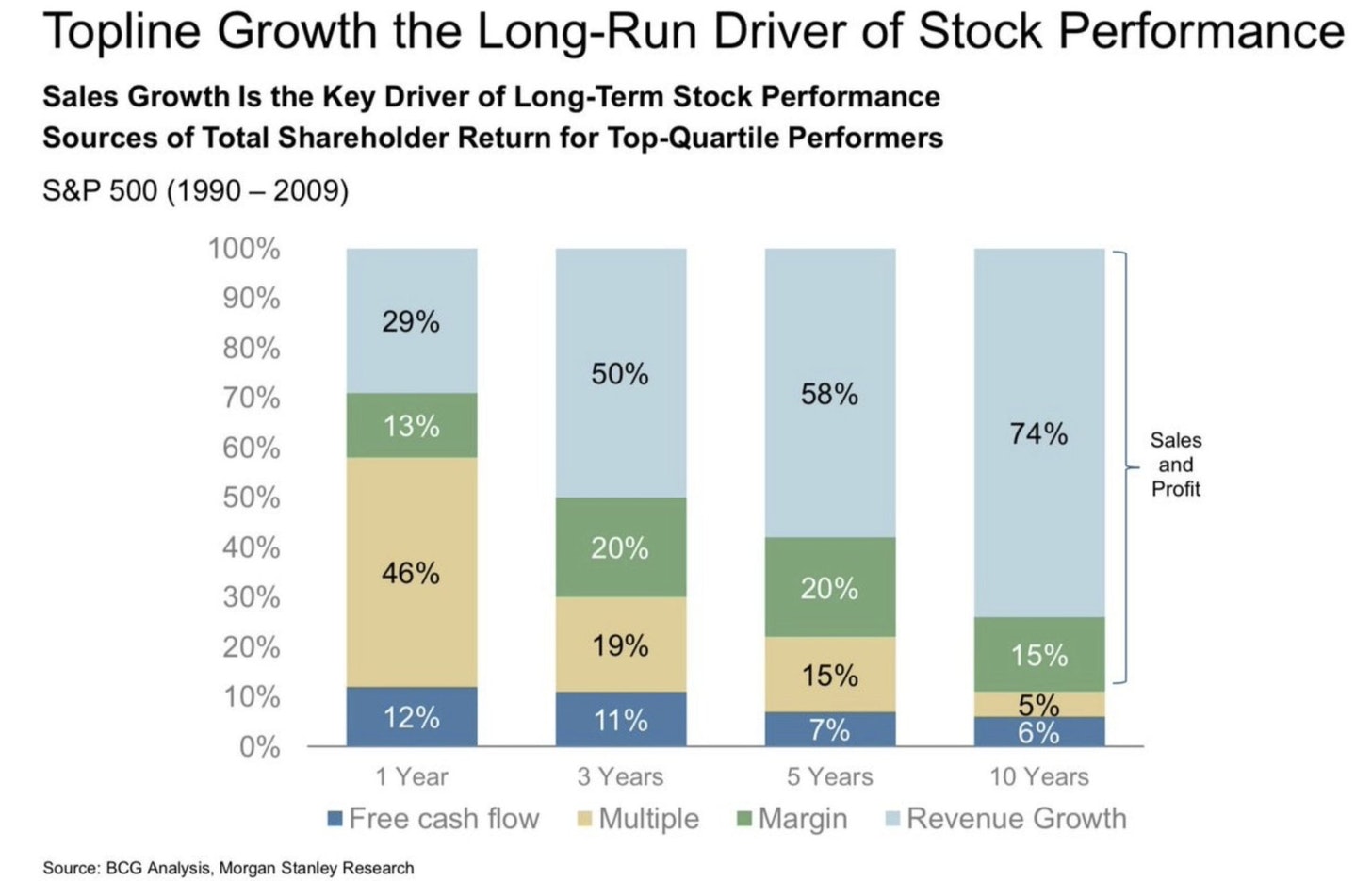
It has been about 1.5 years since the COVID crash in March 2020. How much of the stock performance was due to multiple expansion? Rehashing another updated pic from Jamin Ball, writer of the Clouded Judgement:
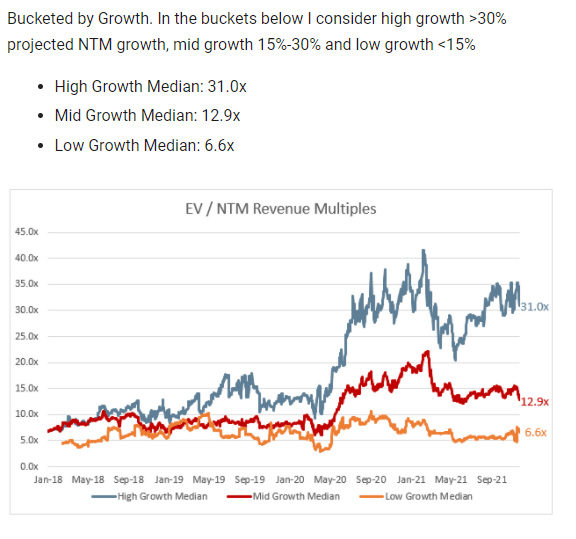
I’m not predicting that there will be an impending crash. I am saying that there’s a detachment between stock price performance and business performance. Over the long term, there should be a convergence between fundamentals and the stock price.
There’s actually a third phase in the tail-end of November, where a new COVID-19 variant was discovered that seemed to have similar amounts of mortality, but way higher transmissibility than say Delta-variant or the original disease. The discovery happened during the last weekend of November, but that caused a quick crash in both stocks (index futures) and crypto as apparently, fear via the internet spread way quicker than the actual variant. Will we see another situation where stay-at-home stocks get bid again (aka $ZM, $TDOC etc)? Or will inflation take the central narrative in spite of omicron?
TL;DR: The stock markets rely much more on narratives than you think.
Ok, let’s not bore you with reused takes on how the markets will look like in 3 - 6 months. Nobody knows. I’m not smart enough to predict that either. Everything is just a simple calculated bet between probability & expected value. Moving onto my portfolio movements.
=
Portfolio movements
By and large, those that were expensive to begin with ($NET, $DDOG) went even more expensive. My trim of Cloudflare at $169 did not pan out the way I wanted to and I continued to be wowed by its stock (& business) performance. Likewise for many of my companies.
With the impending macro environment and just how far and fast these stocks have already been rising over the past year, I took a calculated bet that over the next few months, stock prices will generally be lower than where they are now. I also sold off 3 of my half-positions in Invitae ($NVTA), Lemonade ($LMND) and Ginkgo Bioworks ($DNA). These represent my biotech exposure & at the same time my more speculative bets.
Note that these companies are doing decent on their latest earnings. They are not bad companies. I simply wanted to raise cash for a future scenario where I can deploy capital to take advantage of market gyrations, and these 3 companies are the ones I’ve not got the highest conviction on. Even after selling I’ve only got 12% cash and so my portfolio is still exposed if the broader market tanks. In the long run though, 12% is more than enough dry power to deploy.
Always have cash on the sidelines.
Aside from the portfolio positioning, my partner and I are reducing our investment contributions by 50% for the foreseeable future as we are looking to settle down. As many Singaporeans will know, settling down (aka buying a house and marriage) requires way more money than you think. The housing loan and renovations alone will disrupt my investment plans, not to mention marriage and having kids. However, I also believe in the power of compounding, which is why I still try to contribute some money into the markets for as long as I can, and by raising cash within my portfolio by consolidating into my higher conviction holdings.
=
Portfolio Earnings
If you’re interested in my review of my portfolio companies, you can check out the threads linked in the meta-thread here. I’ve also tried to find and link other people’s threads within my own review if I found them to be insightful.
Note that there are still some companies that have yet to report on their Q3 2021 results (e.g., $SNOW, $CRWD, $OKTA). Those will be added once they’ve released their results and I’ve reviewed them.
This is also par for the course if you’re doing stock picking. No point owning stocks if you don’t even bother examining how the company does on a quarterly basis. It need not be a 10-tweet thread like mine, but just tracking financial and usage metrics to assess any acceleration and slowdown in execution will go a long way in building conviction. Of course, you won’t need conviction in a bull market where everything is up only.
You will need conviction in a bear market (or a crash) where stocks left and right are dropping 10% and suddenly don’t know how the business is doing. Are they doing great? Is the stock price an accurate reflection of their fundamentals? Is there a mispricing?
If all of these sounds too much effort, you should simply buy an ETF and DCA into it over time. You can spend your free time on your hobbies or resting ;)
85% of investors fail to outperform the stock market over the long-term.
Probably not 85% as this study showed. But the point still stands (perhaps even higher for retail investors).
=
Conclusion
Thank you for reading thus far. October’s portfolio review got me 100 viewers, which I will be forever grateful for. I really appreciate each and every reader for this article. My hope is that through this article, I improve my thought process & clarity, whereas you join me on this journey of life where I pursue the _finer _things in life: financial freedom & my passions (investing + crypto).
Rich or poor, I will be writing every month. I don’t need 1000 readers, but as long as 1 reader benefits from reading these articles, I will keep writing.
Have a great December, and Merry Christmas!
Cheers,
Joey
Comments
104
0
ABOUT ME
Crypto and Growth stocks investing with focus on thematic trends Aim: Achieved outsized returns over the long term.
104
0
Advertisement
No comments yet.
Be the first to share your thoughts!