Advertisement


OPINIONS
Is the Convenience of Food Delivery Apps Worth the Price?
Food delivery is super convenient, but you’re quietly paying a lot extra for the ease.
This post was originally posted on Planner Bee.
With everything in Singapore being fast-paced, many people find it hard to make time for meals. Food delivery apps, which became popular during the COVID-19 pandemic, have now become a regular part of daily life. The main appeal is convenience. Getting food delivered straight to your doorstep is especially helpful for busy professionals and families. But this convenience comes at a cost.
In this article, we’ll look at why so many people rely on food delivery apps, compare the main platforms, and share some tips on how to save money while still enjoying the service.
Why do we rely on food delivery apps?
Food delivery services came into the spotlight during the pandemic when people wanted to limit contact and reduce the risk of getting sick. Being able to stay home while still getting meals for a small fee was an easy choice for many Singaporeans.
Even though the pandemic has eased, many people continue using food delivery apps. Several reasons explain this ongoing trend:
Busy lifestyles
Long hours at work and packed schedules make it hard to cook or eat out. Ordering food after a tiring day saves time, and there’s no need to clean up afterwards. For parents or caregivers, it also helps manage mealtimes more easily when juggling other responsibilities.
Accessibility
These apps offer a wide range of food options to suit all kinds of tastes and dietary needs. Thanks to islandwide delivery, you can live in Jurong and still order food from Pasir Ris without leaving home. Some platforms also cater to specific preferences, such as halal, vegetarian, or low-carb meals.
Weather conditions
Singapore’s hot and humid weather, along with frequent rain, makes going out for meals less appealing. While hawker centres are more affordable, eating out often means sweating through your meal.
Promotions and discounts
Regular offers and deals make ordering even more tempting. Some platforms offer subscription plans with free delivery, which encourage frequent use.
Social convenience
Ordering in is also convenient for group gatherings, whether at home or the office. It avoids the hassle of coordinating restaurant bookings or splitting bills.
Cost breakdown: What you’re really paying for?
The cost of using food delivery apps goes beyond the price of the food itself. You also pay for things like delivery fees, small order charges, platform fees, and markups.
These platforms can take up to 30% of an order’s value as a service fee. Most restaurants pass this cost on to consumers. This means you might be paying 30% more, or even higher, every time you order food.
Here’s a simple example using a McDonald’s meal:
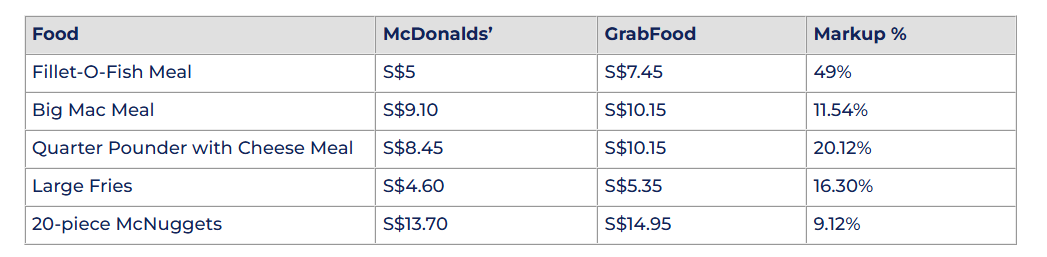
Even before adding other charges, the markup per item ranges from nearly 10% to 50%.
For McDonald’s, there is also a small order fee if your order is below S$12, which is the minimum order amount. This minimum can vary depending on the restaurant, location, and the time you place your order.
The small order fee is simply the difference between what you ordered and the minimum order amount. For example, if you order a Fillet-O-Fish meal for S$7.45 on GrabFood, and the minimum order is S$12, you’ll be charged an extra S$4.55. You can avoid this by adding more items to reach the minimum amount.
Delivery fees also apply to most orders. These are based on the distance between the restaurant and your location. Fees may go up during peak hours, bad weather, or when there are more orders than delivery partners. In most cases, delivery fees are usually priced below S$5, but islandwide delivery fees can go over S$15 per order.
There is also a platform and partner fee. GrabFood and Foodpanda charge S$0.60 per order, while Deliveroo charges S$0.50.
Now, let’s look at another example using the chain _tze char _store, Kimly Seafood:
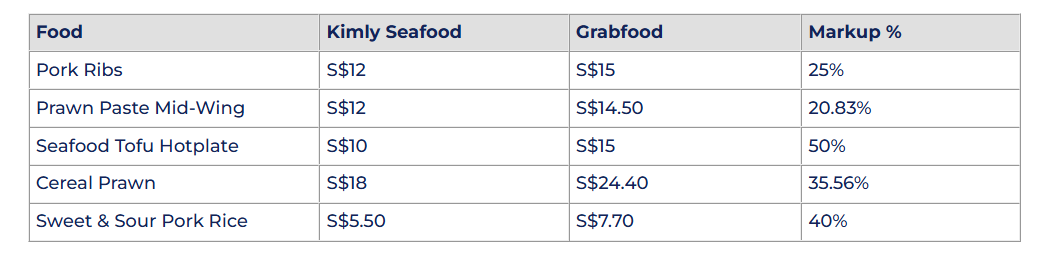
If you eat at the store or go in person to buy takeaway, you can save between 20% and 50%, depending on what you order.
Read more: Grandma’s Budgeting Secrets That Still Work Today
Comparing GrabFood, Foodpanda, and Deliveroo
All three platforms offer food delivery, but they differ slightly in terms of food choices, pricing, and discounts.
GrabFood
GrabFood is part of the Grab super app. It offers a wide range of food options, including hawker stalls, fast food, trendy cafes, and Michelin-starred restaurants. Many vendors provide islandwide delivery, allowing you to order from across the country as long as you are willing to pay the higher delivery charges.
The group order feature on GrabFood allows users to enjoy 5% to 15% off their order, as long as there are three to six users ordering from the same store, delivered to the same address.
Some brands are only available on GrabFood. These include Wingstop, Playmade, Paris Baguette, Swee Choon Tim Sum Restaurant, and Tanyu. You can also earn GrabRewards points and use GrabPay when ordering through GrabFood.
Foodpanda
Foodpanda has a wide selection of options, including local hawker stalls, fast food chains, and mid-range restaurants. It frequently offers promotions, which can help you save on regular orders.
Delivery is limited to a maximum distance from your location. Many vendors provide free delivery when you meet a minimum order amount.
Deliveroo
Deliveroo lets you place orders through both its app and website. This sets it apart from the other two platforms.
Most of its vendors are located within specific zones. As a result, delivery fees are usually lower. However, your food options are limited to nearby places. In some cases, it may be more cost-effective to collect your order in person.
Deliveroo’s group order feature supports up to 100 people, which is useful for large groups or office orders. Deliveroo for Work also lets companies provide regular or one-off meal allowances for teams and individuals.
Ways to spend less on food deliveries
While food delivery usually costs more, sometimes the convenience is worth paying for. If you order regularly, there are a few ways to cut down on those extra charges.
One option is to subscribe to services like GrabUnlimited, Pandapro or Deliveroo Plus. These subscriptions range from S$3.99 to S$12.90 per month. They offer benefits such as free delivery or a couple of dollars off each order, along with extra discounts at participating restaurants and other exclusive perks.
For example, Foodpanda Pro costs S$4.99 monthly and offers unlimited S$3 off deliveries from all restaurants. If you place at least two delivery orders a month, the savings cover the subscription fee.
You can also save by ordering together with neighbours. On GrabFood, group orders of three to six people from the same store, delivered to the same address, get 5% to 15% off. By splitting the delivery fee and scoring additional discounts, group orders can make food delivery much more cost-effective.
Read more: How To Cultivate Mindful Eating and Improve Your Relationship With Food
To deliver or not to deliver?
Food delivery apps have changed the way many people eat, offering convenience for a price that most see as reasonable. This is especially helpful for busy individuals and working parents who want meals without the hassle of cooking and cleaning.
Still, the additional costs can quietly add up if you order delivery often. Staying aware of these charges and using discounts where possible can help you save money.
By picking the right app, making use of offers, and planning your orders well, you can enjoy the ease of food delivery without spending more than you need to. Delivery is great for ease and speed, but cooking or picking up your order can save you money. Choose what fits best with your time, budget, and mood.
Comments
75
44
ABOUT ME
Your Personal Mobile Financial Advisor Application Join us at telegram! https://t.me/plannerbee
75
44
Advertisement
No comments yet.
Be the first to share your thoughts!