Advertisement


OPINIONS
Is gold really the safe haven asset it used to be?
As uncertainty looms in today's macro environment, should investors really be flooding to gold?
The macro-environment today has been nothing short of volatile and uncertain. With the raging Russia-Ukraine war, overwhelmingly high inflation, the rapid rise in interest rates, China's pandemic lockdown, and supply chain disruption; it is no wonder that investors look towards safe-haven assets like gold to preserve their wealth. But is Gold really the best safe haven asset for today's volatile environment?
An introduction to Gold as a safe haven asset
For years, gold has been considered an effective store of value against inflation. As a physical commodity, it cannot be printed like money, and its value is not impacted by interest rate decisions made by a government. Because gold has historically maintained its value over time, it serves as a form of insurance against adverse economic events. Furthermore, Gold also provides diversification in a portfolio as it decouples and becomes inversely correlated to the stock market during periods of stress, which is beneficial in times of market volatility.
With no signs of the Russia-Ukraine war ending, inflation forecasted to remain high, and a stock market expected to remain weak due to supply chain disruptions and rising interest rates, economic uncertainty today is elevated. So everyone should buy Gold now, right?
Well, hold that thought first.
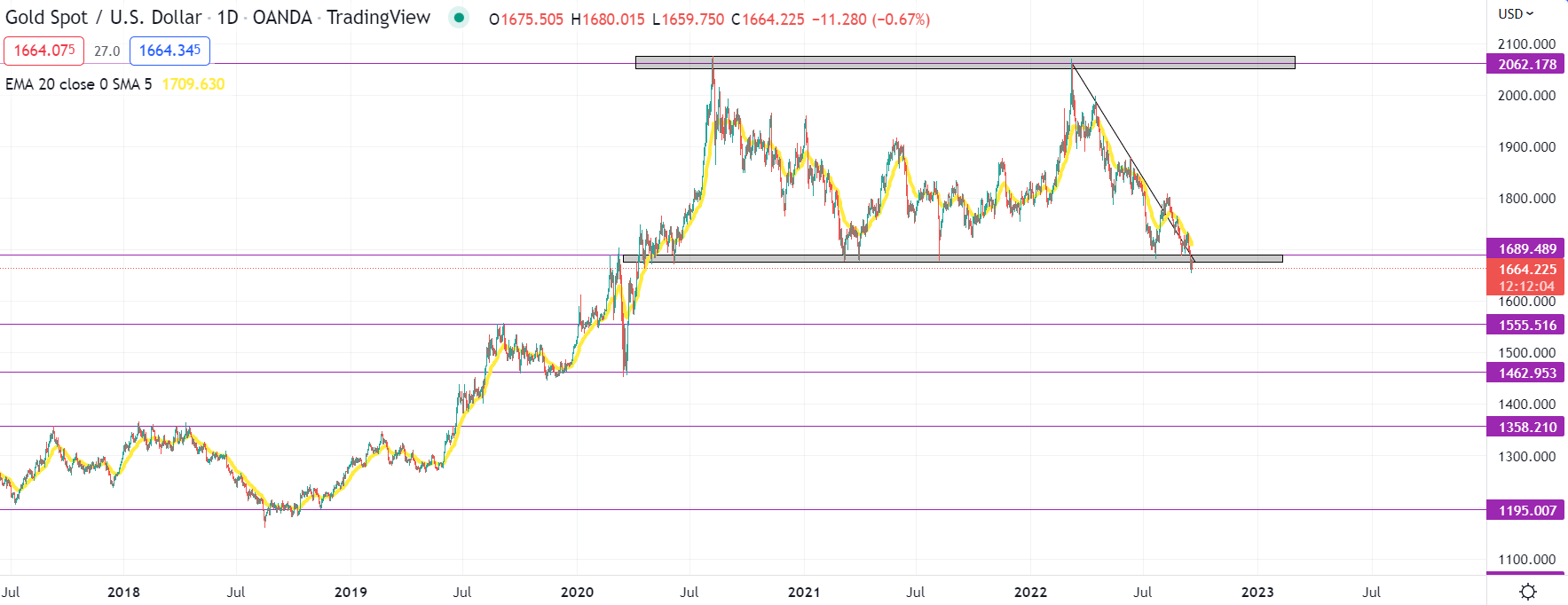
At the time of writing on 19 September, Gold stands at $1,664/oz.
After the initial huge run-up of close to 13%, Gold has dwindled in value and reversed the earlier gains. With inflation still rampant and uncertainty remaining elevated, why is gold actually depreciating in value?
There is a myriad of reasons for this phenomenon, but in my opinion, these are the prominent ones.
Rapid interest rate hikes by the FED to curb overwhelming inflation.
To slow down the high 8.26% inflation rate experienced by the US economy, the Federal Reserve has been aggressively increasing interest rates. In 2022 alone, the Fed raised interest rates by 200 basis points, the fastest rate hike cycle in 30 years.
Gold and interest rates traditionally have a negative correlation in the relationship between the two. It is not guaranteed but usually, the gold price goes down when interest rates go up. Unlike bonds and saving accounts, Gold does not pay interests, this increases the opportunity cost of holding Gold relative to interest-bearing safe-haven assets. Furthermore, in today's high-interest rate environment, yields from bonds and saving accounts are rising, increasing their appeal to investors, and reducing the demand for Gold as investors shift their investment away from Gold towards bonds and saving accounts
Strong US Dollar
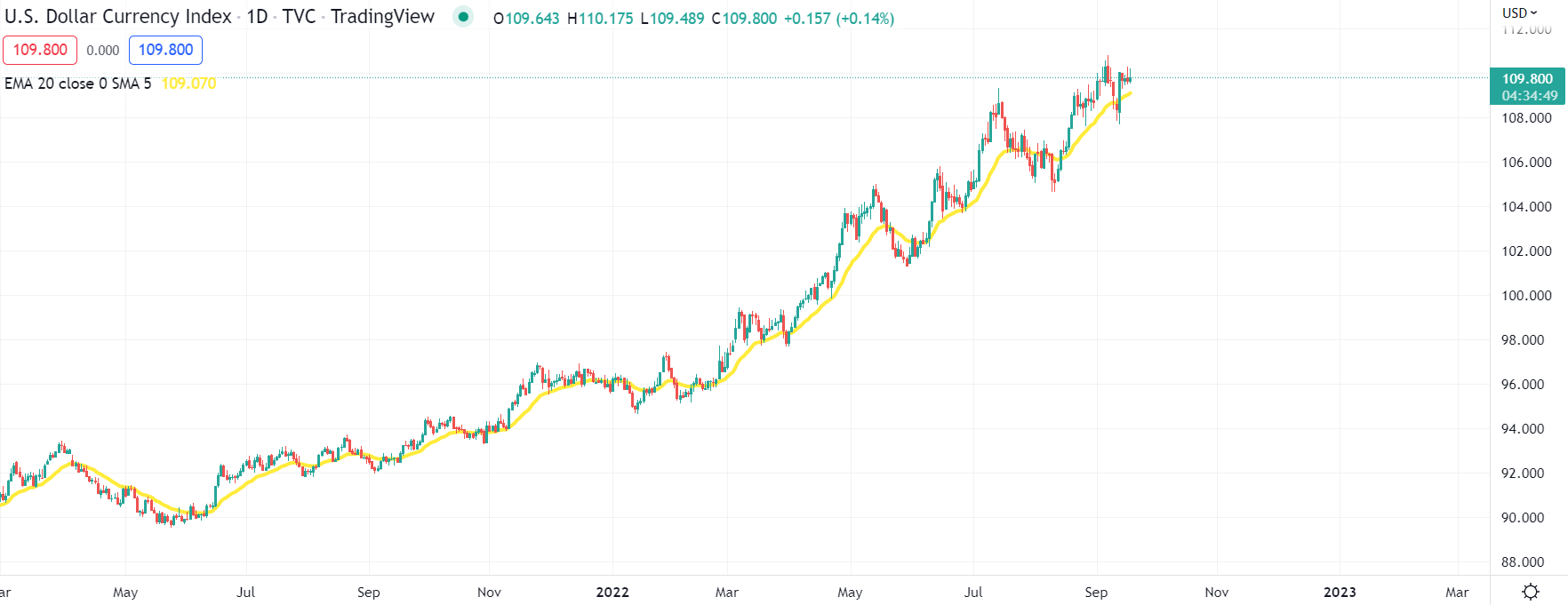
At the time of writing on 19 September, the US Dollar Index which measures the strength of the United States Dollar stands at $109.80, the highest since 2002.
The price of gold is generally inversely related to the value of the United States dollar because Gold is dollar-denominated. All else being equal, a stronger U.S. dollar tends to keep the price of gold lower and more controlled, by reducing demand for gold (because less gold can be purchased when the dollar is strong). Furthermore, United State Dollar has also been competing with Gold as a safe haven asset. When investors exit high-risk assets, they typically choose between Gold, Cash, or Bonds, and this year many investors chose to hold cash as the USD has been strengthening.
Conclusion
The concept of Gold as a safe haven asset has been introduced a long time ago, in a macro-environment vastly different from the one we have today. While Gold can still function as a safe haven asset, preserving purchase power, and hedging against inflation and uncertainty; it is no longer as popular, and Gold's performance recently has been nothing short of disappointing. In today's high-interest rate environment, where bond yields are rising, non-interest-bearing Gold might not be the best choice after all. However, this does not mean a complete obliteration of Gold from your portfolio, especially since Gold still has a low correlation to other asset classes, providing an effective way for you to diversify your portfolio. Furthermore, arguments can be made that downtrends in Gold are long and boring, while uptrends are short and explosive. This means that Gold spends a lot of time stuck in the mud, preparing for explosions in price, and we may see a strong recovery in Gold prices soon.
None of the information contained here constitutes an offer (or solicitation of an offer) to buy or sell any financial instrument, to make any investment, or to participate in any particular trading strategy. Everything posted in this article is my own opinion and does not constitute as financial advice. I will not be responsible for any loss arising from any investment based on any perceived recommendation, forecast, or any other information contained here.
Comments
363
2
ABOUT ME
363
2
Advertisement
No comments yet.
Be the first to share your thoughts!