Advertisement

OPINIONS
Introduce Your Child to CPF through English & Maths
Let's get them hooked on saving for a rainy day.
Cryotosensei
05 Jun 2021
Blogger at diaperfinancingfund.blogspot.com
Nope, CPF didn't sponsor me to write this (although they should). Like many of you, I think that CPF serves as a steady bedrock to our retirement plans. Since we ought to leverage the power of compounding from a young age, we should introduce CPF to our young ones as early as we can, right?
However, as well-meaning as our intentions may be, kids are kids. They are more likely to want to immerse themselves in the black holes of TikTok and Roblox (not judging) than widen their eyes with glee at the sight of CPF's interest rates. And it's understandable, given their current affinity for fun. So, how do we let them learn about CPF in a way that's palatable to them?
As I work as a teacher, I think I am in a unique position to help pave the way and shed some insight on this matter because I not only work closely with children, but am also familiar with the local syllabus. Want to level up your child's academic competencies while arming him/her with some form of financial literacy? Read on!
- Visual Text Comprehension (English)
Given our data-driven society nowadays, imparting children with the skills to analyse information from infographics is becoming increasingly important. Hence, why not use CPF's event posters to pique your child's curiosity about CPF? Take for instance this publicity poster on an upcoming webinar below:

Image taken from CPF Board (https://www.facebook.com/CPFBoard)
You can guide your child to examine PAC, which stands for Purpose, Audience and Context. Purpose refers to the main objective CPF intends to achieve with its poster; Audience refers to the group of Singaporeans CPF wishes to target; Context refers to the tone adopted by CPF in its poster. If we use the above poster as an illustration, your child be able to articulate that the purpose of this event is to impart the know-how of home financing. He or she should also be able to identify the target audience as potential first-time home buyers, who are most likely in their 20s or 30s. Lastly, this poster is written in a succinct manner, so we don’t really have much content to evaluate if the poster employs formal or informal writing. But I’m sure your child will agree that the tone adopted is friendly.
Using CPF’s event posters as authentic learning materials could create opportunities for you to share with your child the decision-making process that governed the purchase of your home. Of course, given that your child is still young, it’s important that we use child-friendly language and refer to physical entities so that he or she can visualise things better in his or her mind - “We chose this current flat because it’s a stone’s throw away from the MRT station.” After that, you can explain to hI’m or her how you harnessed your Ordinary Account to pay for your housing loan installments. At the very least, your child will know of the existence of the Ordinary account, thanks to you!
- Percentage (Maths)
When your child internalises that his or her CPF comprises the Ordinary Account, you can then stretch his or her understanding of CPF to include the other two accounts: Special Account and Medisave.
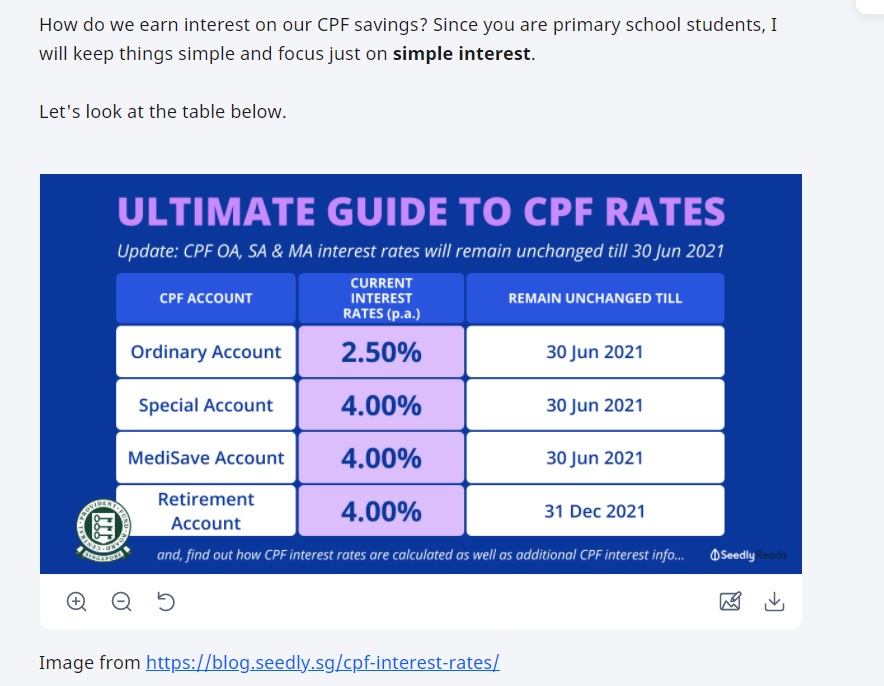
The above image is an example of what I attempted to do with my students. Yes, I do believe that Seedly has the clearest illustration of CPF's interest rates out there!
Upper primary students encounter percentages during Maths classes, so what other better opportunity to expose them to the various interest rates offered by these 3 accounts? In fact, they often tackle questions on interest earned, so it's a great chance to get them to consolidate their knowledge of simple interest. For a start, you can keep things simple like what I have done:
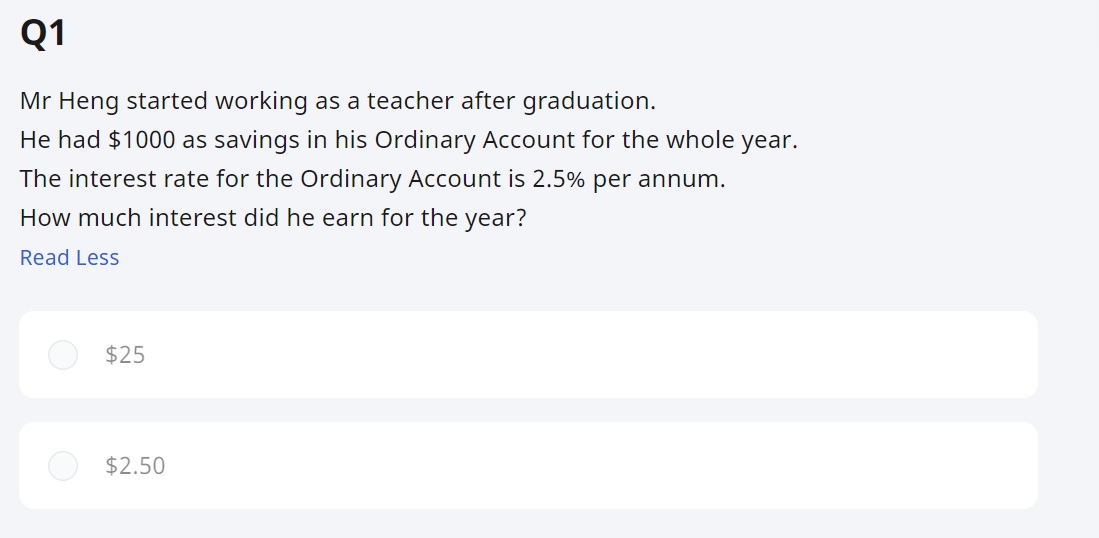
Image is taken from my online Student Learning Space lesson.
When your child gets used to calculating the simple interest earned, you can go one step further and introduce him or her to the fascinating world of compound interest. Perhaps you will have the pleasure of "seeing" a lightbulb light up in your child's mind - with he or she asking you questions on how to grow his or her money through CPF! Ideally, he or she will want to top up his or her CPF account using his or her savings accumulated from pocket money, hongbao stashs, windfalls, and rewards earned from doing household chores. But even if your child doesn't express an interest in saving for a rainy day, this seed that you plant in him or her will surely germinate with time.
Well, I hope you apply these two tips with your child and let me know how things turn out. All the best!
If you enjoyed reading this, you might want to read another of my musings: 10 Money Stories Singaporeans Grow Up With (https://diaperfinancingfund.blogspot.com/2021/05/10-money-stories-that-singaporeans-grow.html) .
Comments
821
2
ABOUT ME
Cryotosensei
05 Jun 2021
Blogger at diaperfinancingfund.blogspot.com
I grow my compounding crypto portfolio without investing my own fiat currency, and am dedicated to helping you do the same.
821
2
Advertisement
No comments yet.
Be the first to share your thoughts!