Advertisement


OPINIONS
Insights and Inspirations: Key Lessons from Seedly Personal Finance Festival 2023
Something to take away from hearing the financial superstars speak.
Check out my blog, The Coloured Paper, for more articles on personal finance for Singaporeans!
I attended the Seedly Personal Finance Festival 2023 yesterday and was it a blast!
I got the chance to listen to many of the financial ou xiangs (idols in Chinese) I looked up to in the personal finance space and came away with some game-changing insights.
Sadly, I couldn’t attend every single section as they were split between two stages, hence whatever I am going to share with you were just the sections I managed to attend.
I hope you will take away lots from this article as I did from the festival.
Game on!
Note: TL;DR summary at the end.
How to Super Optimise Your Savings and Spending to Build Wealth

Wealth comes in layers. Always build it layer by layer from the bottom to ensure that your financial safety is well-covered as you take on more risk.
The bottom layer will be your emergency funds, followed by savings and then investments with increasing risk. It is best to keep your bottom-most layers in the most liquid form as your financial safety net, but with the maximum yield possible.
A few of the panelists keep only their emergency funds as cash to maximise yield.
Although I think having more cash than just emergency funds is a more prudent way to manage our money, everyone has their own preferences. After all, personal finance is personal and what matters is what you are comfortable with.
Sometimes there is a trade-off between liquidity and yield, and you have to work within your comfort zones to achieve the optimal combination.
For example, SSBs have great yield relative to bank accounts, but are not as liquid. But if you are comfortable with its liquidity as an emergency fund, then why not? It’s a balancing game we need to play.
On my blog, I discussed on how relevant SSBs are in 2023. You can learn more about my views on it here and see how you can incorporate into your money management system.
Also, use credit cards in combination with high-yield savings account to optimise both your spending and savings.
When your spending is well-optimised, small cashbacks or miles can accumulate and snowball into four figure savings across months of spending.
My thoughts:
While it is great we have so many options to optimise our savings and spending, it might be tiring for most of us to do research and find the best way to do so.
It’s okay not to have the most optimal way of saving and spending. Products change all the time and we have to constantly adapt to keep up with the changes.
What matters most is that you implement a plan to save and spend, you are already ahead of majority of people. If you are consistent in this plan, you will always be ahead of the herd.
The Rise of Multitudes of CPF Millionaires: Are You One Of Them?

Even though Mr Loo was mostly reiterating points he raised before in his Youtube videos regarding his 1M65 movement, it was really nice seeing him speak in person and he brought up some important pointers for young adults.
If you don’t know what is 1M65 and wish to know more about it, you can read more about it in an article posted by Seedly here.
What was most important during his section was the Q&A session. That was when he pulled out the big guns with CPF tips for young adults.
One point he mentioned caught my attention; that a well-built CPF will serve as the foundation for wealth-building as it stabilises your investing emotions knowing that you have a means to retire which is protected by the government.
Referring to the lesson on optimising our saving and spending, we can put CPF below our emergency funds as the foundation of foundations. The stronger the foundation, the more risk we can allow ourselves to take, which includes business ventures and angel investing at the riskier extremes.
Also, don’t buy an expensive house right from the start. It can make you look wealthy, but you are damaging your wealth by doing so.
Instead of living well within your means and building your CPF for financial safety, you will most probably be trying to keep up with your mortgage payments and living paycheck to paycheck.
Lastly, you should leave some funds in your OA to act as a safety net for mortgage payments should we find ourselves in a situation without a job.
My thoughts:
Leaving funds in our OA as a safety net for mortgage payments should go hand-in-hand with emergency funds which supports our living expenses.
Both of these sums of money should be planned in a way that they are able to support you for the same lengths of time.
There is no point having a decent emergency fund but a weak OA. That will reduce the life of your emergency fund since you need to siphon funds out of there to pay for your mortgage when your OA runs out.
Managing Your Finances as a Household

A joint account makes it easier for a household to manage finances as it reduces the amount of transactions happening within each household when paying for shared expenses like utilities, necessities etc.
However, each household is unique and a joint account might not be suitable for every single one despite its perks.
The panelists brought up some very valid points to think about.
Firstly, there is the issue of how much each person should contribute. If one earns more than the other, are both parties then comfortable with putting in the same amount of money, or the same percentage of their salaries.
It all boils down to the comfort levels of both parties. There is no right or wrong, just how ‘right’ it feels when it comes down to handling money between the two of you.
Another issue is that by not using a joint account, both parties can keep that money in their personal savings account with their existing savings. This can potentially earn higher interest for each party by fulfilling higher deposit tiers.
So, by using a joint account, some opportunity cost is incurred.
It is also interesting to note that by not using a joint account, tension might be created by constantly needing to ask each other about splitting bills and making transfers to even out transactions.
Although it is understandable, it’s just not nice to hear about money and bills when having a nice night out or after a tiring day of work.
Some closing advice left by the panelists were to have clear budgets when it comes to household finances, and always leave extra wiggle room when it comes to budgeting for children as unexpected situations are always bound to happen (ironic but true) like doctor visits.
Also, try to be transparent as possible to maintain trust and openness with your partner. This creates an environment for you and your partner to openly share and plan well for the future.
My thoughts:
I am still a student but have recently explored opening a joint account together with my partner to make shared payments like food and activities easier.
However I don’t find joint accounts extremely relevant until we actually own a home since we usually pay with our own credit card (yes, a student credit card) and then transfer out the full sum from the joint account to the account of either one of us who paid. That’s a lot of work for one transaction.
We use an app called Splitwise to monitor our shared spending so perhaps for those who don’t use joint accounts yet, you can check that out.
Building a Business Empire of Your Own
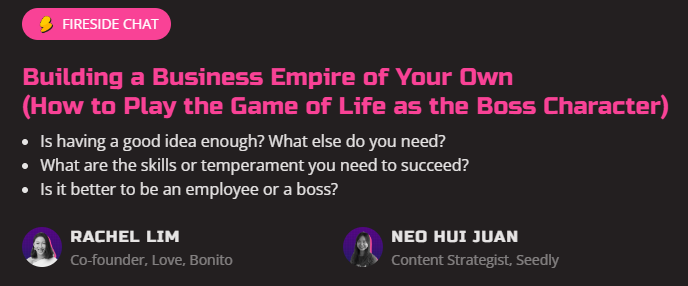
Rachel’s section was an inspirational one. She talked about the ups and downs of being an entrepreneur, and gave valuable tips for aspiring entrepreneurs.
She talks about self-awareness being paramount to building your own business. By knowing yourself, your strengths and weaknesses, you will know how to compliment yourself with the right people for your team and how to improve.
People will make or break your business, so pick people that are aligned with your interests and goals for the business, but who are also smarter than you in their respect.
One of the greatest takeaways from her section was the idea of launching bullets before cannonballs; that means to test small before going big.
This give you lots of leeway to fail while learning big lessons.
Everyone can inspire to run a marathon, but if you push yourself too hard at the start, you collapse before you even get to the halfway mark.
Finding the Right HDB Home

This was the perfect talk for any prospective homebuyers.
Jerry gave some insightful tips regarding loans, grants and financial planning for new homeowners.
Firstly, for homeowners struggling to get a queue number, it is recommended that you go for projects with application rates below 1.7.
Althought not guaranteed, at least the figure came from a HDB official himself to vouch for its credibility. So its a good benchmark to use while applying for a BTO.
Next are the grants. I’m not going to give a full breakdown of the grants here but 99.co gives a very insightful infographic to show it.
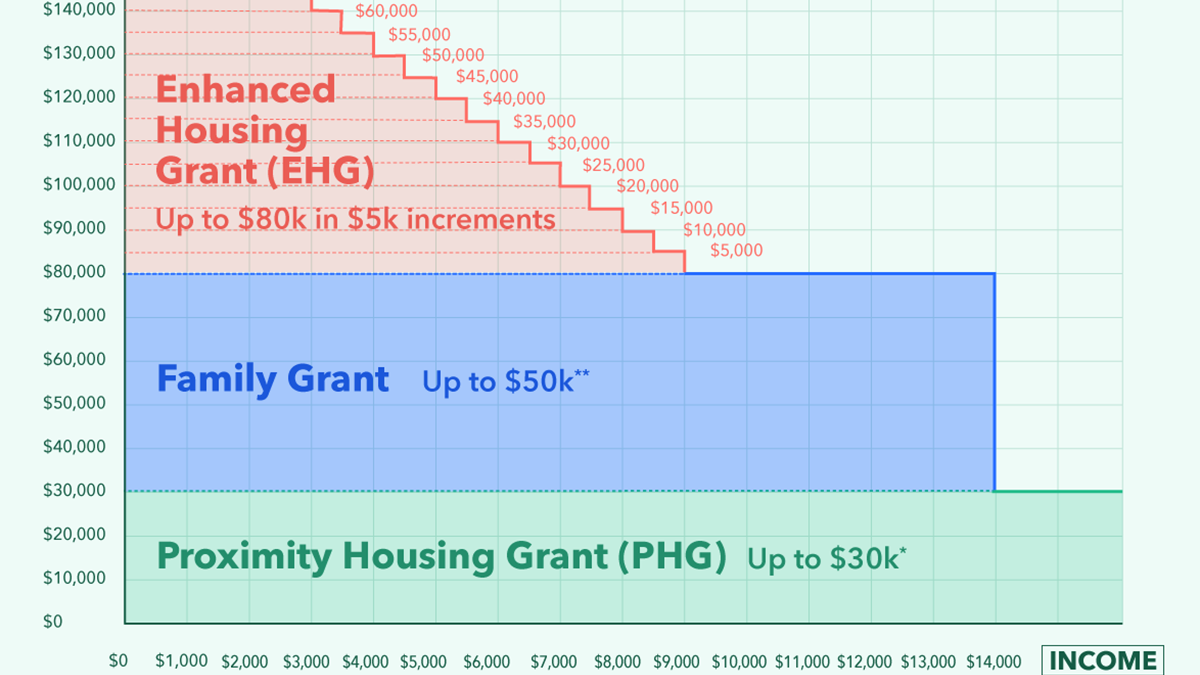
Credits: 99.co
In fact, Jerry showed a very similar one during the talk itself but I didn’t manage to snap a photo.
And lastly the part with the biggest takeaways - financial planning for your first HDB.
Jerry presented us with a formula for costs related to buying a HDB.
CPF savings + cash savings + HDB housing grants + housing loan = flat budget + stamp, legal, admin fees + renovation cost + property agent commission (for resale)
This is a good reference to have while preparing your budgets for your HDB purchase.
It is imperative to know how much you can get in loans and grants and how much you have in CPF savings and cash savings to be able to come up with an informed decision the type of housing you can purchase.
You should always plan your housing purchase around your budget, and not the other way round.
Regarding housing loans, it is important to consider the loan amount, interest rate and repayment period to fit how comfortable are you with the monthly instalment as well as the total interest paid upon complete loan repayment.
One interesting thing Jerry mentioned as well was that we must be wary of expenses we do not incur now as prospective new homeowners.
Daily necessities like toothpaste and dinners that are taken care of by parents are now under your financial camp. They add up to become a significant amount when tying it together with your mortgage loan repayments.
That should be factored in when planning your monthly expenditures before buying a HDB. An insightful and important tip that I might have missed out next time if I did not attend this talk.
My thoughts:
The entire gist of getting a HDB is about preparation.
Before even applying, we must understand what we are entitled to, what we have now and what costs lie ahead in the future.
The information we collect regarding these factors will give us the means to do ample financial planning that allows us to live to the fullest within our means.
And if you fail to plan, you plan to fail.
Tips and Tricks For Your Home Loan

To be honest, I am not very familiar with home loans as I have not experienced getting one before. However, listening to this talk was quite an eye opener and here’s what I learnt:
Having a solid outlook on interest rates direction is very helpful when looking for a home loan.
David showed us data on DBS’s prediction of stagnating interest rates from now till 2024 and then dropping after that.
The prediction seemed sound to me as pushing interest rates further might push the economy past the tipping point, and that is evident in MAS recently announcing that it will not increase rates just about three days ago.
Using this knowledge, we can go about deciding which home loan to take according to the lock-in period and lock-in interest rates.
The longer the lock-in period, the lower the lock-in interest rate. However, with interest rates predicted to drop from next year, that would mean even if you took a home loan with a lower lock-in interest rate, you might potentially be paying more even when policy interest rates start to fall next year since your lock-in period is longer.
You are locking in yourself to higher interest rates for an extended duration even when floating rates become lower. This is why it’s so important to have a solid view of where interest rates are going in the future.
In this case, it is more beneficial to take a loan with a shorter lock-in period but a higher lock-in interest rate. After the lock-in period, the rates will be pegged to the SORA (we can refer to this as the floating rate for simplicity sake) with a bit of a premium above it for banks to earn their cut.
This SORA is predicted to go down next year in 2024 as mentioned before alongside MAS loosening their monetary policy.
My thoughts:
Basically, if it’s too much for you to take in, the key message here is to be aware of the current economic environment and be on the lookout for clues on how interest rate will move. This will give you the opportunity to optimise your choice of home loan.
If you feel home loan optimisation is way too complicated to handle on your own, you can consult a mortgage broker which I found quite to be quite convenient as they suggest the best home loans to us and give us expert advice on refinancing as well.
So take note of this as mortgage brokers can be a powerful tool for us to use to optimise our mortgage payments.
Since they take no fees from us and are not sponsored by any bank, I don’t see any shortcomings to use their services. In fact, I don’t even mind paying a small premium to get expert advice on which loan I should take and when to refinance.
Even with the small premium, the savings obtained by optimising the choice of home loan will most likely cover it with more to spare.
Note: David did promote his company’s services during his section, but it seemed like something worth sharing as I see the benefit from the services mortgage brokers provide to me and hopefully to you. I am not sponsored in any way.
Finding The Right Fit to Renovate Your Home
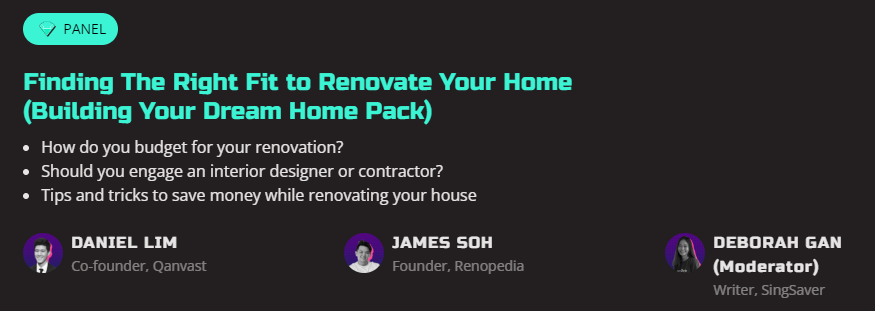
This topic was a really hot one amongst young couples. The entire crowd listening in to this section was almost entirely full of them!
The panel discussion generated some useful tips for those who do not have any experience with renovations before.
Right off the bat, a big question was addressed: ID or contractor?
Funnily enough, one of the panelists who is James from Renopedia shared his personal experience of going the contractor route to save money.
The verdict? Just get an ID to make your life easier as a beginner.
Going the contractor route essentially makes you the ID, to project-manage and coordinate all renovation works on your own.
On top of this, since you do not have any experience with renovation works, you might have to end up settling with some defects since you were not well-prepared with planning out the problems the renovation works will entail.
Next up were some tips on how to properly plan for a renovation (not as an ID).
A budget is important as it gives your ID or contractor a sense of how they can work around your budget. Getting multiple quotes lets you get a good sense of how much you really need for what you want. You can then fine tune it according to what you can pay for.
During the course of renovations there can be hiccups, so set aside some extra budget and renovation time for safety.
Ensure that you and your partner has a place to stay throughout the course of the renovation plus some extra leeway you have given.
And lastly is about how to save money on your renovation while maintaining the desired look of your home as much as possible.
I’ll list the points out:
- Figure out what you really need first before going to the ID or contractor. This way you avoid going with unnecessary things they recommend you.
- Avoid labour intensive tasks as much as possible such as carpentry and tiling, labour costs a lot more than material. You can consider alternatives like using vinyl to overlay the floor or simply keeping it as is instead of retiling.
- Bring in furniture from your previous home.
- Think long-term costs. Invest in good furniture and material where there is high usage to avoid replacement costs.
My thoughts:
Again, like buying a HDB, renovation is all about preparation.
Arming yourself with the right knowledge is key to having a successful renovation journey and a perfect home.
Nowadays, I think many young couples will leave it up to the ID to settle everything even down to the budgeting and they will just foot the final bill. There is a lot of work in preparing yourself even as a client but it is worth every cent you save.
Can REITs Do Well in an Era of High Interest Rates?
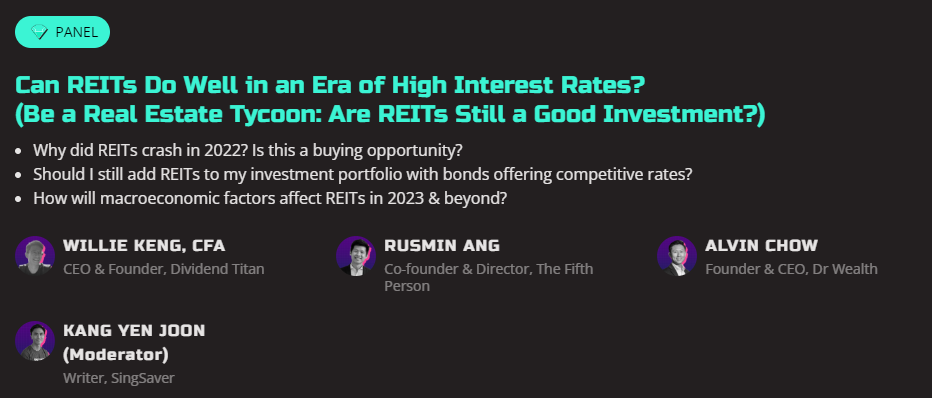
REITs is a topic I’m very passionate about. It is my primary investment vehicle and it was amazing to see all the titans of REIT investing in Singapore talk about it right in front of me.
The panel started off by discussing about how REITs are generally impacted by high interest rates.
Increased borrowing costs due to rising interest rates is the biggest concern for REITs since REITs are leveraged financial instruments that operate primarily on debt.
Because of this, US REITs have trouble staying afloat especially office REITs. With work-from-home measures going strong in the US and a high supply of office spaces, US office REITs have a grim outlook for the next five years ahead.
Rusmin from The Fifth Person recommended it is better to sell off something that cannot be salvaged and look for other opportunities during the drop instead. And I completely agree with his point.
It is good to know when to give up and when to carry on. This is one of the times where even data can easily show it is better to give up if you are holding onto US office REITs and use this time to invest in quality assets at a discount.
Singapore REITs (S-REITs), however, seem to be handling the situation quite well especially with retail REITs recovering at phenomenal speeds.
Looking around us at the increased traffic at malls just gives us an insight into how well retail REITs are recovering.
Even office REITs here are doing well with people returning to offices coupled with a low supply of office spaces here in Singapore. Office rents are even increasing because of this.
The panel mentioned about the benefits of buying S-REITs as a local being able to have a first hand experience of the economic situation here to make an informed decision, and our retail and office REITs are prime examples.
S-REITs are also more familiar to us locals with recognisable names which is an added plus.
Lastly, Rusmin gave cheeky recommendations on which S-REITs are bound to do well over the next few years, maybe you might want to guess what they are before I share it in the comments below!
My thoughts:
I was nodding heads in agreement most of the time throughout the panel discussion as all their points made resonated with what I thought about REITs in our current market environment.
REITs, although greatly affected by increasing interest rates, still remain a strong investment vehicle in a Singapore context.
We should take this opportunity to buy REITs with high quality assets which have high tenancy rates and high traffic (for retail), good debt management as well as low gearing for the REIT to be able to continue seizing acquisition or asset enhancement opportunities should they arise.
A good lesson to be learnt from this section is about knowing when to give up and be aware of having sunk cost fallacies. By holding on to something just because you are emotionally invested as well, that itself can become a huge opportunity cost and it will be a waste if you don’t realise it.
Achieving Financial Freedom and Happiness

Finally we round things up with a very light topic.
No technicalities involved, just some sharings about attaining financial freedom and happiness from creators behind The Woke Salaryman and The Simple Sum.
I learnt something very interesting here and it came from Wei Choon. He talked about the hedonic treadmill of happiness, which is us pursuing happiness one goal at a time only to be reset after attaining that goal.
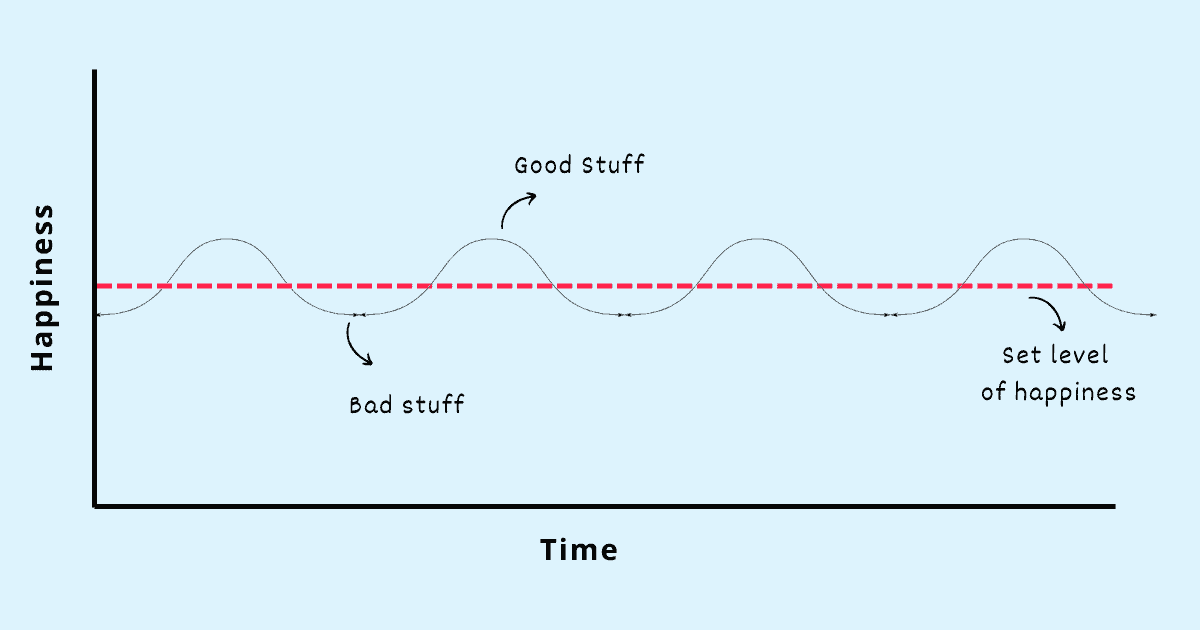
Credits: TechTello
An example from Wei Choon was about our education.
We work so hard to complete our PSLE to think that life after that will be bliss, only to be faced with our ‘O’ Levels, then ‘A’ Levels/Diploma and so on.
We are trapping ourselves in the vicious cycle without having a clear reason about why we want to do what we do. All we want is to have a ‘better life’ after a period of suffering.
Because of this, we are stuck with a fixed level of happiness averaged out over time.
I realised many people around me think this way, not excluding myself. Even though I have long term goals, it is easy to fall back to this hedonic treadmill when the going gets tough.
I start to view the journey as a long and arduous one, instead of learning to enjoy the process. Soon enough the goal will come after slaving away at the work and happiness sets in just for a while.
It’s like a mini dopamine release and then it gets reset since you basically suffered in that journey towards that goal.
To achieve true financial freedom and happiness, we should be enjoying the process alongside working towards the goal. After all, it is the journey that makes the goal that pleasurable to achieve and it is important to find meaning in whatever we do.
That ties in very nicely with what Kai Lun mentioned about financial freedom being a choice. We have the choice of our own paths to financial freedom and whether we want it or not.
Everybody has different means of financial freedom and is a very personal thing.
And because of this, we shouldn’t compare our own path we carved out for ourselves to others. There is no point admiring others as you might not be happy when you try to walk their paths.
After all, the journey is what matters, and that’s the key takeaway from this section.
Summing up,
Even if you did not read every single section of this article this will be some things I learnt throughout all the sections which I want you to take away:
- Personal finance is personal. You don’t have to follow what others do or tell you to do, what matters is what you think is right for your unique self.
Personal finance is also about preparation. If you do not put in any effort to prepare, you will not be able to put yourself ahead of the crowd since majority aren’t doing much about optimising their finance game anyway.
Thank you for reading. Do check out my blog, The Coloured Paper, for more articles on personal finance for Singaporeans!
Comments
373
12
ABOUT ME
Blast off 🚀
373
12
Advertisement
No comments yet.
Be the first to share your thoughts!