Advertisement


OPINIONS
If You Like Your Job, what is your ideal Retirement Age? (And what if you don’t like it?)
If money is not an issue, what would be your ideal retirement age.
Ng Lip Hong Kyith
09 May 2021
Chief Editor at Investment Moats
One of my Facebook friend asked this question about retirement:
"If you like your job, what is your ideal retirement age? If you don’t like your job, what is your ideal retirement age?"
An interesting question and I didn’t see an answer that would help me make my decision better.
However, the question is interesting enough for me to take a stab at it.
Here is my response.
The Answer to your Ideal Retirement Age is a Question of Life priority.
A simple answer is, if I like my job, ideally I would not want to retire so soon. I wish to work more, and enjoy the elements of fulfillment that keeps me ticking.
However, if I do not like my job, and I felt that there s nothing for me to look forward in my domain of work, I would want to retire as soon as possible.
Ok before we continue, let us set some assumptions. Retirement for most of this article means you get into a state where you do not make an income. You can work on other things intensely, but the key criteria are you don’t earn an active income in exchange for your effort.
My friend labelled it as ideal because he wishes to take the monetary considerations out of the equation. We can safely assume that if you wish to retire at 35 years old, your money will allow you to. You should then consider more whether you wish to retire at that age or not.
Now if I do not like my job now, I would postpone my retirement if I felt that this job isn’t for me, but there are some paid work that will eventually fit me.
I would go find a job in my industry or some other industry that I will get paid. Retirement will not be on the cards now.
What greatly determines our retirement age, is what we rank higher than our retirement. If there are greater motivations than retirement, the natural thing to do is to pursue the greater motivations.
The Priorities of 4 Different Person
The diagram below shows how 4 different people rank their life priorities:
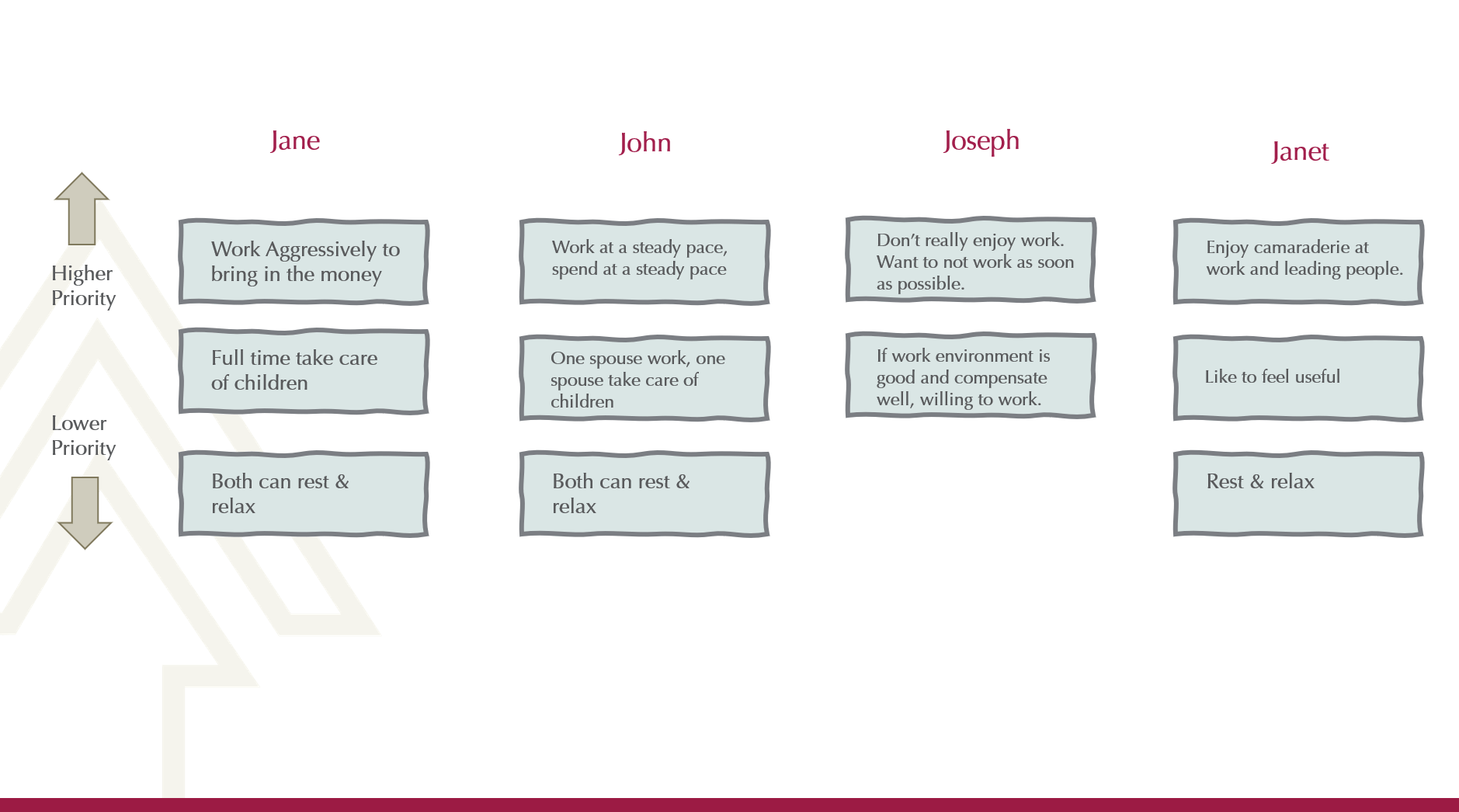
Each of these ladies and gentlemen rank their life priorities uniquely.
John has the most typical set of priorities.
Other than work and family, he pretty much do not have other aspirations. His job is rather reasonable and gives him adequate money to spend and save.
He really thinks this is the way life should be and does not want things to change.
However, if given the choice, he would hope that one day (not today) that one of them could stay home with the kids.
Retirement would be something in the future. Perhaps closer to 65 years old.
Joseph is the opposite.
He and his wife have been slogging for 12 years. Despite whatever they tried, both could not climb further in their management position.
Both of them tried moving around. At first, a new job presents fresh challenges and higher pay. But they soon realize that wherever they go, the job situation is the same.
They are just clearing the predecessor’s shxt that couldn’t be cleared (because they could not tolerate it anymore.)
While there are pay increments, the additional work load and mental stress just drained them.
Given the choice, if money is not an issue, they would rather choose to retire and not work. However, if an opportunity comes along next time that they can work and earn according to their own terms, they wouldn’t mind jumping back to work.
I think for most people, they will have more state of life that they considered.
They will lean closer to Jane or Janet.
It’s not that they want to stop work but there are more things they wish to pursue on their mind.
If a job does not work out, Janet would think this was not a good fit for her. Perhaps it’s time for her to try her hands on something else.
She still feels the urge to work in different environment, expand her leadership capability. If her current domain is challenging, she is willing to try venture to another domain and see how that work out.
She always believe the management skillset that she built up is pretty portable.
People Stay Working Due to Positive Characteristics of Job
You would continue to work if the positives outweigh the negatives at work.
For some work, means not needing to see their kids 24-7, or they get to be with people that are not their friends, or spouse.
Some are genuinely interested in the industry and the work they do. There are some who got frustrated at their current work place and chose to start something on their own because they felt that there is a problem that needs solving and the risk versus reward versus effort might just be worth it.
These are kind of positive characteristics and if you have more of them, work is still a large part of your identity.
On the contrary, if you identify less with the people, the work and the office, these are negative characteristics about the work that tends to push you closer to retirement.
People Might Just Need a Break
Sometimes we felt that the ideal age to retire is 65 years old.
Then, when we cannot catch a good break in our jobs or career, we wish it was 45 years old.
I think often, the remedy might be to just quit and take a couple of months, 3 months or 6 months to figure things out.
That break might be enough to recalibrate your work and play desire. Some would be bored to death as they realize much of their identity is still tied to their work (more than they know it.)
Conclusion
The same framework to determine your ideal retirement age, if money is not a problem can be inverted to decide if you should continue to work.
Our assumption for it to be considered as retirement is not to take in income. In reality, what is stopping you from attempting reduced working hours.
According to the Bureau of Labor Statistics, the average worker currently holds ten different jobs before age forty, and this number is projected to grow.
Forrester Research predicts that today’s youngest workers will hold twelve to fifteen jobs in their lifetime.
If you ever asked yourself when is your ideal retirement age, rank your life priorities and you may better figure out the ideal age (if money is not a problem.)
While we assume money is not a problem in your retirement decision, the reality is that you do have to save for it to make it come through.
Lastly, sometimes it is good to take a break.
Build up your finances so that you can afford to take a break.
When you take a break, you can then war-game and test out your life goals to see if you like the experience.
Kyith writes at InvestmentMoats.com
Comments
113
0
ABOUT ME
Ng Lip Hong Kyith
09 May 2021
Chief Editor at Investment Moats
Once an engineer. Once educated in Singapore. Currently Financially Independent. Now working in a Fee-only firm.
113
0
Advertisement
No comments yet.
Be the first to share your thoughts!