Advertisement


OPINIONS
How to save your portfolio from the bear market?
The stock markets hasn't been friendly to investors this year...
Ngooi Zhi Cheng
Edited 25 Aug 2022
Student Ambassador 2020/21 at Seedly
Should you save or invest during periods of market volatility? Should you pivot towards growth or defensive stocks? How should we position our portfolio during this era of high inflation and high-interest rates?
Today I will be sharing some of my perspectives on the market, and some ideas on how to position our portfolio through an analysis of the:
- US Equities
- Chinese Equities
Tech Sector
US Equities
In an attempt to dampen inflation, the Feds have been raising hikes since Nov 2021. The current fed fund rates are hovering between 2.25% and 2.5%
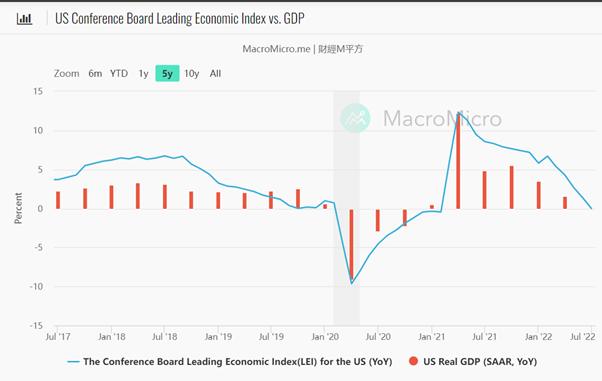
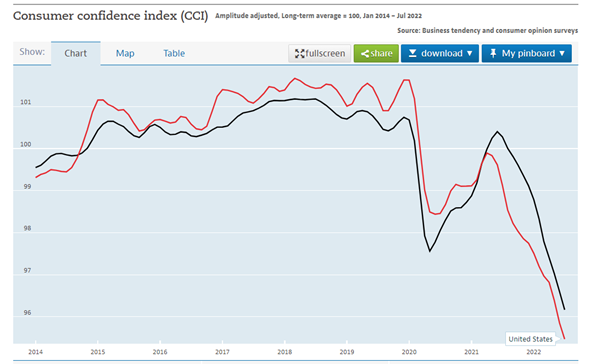
The current quantitative tightening could be too much for the US Economy to handle.
As we can see from the leading indicators above, the US has been having weaker economic sentiments weaker, and an expectation that businesses are likely to be faced with tougher conditions.
Simply put, inflation raises input costs - eats into margins - lower earnings growth and equity prices. With these input cost increases - businesses need to pass on this cost to consumers in terms of increased price - strain on consumer spending and budget.
However, I believe that is very unlikely for the US Economy to enter a “deep” recession or “hard landing”, and instead would expect a slow growth or single negative digit GDP growth for 2023 – a “soft landing”
Why?
- Corporate performance has been pretty sound
- The current earnings consensus appears to be optimistic. Bloomberg has revised their consensus earnings.
- Individual household savings has been at a record level
- People tightening their pockets, no money to spend → choosing to be prudent
We are in a better position than in past recessions
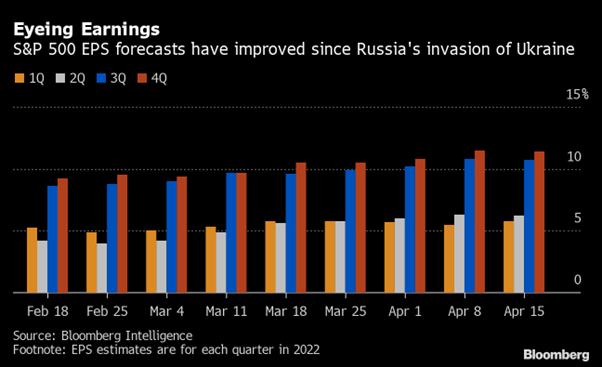
Does this mean we should not be investing in the US Markets? NO
US is in a bad state ≠ Pulling out of the US completely. This is because the US economy still plays a major part in GDP and investors’ portfolios.
What should we do in the current environment of rising rates?
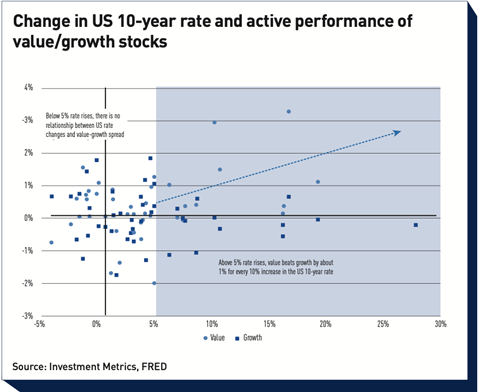
Most people might tell you to focus on value stocks due to the rising interest rates, is this necessarily true?
Yes, rising rates will ultimately see value outperform but, crucially, only if they rise fast enough. Betting on value stocks before long rates rise more than 5% in a given month in the US might not bring investors the returns they hope for. Historically, when interest rate increases were slower than those thresholds, there was no clear winner between value and growth. Only rapidly increasing rate hikes resulted in a clear outperformance by value.
So should we still adopt a value tilt now?
Yes
I believe that this is because long-term interest rates force growth stocks, which tend to have longer-term cash flow horizons than value stocks, to be more heavily discounted. As a result, growth stocks appear less valuable, this reduces the advantage that growth stocks have had over the past 10 years. A value tilt captures the _potential _momentum that value stocks might have.
Chinese Equities
I still firmly believe that Chinese markets should be a core aspect of our portfolios due to the fact that China takes up approximately 15% of global GDP, requiring us to have a more indicative exposure to Chinese equities.
While the Chinese market has much progress in the last 40 years, since 2021 Chinese equities have been sold off for many reasons
(e.g pact breakdown, the property selldown, and COVID zero policy lockdown where some cities entered lockdown again.)
Thankfully at the start of 2022: the Chinese government signaled more aggressive policies to stabilize the economy.
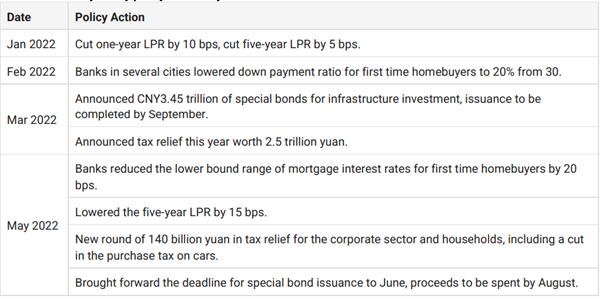
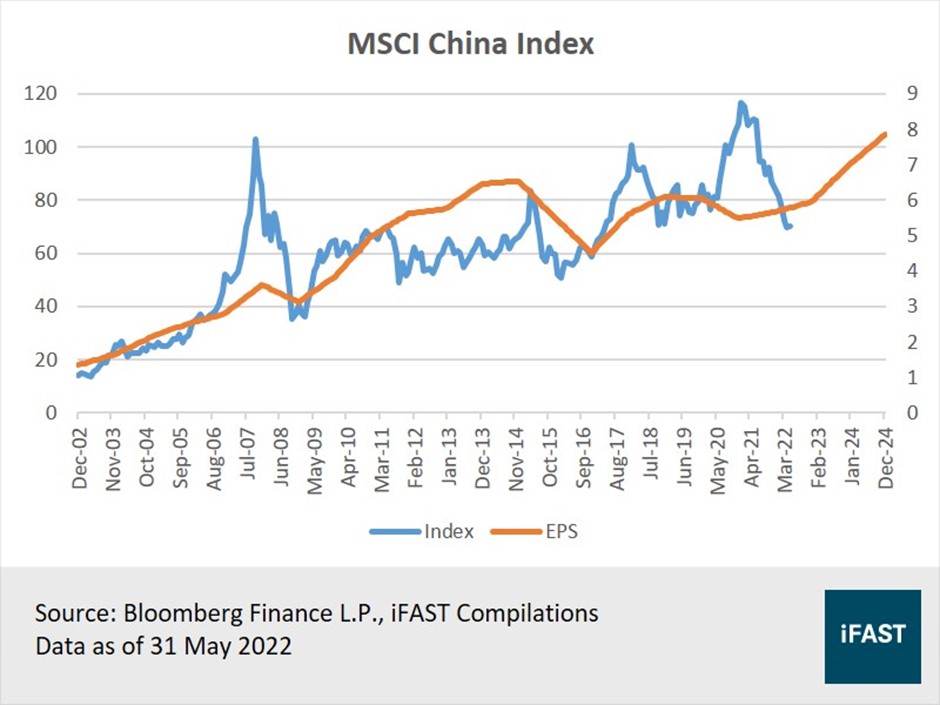
Policy support should give Chinese equities some tailwind moving forward, with the depressed valuation attracting investors
While China’s dynamic zero coping policy is not helping the economy reach its 5.5% GDP target, Chinese authorities will likely continue to launch positive stimulus measures e.g infrastructure spending and relief to revitalize and boost the economy → we believe this region will have a comparatively better showing. With the Chinese markets, the upside potential current outweighs the downside risks.
Should we still invest in the tech sector though?
As previously mentioned, there is no clear-cut connection from data that if interest rates go up all tech stocks will suffer.
In times of high inflation high-interest rate environment, we have to ensure that the growth stocks we invest in:
- has quality earnings
- business model already generating earnings for the company rather than starting in the future
I would want to shift my exposure more towards more steady companies with strong present-day earnings and cash flow.
One such example is Big tech companies who are generally more resilient in high-interest rates climate as they have:
- more steady earnings - the business model is already in the market and generating earnings.
- despite derating in their P/E – the drop is not so big as compared to high growth tech stocks.
- these companies are not trading at massive PE valuations in the hundreds.
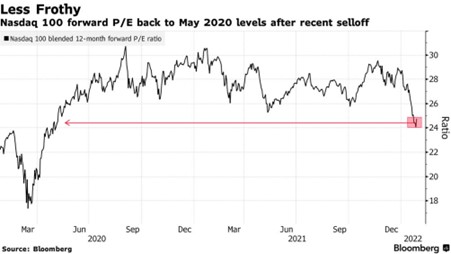
Although NASDAQ's current PE is approximately at 27.3, slightly below the 5-year historical average of 28.66, we should still remain cautious.
According to analyst earnings for next year - NASDAQ PE could drop lower to 21.62. Thus I am not calling for an all-out move to tech though tech stocks have corrected. This is especially due to the earnings of the 5 biggest US tech giants also slowing down due to inflation, recession, and a slowing economy.
In summary, I would maintain an overweight exposure to value, while staying invested within the US Equity markets. Not to exit completely and maintain current exposure. I would also move some of my allocations to Asia Ex-Japan Equities, with slight exposure to Chinese equities. While it is fair to maintain caution towards the tech sector, it is still a good time to add in a small portion through DCA for exposure to big tech companies. You can also consider commodities as a hedge against inflation.
While the markets are extremely volatile now, the age-old advice still maintains:
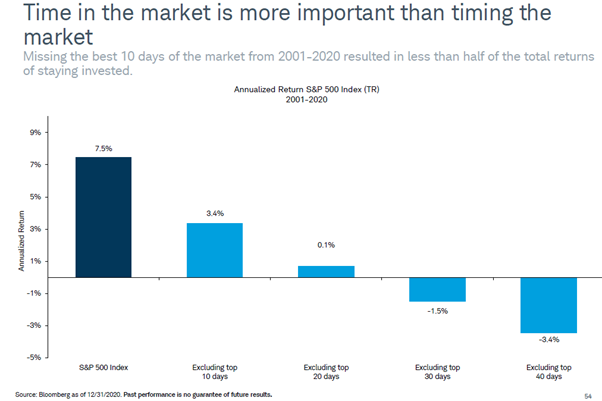
- avoid timing the market
- don’t let your emotions run wild
- staying invested - be disciplined
look beyond short-term noises
You can slide into my DMs here.
Or connect with my Linkedin here.
Talk more,
Ngooi
Comments
658
3
ABOUT ME
Ngooi Zhi Cheng
Edited 25 Aug 2022
Student Ambassador 2020/21 at Seedly
To empower people to make informed personal financial decisions for each life stage. Financial Consultant|NTU Accountancy|Dancer
658
3
Advertisement
No comments yet.
Be the first to share your thoughts!