Advertisement


OPINIONS
How To Save Up For Your Short-, Mid- and Long-Term Financial Goals
If you don’t set clear financial goals, it’s way too end up scrambling when life throws a curveball.
This post was originally posted on Planner Bee.
Most people tend to spend more than necessary if they are not working towards specific financial goals. When there are unexpected expenses or emergencies, they often find themselves short on cash, and this can lead to a challenging cycle of debt.
Goal-setting is a crucial first step towards proper financial planning. Your short-, mid-, and long-term goals are important if you want to be financially secure, helping you avoid the stress of dealing with overwhelming debt.
Whether you’re saving for a home, planning a vacation, or preparing for retirement, establishing financial goals in advance offers the freedom to enjoy life’s little pleasures. With proactive planning, unexpected expenses become less daunting, and you’re better prepared when extra funds are required.
Types of financial goals
It can be pretty unnerving if you think about a lifetime’s financial goals altogether.. Categorising them into short-, mid-, and long-term goals can make it clearer and less daunting.
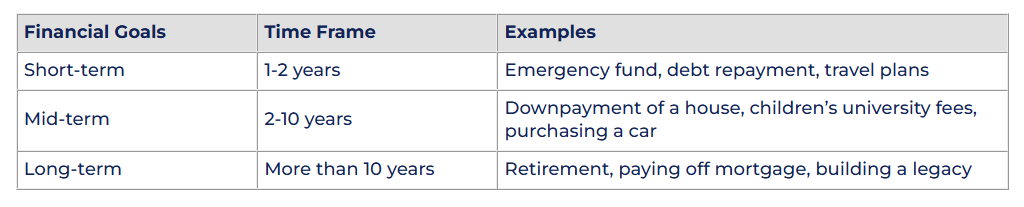
You can work towards more than one goal at any given time. By identifying your financial goals early in life, you can make use of compounding interest, a powerful tool in savings and investments, to help you reach your financial goals earlier.
Short-term financial goals
Short-term goals relate more to your immediate plan. Outside of your necessities, it concerns money you need within the next one to two years. Setting these short-term financial goals gives you the confidence you need to hit the bigger targets that would need more time, as they are typically smaller monetary goals and more achievable.
These goals are generally building an emergency fund, debt repayment, and small pleasures in life such as minor home renovations or a well-deserved vacation.
To reach any financial goal, it’s essential to understand your current finances. Start with an honest audit of your finances, check what are your high-interest debts, and find out what monthly expenditures you can cut down on. Thereafter, if you have yet to have one, it is time to set aside anything from S$100 to S$300 as a starter for your emergency fund.
Read more: What’s an Emergency Fund and How Much is Enough?
Finally, look at the available investments that you can afford to help you reach your short-term financial goals.
Saving for short-term financial goals
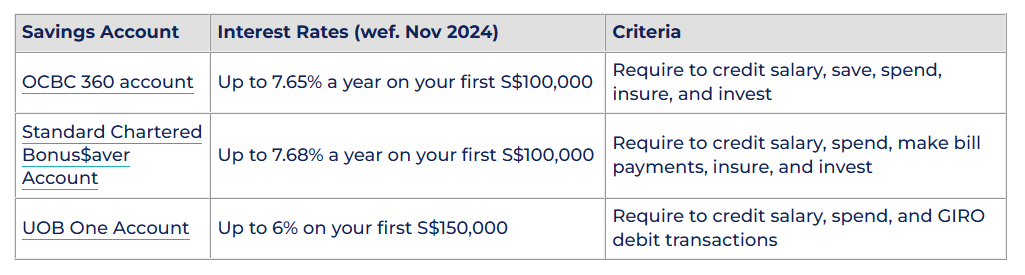
Liquidity is the most important when we talk about short-term goals. You want to put your money somewhere that offers you more than the 0.05% interest that regular saving plans offer.
High-interest savings accounts are recommended for those who need high liquidity for their money. Most of these accounts require you to hit two to six criteria before crediting you the high interest promised. Here are some high-interest savings accounts available in Singapore:
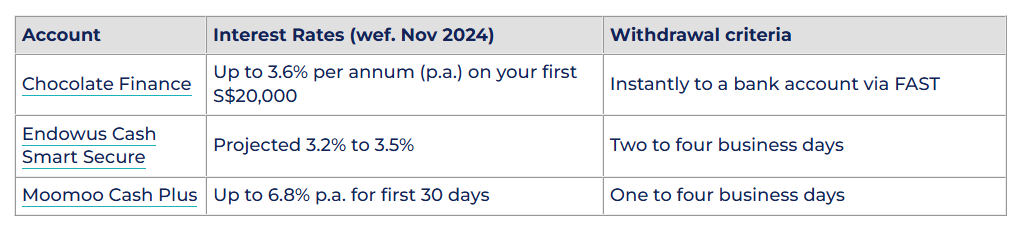
Cash-managed accounts are another way to save for short-term financial goals, and are usually offered through brokerages and robo-advisors.
Though they might offer some similar benefits, these accounts aren’t meant for everyday savings as they are investment products. This means your capital isn’t protected by the Singapore Deposit Insurance Corporation (SDIC). Interest rates for cash-managed accounts are also usually not fixed and can vary over time. Here are some cash-managed accounts available in Singapore:
Fixed deposit accounts offer guaranteed interest rates, based on a rate contracted when the funds were first deposited, and hold your money for a fixed period of time.
With tenure options from as low as three months, fixed deposits are also something that you can look into for your short-term financial goals.
Alternatively, 6-month Treasury Bills (T-Bill), offered by the Singapore government, is also something you can invest in. The cut-off yield for Dec 2024’s T-Bill auction was 3%.
Read more: T-Bills: What Are They, and What Other Investments Are There for Rookie Investors in Singapore?
Mid-term financial goals
Mid-term goals act as a bridge between your short- and long-term goals, typically saving up for things that will be in your life for a long period of time. These goals can include saving up for a downpayment of a house, your children’s university fees, or even purchasing a car.
Saving for mid-term financial goals
As the money you need for mid-term financial goals can be anything between two to ten years later, the more time you have to save for these goals, the more options you have to play around.
Government-backed Singapore Savings Bonds (SSBs) are considered one of the safest investment options in Singapore.
SSBs offer interest rates that increase over time, with a maximum term of 10 years. It can be redeemed monthly with no penalty, and credited on the second business day of the following month. The 10-year yield is 2% to 3% most of the time.
Fixed deposits are also a great way to save for your mid-term goals. In recent years, it has been common for fixed deposits to run for short tenures, ranging from three to 12 months.
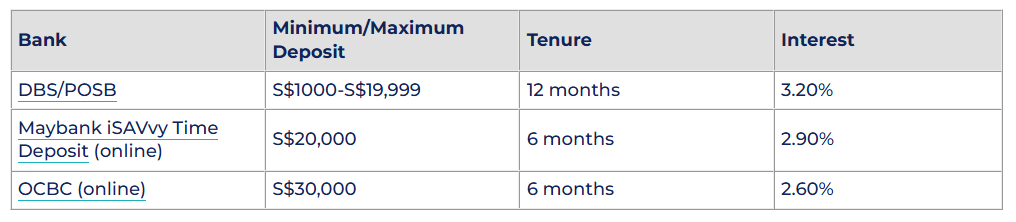
*Rates as of November 2024
When your fixed deposit matures, you can withdraw the money to put it into another round of fixed deposit, choosing whichever can give you the highest interest at that time.
Low-volatility investments are typically stocks and funds that fluctuate less than the overall stock market. Investing in these means you are giving up a little of those expected returns when the markets are performing well, but gain the stability in these funds as they have less wildly unpredictable swings in value.
Some low-volatility investments include:
- BNP Paribas Sustainable Global Low Volatility Equity Fund: A medium to long-term investment that sees a 3-year 7.03% annualised performance.
- iShares MSCI USA Min Vol Factor ETF: Enjoy equity exposure with less volatility by investing in US stocks that have potentially lower risk than the broad market. This fund’s 3-year cumulative performance is 30.71%.
- iShares MSCI USA Small-Cap Min Vol Factor ETF: Exposure to U.S. small-cap stocks with potentially less risk in this mid- to long-term investment. This fund’s 5-year cumulative performance is 29.32%.
Cash-managed accounts are also great for mid-term savings, especially with their high liquidity component, making it easy for you to withdraw money should you need it unexpectedly.
Long-term financial goals
The greatest long-term financial goal is typically saving up for retirement. After working for most of your adult life, you’d want to enjoy your golden years.
By starting early and using the power of compounding interest, you can reach your retirement goals through a portfolio of varied stocks and funds. To take advantage of this valuable tool in compounding interest, make sure you contribute a fixed amount regularly, even if it is as small as $100 monthly.
Saving for long-term financial goals
With an investment horizon of more than 10 years, you will have more options when it comes to saving for long-term financial goals.
Consider investing in stocks and ETFs for higher returns. These are riskier than your traditional savings accounts and bonds such as T-Bills and SSBs, but over the long term, they can offer significant growth potential.
Dollar-cost averaging is a simple strategy where you invest a fixed amount regularly, regardless of the stock price. This reduces the impact of market volatility and helps you buy more shares when prices are low and fewer when they’re high. Over time, this can lead to better returns than trying to time the market.
CPF’s Supplementary Retirement Scheme (SRS) allows for additional retirement savings with tax relief benefits. You can invest SRS funds in stocks, bonds, or other options while enjoying tax advantages, which can help you boost the total amount saved over the long term.
You can also look at annuity insurance plans, which can provide a steady and regular stream of income during your golden years.
Read more: Annuity Insurance Plans: What Is It and What You Should Know
Remember to review your plan annually as financial goals and life circumstances can change. Track your progress and be ready to adjust contributions and targets as needed. Make sure your investment strategies align with your life stage and risk tolerance.
Comments
48
17
ABOUT ME
Your Personal Mobile Financial Advisor Application Join us at telegram! https://t.me/plannerbee
48
17
Advertisement
No comments yet.
Be the first to share your thoughts!