Advertisement

OPINIONS
How to invest in Quality Companies with Strong Economic Moats
Here are examples of some of them.
During a Berkshire Hathaway annual shareholder meeting in 1995, a shareholder asked the following question:
“What are the fundamental rules of economics you used to make money for Berkshire?”
Warren Buffett’s answer (edited for context) is to find a business with a wide and long-lasting moat around it… protecting a terrific economic castle with an honest lord in charge.
Although the economic castle refers to the company and the lord is equivalent to the management team, moats are not that easily understood given that it depends a lot on the businesses themselves.
That said, we will explore what is an economic moat and some examples to provide you with a better understanding.
What is an Economic Moat?
An economic moat refers to a business' ability to maintain a long-term competitive advantage and allows it to earn oversized profits over time.
The term was coined and popularized by legendary billionaire investor - Warren Buffet, who realized that companies which have durable competitive advantages tend to reward investors handsomely over the long term.
Assessing this advantage involves understanding the kind of defense or competitive barrier that the company has been able to build for itself in its industry.
Below, we highlight 4 common economic moats that investors should know.
1) Cost Advantage/Efficient Scale
Companies that can deliver their goods or services at a low cost, typically due to economies of scale, have a distinct competitive advantage because they can undercut their rivals on price.
One of the notable advantages also include dominating a large market share of their industry and squeezing out any new competitors as they are not able to survive in cut-throat competition for long.
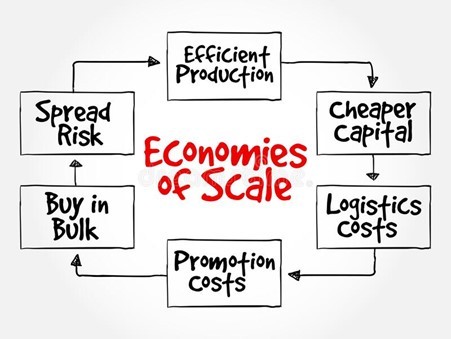
Sheng Siong (SGX: OV8) is a textbook example of a low-cost producer. As a dominant player in retailing and over 50 outlets under its umbrella, the company's size provides it with enormous scale efficiencies, or operating leverage, that it uses to negotiate for favourable item costs.
Since the company positions itself as a low-cost retailer, it wants to ensure it gives the lowest prices to its customers. This can translate into tough negotiating terms for those firms that want to sell their products on Sheng Siong's shelves.
2) Network Effect
The network effect occurs when the value of a particular good or service increases for both new and existing users as more people use that good or service. It can also occur when other firms design products that compliment an existing product, thereby enhancing that product’s value.
This is commonly seen in internet, consumer-focused companies such as Facebook (NASDAQ: FB), Twitter (NYSE: TWTR), Airbnb (NASDAQ: AIRBNB), Grab and the likes. Value is placed on the sheer volume of users of said service, and if a company can monetize their users, they’d achieve an economic moat in its network.
Using Instagram (part of Facebook) as an example, the value of the app increases exponentially as more and more people use it. In fact, the strong network effect is already apparent given its humongous 1+ billion active user database.
In the local context, we also have iFast Corporation (SGX: AIY) enjoying this network effect in its B2B business model.
In its early days, iFast’s ability to secure ‘suppliers’ such as fund houses, banks, and asset management firms provides a good value proposition to insurance agencies who want to promote/sell these products to their own clients.
With more sales coming from the insurance agencies’ clients, the suppliers would then be more motivated to add even more products to iFast’s pool.
In turn, this results in a flywheel phenomenon where the economic moat keeps expanding as more and more users join to make it more valuable.
Simply put, a strong network effect is difficult to dislodge and becomes almost unbeatable once it gains momentum over the long run.
3) High Switching Costs
Switching costs can be defined as a barrier to entry that involves the one-time inconvenience or expense a buyer incurs to change over from one product or service to another.
If you've ever taken the time to move all of your account information from one bank to another (i.e. DBS to OCBC), you know what a hassle it can be – filling up of new forms and external linkages again.
Hence, a firm with a domineering position within its industry usually aim to create high switching costs in order to "lock in" customers, deterring them from going to their competitors. The more customers are locked in, the more likely a company can pass along added costs to them without risking customer loss to a competitor.
Lastly, switching costs does not necessarily just mean monetary costs. It can include intangible costs in the case of Adobe (NASQAQ: ADBE) . A fact-check with many designers will reveal that they cannot do without Adobe Photoshop and they will lose all their ‘edge’ in their education/knowledge to use other software.
4) Intangible Assets
Intangible assets generally refer to the intellectual property that firms use to prevent other companies from duplicating a goods or services. It can also refer to a rather broad range of things such as patents, regulations, branding and even culture.
Patents are a legal barrier to entry that protect companies from unauthorized commercial usage of their products by competitors. A classic example is how Pfizer owns the Viagra's patent for the past 20 years and has carved the drug into a household name throughout this period.
In addition, government licenses may raise the entry hurdles for new competitors while brand equity can increase a customer’s willingness to pay for a product or service.
For the latter, one company that comes to mind would be Haw Par Corporation (SGX: H02), the company behind the iconic Tiger Balm Brand. With a unique herbal formulation that has over 100 years of proven success in 100 countries, Tiger Balm’s world renowned ointment is arguably one of the world’s leading and most versatile topical analgesic brand.
Conclusion
All in all, successful long-term investing is not just about finding undervalued or fast-growing businesses, but more on evaluating whether a business will stand the test of time.
On this note, identifying economic moats can be a good starting point to understand a company's competitive position and also to determine its long-term pricing power.
In our next article, we will touch on mistaken moats that you should take note of.

Join over 3,500 investors on our Telegram now: https://rebrand.ly/dab7ea
Comments
1001
0
ABOUT ME
A portal that provides a holistic approach to assess SGX listed companies through a wide array of viewpoint.
1001
0
Advertisement
No comments yet.
Be the first to share your thoughts!