Advertisement


OPINIONS
How To Budget for Food in Singapore
Set a food budget that fits your lifestyle by planning for groceries, eating out, and daily meals.
This post was originally posted on Planner Bee.
A food budget in Singapore refers to the total monthly amount allocated to groceries, dining out, snacks, beverages, and health-related consumables.
Recent household expenditure data shows that the average Singaporean household spends approximately S$455.90 per month on groceries and non-alcoholic beverages, accounting for about 8.5% of overall household spending.
This figure varies significantly by housing type and household size. Households in HDB flats typically spend between S$400 and S$700 per month, while private housing residents may spend S$800 to S$1,200.
Food inflation continues to affect everyday staples such as rice, vegetables, poultry, and prepared meals. As a result, setting a realistic food budget requires aligning spending with lifestyle habits rather than relying on national averages alone.
How food spending is structured in Singapore
Food expenditure in Singapore generally falls into four distinct categories. Understanding these categories enables more precise budgeting and clearer cost control.
- Groceries cover staple ingredients consumed at home, including rice, meat, vegetables, dairy, and pantry essentials.
- Dining out includes hawker centre meals, food courts, cafés, and restaurants.
- Snacks and beverages include packaged snacks, coffee, bubble tea, and convenience drinks.
- Health-related food items include supplements, vitamins, and speciality health foods.
Each category responds differently to lifestyle choices. Individuals who meal prep allocate more towards groceries and less towards dining out. Busy professionals tend to spend more on convenience meals.
Food budget by household profile in Singapore
Food expenditure differs substantially depending on household composition. The following ranges include groceries, dining out, and discretionary food-related spending.
Single working adult
Single adults frequently dine out for convenience while preparing simple meals at home.
- Groceries: S$200–S$350
- Dining out: S$150–S$300
- Snacks and drinks: S$50–S$100
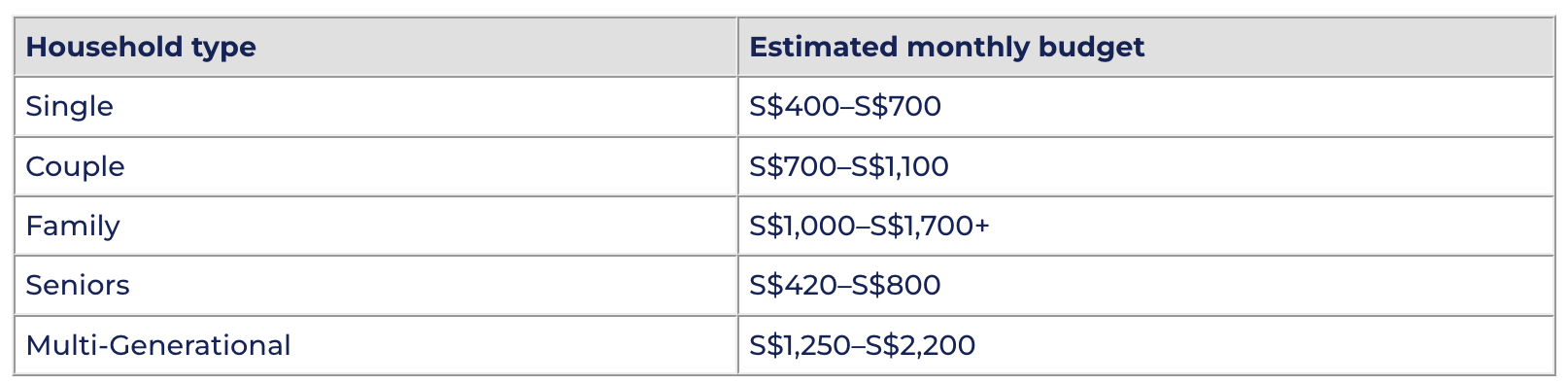
- Estimated total: S$400–S$750 per month
Hawker meals typically cost S$4–S$6, while café meals range from S$15–S$25. Cooking three additional dinners at home each week can reduce monthly spending by approximately S$100–S$150.
Couple
Couples benefit from shared grocery costs and bulk purchasing efficiencies.
- Groceries: S$350–S$550
- Dining out: S$250–S$450
- Snacks and drinks: S$80–S$150
- Estimated total: S$650–S$1,150 per month
Bulk purchasing staples such as rice, poultry, and frozen vegetables can reduce grocery costs by up to 15%, particularly when using house-brand products from major supermarkets.
Family with young children
Families allocate the largest share of spending to groceries due to volume purchases and child-specific items.
- Groceries: S$500–S$900
- Dining out: S$300–S$600
- Snacks and children’s items: S$120–S$250
- Estimated total: S$920–S$1,750 per month
A home-cooked meal for four costs approximately S$15–S$20. A comparable restaurant meal costs S$60–S$80. Reducing one weekly restaurant visit can lower annual expenditure by more than S$3,000.
Seniors or retirees
Retirees generally consume smaller portions and cook more frequently at home.
- Groceries: S$250–S$450
- Dining out: S$120–S$250
- Health foods and supplements: S$50–S$100
- Estimated total: S$420–S$800 per month
Wet market purchases often cost 10–15% less than supermarket equivalents for fresh produce and fish.
Multi-generational household
Large households combine diverse dietary needs and higher volume purchases.
- Groceries: S$700–S$1,200
- Dining out: S$400–S$700
- Snacks and drinks: S$150–S$300
- Estimated total: S$1,250–S$2,200 per month
Bulk buying long-shelf-life staples such as rice, cooking oil, oats, and frozen vegetables improves cost efficiency.
Read more: 8 Habits That Could Lead to Lifestyle Inflation and How To Keep Your Finances in Check
Typical grocery prices in Singapore (2026 estimates)
Understanding average unit prices supports more accurate budgeting.
- Rice (1 kg): S$2–S$5
- Chicken (1 kg): S$8–S$15
- Eggs (12): S$4–S$6
- Fresh milk (1 L): S$3–S$5
- Leafy greens (500 g): S$2–S$4
A weekly grocery bill averages S$40–S$60 for one person and S$150–S$200 for a family of four.
Unit price comparison on shelf labels (per 100 g or 100 ml) allows objective comparison between branded and house-brand options.
Dining out costs in Singapore
Dining expenses vary significantly by venue type.
- Hawker centre meal: S$3.50–S$8
- Food court or casual eatery: S$6–S$12
- Café or restaurant: S$15–S$30+ per person
Daily dining out can double total monthly food expenditure compared to primarily home-based cooking.
The long-term financial impact of food choices
Food budgeting directly affects long-term financial resilience.
Diets high in processed and fried foods increase the risk of chronic illnesses such as cardiovascular disease and diabetes. These conditions are among the leading causes of hospitalisation in Singapore. Preventative dietary habits reduce healthcare expenditure and income disruption later in life.
Balanced nutrition supports both financial planning and medical cost management.
Read more: Time To Start Adulting: A Guide to Cost of Living in Singapore for Fresh Graduates
Practical food budgeting methods
The following structured budgeting approaches improve spending discipline and predictability.
1. Percentage allocation model
Allocate food spending into defined proportions:
- 50% groceries
- 30% dining out
- 20% discretionary items
For an S$800 food budget, allocate S$400 to groceries, S$240 to dining out, and S$160 to extras.
2. Weekly cap with monthly buffer
Set a fixed weekly spending cap and maintain a separate buffer for irregular occasions such as celebrations or festive periods. This approach prevents unplanned overspending from affecting savings.
3. Category envelope system
Create separate allocations for groceries, dining out, and discretionary items. When one category is depleted, spending in that area pauses. Many banking applications allow digital sub-wallet implementation.
4. Meal preparation strategy
Plan weekly meals using:
- Three protein sources
- Two carbohydrate bases
- Three vegetable options
Cooking in batches reduces waste and lowers per-meal cost.
5. Bulk purchasing framework
Bulk purchase non-perishable items used weekly with shelf life exceeding 30 days. Purchase perishable items weekly to reduce spoilage.
Read more: 8 Habits That Could Lead to Lifestyle Inflation and How To Keep Your Finances in Check
Average monthly food budget ranges in Singapore (2026
All budget ranges, grocery prices, and dining cost examples presented in this article are planning estimates based on typical market observations as of 2026. Actual spending will vary depending on:
- Household size and dietary preferences
- Frequency of dining out
- Supermarket selection and promotional cycles
- Brand preferences (house brand versus premium brands)
- Inflation, seasonal supply changes, and global commodity costs
Food prices in Singapore fluctuate over time. Use these figures as budgeting benchmarks rather than fixed guarantees, and review your actual monthly spending regularly to adjust for lifestyle or price changes.
Conclusion
A realistic food budget in Singapore depends on household size, dining habits, and sourcing strategies. National averages provide context, but individual spending patterns determine actual requirements.
Effective food budgeting combines structured allocation, conscious dining frequency, bulk purchasing where appropriate, and nutritional awareness. With disciplined planning and consistent tracking, households can maintain dietary quality while keeping expenditure within sustainable limits.
Read more: Grandma’s Budgeting Secrets That Still Work Today
Comments
16
1
ABOUT ME
Your Personal Mobile Financial Advisor Application Join us at telegram! https://t.me/plannerbee
16
1
Advertisement
No comments yet.
Be the first to share your thoughts!