Advertisement


OPINIONS
How To Boost Your Portfolio With Active vs Passive ETFs
ETFs provide a simple way to diversify investments and grow wealth.
This post was originally posted on Planner Bee.
Given the rising cost of living and uncertainty in the job market, simply saving money in the bank is no longer enough. New ways to grow wealth are becoming part of the Singaporean lifestyle.
One investment option that is gaining popularity is Exchange-Traded Funds (ETFs). These funds are simple to invest in and provide exposure to a variety of markets, making them a powerful tool for diversifying your investments.
But what exactly are ETFs, and how could they fit into your investment strategy? More importantly, how can they help improve your portfolio, whether you are just starting or already an experienced investor?
What are Exchange-Traded Funds?
An Exchange-Traded Fund (ETF) is an investment fund listed on the stock market. It is made up of a collection of assets such as stocks, bonds, commodities, or money market instruments, packaged and sold as a single stock.
For investors, this means that one purchase can give you exposure to a wide range of assets without having to buy each one separately.
ETFs can be bought and sold on a stock exchange at any time during trading hours. They can be managed either actively or passively, depending on the approach of the fund.
Differences between active and passive ETFs
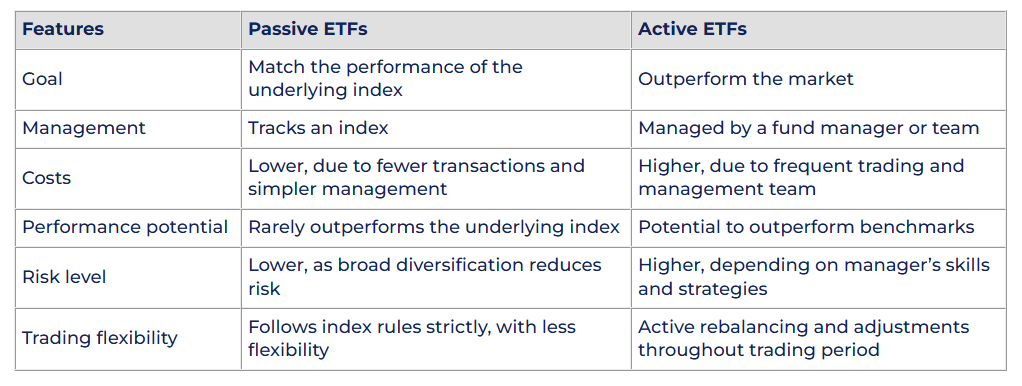
The most common ETFs are passive ETFs. These usually track a specific index, such as the S&P 500, copying both its composition and the individual stocks involved.
Passive ETFs aim to deliver performance similar to the index they follow. They do not aim to beat the market, but they also do not underperform it. When the index performs well, the ETF benefits, but it will also mirror any downturns.
Because passive ETFs are generally less risky, they are often used as part of a long-term investment strategy.
Active ETFs, on the other hand, offer the potential to outperform the market.
These funds are managed by a professional or a team who research opportunities and select securities and allocations to achieve higher returns. They often rely on financial metrics, company earnings, and market trends to guide their choices.
However, active ETFs usually charge higher fees to cover the cost of continuous management and portfolio adjustments.
Read more: Why It’s Important to Rebalance Your Investment Portfolio
Pros and cons of passive ETFs
Every investment has advantages and drawbacks. Choosing between passive and active ETFs depends on your risk tolerance and investment goals.
Pros
- Diversification: Provides broad exposure to a range of assets, reducing the risk of relying on a single stock.
- Cost efficiency: Lower management fees due to fewer transactions and a smaller team managing the fund.
- Simplicity: Easy to understand and straightforward to start investing.
Cons
- Limited potential: Passive ETFs aim to match the performance of an index, not to outperform it.
- Market risk: If the index falls, the fund will also lose value, as no adjustments are made to the holdings.
- Long-term commitment: Passive ETFs are best suited for investors willing to stay invested over a long period to see meaningful growth.
Pros and cons of active ETFs
Active ETFs also have their own advantages and risks.
Pros
- Potential to outperform: Skilled managers can exploit market inefficiencies to increase fund growth.
- Flexibility: Fund managers can adjust asset allocation according to market conditions, which may improve returns.
Cons
- Higher fees: Management costs are higher and can reduce overall returns if performance does not justify them.
- Performance risk: Active funds may fail to meet benchmarks and could underperform the market.
How to enhance your portfolio with passive and active ETFs?
ETFs vary in terms of geographical focus and the underlying assets they hold. This makes it easier for investors to select funds that match their objectives.
Equity ETFs allow investors to access a wide range of stocks and assets without owning the individual shares. They are designed to track the performance of a specific stock index or a collection of stocks.
For example, the Nikko AM Singapore STI ETF is a passive equity ETF that tracks the Straits Times Index (STI). It holds the 30 largest companies listed on the Singapore Exchange by market capitalisation. Investing in this ETF gives exposure to major Singaporean companies such as DBS, Singtel, and CapitaLand.
Commodity ETFs provide exposure to raw materials such as gold, oil, and agricultural products. These can help hedge against inflation, as commodity prices often rise during such periods. Commodities are also considered an alternative investment because their prices do not always move in line with the equity market.
An example is the Invesco DB Commodity Index Tracking Fund, which invests in a portfolio of exchange-traded futures covering oil, natural gas, gold, silver, corn, sugar, and other commodities.
For investors willing to take on more risk, active ETFs offer the potential for higher returns. The first active ETF listed on the Singapore Exchange (SGX) is the Lion-Nomura Japan Active ETF (Powered by AI), launched in January 2024. It uses the Tokyo Stock Price Index (TOPIX) as its benchmark and aims to achieve long-term capital growth through an actively managed portfolio of Japanese equities, diversified across sectors and market capitalisation.
Read more: What to Look Out for When Investing in ETFs?
Due diligence is essential
With 49 ETFs listed on SGX and a combined assets under management exceeding S$15 billion, Singapore’s ETF market continues to grow.
Passive ETFs are often ideal for new investors, offering a low-cost way to diversify a portfolio. Active ETFs, when used strategically, offer potential for higher returns but carry greater risks and higher fees.
Whether you choose passive or active ETFs, thorough research is essential to ensure your investments align with your financial goals.
Read more: Smart Money or Blind Bet: Assessing Your Investment Approach
Comments
29
9
ABOUT ME
Your Personal Mobile Financial Advisor Application Join us at telegram! https://t.me/plannerbee
29
9
Advertisement
No comments yet.
Be the first to share your thoughts!