Advertisement


OPINIONS
How Much You’ll Pay for LASIK in Singapore?
LASIK can be life-changing, but it’s worth weighing the cost and finding a clinic you truly trust.
This post was originally posted on Planner Bee.
Being an adult comes with enough challenges. Misplacing your glasses in the morning or dealing with contact lenses every day shouldn’t be one of them. If you’ve thought about leaving them behind for good, you’ve probably looked into LASIK surgery.
If you’re trying to decide whether it’s the right move, especially when it comes to cost, this guide can help. It’s all about seeing clearly, both in terms of vision and your budget.
What is LASIK, and how does it work?
LASIK stands for Laser-Assisted In Situ Keratomileusis. It’s a type of laser eye surgery that reshapes the cornea to correct vision problems. It’s commonly used to treat:
- Myopia (short-sightedness)
- Hyperopia (long-sightedness)
- Astigmatism (blurred vision due to irregular corneal shape)
The procedure itself is remarkably quick, often taking less than 30 minutes for both eyes. Most people notice a clear improvement in their vision within 24 hours, and many no longer need glasses or contact lenses afterward.
While convenience is a big draw, LASIK can also have a major impact on quality of life. Still, it’s important to weigh the benefits against the potential risks and costs.
Are there any side effects or risks?
Like any medical procedure, LASIK comes with some risks. Knowing what to expect can help you make a more informed and confident decision.
Common side effects
- Dry eyes: Temporary dryness is common and may require eye drops for several months.
- Glare or halos: Especially noticeable at night, particularly when driving.
- Visual fluctuations: Some people experience mild vision changes during the healing period.
- Discomfort or irritation: Mild itchiness or pain just after surgery is normal.
Less common but more serious risks
- Flap complications: The procedure involves creating a flap in the cornea. In rare cases, this can lead to healing problems or infection.
- Regression: Some people may find their vision slowly worsens again over time, especially if their prescription was high to begin with.
- Under- or over-correction: Occasionally, a second procedure called LASIK enhancement may be needed if the first didn’t fully correct your vision.
Before moving forward, you’ll need a full eye assessment. Not everyone is a suitable candidate, as factors like thin corneas, severe dry eyes, or autoimmune conditions may make LASIK unsuitable.
What affects LASIK pricing in Singapore?
If you’ve searched “How much does LASIK cost in Singapore?”, you’ve probably noticed that prices can vary quite a bit. That’s because several factors influence the cost:
1. Type of clinic or hospital
Private clinics and hospitals typically charge more, but you may get access to the latest technology, shorter waiting times, and more personalised care. Popular private LASIK providers include Eagle Eye Centre, Atlas Eye Specialist Centre, and Shinagawa Eye Centre.
Public institutions like the Singapore National Eye Centre (SNEC) may offer lower-cost options, especially for Singaporeans and PRs eligible for subsidies. However, the trade-off may be longer wait times and fewer options when it comes to choosing your surgeon.
2. Type of LASIK technology used
- Standard LASIK: Uses a blade to create the flap. It’s the most budget-friendly option.
- Bladeless LASIK (FemtoLASIK): A laser creates the flap, offering more precision and reducing risk.
- Custom or Wavefront-guided LASIK: Tailored to your eye’s specific shape, which may lead to better outcomes.
- ReLEx SMILE: A newer, flapless procedure with quicker recovery and less chance of dry eyes, but it’s usually more expensive.
3. Surgeon’s experience
More experienced or highly sought-after surgeons may charge higher fees. While it’s natural to consider cost, it’s important to prioritise skill and reputation when it comes to your vision.
4. What the package includes
Some clinics offer comprehensive packages that include screening, surgery, medication, and follow-up visits. Others may charge separately for each step. Always check what’s included. Follow-up care is important for recovery, so it’s worth ensuring it’s part of the plan.
So, how much does LASIK actually cost in Singapore?
Here’s a general overview of LASIK costs in Singapore (as of 2025):
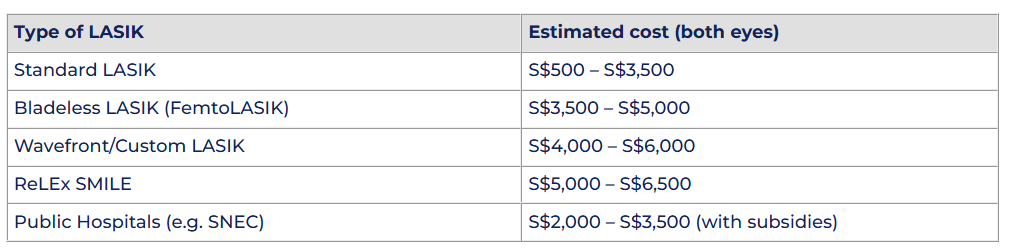
Tip: Many clinics offer flexible payment plans or instalment options, so you can spread out the cost instead of paying a lump sum.
Can you use MediSave to pay for LASIK?
Generally, MediSave cannot be used for LASIK if it’s done purely for convenience. However, there are some exceptions.
You may be able to use MediSave if:
- You have anisometropia, which means there’s a significant difference in prescription between your two eyes.
- Your uncorrected vision is causing functional or medical issues.
- LASIK is done in response to post-surgical complications or trauma.
Even in these cases, claims must usually be supported by a medical certificate and are more likely to be approved when done at a public hospital. It’s always best to check directly with your clinic and the CPF Board before assuming any amount can be claimed.
Read more: Should You Max Out Your Basic Healthcare Sum in Your CPF MediSave Account
How does LASIK compare to other vision correction options?
LASIK isn’t suitable for everyone. Here are a few other treatments to consider, along with their costs in Singapore:
1. PRK (Photorefractive Keratectomy)
- Works for people with thinner corneas
- Healing takes longer and can be more uncomfortable
- No corneal flap is created
- Cost: S$2,500 – S$4,000 (both eyes)
2. Implantable Collamer Lens (ICL)
- A synthetic lens is implanted inside the eye, behind the iris
- Good for those with very high prescriptions or dry eyes
- Cost: S$7,000 – S$10,000 (both eyes)
3. Refractive Lens Exchange (RLE)
- Similar to cataract surgery; it replaces your eye’s natural lens
- More common for adults over 40, especially if you have presbyopia
- Cost: S$9,000 – S$12,000 (both eyes)
4. Orthokeratology (Ortho-K)
- Special hard contact lenses worn overnight to reshape the cornea temporarily
- Non-surgical and reversible
- Cost: S$1,500 – S$3,000 for initial lenses and fitting
These options vary widely in suitability and cost, so a comprehensive eye assessment is essential before choosing a path forward.
Thinking about LASIK? Here’s what to do next
LASIK is a big decision in every sense. It has medical, financial, and emotional considerations. It’s not just about looking good without glasses. It’s also an investment in your daily comfort, long-term savings, and lifestyle goals.
If you’re considering LASIK, here are some final steps you can take:
- Book a pre-LASIK assessment to check if you’re a suitable candidate.
- Compare clinics and request itemised quotes to understand the full cost.
- Ask about payment plans, enhancement policies, and post-op care.
- Don’t forget to review your insurance and MediSave options if there’s a medical reason behind the procedure.
As with any financial decision in adulthood, the key is to balance cost, safety, and value. It’s important not to simply choose the cheapest or trendiest option.
Read more: Health Insurance in Singapore: All You Need To Know
Comments
13
21
ABOUT ME
Your Personal Mobile Financial Advisor Application Join us at telegram! https://t.me/plannerbee
13
21
Advertisement
No comments yet.
Be the first to share your thoughts!