Advertisement


OPINIONS
How Much Does It Cost To Own an Electric Vehicle in Singapore?
Are EVs really practical in Singapore, or still too costly to make the switch?
This post was originally posted on Planner Bee.
With the certificate of entitlement (COE) prices constantly increasing, it’s becoming more challenging to be a car owner in Singapore. Despite this, many still aspire to have their own vehicle. For some, electric vehicles (EVs) are an appealing option, not only because of rising fuel costs, but also due to growing environmental concerns.
Singapore has committed to reaching net zero emissions by 2050, and part of that effort includes encouraging the shift towards greener transport. Incentives and infrastructure for EVs are gradually expanding, making them a more viable choice than before.
But how practical is it to own an EV in Singapore today? This guide breaks down the key costs and considerations you should know before making the switch.
Types of electric vehicles in Singapore
In Singapore, there are three types of EVs available:
- Hybrid Electric Vehicles
- Plug-in Hybrid Electric Vehicles
- Fully Electric Vehicles
Plug-in hybrids are the most common type of EVs. This type can be recharged from any external electricity source, including charging stations or home charging packs.
Fully electric vehicles run only on electricity and produce no tailpipe emissions. They’re cheaper to run and maintain, though their range depends on the battery and charging access.
Hybrids combine a petrol engine with an electric motor but can’t be plugged in. Their batteries charge through braking and the engine.
How much do electric vehicles cost in Singapore?
Compared to Internal Combustion Engine (ICE) vehicles, EVs tend to be more costly because of the cost of development and materials needed to build an electric car, as well as the basic economies of scale.
Typically, the amount that you have to fork out for an EV will be higher than an ICE vehicle, though the exact price would ultimately depend on the model and brand you pick. Although EVs are expensive, you can qualify for up to S$45,000 in rebates.
The estimated prices* of EVs in Singapore are as follows:
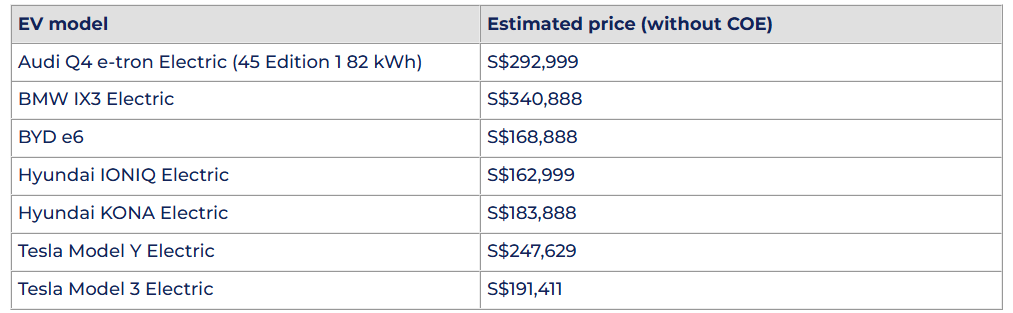
*Prices are taken from listings on SG Car Mart, and may vary from time to time.
New EV models and features
Several new EV models have been introduced or are expected in Singapore:
- Deepal S07: A mid-size SUV from China’s Changan Automobile, priced at approximately S$220,000. It features a 15.6-inch touchscreen and a 14-speaker system.
- MG S5 Electric SUV: Launched in April 2025, this model offers spacious interiors and modern features.
- Mercedes-Benz CLA-Class EV: Set to arrive by late 2025, it’s anticipated to deliver a range of over 750km.
Road tax
Historically, electric vehicles (EVs) in Singapore incurred higher road taxes compared to internal combustion engine (ICE) vehicles. However, to promote EV adoption, the Land Transport Authority (LTA) revised the road tax structure in 2021.
This involved merging the 30–90kW and 90–230kW power bands, applying the lower tax formula to both. As a result, mass-market EVs now enjoy significantly reduced road taxes. For instance, the annual road tax for a Hyundai Kona Electric decreased from approximately S$1,400 to S$1,100, while that for a Tesla Model 3 dropped from S$2,300 to S$1,500.
Read more: Owning a Car in Singapore: What You Should Know and Consider
How do I renew the road tax?
To renew your EV’s road tax in Singapore:
- Ensure prerequisites are met: Your vehicle must have valid insurance and pass the necessary inspections.
- Calculate road tax: Use the OneMotoring Road Tax Calculator to determine the amount payable, which depends on your EV’s power rating.
- Renew online: Visit the OneMotoring Road Tax Renewal Portal to complete the renewal process.
Road tax can be renewed for six or 12 months.
Certificate of Entitlement (COE)
As of March 2025, Certificate of Entitlement (COE) prices in Singapore have slightly declined compared to the previous year.
According to recent data, COE premiums stand at S$92,730 for Category A vehicles (cars with engine capacities of 1,600cc and below or with horsepower not exceeding 130bhp), and S$113,000 for Category B vehicles (cars with larger engine capacities or higher horsepower).
The COE remains valid for 10 years when purchasing a brand new electric vehicle (EV) or any new car. The recent dip in COE prices is largely attributed to the Land Transport Authority’s move to inject up to 20,000 additional COEs across all vehicle categories starting February 2025, in an effort to ease supply constraints and stabilise prices.
Read more: Certificate of Entitlement (COE): A Crash Course
COE price trends
In early 2025, COE prices experienced fluctuations. In February’s first bidding exercise, premiums fell across most categories, with Category A (cars ≤1600cc & ≤130bhp) dropping to S$85,000. However, by mid-May, Category A premiums rebounded to a seven-month high of S$103,009, indicating a volatile market.
For EV buyers, these COE trends are significant, especially since many EVs fall under Category A. The recent price hikes could increase the overall cost of EV ownership. However, the Land Transport Authority (LTA) plans to add up to 20,000 COEs across vehicle categories over the next few years, which may help stabilise prices in the long term.
Car insurance
Currently, the following insurance providers provide coverage for EVs.
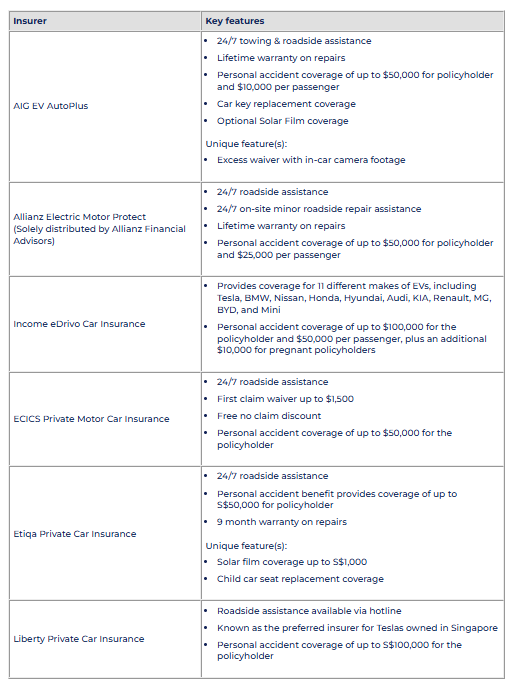
The actual cost of your car insurance would depend on factors such as your:
- Age and gender
- Occupation
- Type of car, car model, age of car, and car usage
- Marital status
- Claims history and No Claims Discount (NCD)
- Driving experience
- Certificate of Merit (COM) discount
Unsure of how much your premiums will cost? Get a personalised quote here.
Where do I charge my electric vehicle?
With most cars on the roads still being ICE vehicles, the number of charging stations available in Singapore is still quite elusive. Nonetheless, the Singapore government intends to gradually increase the number of charging stations in Singapore to 60,000 by the year 2030. Additionally, all 2,000 HDB carparks in Singapore will have at least three charging points ready by 2025.
Currently, there are around 3,600 charging points, and each station can only charge one car at any given time.
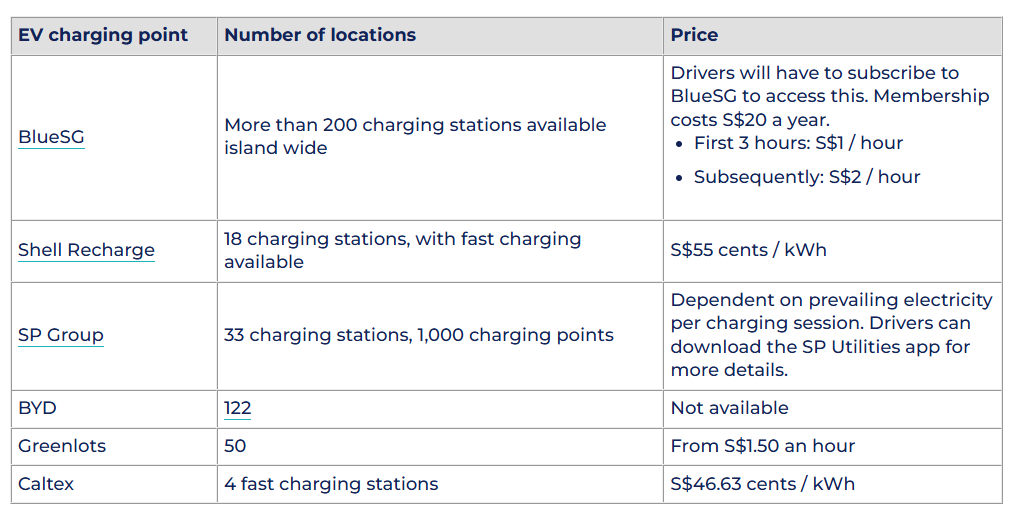
Furthermore, the MyTransport.sg app by Land Transport Authority (LTA) lets you locate over 800 public charging points at more than 200 locations in Singapore. You can even filter by charging types, price and charging providers.
Read more: Guide to Car Sharing Options in Singapore
Incentives for purchasing an electric car
To encourage the adoption of EVs, the government has introduced several incentives, such as:
- Additional Registration Fee (ARF) Floor Reduction: Reduces the minimum ARF payable for EVs
- Revised Road Tax Framework: Adjusts road tax calculations to be more favorable for EVs
- EV Early Adoption Incentive (EEAI): Provides an Additional Registration Fee (ARF) rebate of up to $15,000 for eligible EVs
- Enhanced Vehicular Emissions Scheme (VES) rebate: Offers rebates based on the vehicle’s emission band, with up to S$25,000 for Band A1 EVs
Thinking about switching to an EV?
Electric vehicles (EVs) may not be the cheapest option right now, but they do come with their own set of benefits. Singapore is working towards a more sustainable land transport system and plans to phase out internal combustion engine (ICE) vehicles by 2040.
As a driver, it’s worth thinking about making the switch to an EV sooner rather than later. Demand is growing, and that could push prices up over time.
Choosing an EV not only supports Singapore’s sustainability goals but can also save you money on fuel and maintenance in the long run. Taking the step now means you’re better prepared for the future of driving.
That said, it’s important to weigh up whether an EV fits your budget. If you’re unsure whether it’s the right move for you, feel free to get in touch at [email protected]. We’re happy to chat and help you work it out.
Read more: Owning vs Renting a Car in Singapore: A Cost Breakdown
Comments
19
21
ABOUT ME
Your Personal Mobile Financial Advisor Application Join us at telegram! https://t.me/plannerbee
19
21
Advertisement
No comments yet.
Be the first to share your thoughts!