Advertisement


OPINIONS
How Much Do Fresh Graduates Earn in Singapore? A 2026 Guide
Compare fresh graduate salaries by industry and degree to see what starting pay you can realistically expect.
This post was originally posted on Planner Bee.
Fresh graduate salary refers to the gross monthly pay offered to individuals entering their first full-time job after completing tertiary education. In Singapore, starting salaries vary significantly depending on industry, degree programme, and technical skill set. Data from the Joint Autonomous Universities Graduate Employment Survey (JAUGES) and the Ministry of Manpower (MOM) indicates that starting salaries have continued to rise despite a more selective hiring environment.
Employers increasingly prioritise specialised skills, internship experience, and professional certifications when determining salary offers. As a result, graduates in fields such as artificial intelligence, cybersecurity, finance, and data science often command significantly higher starting salaries than generalist roles.
Key takeaways
- The median starting salary for graduates from Singapore’s autonomous universities reached S$4,500 in 2024.
- Technology and finance roles often offer starting salaries above S$5,500 per month.
- Specialists in areas such as AI, cybersecurity, and data science can earn 15–20% above market averages.
- Education pathway affects earnings: autonomous university graduates earn a median S$4,500, private education graduates S$3,500, and polytechnic graduates S$3,000.
- Graduates can typically negotiate 5–10% salary increases when they have competing offers or specialised skills.
Average fresh graduate salary in Singapore
The median starting salary for the Class of 2024 graduates from Singapore’s autonomous universities (NUS, NTU, SMU, SUTD, SIT, and SUSS) reached S$4,500 per month. This represents a 4.2% increase compared with the previous year, indicating sustained demand for skilled graduates despite a more competitive job market.
Understanding how salary statistics are calculated is important when interpreting graduate salary reports.
Median salary
Median salary represents the middle value of all salaries reported, meaning half of graduates earn more and half earn less. This figure is considered the most reliable benchmark for career planning.
Mean salary
Mean salary is the average of all reported salaries. High-paying roles such as investment banking or artificial intelligence research can inflate this figure because some graduates earn significantly higher starting pay.
25th percentile salary
The 25th percentile represents the lower quartile of salary distribution. Roles in start-ups and small-to-medium enterprises often fall within this range, typically between S$3,500 and S$4,000.
Public sector vs private sector starting salaries
Graduate salaries differ significantly between the public and private sectors due to compensation structures and bonus systems.
Public sector salaries
Most fresh graduates joining the Singapore Civil Service start as MX13 officers, with base salaries typically ranging from S$3,800 to S$5,200 per month. While base salaries may appear lower than some private-sector roles, civil servants receive structured bonuses. In 2025, civil servants received a total annual variable component of 1.7 months.
Private sector salaries
Private sector salaries vary widely depending on industry and company size. Large multinational corporations in finance and technology frequently offer starting salaries between S$6,000 and S$8,000, which represent the upper end of the graduate salary range. Smaller local firms may offer lower starting pay but often provide faster career progression and broader job responsibilities.
Read more: A Fresh Graduate’s Complete Guide to Job Hunting
Fresh graduate salary by industry
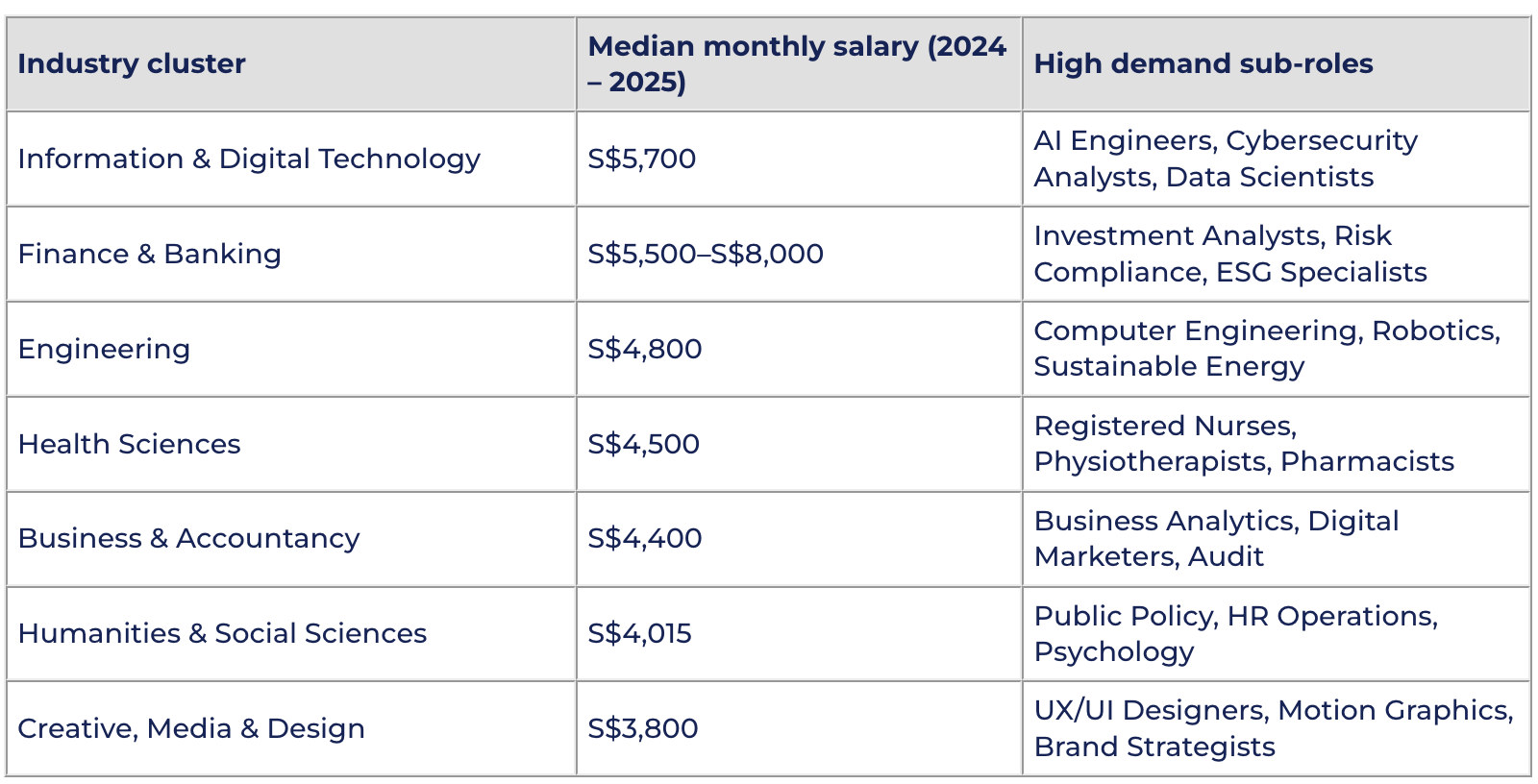
Industry choice is one of the most significant factors influencing graduate starting salaries. Certain sectors consistently offer higher compensation because of strong demand for specialised technical skills.
Banking and Finance
Front-office roles in global investment banks offer some of the highest starting salaries. Base pay typically ranges from S$5,500 to S$8,000 per month, and performance bonuses can significantly increase total first-year compensation.
Technology
Technology companies pay higher salaries due to strong demand for specialised technical talent. Professionals with expertise in artificial intelligence, cybersecurity, and cloud engineering often receive 15–20% higher salaries than standard market benchmarks.
Healthcare
To remain competitive with private healthcare employers, the Ministry of Health introduced salary adjustments in 2025. Allied health professionals such as physiotherapists and pharmacists received increases of up to 7%, while nurses received an additional 4% base salary adjustment.
Business and Accountancy
Fresh graduates entering the Big Four accounting firms typically earn between S$4,300 and S$4,350 per month. Graduates specialising in data analytics or digital marketing often command slightly higher salaries due to increasing demand for digital skills.
Creative Industries
Creative fields generally have lower median salaries, but specialised roles such as UI and UX design can command higher pay. Traditional graphic designers often start between S$2,400 and S$3,200, while UI/UX designers can earn S$4,200 to S$6,500 due to their role in digital product development.
Salary differences by degree and qualification
Educational background plays a significant role in determining starting salary levels.
- Autonomous Universities: Graduates from Singapore’s autonomous universities reported a median starting salary of S$4,500 and a full-time employment rate of 79.5% for the 2024 cohort.
- Private Education Institutions: The Private Education Institution Graduate Employment Survey 2023–2024 reported a median starting salary of S$3,500 for full-time permanent roles, with a full-time employment rate of 46.4%.
- Polytechnic (Post-NS): Polytechnic graduates typically start with salaries around S$3,000 per month, although specialised diploma programmes in healthcare and technical fields may command slightly higher pay.
- The Honours Impact: University honours classifications can influence salary offers. Graduates receiving high honours or Cum Laude distinctions in competitive programmes such as computer science or economics may receive starting salaries S$500 or more above the cohort median.
Factors influencing fresh graduate salaries
Several labour market trends influence how employers determine graduate salary offers.
- AI and digital skills: Employers increasingly seek graduates with AI tool proficiency and automation skills. These capabilities allow employees to integrate AI technologies into business workflows, which explains the 15–20% salary premium observed in many technical roles.
- Internship conversion: Internship programmes frequently serve as recruitment pipelines. At Singapore Management University (SMU), 31.6% of graduates accepted full-time offers from their internship employers, and these offers often fall at the higher end of salary ranges because the employer has already evaluated the candidate’s performance.
- Skills-based hiring: Labour market data shows that 78.8% of job vacancies in 2024 prioritised practical skills over formal academic credentials, reflecting a broader shift towards skills-based recruitment.
Highest-paying degrees for fresh graduates
Certain university degree programmes consistently report higher median starting salaries because of strong employer demand.
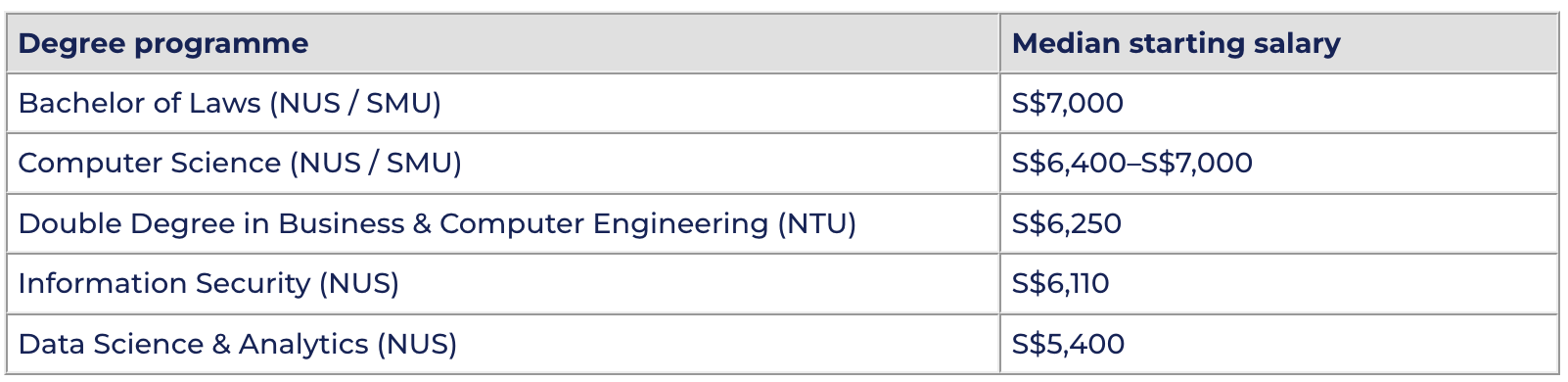
These programmes typically lead to careers in industries experiencing rapid technological expansion, including financial technology, cybersecurity, and data analytics.
Singapore fresh graduate salaries compared with Asia
Singapore remains one of the highest-paying markets for entry-level talent in Asia.
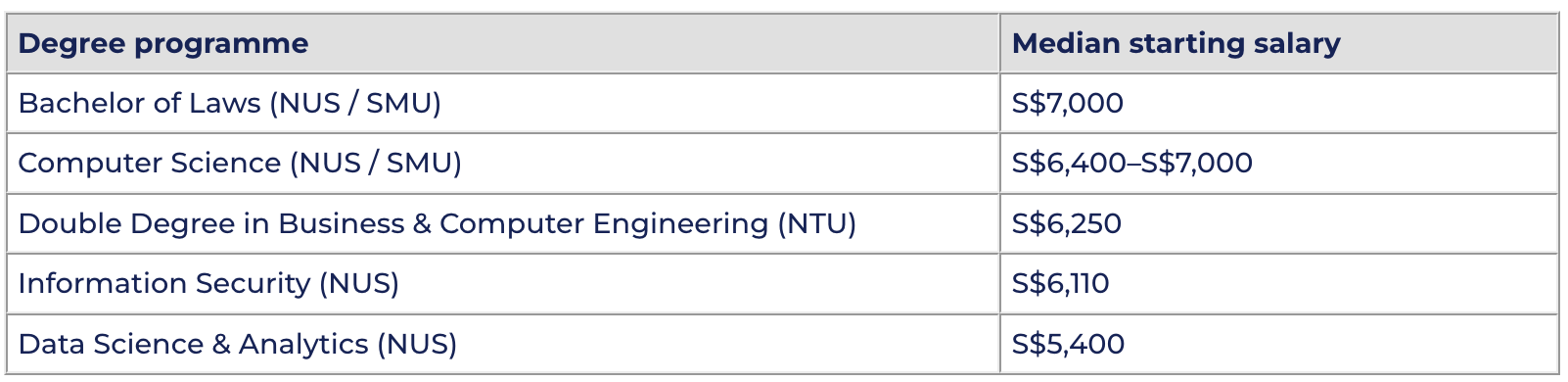
Singapore’s strong financial sector, technology ecosystem, and multinational business presence contribute to its higher salary benchmarks.
Outlook for fresh graduate salaries in Singapore
The Singapore graduate job market increasingly rewards specialised skills and technical expertise. While the baseline median salary of S$4,500 represents a record high, the gap between generalist and specialist roles continues to widen.
Graduates who combine strong academic credentials with technical skills, industry certifications, and relevant internships are most likely to secure higher starting salaries and faster career progression during their first decade of employment.
Read more: A Fresh Grad’s Guide to Insurance Policies You Should Get in Singapore
Comments
42
0
ABOUT ME
Your Personal Mobile Financial Advisor Application Join us at telegram! https://t.me/plannerbee
42
0
Advertisement
No comments yet.
Be the first to share your thoughts!