Advertisement


OPINIONS
How Cord Blood Banking Works in Singapore
Cord blood banking is the collection and storage of blood from a baby’s umbilical cord for treating critical illness.
This was originally posted on Planner Bee.
Cord blood banking: it’s a term expecting parents may have heard being tossed around, but what exactly does it entail? This article explores the question: is cord blood banking just a fleeting trend, or is it a worthy investment?
What is cord blood banking?
Essentially, cord blood banking is the practice of collecting and storing blood from a baby’s umbilical cord after birth. This blood is said to be rich in stem cells and can be used to treat conditions such as cancer, anaemia and some immune system disorders, according to WebMD.
The collection process is pain-free and risk-free for both mother and child. According to the Singapore Cord Blood Bank, the collection process begins in the delivery room where while waiting for the placenta to be delivered, the umbilical cord blood is collected from the clamped umbilical cord. The process is completed once the placenta has been delivered.
There are both private and public banks available to store cord blood in Singapore. Storage conditions will differ based on the banks.
Read more: Maternity Insurance’s Benefits Beyond Childbirth
Benefits of cord blood banking
There are many benefits to cord blood banking. Health Hub mentions that the stem cell-rich cord blood can be used for stem cell transplants, which can potentially be used to treat certain blood cancers. In the event that the baby or a related family member develops a disease that can be treated with stem cells, the cord blood may be used to treat the disease.
It has also been said to act as a biological insurance that protects your child’s wellbeing with a potential source of compatible stem cells if needed. However, it should be noted this is not necessarily true. There are two different types of stem cell transplants: autologous, and allogenic.
Autologous stem cell transplants refer to transplants that use the child’s stem cells to operate on the child themselves. This is what the term ‘biological insurance’ is referring to: your child can act as a donor for themselves. The chance that a child would be able to use their own cord blood is extremely low, from a 1:400 to 1:200,000 chance over their lifetime.
Allogenic stem cell transplants, on the other hand, are when the child’s stem cells are used to operate on other individuals who “match” with the donor cells.
There is also the option to donate your cord blood to a public bank, which makes it available for anyone in need of a stem cell transplant. As ethnicity plays an important role in finding a stem cell match, storing cord blood of different ethnicities is not only critical in helping to save needy patients, but especially important in a multi-ethnic country such as Singapore.
Where you can get cord blood banking done
There are three private banks and one public bank in Singapore where you can get cord blood banking done. A brief overview of the banks can be found below.
Private
- Cordlife: Cordlife was founded in 2001, and is the oldest cord blood bank in Singapore. It has extensive transplant experience across Asia, from China and India to South Korea. Cordlife has been accredited by both the American Association of Blood Banks and NetCord-FACT. AABB is an international organisation which updates its standards every two years to reflect the changing nature of the field. NetCord-FACT is an established organisation that develops international standards for cord blood banking.
- Cryoviva: Established in 2015, Cryoviva is a relatively younger private cord blood bank. It has successfully stored over 10,000 units of cord blood and has a highly experienced team of medical professionals. It operates internationally as well, in Thailand, India, the Gulf and Vietnam.
- Stemcord: Stemcord is a leading private cord blood bank, which introduced the StemCord CultureFirst technology. This technology allows for cord blood to yield up to 8 times more stem cells. Founded in 2002 by a group of medical doctors, it is headquartered in Singapore, and has a regional presence in Indonesia, Sri Lanka, and Philippines. It has been awarded the NetCord-FACT accreditation four times since its inception.
Public
Singapore Cord Blood Bank (SCBB): SCBB is the only public cord blood collection bank in Singapore. Established in 2005, SCBB is a non-profit community cord blood bank. It currently collects cord blood from three public hospitals: KK Women’s and Children’s Hospital, National University Hospital and Singapore General Hospital. It also collects cord blood from all seven private obstetric hospitals: Gleneagles Hospital, Mount Alvernia Hospital, Mount Elizabeth Hospital, Mount Elizabeth Novena Hospital, Parkway East Hospital, Raffles Hospital and Thomson Medical Centre. It has successfully facilitated more than 300 cord blood transplants in Singapore, and adheres to stringent standards in the collection, processing, and storage of cord blood.
How cord blood banks compare
At a glance, here are the common points of comparison across the four banks.
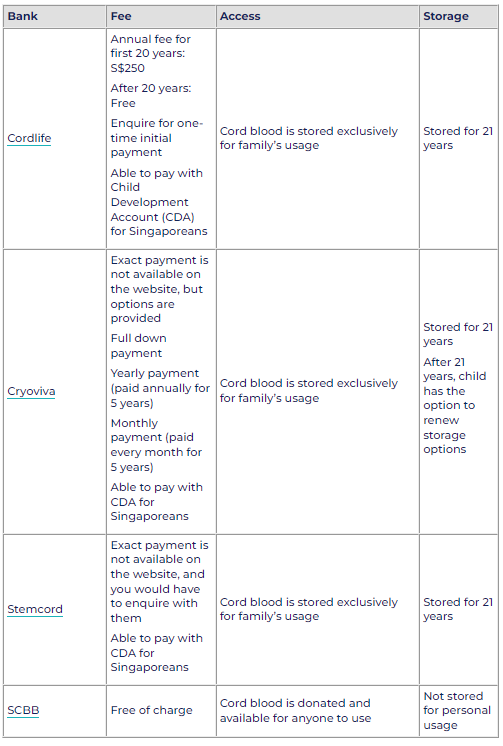
As the table above illustrates, private banks tend to charge a fee for the collection and storage of the cord blood. This is normally stored for 21 years, when the child comes of age. They may then have the option to renew storage options. Though the fee is exorbitant, with prices averaging at S$5,000 for storage options, you are also afforded exclusive access to the stored cord blood.
This means that the blood is reserved for the members of your family. If there is a situation where the stem cells need to be used (for e.g.. in the case of a medical condition), you will be guaranteed the stem cells that were stored from the umbilical cord.
As for the public bank in Singapore, SCBB, donation is free of charge. SCBB collects cord blood from three public hospitals and all of the seven of the private obstetric hospitals in Singapore. However, this cord blood is available for anyone in need, and is not reserved exclusively for your family.
Not to mention, public banks often have stringent selection criteria, and not all donations may be accepted in the first place. For SCBB, this includes not being able to accept cord blood from expecting mothers of twins. According to their website, the medical history of the child’s mother, her spouse and your immediate and extended families will be taken into consideration.
Read more: The Comprehensive Guide to Buying Maternity Insurance in Singapore
Is it worthwhile?
The million-dollar question is whether or not cord blood banking is worth the investment. While only you can make that decision, here are some other factors to help you reach a decision.
- Cost: Cost is arguably the most important factor for many people. It is helpful to know that Singaporeans can tap into their Child Development Account (CDA) to pay for the cord blood banking in all three private banks. Still, it is a big investment for something that might have little to no use.
- Limited use: Cord blood usage is still rather new, and the possibilities of stem cell usage are still being explored. Currently, there are many studies on the limited use of cord blood and stem cells in medical treatments. For example, cord blood cannot be used to treat a genetic disease in an autologous transplant, because the stored cord blood would contain the same genetic variant as the condition being treated.
- Medical history: Your medical history will be thoroughly investigated if you choose to donate your cord blood. It is also very likely that your donation may not be accepted if your medical history is not up to par. Accreditation of the bank: While the banks mentioned in this article are well-established and accredited, it is important to be dutiful when researching the different banks. Before you decide on any one cord blood bank to go with, you should read the terms and conditions carefully and ensure there are no hidden costs.
The bottom line
Even as aspiring and expectant parents navigate a myriad of decisions, cord blood banking is something that could be worth spending some time pondering. With numerous factors at play, from private bank exclusivity to public bank altruism, careful evaluation of your family’s needs and preferences is paramount. Ultimately, the decision hinges on what aligns best with your unique requirements.
Read more: Financial To-Do List To Prepare for Your Baby’s Arrival
Comments
97
0
ABOUT ME
Your Personal Mobile Financial Advisor Application Join us at telegram! https://t.me/plannerbee
97
0
Advertisement
No comments yet.
Be the first to share your thoughts!