Advertisement


OPINIONS
Gold ETFs for Singapore Investors As Prices Hit Record Highs
Gold prices have climbed sharply amid inflation concerns, rate cut expectations, and rising global tensions.
This post was originally posted on Planner Bee.
Gold has surged back into the spotlight, hitting record highs of more than US$4,300 per ounce, up roughly US$1,200 from a year ago. This rally comes amid expectations of global interest rate cuts, persistent inflation concerns, and geopolitical tensions, all of which have pushed investors towards safe-haven assets such as gold.
Physical bullion continues to appeal to many investors, particularly those who value holding tangible assets. However, gold exchange-traded funds (ETFs) offer a practical and cost-effective way to gain exposure to gold’s performance without dealing with storage, insurance, or security challenges.
For Singaporean investors, the key question is no longer whether to own gold, but how to do so efficiently. This guide breaks down what’s driving the surge in gold prices and what you need to know about gold ETFs listed in Singapore and abroad.
What is driving the rally in gold prices?
Gold is often viewed as a store of value and a safe haven during periods of political or economic uncertainty. With escalating global tensions, fears of economic slowdown, and inflation remaining sticky, investors have shifted their money out of riskier assets and into gold.
As at 25 November 2025, gold has gained nearly US$1,200 per ounce, roughly a 42% increase over the past 12 months.
Gold has also historically protected purchasing power during inflationary periods. For example, between 1978 and 1980, gold prices jumped almost fourfold, from US$217 to US$850 per ounce.
Expectations of further interest rate cuts, a weakening US dollar, and continued macro-financial uncertainty have also contributed to the current rally. Analysts expect gold prices to remain elevated over the coming months.
What are gold ETFs for Singapore investors?
A gold ETF is a fund listed on an exchange such as the Singapore Exchange (SGX) that tracks the price of gold. Investors can buy and sell ETF units just like shares, offering a more liquid and accessible alternative to owning physical bullion.
Gold ETFs may hold:
- Physical gold
- Gold mining company shares
- Gold futures or derivatives
This provides diversified exposure to the gold market without handling physical metal.
Physical gold vs gold ETFs
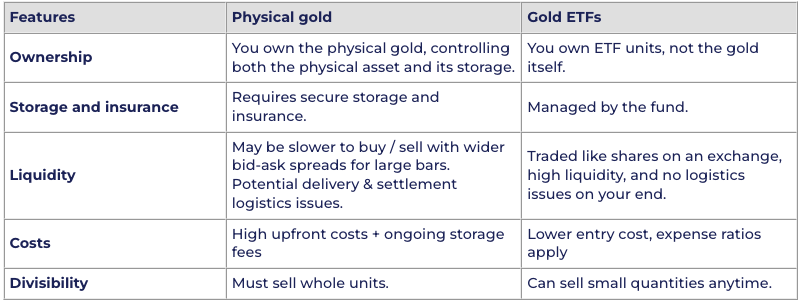
Physical gold offers tangible ownership but comes with higher costs and logistical challenges. Gold ETFs are more convenient, liquid, and accessible for most investors.
Read more: The Singaporean Guide to Investing in Gold
Advantages and disadvantages of gold ETFs
Gold ETFs offer a simple and cost-effective way to invest in gold without handling physical bullion. They have become popular among investors seeking exposure to the gold price, portfolio diversification, and an inflation hedge.
Advantages
- Gold ETFs provide convenience and liquidity, letting investors trade during market hours without storing, insuring, or verifying physical gold.
- They are affordable and accessible, allowing investors to start with a small amount and use gold for diversification and inflation protection.
- They offer full transparency through published holdings, daily prices, and tracking accuracy.
Disadvantages
- Gold ETFs lack physical ownership, which may concern investors who prefer tangible assets for crisis protection or long-term preservation.
- They are subject to market risk and tracking error, as sentiment, liquidity, and trading costs can cause deviations from spot gold.
- Fees such as management charges and brokerage costs can reduce long-term returns.
- As financial instruments rather than physical assets, they may be less appealing in severe systemic crises when some investors prefer holding physical gold.
Read more: Beginners’ Guide to Sustainable Investing in Singapore
Gold ETFs to monitor
This section features two prominent gold ETFs available to Singaporean investors.
1. SPDR Gold Shares (SGX: O87 / GLD)
Listed on SGX since 2006, SPDR Gold Shares aims to replicate the performance of physical gold bullion (minus expenses). It is backed by over 1,039,200 kg of gold stored in HSBC’s London vaults.
- Tradable in USD and SGD
- Board lot size: 1 share
- Eligible for CPF OA investments
- Expense ratio: 0.40%
- SGX clearing fee: 0.0325%
- Price performance: +46.81% year-to-date
2. iShares Gold Trust (NYSE: IAU)
Listed on the NYSE since 2005, iShares Gold Trust mirrors the price of gold before fees. It holds roughly 483,000 kg of physical bullion.
- Denominated in USD
- Expense ratio: 0.25%
- Price performance: +46.98% year-to-date
Both ETFs have seen strong gains driven by the surge in gold prices.
Things to note when buying gold ETFs
When investing in gold ETFs, it’s important to remember that these funds do not pay dividends, as returns come solely from changes in the price of gold. Your gains depend entirely on whether the gold price rises above your purchase cost.
Singapore-based investors should also be mindful of currency risk, because many gold ETFs are denominated in USD. As a result, fluctuations in the USD/SGD exchange rate may affect your returns, even if gold prices move in your favour.
If you choose a US-listed ETF, you may also face tax implications, depending on your brokerage platform and account type.
Another key point is that owning gold ETFs is not the same as owning physical gold. You do not have direct ownership of any gold bars held by the fund. Instead, you hold units that track the price of gold.
While this structure offers convenience and liquidity, it may not satisfy investors who want physical gold for crisis protection or personal assurance. With these considerations in mind, it’s essential to approach gold ETFs with a clear understanding of their structure, risks, and role in your investment portfolio.
In conclusion
For Singaporeans seeking exposure to gold without dealing with vaults, insurance, or authenticity checks, gold ETFs offer a compelling, efficient, and affordable solution.
However, with gold at record highs, investors should assess whether buying gold aligns with their portfolio strategy, risk appetite, and investment goals. Gold ETFs like SPDR Gold Shares and iShares Gold Trust provide accessible and liquid exposure to gold, but they still carry market risks, fees, and currency considerations.
Gold should complement your portfolio, not replace it. Enter with a clear purpose, sound research, and understanding of how gold fits into your long-term investment plan.
Read more: What Are Money Market Funds and Should I Invest in Them?
Comments
6
1
ABOUT ME
Your Personal Mobile Financial Advisor Application Join us at telegram! https://t.me/plannerbee
6
1
Advertisement
No comments yet.
Be the first to share your thoughts!