Advertisement


OPINIONS
Getting a Divorce: The Financial Implications of Ending a Marriage in Singapore
Divorce is emotionally taxing, and is also accompanied by a list of financial considerations.
This was originally posted on Planner Bee.
Divorce is not something anyone plans on going through. It’s emotionally taxing, and is also accompanied by a list of financial considerations.
Singapore is known for its stringent legal framework, and navigating divorce proceedings requires careful attention to issues like laws, financial documentation and asset division.
Let’s delve into the intricacies of divorce here, and shed light on the financial realities individuals face during and after this significant life event.
Cost of divorce in Singapore
Firstly, understanding the financial implications of divorce is crucial. In Singapore, the cost of divorce can vary widely depending on various factors such as the complexity of the case, whether it’s contested or uncontested, and legal representation fees.
On average, a straightforward, uncontested divorce can cost anywhere from S$1,500 to S$3,500, while a contested divorce involving disputes over assets, custody, or maintenance can escalate to an estimated S$10,000 to S$35,000, or even beyond that.
Legal fees typically include court filing fees, lawyer’s fees, and any additional charges for services like mediation or expert witnesses. It’s essential to budget for these expenses and seek legal advice to understand the potential costs involved.
Legal requirements of a divorce
To initiate divorce proceedings in Singapore, certain legal requirements must first be met. The most common ground for divorce in Singapore is the irretrievable breakdown of the marriage, which can be established through one of the following six facts:
- Adultery
- Desertion
- Unreasonable behaviour
- Mutual agreement (Starting from 1 July 2024)
- Separation for three years with consent OR
- Separation for four years without consent.
Additionally, couples must have been married for at least three years before filing for divorce, with exceptions made for cases involving exceptional hardship or where there are children of the marriage.You or your spouse must also be citizens of Singapore, or at least resided in Singapore for three years prior to the application of divorce.
What are the required documents?
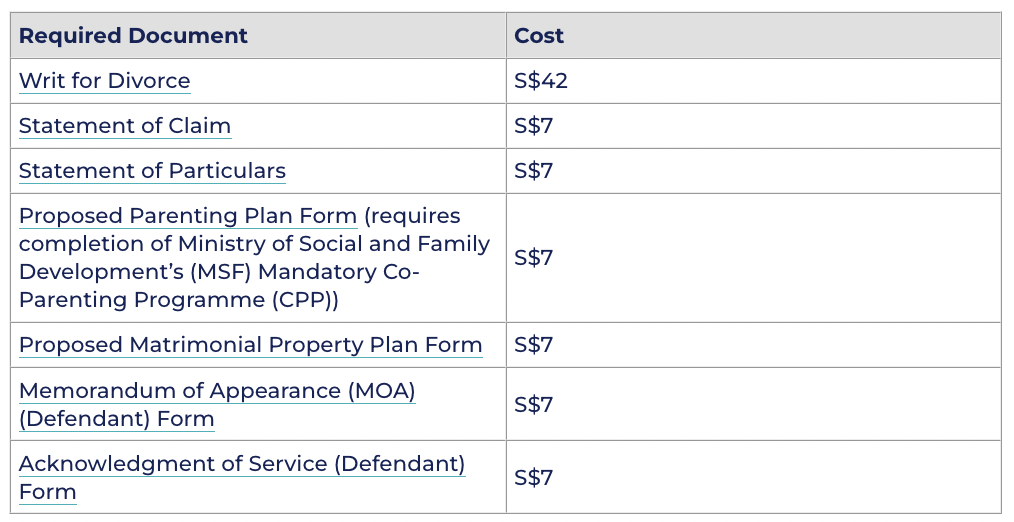
If you’re initiating the divorce application as the plaintiff against your spouse, the defendant, you should gather the following:
How will matrimonial assets be divided?
The division of matrimonial assets during a divorce often sparks contentious debates, given its potential long-term ramifications on one’s lifestyle. In Singapore, these assets encompass:
- Assets acquired individually or jointly during the marriage
- Assets utilised by the couple and their children for various purposes
- Assets obtained before marriage but significantly enhanced in value during the marital period.
Examples of such assets include the family car, matrimonial residence, savings, Central Provident Fund (CPF) balances, businesses, inheritances, and jewellery.
Contrary to popular belief, the division of matrimonial assets isn’t necessarily a straightforward 50-50 split. Various factors come into play, including:
- The financial contributions of each spouse towards these assets
- Non-financial contributions to the family’s welfare, like caregiving responsibilities and sacrifices made for family well-being
- The needs of any children involved
- Pre-nuptial or post-nuptial agreements outlining asset division
- Duration of the marriage
- Individual debts
- Financial standing and earning capacity of each party
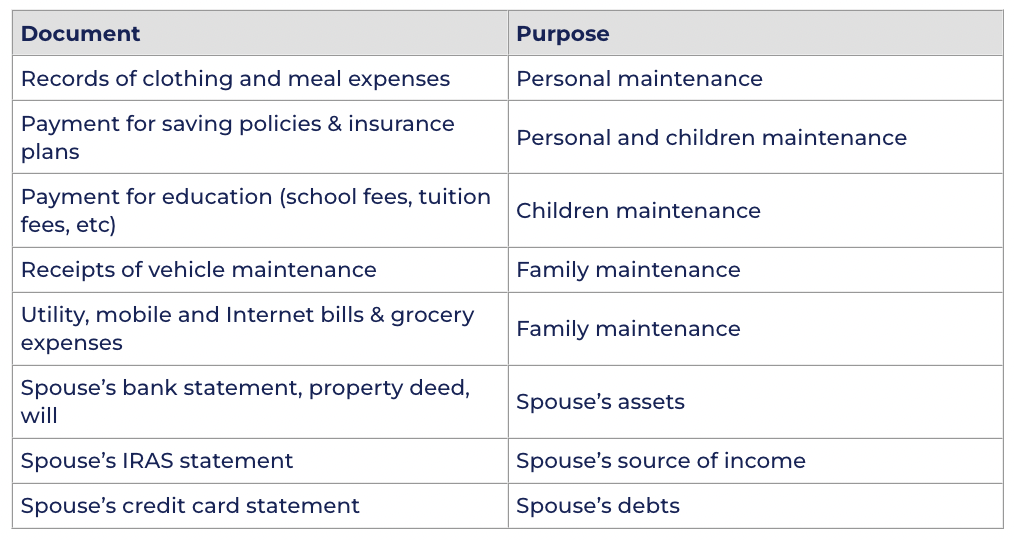
Given the absence of a universal formula, such determinations are typically made on a case-by-case basis. To safeguard your assets, it’s advisable to maintain meticulous records of major matrimonial assets and your respective contributions to them.
For example, if you’re responsible for covering your child’s tuition fees, providing bank statements reflecting the monthly deductions from your account can substantiate your financial contribution to the family.
Some useful documents include:
The court will consider various factors when determining how to divide matrimonial assets, including the financial contributions of each party, the welfare of any children, the length of the marriage, and any other relevant circumstances. The goal is to achieve a fair and equitable distribution of assets based on the individual circumstances of each case.
Picking yourself up after divorce
Moving on after divorce can be challenging, but it’s essential to take proactive steps to rebuild your life, both financially and emotionally. Here are some practical tips for picking yourself up after divorce.
- Be honest about your needs: Take stock of your financial and emotional needs and be honest with yourself about what you require to move forward. This may involve reassessing your budget, seeking employment or additional sources of income, and prioritising self-care and emotional healing.
- File a maintenance order if necessary: If you are entitled to financial support from your ex-spouse, consider filing for a maintenance order to ensure your needs and the needs of any dependents are met. This can provide essential financial stability during the transition period following divorce. To expedite a maintenance order, using iFAMS, or the Integrated Family Application Management System, is recommended.
- Seek support: Joining divorce recovery support groups can be immensely beneficial in navigating the emotional challenges of divorce and connecting with others who understand what you’re going through. Whether online or in-person, support groups can provide a sense of community, validation, and practical advice for moving forward. Some useful avenues include DivorceCare for Christians, or secular platforms like Meetup.com.
If you have children, you can also try these strategies:
- Foster a positive co-parenting relationship: Co-parenting effectively requires mutual respect, communication, and a focus on the best interests of the children. Keep conflict away from your children and prioritise peaceful, constructive communication with your co-parent. Collaborate on parenting decisions, maintain consistency in parenting styles, and demonstrate a united front when it comes to your children’s well-being.
- Embrace open communication: Children are remarkably perceptive and resilient, but they need honesty and reassurance during times of upheaval. Maintain open, age-appropriate communication with your children about the divorce, emphasising that it’s not their fault and that both parents love them unconditionally. Encourage them to express their feelings and concerns, validating their emotions and offering reassurance.
- Focus on quality time: Divorce may alter the dynamics of your family, but it doesn’t diminish the love and connection you share with your children. Make the most of the time you spend together by prioritising quality over quantity. Engage in meaningful activities, create cherished memories, and reassure your children of your unwavering love and support.
The start of a new chapter
Navigating divorce in Singapore can mean grappling with complex legal requirements, financial considerations, and emotional challenges. By understanding the financial realities of divorce, documenting your financial situation diligently, and taking proactive steps to rebuild your life, you can navigate this challenging time with resilience and confidence.
Remember, while divorce marks the end of one chapter, it also signifies the beginning of a new journey towards healing, growth, and eventual restoration.
Read more: How To Sell an HDB Flat During a Divorce
Comments
25
6
ABOUT ME
Your Personal Mobile Financial Advisor Application Join us at telegram! https://t.me/plannerbee
25
6
Advertisement
No comments yet.
Be the first to share your thoughts!