Advertisement


OPINIONS
Contract For Difference Explained with Trading Pros & Cons
CFDs allow low-capital trading but involve high risk and no ownership of the underlying asset.
This post was originally posted on Planner Bee.
Do you wish you could trade stocks without putting in a lot of money? Contracts for Difference (CFDs) might be what you are looking for.
CFDs are popular with investors seeking faster trading opportunities. They give access to a range of assets with lower upfront capital. However, CFDs are not the same as owning stocks, and they carry risks that can be significant if you are not careful.
Should you try CFDs? Planner Bee explains how they work.
What are Contracts For Difference (CFDs)?
A CFD is a financial derivative that lets you speculate on the future price of an asset, such as stocks, indices, commodities, or forex, without actually owning the underlying asset.
It is an agreement between an investor and a CFD provider to exchange the difference in value between the opening and closing of the contract.
Remember, you do not own the underlying asset. You are only betting on whether its price will rise or fall by the time the market closes.
How do CFDs work?
Leverage is a defining feature of CFDs. It allows you to control a large position with relatively small upfront capital.
For example, if the CFD provider requires a 10% margin, you only need $500 to open a position worth $5,000. Similarly, with a 5% margin, you could control a $10,000 position with just $500.
Unlike traditional investing, CFDs let you profit if prices move up or down.
Holding long
You open a long position if you believe the price of the asset will rise. If the closing price is higher than the opening price, you earn the difference.
For example, you go long on a stock with a 10% margin. You want 1,000 shares at $2 each. Instead of paying $2,000, you only need $200.
- If the price rises to $2.20, your profit is $0.20 per share, or $200, a 100% return on your initial $200.
- If the price falls to $1.80, you lose $0.20 per share, which is $200, the full amount of your initial investment.
Going short
You open a short position if you expect the price to fall. If the closing price is lower than the opening price, you make a profit.
For example, you hold a short position on the same stock with a 10% margin. You buy 1,000 shares at $2, only paying $200 upfront.
- If the price falls to $1.80, you earn $0.20 per share, or $200.
- If the price rises to $2.20, you lose $200, your full investment.
This magnifying effect makes CFDs attractive but also risky if not managed carefully.
The bid-ask spread
Another thing to understand is the bid-ask spread. When you open a CFD trade, you start slightly behind the market price.
Imagine buying an apple that costs $2. The seller charges $2.01 (ask) but will buy it back for $1.99 (bid). The $0.02 difference is the spread.
Small spreads may not matter much, but larger spreads, like $0.10, mean your trade must move enough in your favour to cover the gap before you break even.
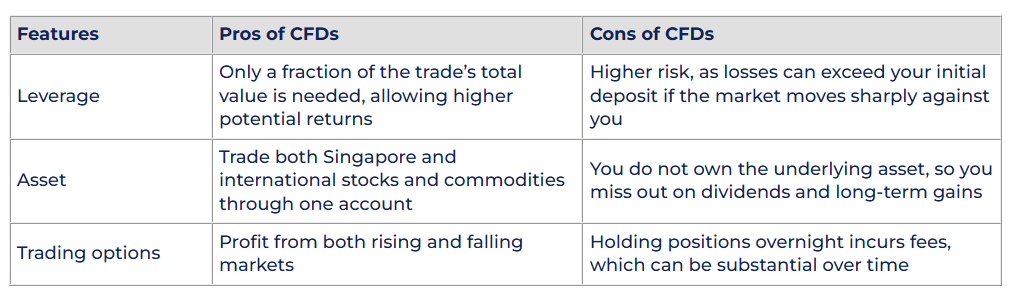
Pros and cons of CFDs
CFDs provide the advantages and risks of owning an asset without actually owning it. They can offer flexibility and potential for profit in both rising and falling markets. However, they also carry significant risks, especially due to leverage.
Whether CFDs are suitable for you depends on your investment goals, experience, and tolerance for risk.
Read more: Investing 101: What You Should Look Out for As A Beginner Investor
Minimising risks when trading CFDs
Before trading CFDs, it is important to research and understand how they work.
CFDs are not designed for long-term wealth accumulation. They are short-term strategies with higher risks than traditional investments. Make sure your risk tolerance aligns with these products.
When starting out, use smaller positions to familiarise yourself with the mechanics before increasing your exposure. Set stop-loss orders to protect against large losses.
Leverage is a key feature of CFDs, but avoids over-leveraging. Higher leverage increases both potential gains and potential losses. Also, consider spreads and overnight funding charges, as these small costs can accumulate over time.
Frequently asked questions (FAQs)
Can I trade CFDs 24 hours a day?
CFDs typically follow the trading hours of the underlying market. Some brokers may offer extended or weekend trading, but availability depends on the asset and broker.
What are overnight fees for CFD trading?
When holding a CFD position overnight, brokers usually charge a financing or swap fee. The cost varies depending on the broker, position size, and asset.
Can I use CFDs to protect my investments?
Yes. CFDs can be used as a hedging tool to offset potential losses in other investments without selling the underlying assets.
Do I get dividends when trading CFDs?
You may receive a dividend adjustment if the underlying asset pays dividends, but you do NOT directly own the stock or asset itself.
Are CFDs the same at every broker?
No. CFD products, spreads, leverage, and fees vary between brokers. Always review the broker’s terms and offerings before trading.
How are CFD profits taxed?
Tax rules for CFDs vary by country. Profits may be treated as capital gains or as income depending on trading frequency and local regulations. Consult a tax advisor for guidance.
Can I lose more money than I invest in CFDs?
Yes. Because of leverage, losses can exceed your initial deposit if the market moves against your position. Using risk management tools like stop-loss orders can help limit losses.
The bottom line
CFDs can be a useful tool for investors seeking flexible trading and opportunities in both rising and falling markets.
However, they are high-risk products with the potential for significant profits and losses. CFDs are best used as short-term trading tools rather than a core part of a long-term investment portfolio, and strict risk controls are essential.
Before trading, it is important to understand costs such as bid-ask spreads and to have a solid risk management plan in place.
Read more: A Beginner’s Guide to Dividend Stocks
Comments
6
0
ABOUT ME
Your Personal Mobile Financial Advisor Application Join us at telegram! https://t.me/plannerbee
6
0
Advertisement
No comments yet.
Be the first to share your thoughts!