Advertisement


OPINIONS
CDP vs Custodian Account? Which Should You Choose and Why
CDP gives you direct ownership and control, while custodian accounts offer lower fees and wider global access.
This post was originally posted on Planner Bee.
Have you ever wondered where your investments go after you buy them?
In Singapore, brokerages allow investors to store their assets in either a CDP account or a custodian account. Each works differently and comes with its own advantages and disadvantages.
This guide explains how both accounts work, what makes them different, and which one may suit your needs.
What is a CDP account?
CDP stands for Central Depository. It is an account under Singapore Exchange (SGX) that acts as a central place to safely keep your Singapore-listed securities. Think of it as a safe for your investments.
Advantages of a CDP account
Use with multiple brokerages
Because CDP is centralised under SGX, you can link it to any broker that supports CDP-linked trading. This grants you the freedom to buy shares through one broker and sell them with another.
Note: Not all brokers offer CDP-linked accounts.
Direct ownership and shareholder rights
When you buy stocks through CDP, they are in your name. This means you are the legal owner and enjoy shareholder rights, such as:
- Attending the company’s Annual General Meeting (AGM)
- Receiving announcements and annual reports directly
- Voting on company matters
- Receiving dividends in your own name
Dividends credited to your bank account
Through the Direct Crediting Service (DCS), dividends or cash distributions can go straight to your registered bank account. This saves time and avoids relying on a specific broker.
Disadvantages of a CDP account
Higher fees
CDP accounts come with various charges, such as clearing fees, trading fees, and settlement fees. These can add up and reduce returns. There are also penalties for failed trades or selling more shares than you own.
- Clearing fee: 0.0325% of the contract value (CDP)
- Trading fee: 0.0075% of the contract value (SGX)
- Settlement fee: About S$0.35 per contract
- Failed trade processing fee: S$75 + GST (S$80.25 total) per failed contract
- Buy-in brokerage: 0.75% of each buy-in contract (excluding GST)
Note: CDP accounts do not protect against short selling. If you sell more shares than you own, SGX may carry out a buy-in and charge extra fees. The penalty is S$1,000 or 5% of the contract value, whichever is higher. Always make sure you have enough shares before selling.
Limited to Singapore-listed investments
CDP accounts only hold securities listed on SGX. To invest in overseas markets, you will need a custodian account instead.
Read more: Investing 101: What You Should Look Out for As A Beginner Investor
What is a custodian account?
A custodian account is managed by a financial institution or brokerage. When you buy securities, your investments are stored in this account under the broker’s name, rather than directly under yours.
The broker holds them on your behalf. Robo-advisers such as Syfe and Endowus only offer custodian accounts.
Unlike a CDP account, which serves as a central depository for Singapore-listed securities, a custodian account is tied to one broker. This means you can only trade and manage your investments through that broker.
If you decide to switch, you will need to transfer your holdings, which may come with fees or restrictions.
Advantages of a custodian account
Lower fees
Custodian accounts usually cost less than CDP accounts. This is because you must trade through the same brokerage that holds your assets, which encourages you to keep using their services.
Dividends are typically credited into a cash wallet within your brokerage account. This setup makes it easier for you to reinvest or use other products the broker offers, such as insurance or cash management tools.
Since brokers can earn from multiple services you use, they are often willing to charge lower trading fees compared to a CDP account.
Access to foreign markets
If you want to invest in overseas securities, you will need a custodian account. Unlike CDP, which only supports Singapore-listed assets, a custodian account can hold both local and foreign investments. This gives you more flexibility to build a diversified portfolio.
Some countries have their own central depository accounts, but managing several across different markets can be difficult. A custodian account removes this hassle by keeping everything in one place.
Do note that foreign investments may come with tax implications. For example, U.S. dividends are usually taxed at 30%. For Singapore investors, this is reduced to 15% if your broker applies the tax treaty correctly. Most custodian brokers handle this automatically, but it is worth checking.
Privacy protection
Since securities are held in the broker’s name, companies do not have your personal details. Some investors prefer this extra layer of privacy.
Disadvantages of a custodian account
No direct ownership
With a custodian account, stocks are not registered in your name. You can still sell them after purchase, but you do not hold the rights of a legal shareholder.
This means you must rely on your broker for company announcements, annual reports, or access to shareholder meetings. Custodian account holders may attend AGMs, but seats are limited and the application process is often cumbersome.
Possible hidden fees
While custodian accounts are often cheaper than CDP accounts, not every brokerage is upfront about their fees. It is important to know the full cost before you commit. Common charges include:
- Custodian fee: For holding your assets in nominee form
- Account maintenance fee: Ongoing charges to keep your account active
- Trading fee: Brokerage charges per transaction
- Transfer fee: For moving securities in or out of the account
Always review a broker’s fee structure carefully. Reading the fine print can help you avoid hidden costs later.
Read more: A Beginner’s Guide to Investing with Robo Advisors in Singapore
CDP vs Custodian for ETFs
When investing in ETFs, the choice between a CDP and a custodian account depends on your needs. For SGX-listed ETFs, a CDP account gives you legal ownership and allows you to track your holdings across different brokers.
For foreign-listed ETFs, such as those in the U.S. or Hong Kong, you will need a custodian account. These accounts usually come with lower fees and wider market access. However, they may involve extra tax considerations and fewer investor rights, such as limited voting privileges.
What if your broker goes bankrupt?
Brokerages keep client assets separate from their own, so your investments remain safe from creditors. However, the transfer process may take time if the broker collapses.
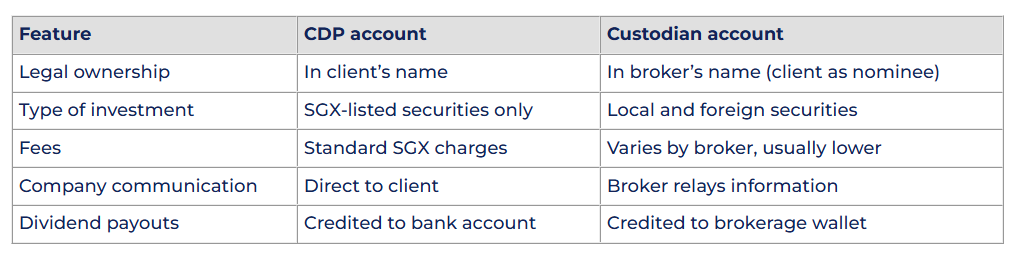
Key differences at a glance
Which should you choose?
The right account depends on your goals.
- Choose a CDP account if you mainly invest in Singapore-listed stocks and value direct ownership.
- Choose a custodian account if you want lower fees or access to foreign markets.
In many cases, investors end up using both. If you want to explore custodian accounts, some popular platforms in Singapore include Tiger Brokers and MooMoo.
Read more: Best Trading Platforms in Singapore for New Investors
Comments
49
14
ABOUT ME
Your Personal Mobile Financial Advisor Application Join us at telegram! https://t.me/plannerbee
49
14
Advertisement
No comments yet.
Be the first to share your thoughts!