Advertisement


OPINIONS
CareShield Life 2026 Payouts Premiums and Coverage
CareShield Life provides essential financial support to help cover long-term care needs.
This post was originally posted on Planner Bee.
Healthcare costs in Singapore are rising steadily, and long-term care can quickly become expensive for anyone who experiences a severe disability.
CareShield Life, the national long-term care insurance scheme, provides lifelong monthly payouts if you become severely disabled.
Recent enhancements starting 1 January 2026 make CareShield Life even more crucial for financial planning and peace of mind CPF source. By understanding what CareShield Life offers and the upcoming changes, you can plan your healthcare finances more effectively.
What is CareShield Life?
CareShield Life is designed to help Singaporeans cover long-term care costs if severe disability strikes.
Severe disability is defined as being unable to perform three or more Activities of Daily Living (ADLs), which include washing, dressing, feeding, toileting, walking, or transferring (bed to chair).
Coverage is automatic for most citizens, but the rules differ depending on your birth year.
- Born 1980 or later – Automatic enrolment at age 30.
- Born 1970 to 1979 and insured under ElderShield 400 – Automatic enrolment from 1 December 2021, provided you have not developed severe disability.
- Born 1979 or earlier – Choose to join CareShield Life anytime if you are currently not disabled.
Premiums are payable via MediSave until age 67 or until you make a claim. Coverage is also worldwide, so you can receive payouts even if you live overseas. This ensures financial support is available regardless of your location, giving you greater flexibility and security.
CareShield Life enhancements from 2026
Following the 2025 Council review, several major enhancements will take effect from 1 January 2026.
These changes aim to make CareShield Life benefits more substantial, ensure payouts keep pace with rising long-term care costs, and make premiums more manageable.
1. Higher payout growth
Monthly payouts will rise 4% per year for 2026–2030 (up from 2%). This adjustment ensures payouts better keep pace with the real costs of long-term care, such as hiring caregivers or paying for specialised equipment. Payouts continue until age 67 or a successful claim, whichever comes first.
For example, a claimant receiving S$731 per month under the old 2% growth path could see this increase to S$806 per month by 2030 under the enhanced 4% growth path.
2. Premium adjustments and government support
To fund higher payouts, there will be a one-off gross premium increase in 2026, followed by approximately 4% annual growth thereafter. The Government will provide over S$570 million in additional transitional support, which moderates the actual increases for policyholders.
With this support, annual premium increases are expected to average S$38 per year, and will not exceed S$75, even though the gross premium without support could have increased by around S$126 in 2026.
This transitional support is particularly beneficial for low- to middle-income Singaporeans, who also continue to receive means-tested subsidies.
3. Reinstated underwriting for older cohorts
Optional enrolees born 1979 or earlier will only be able to join if they have no pre-existing disabilities. This change helps keep premiums fair and sustainable for all policyholders by reducing adverse selection, ensuring that older optional participants do not disproportionately raise overall scheme costs.
4. Administrative improvements and enhanced long-term care support
Disability assessments and claims processes will be streamlined for easier access. Individuals assessed for CareShield Life may also automatically be assessed for other long-term care grants, reducing the need to submit multiple applications.
In addition, related grants, such as the Home Caregiving Grant, subsidies for mobility aids and medical devices, and other long-term care support schemes, will be expanded from 2026.
By providing faster payout growth, moderated premiums, targeted support, and smoother claims processes, these enhancements ensure CareShield Life continues to serve as a robust and sustainable safety net for Singaporeans facing severe disability.
Read more: Compare & Upgrade Your CareShield Life Coverage with These Supplements
CareShield Life vs MediSave vs MediShield Life
Understanding the differences between CareShield Life, MediSave, and MediShield Life is important, as they serve distinct purposes and complement each other.
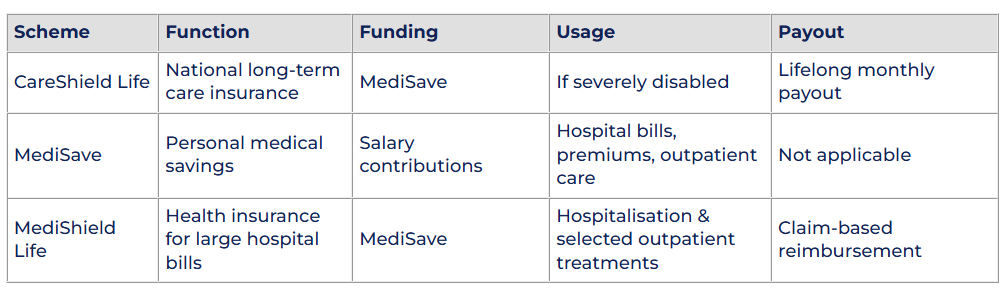
CareShield Life provides a safety net specifically for severe disability, while MediSave covers general medical costs, and MediShield Life protects against large hospital bills. Knowing how these schemes interact allows you to plan comprehensively for both everyday healthcare needs and long-term care.
Is CareShield Life enough?
CareShield Life alone may not fully protect your finances. It is important to consider additional coverage.
An Integrated Shield Plan (IP) supplements MediShield Life, providing higher coverage and access to private hospitals. Critical Illness (CI) or Early Critical Illness (ECI) insurance provides a lump sum payout upon diagnosis of covered illnesses.
Term life insurance offers a lump sum on death or total permanent disability, supporting your dependents. Additionally, Personal Accident (PA) plans provide coverage for accidental death, disability, and medical costs.
Together, these policies complement CareShield Life and help you build a more complete financial safety net.
Read more: Why You Should Plan For Long-Term Old Age Care, Even If You’re Young
What you should do
To make the most of CareShield Life, start by checking your enrolment status to determine if you are automatically enrolled or need to opt in.
Next, review your premium schedule on CPF and consider voluntary top-ups if MediSave is insufficient CPF Premium Checker.
Finally, assess your insurance gaps. Speak with your insurance agent and use planning tools such as Planner Bee’s insurance calculator to ensure you have adequate coverage for long-term care and related expenses.
Frequently asked questions
How are premiums calculated?
Premiums are based on your age, gender, and cohort. You can check your personal schedule on CPF.
Can I pay premiums via MediSave?
Yes. If your MediSave balance is insufficient, family members may make top-ups to ensure continued coverage.
What if I can’t afford premiums?
Additional Premium Support (APS) is available to prevent loss of coverage.
How do I make a claim?
Contact an MOH-accredited assessor. The first assessment fee is waived and reimbursed with your first payout if approved.
Conclusion
CareShield Life is a key part of Singapore’s long-term care safety net, and the 2026 enhancements make it even more valuable.
By understanding the payouts, premiums, and enrolment rules, you can plan ahead and ensure financial protection for yourself and your loved ones.
Check your CareShield Life enrolment today and review your long-term care plan to stay financially prepared.
Remember, higher payouts and government support from 2026 make CareShield Life a crucial safety net for severe disability!
Read more: How To File for Critical Illness Insurance Claims and Steps To Take Note Of
Comments
25
1
ABOUT ME
Your Personal Mobile Financial Advisor Application Join us at telegram! https://t.me/plannerbee
25
1
Advertisement
No comments yet.
Be the first to share your thoughts!