Advertisement


OPINIONS
Calculating Your Life Insurance Returns
Understanding life insurance returns helps you choose between affordable protection and long-term savings more wisely.
This post was originally posted on Planner Bee.
It’s well known that life insurance protects you and your loved ones against financial loss in the event of death or total permanent disability (TPD). But things get a bit murky when industry jargon comes in, especially when comparing the different types of life insurance in Singapore.
We get it, it’s easy to get confused. But don’t worry, we’re here to help you make sense of it all, especially when it comes to understanding insurance returns with cash value. More importantly, we’ll show you how to calculate the real returns on your life insurance policy.
That knowledge will help you choose which type of insurance best suits your needs and financial goals.
Why understanding life insurance matters
In Singapore, life insurance plays a key role in long-term financial planning, not just for protection but also for wealth accumulation, legacy planning, and retirement income.
With rising healthcare costs and an ageing population, many Singaporeans use life insurance with cash value to grow their savings while staying protected.
Understanding your policy’s real returns helps you decide whether to prioritise affordability and protection (term life insurance) or build savings and investment returns (whole life insurance).
Since CPF Life already provides guaranteed lifelong payouts, your private life insurance should complement, not duplicate, your coverage. Knowing how your policy performs can prevent you from overpaying for protection you may not actually need.
The difference between cash value and no cash value policies
When you buy a life insurance policy, you pay a sum known as a premium in return for coverage.
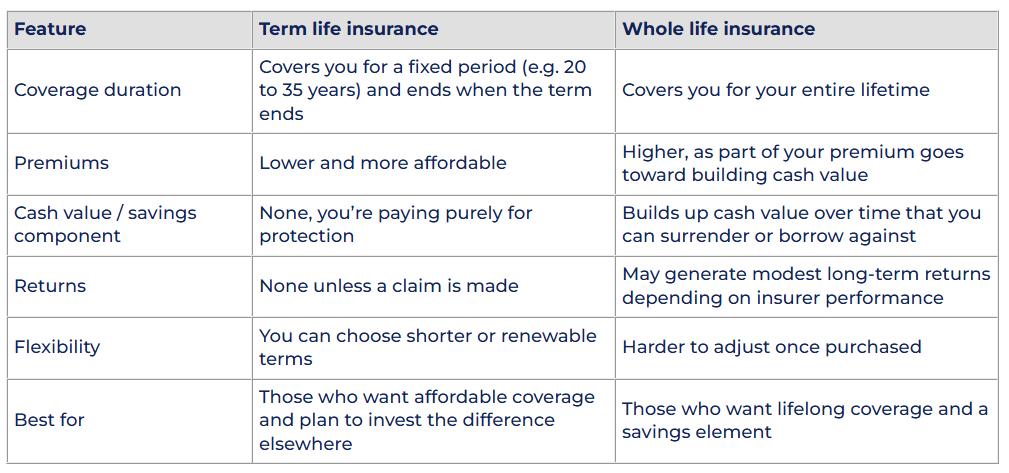
- Life insurance with cash value (whole life insurance) is more expensive, but part of your premium is invested by the insurer to generate returns over time. These returns form the cash value or surrender value, money you can receive when you end your policy. You also stay covered for life.
- Life insurance without cash value (term insurance) is cheaper because it only covers you for a set period. You get no payout when it ends, unless you make a claim.
Both have their place, the key is understanding the real returns on each.
Differences between term life and whole life insurance
Read more: Term Life vs Whole Life Insurance: Which Should You Get?
How to calculate your life insurance returns?
Now that you understand the basics, let’s talk about how to calculate your real returns, or your insurance IRR (Internal Rate of Return). Even if your policy illustration doesn’t show returns clearly, you can estimate them easily using an Excel template.
Here’s how:
Step 1: List your annual premiums and payouts
Record how much you pay each year and any returns or payouts you receive.
Step 2: For whole life insurance (with cash value)
Record your annual premiums as negative cash flows, and your maturity or surrender value as a positive cash flow at the end of the policy.
Step 3: For term life insurance (without cash value)
Record your annual premiums only, there’s no payout unless a claim occurs.
Step 4: Find the cash flow difference
Compare both sets of cash flows to determine how much more (or less) you’ve paid for one over the other.
Step 5: Calculate the Internal Rate of Return (IRR)
Use Excel’s =IRR() function to compute your effective annual return on the whole life policy’s cash value, compared to term insurance.
Example: Comparing FWD term life vs Whole life insurance
Let’s look at this example: Mr. Yang, age 30, is considering two plans from FWD Singapore. After doing a needs analysis, he decides he needs S$200,000 of critical illness coverage until age 70. He’s now choosing between two options:
Option 1 – Term life (no cash value)
- Plan: FWD Future First
- Coverage: S$200,000 until age 70
- Annual premium: S$1,461.73
- Total premiums paid over 40 years: S$58,469.20
- No payout at the end unless a claim is made
Option 2 – Whole life (with cash value)
- Plan: FWD Life Protection
- Coverage: S$200,000 until age 70
- Annual premium: S$1,527.30 for 20 years
- Total premiums paid: S$30,546
- Receives S$56,664 surrender value at age 70 (illustrated at 4.25% investment return)
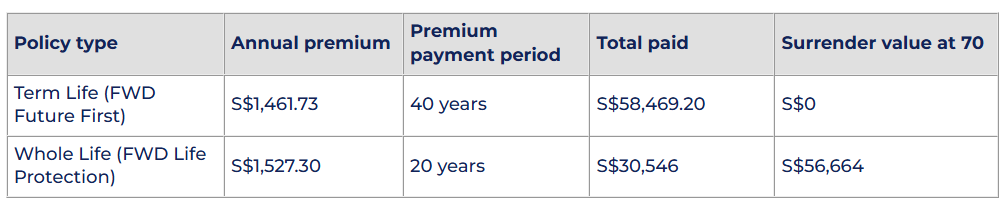
Note: __Example based on actual FWD Singapore policy illustrations for a 30-year-old non-smoker (Planner Bee sample, November 2025). Figures taken from FWD Life Protection (whole life) and FWD Future First (term) policy illustrations.
How to work out the real return
- List cash flows for each year.
- For FWD Life Protection: Record –S$1,527.30 each year for 20 years, then +S$56,664 in the final year (age 70).
- For FWD Future First: Record –S$1,461.73 each year for 40 years, with no positive payout at the end.
- Compare both cash-flow streams to see the cost difference between the two.
Use Excel’s =IRR() function on the difference column to find the internal rate of return (IRR). In this example, the IRR works out to about 2.7% per year, meaning the investment portion of FWD Life Protection effectively earns 2.7% p.a. compared to buying FWD Future First and investing the difference elsewhere.
In short, if you believe you can consistently earn more than 2.7% per year by investing on your own, a term plan like FWD Future First plus investing the difference could yield better results.
If not, a whole life plan such as FWD Life Protection may still make sense for the guaranteed value and forced savings it provides.
Should you choose term life or whole life insurance?
It depends on your life stage, financial goals, and existing coverage. If you’re young, healthy, and focused on affordable protection, go for term life insurance. If you want long-term savings and legacy planning, whole life insurance may suit you better.
Before you decide, review your CPF Life, MediShield Life, and employer insurance coverage. There’s no need to over-insure if you already have strong protection.
Bonus tip for Singapore residents
If you already have CPF Life, you might not need excessive whole life coverage. A term life insurance plan can offer flexibility, and you can invest the savings from lower premiums elsewhere, maybe in ETFs or to boost your emergency fund.
Ultimately, understanding the real returns on your life insurance helps you make smarter financial decisions that match your long-term goals, not just pay for protection you might not fully use.
Read more: Why You Should Make a Lasting Power of Attorney (LPA) in Singapore
Comments
10
3
ABOUT ME
Your Personal Mobile Financial Advisor Application Join us at telegram! https://t.me/plannerbee
10
3
Advertisement
No comments yet.
Be the first to share your thoughts!