Advertisement


OPINIONS
Beginner Friendly Guide to Investing in REITs in Singapore
REITs make it easier for everyday investors in Singapore to earn from property without owning one.
This post was originally posted on Planner Bee.
Investing in real estate has traditionally been seen as a capital-heavy venture and often out of reach for many new investors. However, Real Estate Investment Trusts (REITs) have levelled the playing field. It is now a popular way to invest in property without ever having to buy or manage a building.
REITs give investors access to real estate assets that can provide steady income through dividends. REITs also offer a relatively accessible entry point for both retail and institutional investors.
This guide will cover the basics of REITs and everything you need to know to get started.
Introduction to REITs
REITs, or Real Estate Investment Trusts, are companies that own, operate or finance income-producing properties. In Singapore, REITs are traded on the Singapore Exchange (SGX), allowing everyday investors to buy shares in them just like any other stock.
Why are REITs popular?
Here are several key reasons why REITs have become a popular investment choice:
- Diversification: REITs offer exposure to a variety of property types, reducing the risk associated with investing in a single asset.
- Regular income: REITs are legally required to distribute at least 90% of their taxable income to shareholders, making them ideal for income-focused investors.
- Capital appreciation: Well-managed REITs can grow in value, providing potential capital gains.
- Accessibility: Investors can start with just a few hundred dollars and still benefit from large-scale commercial and industrial real estate exposure.
With over 40 REITs listed on SGX, Singapore is considered a global hub for REIT investments, offering access to both domestic and international property markets.
Types of REITs in Singapore
REITs come in various forms, with each catering to different investment preferences. The seven main types are:
- Retail REITs: Invest in shopping malls and retail outlets (e.g., CapitaLand Integrated Commercial Trust).
- Office REITs: Focus on commercial office buildings in CBDs or business parks (e.g., Keppel REIT).
- Industrial REITs: Include warehouses, logistics facilities, and data centres (e.g., Mapletree Industrial Trust).
- Hospitality REITs: Comprise hotels, resorts, and serviced apartments (e.g., CDL Hospitality Trusts).
- Healthcare REITs: Own hospitals, nursing homes, and medical facilities (e.g., Parkway Life REIT).
- Residential REITs: Invest in income-generating residential properties. (Currently, no residential REITS are listed in Singapore).
- Diversified REITs: Hold properties across multiple sectors for greater balance (e.g., Mapletree Pan Asia Commercial Trust).
Each REIT type comes with its own set of risks and rewards. These depend on various factors such as economic cycles, consumer spending habits, and corporate demand.
REIT-specific funds and ETFs
If you want broad exposure without picking individual REITs, REIT-focused ETFs and unit trusts offer a simple solution. These products group multiple REITs into one investment, giving instant diversification.
For example, the Lion-Phillip S-REIT ETF focuses on quality Singapore-listed REITs, while the NikkoAM-StraitsTrading Asia ex Japan REIT ETF offers regional exposure across Asia (excluding Japan).
These ETFs typically have lower fees than actively managed funds and can be traded easily on the SGX like regular stocks. While they don’t allow for picking specific REITs, they are ideal for those who want a simple, cost-effective way to invest in the overall REIT sector.
Platforms to invest in REITs
There are several ways to invest in REITs in Singapore. Each platform has its pros and cons depending on your goals, experience level, and budget.
Traditional brokerages
Traditional brokerages, such as DBS Vickers, OCBC Securities, and UOB Kay Hian, provide access to the SGX and a wide range of REIT products.
Pros:
- Access to detailed investment research and reports
- Comprehensive trading tools
- Strong regulatory oversight and customer support
Cons:
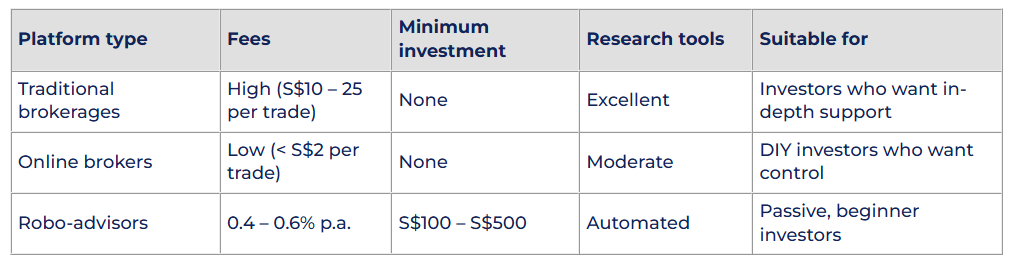
- Higher brokerage fees (typically S$10 – $25 per trade)
- Older interfaces and less mobile-friendly compared to newer platforms
Traditional brokerages are ideal for investors who value detailed research, customer service, and are less sensitive to trading fees.
Online investment platforms
Digital brokerages offer a cost-effective and user-friendly alternative, popular among younger, tech-savvy investors. Platforms like Tiger Brokers and Moomoo are known for low fees and mobile apps. Saxo Markets offers a wider range of local and global REITs and advanced research tools for experienced users.
Pros:
- Low commissions (as low as 0.03%)
- Fast account setup and mobile accessibility
- Easy interface for buying / selling REITs
Cons:
- Limited research tools compared to traditional brokers
- It may feel overwhelming for first-time users unfamiliar with investing platforms
These platforms are great for investors comfortable managing their own portfolios and looking to keep trading costs low.
Robo-advisors
Robo-advisors use algorithms to manage diversified portfolios, often including REITs, with little human input. Syfe REIT+ focuses on Singapore-listed REITs and offers automatic rebalancing. Endowus includes REITs in broader global portfolios for a balanced approach.
Pros:
- Hands-off investing with automatic portfolio rebalancing
- Suitable for long-term passive investors
- Relatively low minimum investment (from S$100)
Cons:
- Limited control over individual REITS in the portfolio
- Management fees (typically 0.4% – 0.6%) apply
Robo-advisors suit beginners who want REIT exposure without active management, but be aware fees can reduce returns.
Read more: Best Robo-advisors in Singapore
TLDR: Comparison of platforms
Tips for choosing a platform
Before you start investing, keep these points in mind to pick the right REIT platform:
- Know your strategy: Are you investing for income or long-term growth? Do you prefer passive or active investing?
- Check fees: Fees reduce your returns. If you plan to trade frequently, choose a low-cost platform.
- User experience: Try out the mobile app or desktop dashboard. The easier it is to navigate, the better your investment experience.
- Research availability: Some platforms offer market insights and REIT reports. If you value analysis, this can be a big plus.
- Regulation and security: Ensure the platform is MAS-regulated and offers adequate account protection.
Read more: Best Trading Platforms in Singapore for New Investors
Closing note
Singapore REITs provide an accessible way to invest in property markets without the need to buy or manage physical real estate. They offer regular income through dividends and the potential for capital growth over time. The variety of REITs available allows investors to diversify across sectors like retail, industrial, healthcare, and more.
With an increasing number of platforms offering low-cost and user-friendly access to REITs, investors of all experience levels can now participate in this market more easily than before. Remember to consider your financial goals, risk tolerance, and investment horizon when choosing which REITs to invest in and which platform to use.
Overall, REITs remain a reliable option for building a balanced investment portfolio that can generate steady income and long-term growth.
Comments
46
27
ABOUT ME
Your Personal Mobile Financial Advisor Application Join us at telegram! https://t.me/plannerbee
46
27
Advertisement
No comments yet.
Be the first to share your thoughts!