Advertisement


OPINIONS
Are Electric Vehicles Cheaper in the Long Run?
EVs may cost more upfront, but long-term savings make them a smart choice for future-focused drivers.
This post was originally posted on Planner Bee.
Car ownership in Singapore is already expensive due to the Certificate of Entitlement (COE) and high taxes, making every dollar spent an important consideration. With electric vehicles (EVs) becoming more popular and Singapore moving towards greener transport, the question is whether EVs are actually more cost-effective than conventional petrol or diesel cars.
While EVs offer lower running costs and environmental benefits, the total cost of ownership depends on factors such as purchase price, government incentives, maintenance, depreciation, and resale value. This article examines these key aspects to determine if EVs are truly the more affordable choice over time.
Upfront costs of EVs
Many people believe EVs are much more expensive than petrol cars, but this gap is narrowing quickly. Advances in battery technology, growing competition, and government incentives are driving costs down. By 2027, battery electric vehicles are expected to be cheaper to produce than petrol cars, thanks to improved manufacturing methods.
In Singapore, government incentives make EVs more affordable. The EV Early Adoption Incentive (EEAI) offers a rebate of up to S$20,000 on the Additional Registration Fee (ARF). The Vehicular Emissions Scheme (VES) provides further rebates of up to S$25,000, depending on emissions. Fleet operators can also benefit from the Commercial Vehicle Emissions Scheme (CVES), making EVs a practical choice for businesses.
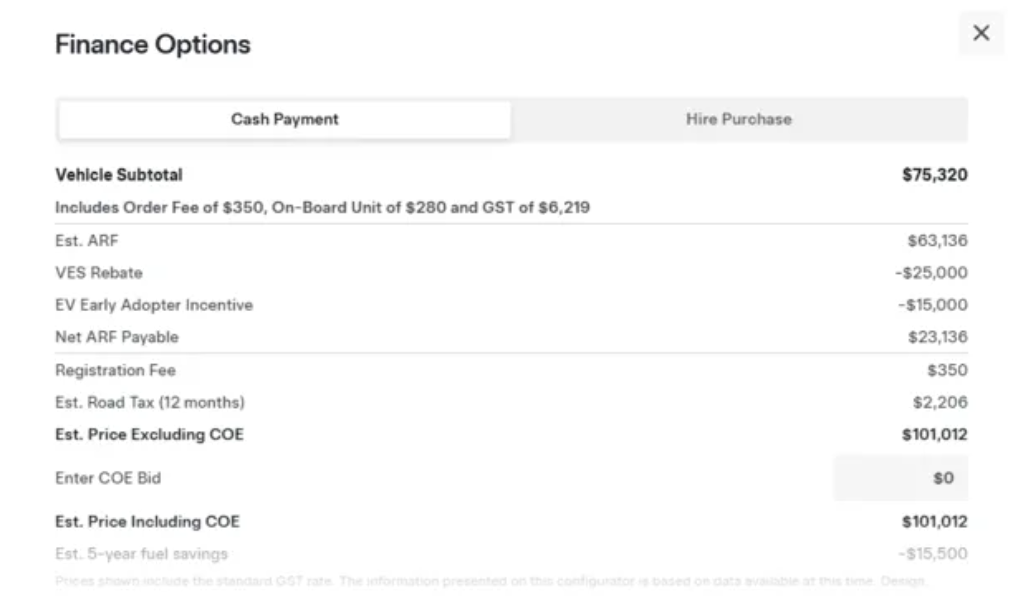
These incentives can significantly lower EV prices. After rebates, a Tesla Model 3 Electric costs S$101,012 excluding COE, or around S$191,012 including COE. In comparison, a petrol-powered BMW 3 Series costs approximately S$293,888 including COE.
Source: Tesla Singapore
The figure provides a detailed cost breakdown for a Tesla Model 3 Electric. It is taken from the order page, which displays the vehicle’s subtotal price, including the taxes and any applicable fees.
Financing options also matter. Some banks and financial institutions offer green loans with lower interest rates for EVs. This helps buyers spread out the costs over time.
Read more: How Much Does It Cost To Own an Electric Vehicle in Singapore?
Running costs of EVs
1. Comparing electricity and petrol / diesel costs
Electricity is much cheaper than petrol or diesel in Singapore. The Energy Market Authority (EMA) estimates that charging an EV costs 50-70% less per kilometre than fuelling a petrol car.
For instance, charging a Tesla Model 3 with a 75 kWh battery at SP Group’s public rate of about S$0.50/kWh would cost around S$37.50 for a full charge, giving roughly 450 km of range. In contrast, filling a 50-litre petrol tank at S$2.80 per litre would cost S$140 for a similar range.
On average, an EV owner spends about S$432 per year on charging, while a petrol car owner spends around S$1,866 on fuel. With petrol prices rising, the savings from driving an EV become even more significant over time.
2. Maintenance costs
EVs have fewer moving parts than internal combustion engine (ICE) vehicles, which helps reduce maintenance costs. They don’t need oil changes, have fewer components that wear out, and use regenerative braking to slow down wear on brakes. Estimates suggest EV owners can save 30-50% on maintenance over the car’s lifetime compared to ICE vehicles.
3. Battery replacement
Battery degradation is a major concern for EV owners. Most EV batteries last between eight and 15 years, but replacing them can be expensive, ranging between S$10,000 and S$20,000, depending on the model.
To address this, manufacturers are offering longer warranties—usually 8 years or 160,000 km. Battery recycling and second-life use are also becoming more common, which may help reduce long-term replacement concerns.
4. Car insurance
Car insurance for EVs is generally higher than for petrol cars. This is mainly due to:
- Higher repair costs: EV components, particularly the battery, are expensive to replace.
- Limited repair options: Not all workshops are equipped to handle EV repairs, which can lead to higher labour costs.
- Technology risks: Concerns about battery fires and software vulnerabilities can impact insurance premiums.
Some insurers now offer green discounts to encourage EV adoption, helping to balance the higher costs. For instance, insuring a Tesla Model 3 Electric with a 50% No-Claim Discount (NCD) costs around S$2,216 per year, compared to S$1,091 for a BMW 3 Series petrol vehicle.
Read more: All You Need To Know About Motor Insurance Policies in Singapore
Depreciation and resale value
Depreciation plays a major role in the total cost of ownership. EVs often lose value faster than petrol or diesel cars due to rapid technological advancements and concerns about battery lifespan. In Singapore, where the Certificate of Entitlement (COE) significantly impacts car prices, EV depreciation trends are still unclear since they are relatively new to the market.
Government policies also influence resale value. Singapore plans to stop registering new petrol and diesel cars by 2030, which could reduce demand for these vehicles and make EVs more appealing in the resale market. However, as battery technology advances quickly, older EV models may become less desirable over time.
Environmental impact
EVs help reduce carbon emissions and air pollution, supporting Singapore’s Green Plan 2030. Although producing EVs—especially their batteries—creates more emissions than petrol or diesel cars, their overall lifetime emissions are much lower, especially when charged with cleaner energy.
Energy consumption is another consideration. Singapore mainly uses natural gas to generate electricity, so EVs still depend on fossil fuels. However, as the country shifts towards renewable energy, EVs will become more sustainable over time.
Total Cost of Ownership (TCO) case study
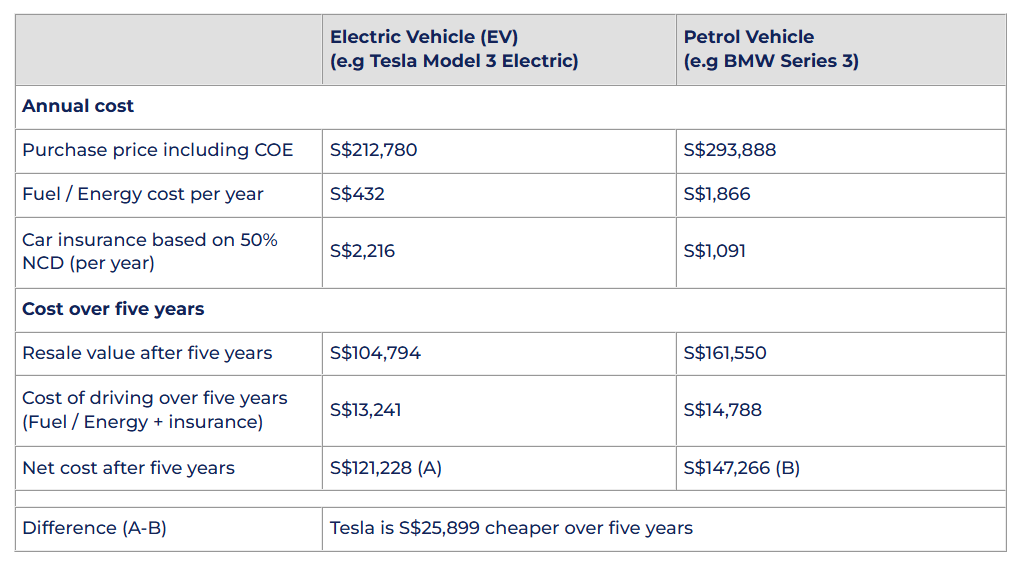
Studies suggest that EVs can break even with petrol cars within five–seven years, mainly due to lower fuel and maintenance costs. However, this varies based on factors like driving habits, electricity prices, and resale values.
Here’s a cost breakdown comparing a typical EV and a petrol vehicle:
Source: Planner Bee’s Case Study
Read more: Owning a Car in Singapore: What You Should Know and Consider
Are EVs more affordable in the long run?
For car owners looking to future-proof their investment while reducing their environmental impact, EVs are becoming an increasingly attractive choice. As charging infrastructure expands, battery costs drop, and government incentives continue, EV ownership is expected to become even more cost-effective.
Whether you prioritise sustainability or long-term savings, the future of mobility in Singapore is undoubtedly electric.
Comments
43
5
ABOUT ME
Your Personal Mobile Financial Advisor Application Join us at telegram! https://t.me/plannerbee
43
5
Advertisement
No comments yet.
Be the first to share your thoughts!