Advertisement


OPINIONS
All You Need To Know About the Platform Workers Act
The Platform Workers Act is a big step towards giving gig workers in Singapore fairer protection and financial security.
This post was originally posted on Planner Bee.
The rise of the gig economy has significantly reshaped Singapore’s employment landscape. Food delivery riders, private-hire drivers, and other platform workers have all become an essential part of Singaporeans’ daily lives.
However, many of these workers don’t have the same protections as traditional employees. To address this, the Singapore government introduced the Platform Workers Act. This law aims to improve the rights, protections, and support for platform workers.
In this article, we’ll look at the key provisions of the Platform Workers Act, the CPF Transition Support scheme, and how workers can boost their finances.
What is the Platform Workers Act?
The Platform Workers Act was introduced to implement the recommendations from the Advisory Committee on Platform Workers. Its goal is to strengthen protections for platform workers. Some key recommendations include:
- Ensuring adequate financial protection for platform workers in case of work injury.
- Improving platform workers’ housing and retirement adequacy.
- Enhanced representation for platform workers.
Who is a platform worker?
According to the Ministry of Manpower (MOM), a platform worker is defined as someone who:
- Works as a ride-hail or delivery worker
- Has a platform work agreement with a platform operator
- Is under the management control of the platform operator when providing platform services in return for payment or a benefit in kind
If you are not under the platform operator’s management control, you’re considered a self-employed person under a contract for service, not a platform worker.
A platform work agreement can be any agreement written or oral agreement between a platform operator and a platform worker for providing services, but it does not include a contract of service.
According to the Labour Force Findings 2024, there are 67,600 platform workers in Singapore as of 2024.
Who is a platform operator?
According to MOM, a platform operator is:
- An individual or entity (such as a sole proprietorship, corporate body, partnership, or unincorporated association)
- Provides ride-hail or delivery services
- Exercises management control over one or more platform workers
In short, platform operators manage platform workers and provide the services that connect them to customers.
Key provisions of the Platform Workers Act
The Platform Workers Act includes four main provisions aimed at improving the rights and protections of platform workers:
1. Gradual increase of CPF contributions
The Act mandates a five-year gradual increase in CPF contributions for both platform workers and operators.
Previously, platform workers were only required to make MediSave contributions of up to 10.5% of their net earnings. Under the Platform Workers Act, their CPF contribution rate will increase by 2.5% in 2025, allocated into their Ordinary Account (OA), Special Account (SA), Retirement Account (RA), and MediSave Account. This contribution will continue to rise, and by 2029, platform workers will contribute at the same rate as full-time employees, which is 20% for those aged 55 and below.
Likewise, platform operators will also be required to contribute their share to CPF savings. They will be required to contribute 3.5% of a platform worker’s net earnings in 2025, with the rate gradually increasing to match full employer contributions by 2029.
2. Mandatory CPF contributions for younger workers
Under the new legislation, CPF contributions will be made mandatory for platform workers born on or after 1 January 1995.
Older platform workers have the option to opt in to the increased contributions, but the decision is irreversible. Those who choose not to opt in will continue making MediSave contributions but will miss out on the operator’s share of CPF contributions.
3. Standardised work injury compensation
Platform workers will be entitled to the same scope and level of work injury compensation as employees under the Work Injury Compensation Act (WICA). This includes medical leave wages, medical expenses, and lump-sum compensation for permanent incapacity or death.
4. Enhanced Platform Workers CPF Transition Support (PCTS)
The CPF Transition Support (PCTS) scheme will run from 2025 to 2028 to help platform workers as their CPF contribution rates gradually rise to match those of employees.
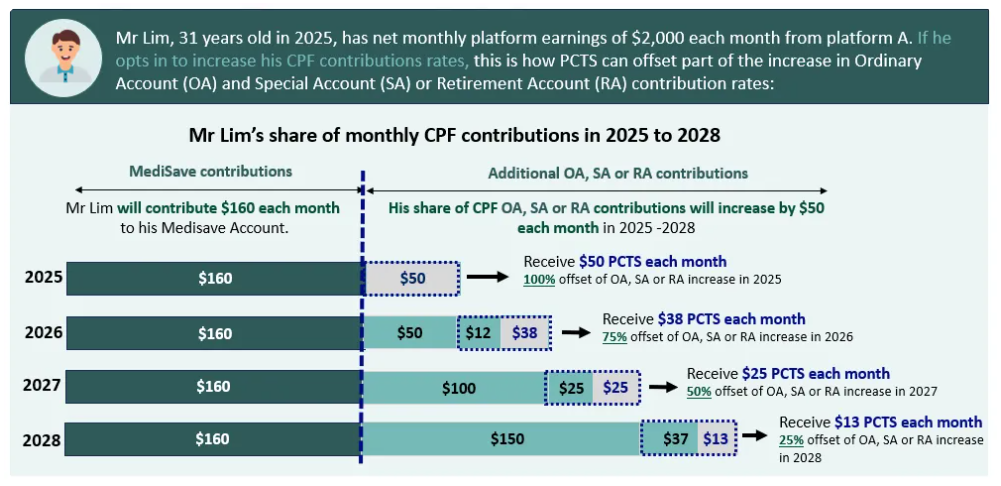
Through PCTS, platform workers will receive monthly cash support to offset part of the yearly increase in contributions to their OA, SA, or RA. Lower-income platform workers who see an increase in their share of contributions will automatically qualify for PCTS. In 2025, they will receive a 100% offset of the increase, which will drop to 75% in 2026, 50% in 2027, and 25% in 2028.
Source: CPF
5. Enhanced representation
The Act also provides platform workers with access to formal representation and dispute resolution frameworks, including union representation. This gives them a collective voice and ensures fairer treatment in contractual or disciplinary matters.
Similarly, platform operators can form and be collectively represented as a platform work association.
Why is there a need for the Platform Workers Act?
Traditionally, platform workers have been classified as self-employed persons (SEPs). This meant they were not entitled to employment benefits such as employer CPF contributions, medical leave, workplace injury compensation, or union representation.
In a statement during the 9 September 2024 Parliament, Senior Minister of State for Manpower Koh Poh Koon said, “We want to better support platform workers by providing them with workplace safety and retirement adequacy. However, if platform workers are given the full suite of employment rights, such as sick pay and vacation leave, the nature of the relationship between the platform operators and the platform workers will likely change to resemble an employment relationship, which would offer less flexibility, something both parties do not want.”
The COVID-19 pandemic and rising cost-of-living pressures have highlighted the vulnerabilities of platform workers. Many lack proper retirement savings, income protection, and healthcare support.
The Platform Workers Bill, introduced in 2024 after extensive public consultation and recommendations from an advisory committee, is the government’s response to address these issues and provide better protection for platform workers.
How does the Platform Workers Act strengthen platform workers’ financial status?
The introduction of mandatory CPF contributions is a game-changer for platform workers. CPF savings are important to Singaporeans as they are essential for retirement, healthcare, and housing financing. By bringing platform workers into this system, the bill significantly improves their long-term financial resilience.
With regular CPF contributions, platform workers can build retirement savings over time, taking advantage of CPF’s attractive interest rates. The OA interest rate is currently 2.5% per annum, while SA, RA, and MediSave interest rates are currently 4.0% per annum.
Additionally, mandatory injury compensation insurance protects platform workers from the financial consequences of workplace accidents, ensuring they have income continuity and access to necessary medical care. This coverage provides a safety net, helping to reduce financial stress during times of injury or illness.
How else can platform workers strengthen their financial status?
While the Platform Workers Act aims to provide a solid foundation for platform workers, they can take further steps to secure their financial futures.
Investing in skills training can open doors to higher-paying opportunities, both within and beyond the gig economy. Platform workers have the flexibility of time on their side and should consider upskilling with government-supported courses under SkillsFuture.
While the Act mandates injury insurance, workers should consider additional coverage such as hospitalisation plans, critical illness insurance, and personal accident policies for broader protection.
Having private insurance is a financial net that can help reduce out-of-pocket expenses for unexpected incidents. There are cash-free insurances that platform workers can look into to enhance their protection.
Read more: Five Cash-Free Insurance Plans You Can Get in Singapore
Platform workers can also improve their financial stability by making voluntary contributions to their CPF accounts. This allows them to benefit from higher interest rates, further boosting their retirement savings. Additionally, exploring low-risk investments such as Singapore Savings Bonds (SSBs) and exchange-traded funds (ETFs) is a smart way to grow their savings over time.
In conclusion
The Platform Workers Act marks a significant shift in how gig workers are protected in Singapore. By mandating CPF contributions, formalising work injury coverage, and offering institutional support, the government is taking concrete steps to bridge the gap between self-employment and traditional employment.
That said, platform workers still have to take ownership of their financial future through disciplined saving, strategic planning, and continuous upskilling. This way, they can build a more secure and resilient livelihood in this fast-evolving gig economy.
If you require financial planning and advice, feel free to reach out to Team Planner Bee at [email protected] today!
Read more: Understanding Employment Rights in Singapore
Comments
40
24
ABOUT ME
Your Personal Mobile Financial Advisor Application Join us at telegram! https://t.me/plannerbee
40
24
Advertisement
No comments yet.
Be the first to share your thoughts!