Advertisement


OPINIONS
A Starters Money Managing Framework with a Twist
We’ve seen many frameworks on how we should allocate our money & in what proportion. Here is one with GIVING in mind.
Brandon Chew
24 Mar 2021
Financial YouTuber at https://www.youtube.com/c/BrandonChewww
If you prefer watching a video instead of a long wall of text, check out the YouTube video instead.
Have you ever wondered what are the different categories you can allocate your money to? Do you know what the optimal allocation ratio is for your financial situation & stage in life?
Similar to the 50/30/20 Rule (which is a proven way of properly managing your finances like the rich), here is one you can adopt to achieve financial independence while having a generational impact on society.
Why is a Financial Framework Important?
Hummingbird Metabolism v.s. Our Finances
I recently came across the hummingbird. They are not found in Singapore or in Asia but are typically found in the Americas.

Their name comes from the fact that they create a humming sound when they rotate their wings in a figure of 8 up to 70 times per second. This adds up to more than 4,000 wingbeats per minute which produces the humming sound. They have the highest metabolic rate in the animal kingdom (excluding insects) where their heart rate can reach as high as 1,260 beats per minute, breathing 250 times a minute at rest.
To put things into perspective, an average human breathes 12 to 20 times a minute which is effectively more than 10 times slower than this little critter.
What does a hummingbird have to do with finances?
As fascinating as the hummingbird is, the tragic part about this is that hummingbirds are constantly hours away from starving to death due to their high burn rate. Just like them, some of us are one critical event away from a financial catastrophe. We fail to prepare for emergencies, and we burn our paycheck at such a high rate.
Instead of having life force our hand, we must instead have a solid plan in place so that we’re not caught off guard.
Introducing the Bucket System (With a Twist)
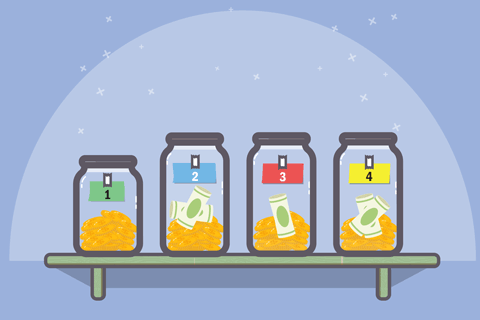
Your entire financial life can be split into various categories, let’s call them buckets. There are 4 main buckets which covers different items and serves different purposes.
1. Expenses
Purpose
Meet your current personal needs & wants
What's Inside?
Daily needs such as Food & Transport
Bills, Taxes, Insurance
Debt/Loans
Strategy
Keep it low, keep it balanced
The general idea is to reduce expenditure as much as possible so that you can allocate the money you would’ve otherwise spent to other buckets. For example, cut out excessive online shopping, cancel subscriptions that you don’t use & take more public transport instead of cabs. These will help you to save & invest more.
I also mentioned keeping it balanced. You shouldn’t skimp on these so much to the point that you feel miserable or not have your needs met.
Finding ways to cut expenditure might seem like a sacrifice to some but it’ll be beneficial to you in the long run. One thing that helps is to gamify this bucket & make reducing expenditure fun.
For example, I cut my own hair which reduces my expenses by about $12 a month which adds up to $144 a year. I will then use some of this money to reward myself with a nice lavish $60 dinner buffet and keep the rest. This makes things fun but at the same time always keeps me on my toes to constantly ask myself, “Do I really need or want this?"
2. Savings
Purpose
Store your emergency fund, your fun fund & spare cash.
What's Inside?
$$ in Bank Account(s)
$$ in Piggy Bank(s)
$$ in any place that is liquid
Strategy
Build up the 3 types of funds
A. Emergency Fund
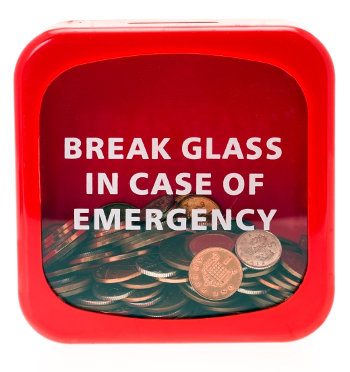
Everyone (and I mean everyone) must have an emergency fund. This is typically 3-6 months of your expenditure saved up for a rainy day. So if you spend $1000 a month, your emergency fund would be $3000 to $6000. This will help to tide you through tough periods of economic uncertainty & critical events such as retrenchment.
Nobody likes to be in that position but if you are, at least you’re prepared for it & have time to get back on track.
B. Fun Fund
This is for rewarding yourself for doing a good job with managing your finances well and enjoy life. This could be going for a nice holiday, or buying that item that you’ve been eyeing for a long time. But be balanced about this and don’t go overboard.
C. Spare Cash
This, goes without saying, is a catch-all for all other miscellaneous items.
3. Investments
Purpose
For the long-term / Grow your money for use later on in life e.g. for retirement
What's Inside?
Stocks
Cryptocurrency
Property
CPF
Strategy
Consistently set aside money to invest in the stock market.
This allows your money to be put to work so that it grows even while you sleep. If you only have a small amount, this doesn't mean you're exempted from doing this. One of my investing principles is “Better something than nothing”.
But why??
Did you know that putting your money in something called the S&P 500 is better than hiding your money in the bank? Bank account interests rates are ridiculously low at 0.05% whereas the S&P500 gives you an average of 10% every year. This means that money in the bank loses out to inflation which is around 2% annually.
You’d also want the 8th wonder of the world on your side which is compound interest. Whatever the amount whether big or small, just invest & invest consistently.
There are exceptions...
If you have a huge high interest debt to pay like from credit cards, get rid of those first before investing. Settle those first. Don’t invest any money until you pay off those debts.
What about property?
I need to go on with a small rant here so bear with me. I see young couples making the mistake of taking on a huge housing loan to buy a depreciating house that they declare would be their forever home. What they don’t realise, is that 10 years down the road with different lifestyle choices and income, they might change their mind on how they want to live. But unfortunately, they’re already stuck with a property that is now worth less than what they paid for.
As such, they miss out on the opportunity to accelerate their financial growth. So please open yourself up to more options by seeing property as a potential investment.
4. Giving
Purpose
Cultivate generosity as a lifestyle + Make a generational impact
Most people would actually put this under expenses but I’d like to propose that this be a separate and dedicated bucket since it serves a different purpose which is to make generosity a lifestyle. It will help in reducing materialism & greed while helping our society. And technically speaking it will also help you financially by qualifying you for tax reliefs.
What's Inside?
Regular donations to non-profits
Gifts to friends/family
Spontaneous giving to someone in need
Strategy
Set aside money to give regularly
Let's start with exceptions...
Don’t give if you are in a dire financial situation. Even if you really love giving, you can’t give what you don’t have. There is a reason why in airplanes, you’re instructed to put on your oxygen mask before assisting others.
Also be balanced, don’t give everything away and leave yourself in a financial mess. Start small & cultivate the habit.
When I was young, I was told that if you can’t regularly give $1 out of $10, you won’t give $100 out of $1000. Both are just 10% but it’ll be much harder to part with that bigger amount & I’ve actually found that to be true.
Regular giving a foreign concept?
For most of us, we weren’t brought up to give regularly. But I’d like to encourage you to find joy in giving. Start somewhere that you’re comfortable with & continue growing from there. Always remember the reasons why you give & never give out of obligation.
Allocation Strategy (My Recommendation)
From your income, start off with the following allocation
50% - Expenses
20% - Savings
20% - Investments
10 % - Giving
This is a simple & sustainable way to keep your finances in check. You may find along the way that you’ll change the percentages up a bit due to different seasons of life or certain lifestyle changes. Just make sure that you keep it balanced and don’t do anything extreme.
You were created a human so live like a human, not a hummingbird. Be consistent in applying the framework. Don’t expect overnight success in your finances but instead enjoy the process and don’t give up.
Comments
3261
6
ABOUT ME
Brandon Chew
24 Mar 2021
Financial YouTuber at https://www.youtube.com/c/BrandonChewww
A 29-year-old personal finance lifehacker. Check out my YouTube channel. I share my experiences on achieving financial freedom.
3261
6
Advertisement
No comments yet.
Be the first to share your thoughts!