Advertisement


OPINIONS
A plate of chicken rice
Breaking down the P/E Ratio & its application
Jared Lee
Edited 08 Oct 2021
Finance at Murdoch University
Introduction
Unless this is your first day in the world of investing, you would have probably come across the Price to Earnings ratio or P/E ratio. In this post, I will be breaking down the meaning behind it all and hopefully I’ll be able to share some insights into this contentious stock measure:
- Background
- What is the Price to earnings ratio?
- How is it calculated?
- When can I apply it?
What is this...P/E Ratio?
In a very basic sense the price to earnings ratio, P/E ratio indicates how much an investor is paying for $1 of the company’s earnings (we’ll define earnings later):
Here’s an example with a theoretical company:
Company X has a stock price of $38. It made $1/share last year. Hence the P/E ratio is 38x.
It is also referred to as a ‘P/E Multiple’ because you paid 38 times for a dollar in earnings.
Some of you might be going… HUH?
Let’s use an example AND present you a dilema using chicken rice (Yum!):
Stall ABC has a plate of chicken rice for sale at the price of $2.50. Tastes so-so (it’s $2.50, what do you expect?)
Stall XYZ on the other hand is going to be the best chicken rice you’re ever going to taste, 3 michelin stars. Bad news is it costs $20. (Bad choice to go MBS for chicken rice)
Now, which one would you choose?
The Dilema
Stall ABC because 'duh', who doesn't like cheap food? Or stall XYZ because it tastes good and you’re willing to pay for good food?
That's where the dilema comes in and form two distinct groups of investors:
There’s a group of investors who will not pay for a company with a 200x P/E no matter how good the company because “Muh fundamentals shows its overvalued”
Then there’s the other group that would pay anything to get their hands on that promising growth tech company even if its P/E is 700x.
So which side should you follow? (i'll explain how we can apply the P/E ratio later)

Calculating the P/E Ratio
Before we see how to apply it, let’s get into the juicy details behind calculating the P/E:

It’s quite intuitive, basically the stock’s price expressed as a ratio of its earnings per share. Now, what does it mean when we say earnings per share?:

Dive into a company’s financial statement and you will see something along the lines of:
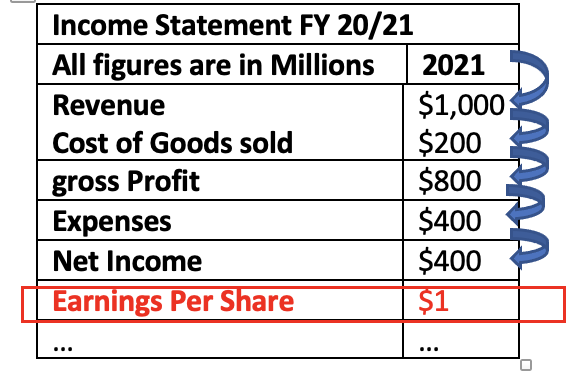
As the name suggest, the Earnings per share is the company’s earnings (net income) expressed as a weighted average number of shares. This gives us a per share number.
Bad news is, us retail investors will not have access to the “weighted average number of shares” because it changes according to any employee stock compensation, share buybacks, etc. Hence the whole Earnings per share amount figure is usually provided by the company in their income statement.
But Hey! it's the 21st century, you can just google the P/E ratio. But my point was to show you what goes into the P/E ratio so you can understand how earnings can affect the P/E ratio.
Bonus Tip**: Most companies pretty much follow this structure of financial reporting, so don’t be intimidated when you see a long list of items in the 10-K/Q as each line item is usually a derivation of the above items. Just walk down the list from Revenue and take away each line item until you arrive at earnings per share. THAT is what we define as ‘earnings’ in terms of P/E ratio. (Yes, I know EBITDA is missing)
When can we apply the P/E ratio?
Now, let’s look at what kind of companies we can evaluate accurately using the P/E Ratio. For the P/E Ratio to work, the following conditions must be met:
1) stable earnings (NOT $8 billion in one quarter and $3 million the next)
2) EPS value more than 0 (explanation below)
As the keen-eyed readers would have realized, the P/E ratio is a fraction. and what happens if you divide a fraction by negative or even 0? you’d get a negative number.
Woah woah hang on.... Can we even have a negative price-earnings ratio? You’re right! You can’t. It’s not very useful other than telling me the company is not making money… yet.
Hence the P/E ratio is useless if the company EPS is zero or negative. This also means that since most growth/young tech companies have no/negative earnings, you can’t use the P/E ratio to measure them. In such cases, other measures may be used such as the Price/Sales ratio.
However, they may be an accurate measure for mature companies with stable earnings & non-cyclicals. Why non-cyclicals? because their earnings are usually less volatile as they’re not as affected by changes in the business cycle as much as cyclical companies would. Example of non-cyclicals include Supermarkets, utility companies, etc. (basically products & services people need to use regardless of the state of the economy)
Finally, using just one P/E ratio to look for a company wouldn’t help a lot. It makes more sense to compare the P/E across companies or across benchmark. For example, if a company has a P/E ratio of 16x, while its competitors are at 32x, it could mean that the company is undervalued, assuming all other factors are constant. Otherwise, it could mean that the company is just a weaker player within the market.
You could also compare the company's P/E ratio with that of an index such as the S&P 500. Anything above could mean overvalued, anything below is undervalued
Conclusion
I hope that this short(?) breakdown helps new investors understand the mechanics behind the P/E ratio and when they can apply it. It is by no means the only metric you should be looking at when picking companies to invest in, but I do find it to be a nice starting point which allows me to filter out companies more effectively when I’m looking for gems to buy into.
P.S: first EVER opinion piece, please let me know if there are any mistakes or other contents that you’d like to see me talk about!
Comments
1756
2
ABOUT ME
Jared Lee
Edited 08 Oct 2021
Finance at Murdoch University
I like Investing
1756
2
Advertisement
No comments yet.
Be the first to share your thoughts!