Advertisement


OPINIONS
7 Common Investing Mistakes You Must Avoid (Part 2 of 3)
We do not learn from experience. We learn from reflecting on experience. Do any of these mistakes sound familiar to you?
4. Lack of diversification
Simply put, do not put all your eggs in one basket. Some new investors are inclined to throw all their money into that 1 stock which they heard about from their friends, hoping that this 1 stock will earn them some good returns. As a general guide for beginners, it would be good to hold around 4 or 5 stocks to diversify your risks depending on the size of your portfolio. By diversification, you can do so either by industry or geographically. You can choose to diversify by industry sectors such as buying stocks from both the technology and healthcare industry or to diversify by geography such as the US market or the China market.
Diversification, however, is not throwing your money into different baskets just for the sake of doing it. We still have to screen for fundamentally strong stocks and diversify by buying only those stocks. We’ve got to ensure that our eggs are placed in the sturdiest baskets. If you diversify by adding into your portfolio both good and bad stocks, you will likely just end up at status quo or even risk being in a worse off state as the losses will offset the profits.
If researching for a basket of stocks sounds a little tedious, a simple way to diversify your portfolio among different sectors is to purchase the SPY ETF which is a basket of securities that tracks the Standard & Poor’s 500 Index. By investing in SPY ETF, you are as good as investing in all the companies that the ETF tracks, thus reducing the concentration risk on any particular company.
Do obtain an understanding of what are the underlying companies of the ETFs you bought. This is to avoid over-allocating your portfolio to certain companies unless they are known to be good businesses. Nevertheless, you are still exposed to country-specific risks by purchasing the SPY ETF alone. You may also reduce your reliance on US equities by also being weighted on the China or Singapore market as well.
5. Blindly buying at the bottom
“Buy low, sell high!” This is the catchphrase of many investors. But we must understand that not all stocks will rally up. Fundamentally strong companies will have their stock prices go up in the long run, while the weaker companies may take much longer or never recover at all. New investors may fall trap to the attractively low prices for these stocks, not knowing that there is a high chance the stock prices will not go up.
Let’s take a look at the stock price charts of some companies you may be familiar with.
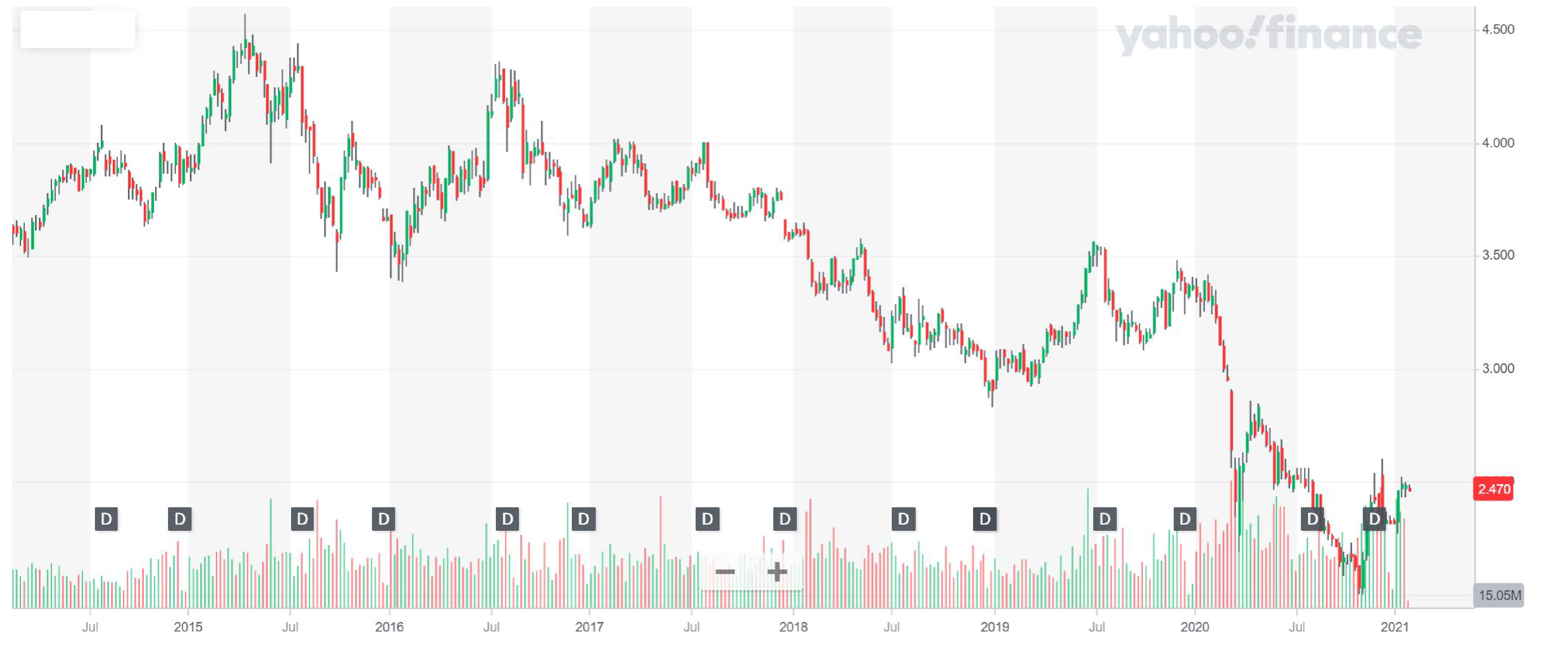
Source: Yahoo Finance
When you see this stock chart, what is your first impression? You might be thinking that this must be some Singapore company that you have never heard about. And actually, this is the stock price chart of Singtel, the top telecommunication company in Singapore! Singtel’s stocks have been on a downtrend since 2015.
If you have started out on investing back in 2015, you may probably be enticed by the declining prices, thinking that you can enter some positions at a low price so that you can close off these positions in the future at a higher price. Because that’s what we always think right? To buy low and sell high. Coupled with the ingrained impression that Singtel must be a very safe stock to buy because it is the top telco company in Singapore backed by Temasek Holdings which has substantial shareholding in Singtel. But after holding the stocks for 5 years, you will find yourself in disappointment that the stock price dropped by 50%.
Recently, it was announced that Singtel was awarded the licence to operate as a digital bank together with Grab. But if you ask me, I think there is still insufficient information or statistics about how the digital bank licence will help Singtel to turnaround in order for me to be enticed to buy the stocks now.
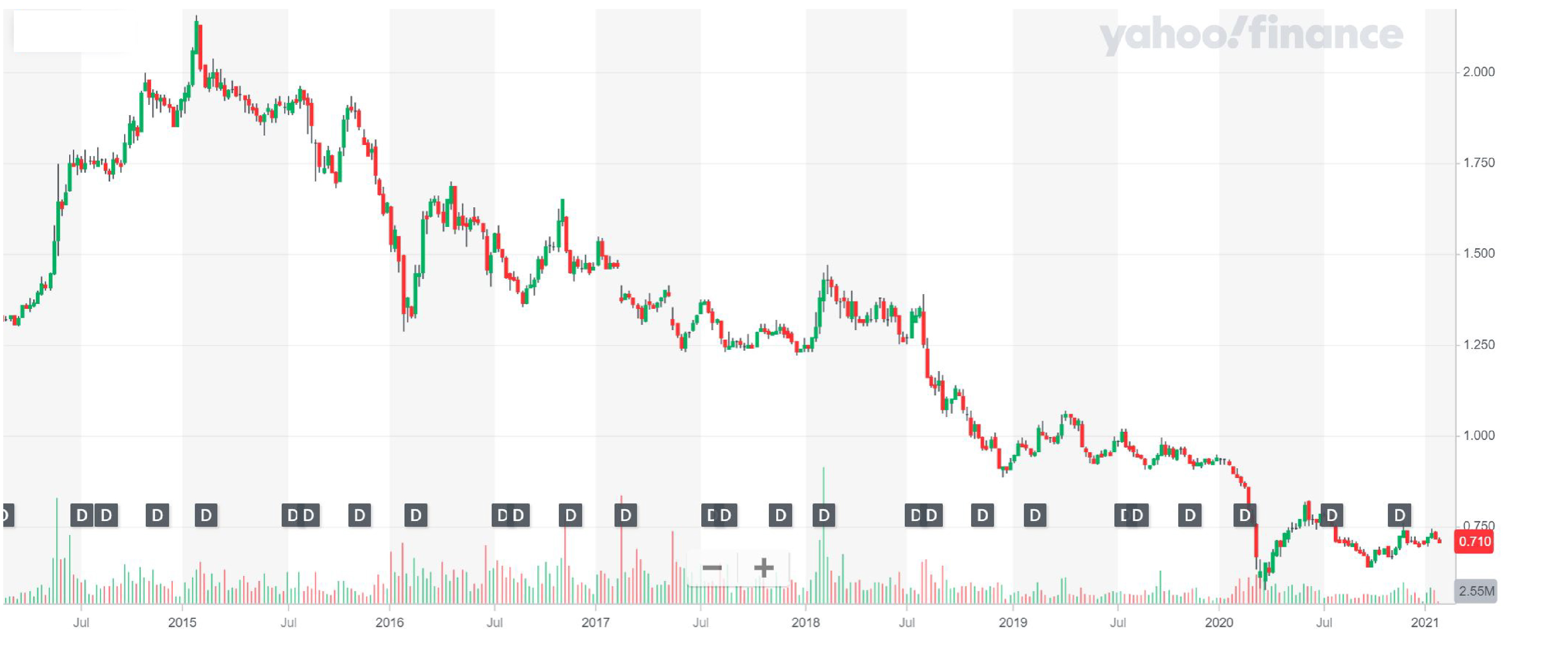
Source: Yahoo Finance
This example might surprise you yet again because this is the stock chart prices of Singapore Post. SingPost’s stock prices fell by more than 50% since 2015. Yet, we still hear people around us talking about investing in Singtel and SingPost shares despite the clear downtrend.
All these examples show us that it doesn’t mean that we must always catch the opportunity and buy when stock prices drop. In fact, we should always first analyse the financials of the company and other important factors to determine if the business is a good one to invest in. Take a look at the financial performance of Singtel and SingPost. We do not see consistently increasing revenue, gross profit or net profit. And these are just only a few of the many indicators we look out for. Clearly, it would make more sense to focus our attention and efforts on other stocks that are a better buy.
Charts don’t lie.
P.S. If you can relate to this article, we would appreciate if you can like and share it!
Stay tune for Part 3 of the article!
Credits
Thumbnail: https://www.freepik.com/vectors/background – Background vector created by rawpixel.com
Comments
97
0
ABOUT ME
Be financially free so that we can free up our time and focus on the people and things that we care about.
97
0
Advertisement
No comments yet.
Be the first to share your thoughts!